Are You as Tuned In as Zipcar?

Recently, I had the opportunity to teach a group of new entrepreneurs (some not yet in business, some with a year under their belts) how to evaluate a business idea. We discussed the fact that, in the ideation process, there must be a filter by which ideas are judged and refined. Just as heating up gold purges the dross, an idea put under scrutiny can be seen for what is truly valuable, versus the parts of it that need to be cast aside to pursue more pure substance. During one of our sessions on idea refinement at the Cary Innovation Center, we spoke about innovators who had gone before them in various fields. One of the intriguing business models we bantered about was the Zipcar.

Zipcar entered my field of vision about three years ago when I went back to school to get my MBA at the #1 part-time program in the United States, Elon University. Situated near the student stores, and within a stone’s throw of the library and dining hall were a row of cars with the Zipcar logo emblazened on the side. There were assigned spaces closest to the buildings and I wondered what this was all about. A couple months later, we studied Zipcar briefly in an innovation elective class I was taking.

Later still, I read Tuned In and the upstart car rental business showed up again. Robin Chase and Antje Danielson recognized the opportunity while vacationing in Berlin and seeing a similar concept. When they returned to the States, they asked around and realized that there was latent demand for a rental car that would fit an urban lifestyle–creating a submarket for those who only wanted a car for a day, a weekend, or a few hours. The identified a target market of people who didn’t want the hassle of owning a car nor the inconvenience of dealing with the traditional rental car companies.

The authors of the book describe a six step process to create an offering that is a “resonator:”

  1. Find unresolved problems.
  2. Understand buyer personas.
  3. Quantify the impact.
  4. Create Breakthrough Experiences.
  5. Articulate Powerful Ideas.
  6. Establish Authentic Connections.

Without going into a ton of deal, suffice it to say that Chase and Danielson did all six with Zipcar. Of the six, the one I spent the most time discussing with my class of entrepreneurs was “Understand Buyer Personas.”  Basically, this is the concept of characterizing a group of people who share one or more challenges. When a company zeroes in on the concept, they use these personas to drive decisions in product design and development, marketing, and communications. Rather than the mass-produced single item method of the industrial revolution, this approach aims for customization to individual target audiences, the sum of which makes for a good business model.

Zipcar, according to the authors of Tuned In, appeals to the following types of buyers–

  • City dwellers who occasionally need to use a car for a few hours,
  • Mayors, city councilors, and police who deal with parking constraints in major cities, 
  • University administrators who wish to set up a car share service for students,
  • University students who occasionally need a car for a few hours, 
  • Landlords who might offer a car share service as a benefit for tenants, and
  • Business managers who might want to set up a car share service as a perk for employees.

As we discussed this profound market segmentation, my pupils (students) were really challenged to think through their own competitive positioning efforts. Even the mentors I had in the room (present company included) had a bit of a gut check as to how well we did this in our own businesses. How about you? Have you taken the time to really think through this in a way that many small business owners never do–at startup or later?

 

Dirty Martini Intrapreneurship

One  of the portals I use to stay abreast of innovation is called Alltop. It is organized by author and an author by the name of Gregg Fraley caught my attention last week. Gregg had written an article entitled, “Do You Want Innovation or a Dirty Martini.” Rather than describe the whole article for you (or violate his copyright), I offer you the following excerpt:

note: Haley references the topic of management engagement in innovation and some “interesting posts lately byPaul Hobcraft

I think many high level executives simply don’t know what they have. Until it’s too late.

There are a lot of smart people out there, with great ideas. Talent is something you need if you really want to innovate. And yet, really, most organizations already have that talent. No, not every employee is Jony Ives and is an impact player at that level, but nearly every company has some people that, under the right circumstances, can hit home runs (score goals, set records, win gold, etc.). Ives himself was locked in a closet before Steve Jobs found the key.

In my travels doing talks and such I often have a chance to chat with line workers and middle managers who are beyond frustrated. They have ideas, they have energy, they care about the company — and none of that goodness is being channeled towards innovation. In fact, it’s being actively suppressed in some cases.

The phenomenon that Haley describes is one in which many organizations, even reading about Google or Cisco, who both encourage creativity and innovation, are faltering. Their people are full of great potential that largely goes untapped because there is not a means to commercialize new ideas (or even pursue new methods) because management is not intentional about cultivating input from others–especially those outside the management side of the building. Haley goes on to argue that even those with creative talent, who are often recruited to organizations that need the proverbial “breath of fresh air,” find that their approach is not valued and they begin looking for their next opportunity too soon after joining an organization that so desperately needs them but is not accommodating to them.

He says, “C-suite types, hear this, if you knew  how much talent is wasting away right under your nose, you’d cry in your martini. Don’t believe it? Ask. Ask a sampling of your people the simple question — where are the hidden gems around here? You’ll find out things you didn’t know. People with secret projects, big ideas they’ve been holding back, crazy ideas that just might work…Want to turn the situation around? Ask another question — what’s holding you back?”

I would add to the questions he asks the following:

What are you doing to foster a culture of innovation?

Here are some suggestions–

  1. Change the way you form work teams. Build diversity of thought into as many teams as possible.
  2. Change your own role from decision maker to facilitator. See yourself as primarily responsible to help others shine and succeed.
  3. Create a knowledge management system that captures lessons learned and best practices to be disseminated broadly and consistently.
  4. Celebrate when an employee takes initiative. Find ways to acknowledge them openly.
  5. Get rid of the traditional research and development process. Instead of a department, create an inter-departmental group that represents not just different disciplines, but also different levels of experience and different demographics.

Intrapreneurship is on the rise among savvy competitors. It does not, however,  come without a price–ego has to be checked at the door and individuals valued for their unique contributions.  Your challenge is to retain creative talent that otherwise would start their own businesses or work for more progressive competitors!

Sacrifice Opens Door to Opportunity for a Leader

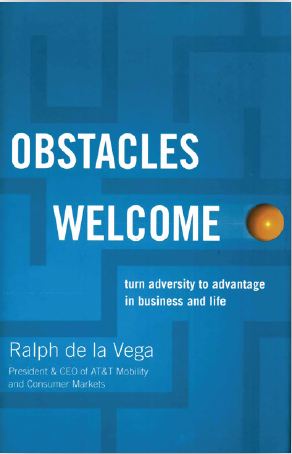
You need not to have been on this planet very long before you will encounter adversity. One popular adage states that we become stronger by going through tough times. Yet, not everyone who encounters obstacles is able to surmount them and achieve success. In Obstacles Welcome, Ralph de la Vega recounts his own “pivot points,” born of a challenging early life that shaped and molded him into a very successful businessman (currently, he serves as the President and CEO of AT&T Mobility and Consumer Markets. His positive responses to adversity formed the backbone of a successful values-based management system.

Rather than seeing separation from his parents at the age of four as a bad omen, de la Vega found a way to accentuate the positives in his life. He innately recognized that dwelling on negative thoughts and feelings was counterproductive. After that tough, early life challenge, he moved to Miami and had to overcome a language barrier in the classroom. He adapted again to his environment instead of letting it get him down in the dumps. 

Many people tack a passive approach to setbacks. They hope, wait, and some earnestly pray for a change in circumstances. The course our example provides, though, is one of planning, taking risks, and maximizing opportunities. In the book, he offers up the premise that obstacles should be embraced as a chance for personal growth. In the midst of living life, we come across those “pivot points” personally and professionally that define us–for good or bad. Getting in the right frame of mind can be achieved through his recommended 8 step process:

1. Hope is not a strategy. It is necessary to plan for success.
2. To achieve big goals and dreams, it is necessary to take calculated risks.
3. Big wins in life come from an ability to recognize opportunities. The most significant and important opportunities lie in problems that are waiting to be solved.
4. Embrace and overcome obstacles. Obstacles and adversity make stronger, wiser, and more capable leaders.
5. Be willing to unlearn old habits and relearn old lessons from life experiences.
6. Building winning teams involves effective, honest, and open communication.
7. The greatest successes always involve willingness to make sacrifices.
8. Leadership is not something inborn, but learned and practiced.

As a young executive at  Bell South Latin America, de la Vega experienced everything from military insurgency, economic meltdown, and political revolution, in addition to unstable markets, lack of uniformity in corporate leadership, and nonexistent profits. How did he respond? He took a chance and embraced the challenges as opportunities to lead an entire sector of the international communications market into profitability. What he advocates is to “become comfortable with being uncomfortable,” In order to do that, we may have to set aside what we feel we already know and become flexible in our approach to the challenges set before us.

A key habit to learn is to not allow the past to hinder the future. That is not to say, however, that our past(s) cannot be instructional. Previous experiences can help us deal with new situations only by using them to look backwards and forwards at the same time. It is important to think about how what we have done before might be useful down the road
in similar situations.  

Finally, de la Vega describes what he terms an “Extraordinary” leader, one who is able to consistently deliver excellence in all aspects of personal and corporate leadership. To achieve such status, a leader needs to do the following:

• Set the direction, create the vision.
• Establish values and lead by them.
• Select strategies and key initiatives.
• Build plans to achieve vision.
• Establish goals, priorities, and focus.
• Establish key metrics to measure progress.
• Align and inspire people.
• Empower and enable people to achieve vision.
• Create winning culture.
• Select, recruit, and develop other leaders.


Can Generalists Thrive in the Conceptual Age?

One of the questions I get most often is: “what do you do?” The answer to that question is not an easy one, as my work with companies ranges from start-ups to those almost middle market size, and the services I offer from advisory board member to turnaround artist. Yet, when my role is marketing consultant, I advise others to be able to answer the very same question crisply, concisely, and in a compelling way. What is poignant is that, as we gain more skills over the years, it becomes harder and harder to specialize. That is not to say, however, that I have not met people in business who are extremely specialized and who succeed in their field. For the moment, though, I want to write for others who have adapted to competitive market demands to embrace new skill sets, become masterful enough that others hire them to provide those new skills, and now are the proverbial “generalists.”

Don’t confuse “generalist” with “General,” however, as many generalists struggle to stay with one organization long enough to rise to the rank of top officer. Furthermore, a generalist has challenges in the unique realm of trying to keep up with evolution in many more topical areas, all of which are changing at a faster rate than at perhaps any time in history. The good news is that, as Daniel Pink points out in A Whole New Mind, we are now living in the Conceptual Age, having evolved from the Information Age to a day and time when creativity will be valued highly. Maybe that is not such good news for left brain folks who are not able to adapt, but for those (for whom the learning of new information was merely a means to an end, the end being to connect emotionally with others, build relationships, and find success while doing so) who embrace right-brained living, it is a brand new day!

Here are the new skills that are needed in the Conceptual Age:

  1. Design – the ability to create something that has significance as well as usefulness.
  2. Story – the ability to put facts into context and deliver them with emotional impact.
  3. Symphony – the ability to see the big picture, connect the dots, combine disparate things into something new.
  4. Play – sense of humor and laughter plus other components to balance the psyche.
  5. Empathy – standing in someone else’s shoes, feeling with his or her heart, seeing with his or her eyes.
  6. Meaning – working for something in which one believes with others who have similar values.

As you can see from the list, the emphasis and value will be placed on original thought rather than automatable routines. Computer power has now rendered many repeatable acts less valuable (not unnecessary, mind you, just worth less than previously because either low wage earners or machines can perform them admirably). What will come to be increasingly important is the ability to think up a new concept, develop it sufficiently, and share it so that it resonates with the heart of another. 

What’s the role of the generalist in this new economy? That depends–can you adapt, or are you trying to pour new wine into an old wineskin? Those of us who can adapt will be able to answer questions like “what do you do?” with less of an elevator pitch and more of a carefully crafted story that captures the mind, will, and emotions of the intended audience, hopefully in a multi-sensory way!

Cheers to you as you embark on the journey to greater relevance, enhanced value to others, and — I sincerely hope — a much greater sense of doing something truly meaningful (other than just adding to your repository of information.)


Risk Assessment for Small Businesses

When someone talks about risk management in a business context, usually the risk is of a financial nature. Yet, other kinds of business risk that cannot be taken care of with an insurance policy or other financial tool  are just as important for you to consider and make plans concerning.

New product roll-outs  mergers and acquisitions, and similar considerations all carry an inherent element of risk. If your company does not have cash reserves or strong current year cash flows, it is very hard to make up for a mistake in terms of something attempted that does not work out. The smaller the organization  the more a setback impacts your ability to recover. If the executive team understands this important principle, then you are well on your way to avoiding unnecessary risks that will kill your long term prospects for success and growth. Three areas of risk are significant:

Location risks:

Location risks include choice of where to offer your products and services, where your staff is located, and where your customers are located. It is extremely unwise to not think through these various parameters and how they impact your strategy and planning. Whether you are thinking of location in terms of geography or online versus in person, you have to wrestle this subject to the ground, develop a keen internal understanding within your team as to how to optimize your choices with regards to locations, and adhere steadfastly to your plan. Any forays into new locations–whether in terms of sales presence, staff, or customer preferences–should be scrutinized with the intent to preserve or improve efficiency in meeting customer needs. In addition to these considerations of location, there is also a need to think about your suppliers, strategic allies, and key advisers. You want to be as close as you can to key stakeholders who can drive your business success.

Locations that you choose should be that delicate balance between affordability and high traffic. being able, for instance, to  get banking and other errands done quickly will make your organization more efficient and, hopefully, reduce costs while improving customer service. Keeping in mind that you can’t spend too much money for a prime location, make sure that you have adequately researched alternatives before settling into a choice.

Design risks:

Market research should support all design decisions. Whether your company makes software, consumer goods, runs a retail store, or delivers a service, the design of your offering to your target market should reflect tat you have done your homework. Your offering should have strong appeal to each target buyer persona, with features and benefits that are tailored to identified preferences. However, designs can become  stale in a short amount of time, so it is advisable to create and revise based on prospect needs as well as initial customers. To only look to keep providing the same thing to an established clientele shuts your organization off from new opportunities and the need to replace customers over time with better ones. Once you have a series of strongly designed offerings, look to promote and sell as much of it as you can as quickly as possible because you will “iron out the wrinkles” and become proficient and prolific in delivery of something in which your fixed cost does not increase and you can exact better margins.

Sales risks:

Sales risks include the reputation of the sales force, distributors, resellers, etc, pricing competitiveness, and product price bracketing. Those who are charged with selling your offering are selected by prior performance in similar situations. Familiarity with your pricing, offerings, and market is a baseline–you want someone who will give you continuous feedback to keep improving what you offer. You need to educate some sales people on both the importance of this feedback  and what you require (and when).

Pricing should be within the boundaries  the market will bear. Not wanting to forego sales for higher prices, or profits for lower prices, it is important to devote a goodly amount of time to setting prices that will attract buyers from each target buyer category at profitable levels.

Being able to address each of these risks is vital if you are going to create and maintain a thriving business. Make sure that you develop plans for risk management in each of these categories, as well as the financial risk that most every business faces.