Create Competitive Advantage

Yesterday, we examined the role of research in growing small businesses. Today, let’s see how decisions about product are an outgrowth of good market knowledge. When you gain a better understanding of buyer preferences and the competitive offerings of other providers, you then have the right kind of information to make better decisions

In the context of home building, for instance, design, location and pricing considerations determine both the volume of homes that can be sold, as well as the margins at which they can be sold. Design attributes must be fairly consistent with the market–even more so in a mature industry such as construction. Minor details can reflect your brand or personal touch, but don’t overdo it! The location of home sites is very important to timely sales; if homes are attractive but in the wrong area, they will take longer to sell. Finally, pricing homes to reflect profitable sales is a science–often requiring that the building company learn to gauge what the buyer will pay through past experience, a trial and error process to be sure.

Design

Design features will vary somewhat from one part of the country to another, and may even vary greatly from one neighborhood to another. The important consideration is to maintain a theme throughout the home or series of homes. This is not unique to construction–branding is important to most every industry and consistent look and feel builds equity in your product or service offering because it represents a promise that is made and kept, thereby demonstrating credibility. Whether you are a builder who hires an interior designer or a public accountant with a secretary who types up a proposal, make sure that those charged with creativity do not proceed with their own view of what is needed rather than seeking to uphold your brand. Contemporary styled fixtures in one bathroom can throw off the traditional design scheme of the rest of the home, which may feature French provincial lighting fixtures everywhere else in the same house. In like manner, a different set of colors in every PowerPoint presentation, none of which matches your logo palette, dilutes your brand.

On the other hand, it is okay to evolve your brand image through minor and gradual design changes over time. Observing competitors’ design patterns can often provide ideas for introducing features (be they plan layout or choice of  tub styles) that are attractive to the buying public but have been previously unavailable. The decision to make such a move must be grounded in research–that’s the main point.

Location

Once you make an effort to create winning designs that the public loves, your next consideration should be location. In home building, this would be neighborhoods in school districts that are popular. In a business like high school athletic team paraphernalia, the equivalent would be going to the stadiums or booster clubs where fans congregate in the largest numbers with the most discretionary income. Using research results, you can hone in on where you want your product displayed, sold, etc. Demographic data must support your offering–make sure there are enough qualified buyers prior to making a commitment to a distribution channel that stakes out your territory. Try to maintain a mix that reaches different target buyers with different offerings at prices and features that they have said they want–available where they want

Pricing

Trying to undercut the market may work in the short-term but is a strategy that only works long-term for well-financed organizations with superior control over input prices, labor costs, and real estate (think of Wal-Mart as an exceptional competitor, not a normal one.) Make sure your prices cover all of your direct and indirect costs, plus an additional margin for profits. It is often better to sell fewer units at higher margins than greater units at lower ones. In general, if your pricing is within 10 percent of the market, you will be given a fair chance to compete. It is best to compete on factors other than price, but you have to be within a reasonable band of tolerance to get the opportunity. Again, to know what the price sensitivity via research data is a competitive advantage.



Growth Through Market Knowledge

Market positioning is won through a combination of market insights, product features, and delivery of “the promise.” Superior use of these three components makes for a winning strategy to outperform the competition. Market insights are critical to determining what to offer, in what way, and how to communicate one’s message effectively. There are two types of insights that should be studied in unison to drive your internal strategies an external tactics–competitor and buyer. 

Researching the Competition

Understanding where your product fits in the market is just good business sense. If you never take the time to study what others are doing, you will likely not be on target. When I was taking a strategy course in my MBA studies, we were treated to a semester long simulator assignment. The simulator was comprised of five teams of students who each organized to make decisions about their unique computer chip company. We were given freedom to make decisions about what size, durability, and other features different models in our product line would have. We also elected financing options, manufacturing capacities and human resources/training choices. Finally, we were able to allocate dollars between marketing and sales activities and each team received market data that showed what buyers were purchasing, along with trend reports showing products likely to be in demand in the future. Observing what changes others were making, and relatively what they were spending for parts of their businesses, then tracking both sales and profitability performance and plotting it against market share and stock price was a very instructional exercise.

What was most valuable for us was to see a glimpse into the decisions that our competitors were making. Much like a game of chess or a soccer match, the tactical maneuvers employed by others were not just to be noticed, but anticipated, planed for, and counter actions developed. Additionally, we would have strategy sessions to think through whether to do something unexpected, stay the course, expand/shrink products based on resource needs and profitability, plus make trade-offs between automation and personnel. 

In your own business environment, research data is compiled form three main sources:

  1. Primary: first-hand interaction with the market and reporting.
  2. Secondary: compiled reference materials outlining primary research others have done.
  3. Tertiary: facts and figures derived from someone else’s summary research statistics.

Surveys, focus groups, interviews, literature searches, online services, and personal observation are all legitimate ways to collect the above data, dependent on your desired level of confidence in the decisions you must make. Industry associations, through conferences and publications, provide a fair amount of secondary and tertiary research information about competitors and buyers.

Buyer Research

Though I have guided many companies in market research projects over the years, these days I try to guide clients to resources when someone is more dedicated to a discipline than I. Jay Nolfo, who writes the blog Pensare, and is a good friend of mine is one such  resource. (By the way, his company uses a rhino rather than a hippo, but at least we’re similar!) Here’s what he had to say in a blog post earlier this year:

  • Introduction of New Product or Service: Any new business, or introduction of a new product or service that the company is thinking of offering, needs market research.  By developing a good understanding of the product by developing a good business plan based on market research helps provide a solid foundation for your offering.
  • Customer Development: Next to understanding the product or service you are offering, understanding the customer who will be buying it is paramount.  In a consumer based business, understanding the demographics and psychographics of a target market can be determined by looking at previous purchase behavior or through a needs analysis.  In a business which sells to other businesses, understanding their needs can be a little more difficult.  However, this can be understood by doing surveys or focus groups.
  • Customer Satisfaction: After your customers have purchased your product or service, following up with them to understand their satisfaction of that purchase is key.  By understanding why they liked or disliked your offering and the reasons why the customer purchased your product or service over the competition can provide a basis of what could be your competitive advantage.

Take the matter to heart…consider how to improve your knowledge of what competitors are doing and what buyers want. You will then, as we did in our MBA class, be better prepared to develop winning business ideas!


5 Ways Creativity Training Accelerates Innovation

“Creativity and innovation training is a highly effective accelerant for business results.”

-Gregg Fraley

Contrary to naysayers’ beliefs, creativity is a skill set for which training can be developed, delivered, and deployed.  In fact, brainstorming is enhanced by training! Those who tout research saying that brainstorming is ineffective are usually quoting studies that were conducted in situations wherein no training was provided in advance.

Another fallacy that people latch onto is the thought that some people are innovative and others are not. Inside larger companies that tend towards bureaucracy and group think, it can be hard to jump start creativity and innovation. Yet, most will acknowledge that analysis sans insight has severe limitations. Fraley advocates for the principle that training can make a big difference in bridging the gap between market knowledge and potential.


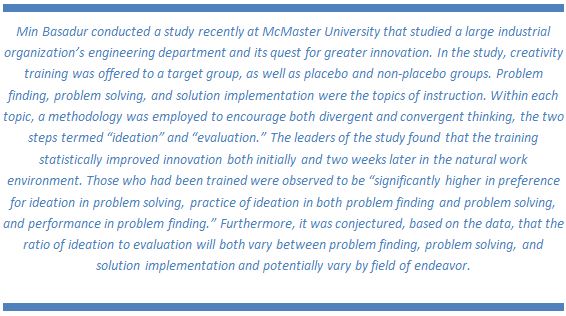
As you can see from the study, creativity training (when done well) can be instructive for employees who need to learn how to think and express ideas in a more positive, focused, and spontaneous way. Breakthrough results often occur when properly fueled by a rapid, flexible, and structured process at the front end of innovation.

Most R&D or innovation initiatives include no budget for training. Since creativity can aid with problem solving and problem finding, organizations need to be awakened to the potential missed from failure to pre-train.  Fraley feels  creativity and innovation training accelerates innovation in five strategic ways:

  1. Improved creative thinking leads to enhanced innovation capacity, and with action, results.
  2. Training helps instill structured creative thinking and innovation process as a cultural value and habit.
  3. Training provides innovation teams with a common language and framework to solve problems, improve communication, expedite complex problem resolution, and moving new business concepts forward.
  4. Training corrects many of the myths that surround creativity and innovation. There is a science to this that is largely ignored. For those that learn and practice the science — it’s a competitive advantage.
  5. Team efficiency improves because a lot of useless chatter, debate, and conflict are eliminated.

Creativity is intimately related to change, decision making, and problem solving — it’s not just artistic self-expression!