Climbing Your Management Everest

Stretching oneself to the maximum can reveal what we are made of. Whether the subject matter is a test of mental strength or physical, it is exhilarating to overcome a daunting obstacle. Sir Edmund Hillary is celebrated for his perseverance in conquering Mount Everest. One of my LinkedIn contacts and an internationally known innovation resource is Gijs van Wulfen. Van Wulfen states that, in the 1950s, the route to Everest was closed by Chinese-controlled Tibet. Nepal allowed one expedition per year.

Sir Edmund Hillary had been part of a British reconnaissance expedition to the mountain  in 1951. The 1953 Everest expedition for which he is now famous consisted of a huge team of over 400 people. Expedition leader Hunt named two assault teams. Hillary and Norgay were the second assault team. The first team only reached the South Col, about 100 meters below the summit. Then Hillary and Norgay got their chance. They reached the 8,848-meter high summit, the highest point on Earth, at 11:30 a.m. on May 29, 1953.Mt Everest

Gijs says the following 10 management lessons came to mind as he read the Hillary accounts:

1. Passion. As a youngster, Hillary was a great dreamer, read many adventure books and walked many miles with his head in the clouds. He was unaware his passion for adventure would make him, together with Tenzing Norgay, the first man to set foot on the highest point on Earth.

2. Urgency. In 1952 the British heard that in 1954 the French had been given permission to attempt Everest. The British wanted more than anything to be first. The expedition just had to succeed.

3. Teamwork. Getting to the summit of Everest is all about teamwork. As Hillary wrote: “John Hunt and D Namgyal’s lift to the depot on the South-East Ridge; George Low, Alf Gregory and Ang Nyima with their superb support at Camp IX; and the pioneer effort by Charles Evans and Tom Bourdillon to the South Summit. Their contribution had enabled us to make such good progress.”

4. Courage. The higher you get on Everest the more courage you need. At 7,800 meters Hillary wrote in his diary: “Even wearing all my down clothing I found the icy breath from outside penetrating through my bones. A terrible sense of fear and loneliness dominated my thoughts. What is the sense of this all? I asked myself.”

5. Test. On the 1951 reconnaissance expedition, team members tested oxygen equipment and did research on high-altitude physiology. The results of both studies were important in determining the right approach for Everest in 1953.

6. Initiative. While in India, Hillary read in a newspaper that the British were taking an expedition to the south side of Mount Everest in 1951. He contacted expedition leader Eric Shipton and suggested that a couple of New Zealanders could make a substantial contribution to the team. And they were invited!

7. Choices. The British Himalayan Committee replaced the 1951 expedition leader Eric Shipton with Colonel John Hunt, a climber. After eight failed attempts on Everest they needed someone to the top first, before the French would have their chance.

8. Overcome setbacks. Along the way there are always major setbacks. After finding a new route up Everest during the reconnaissance expedition of 1951, the British heard that the Swiss had obtained permission for two attempts on Everest the following year. The only thing the British could do was wait and see if the Swiss would succeed.

9. Competition. Hunt proposed that Evans and Bourdillon should use the closed-circuit oxygen equipment to reach the South Summit and Norgay and Hillary would push to the top with the open-circuit oxygen. The competition fueled the eventual success of Hillary’s team.

10. Luck. Hillary, a New Zealander, was lucky to qualify as a British subject and be invited to join the British team. Secondly, in 1952 the Swiss failed to climb Everest on their two attempts. 

How do you view these management lessons in light of your own organization’s efforts to be innovative and competitive?



How to Start Blogging As a CPA or Lawyer

Professional services firms have been very good clients for me over the years. With many firms, I am charged with improving their marketing results. One of the topics that often comes up is social media. Many billable hour professionals struggle with making the commitment to initially launch a social media presence; others with how to optimize what they have. Kevin O’Keefe, who blogs about the need for lawyers to blog, is someone I follow on Twitter. Kevin wrote a blog post some time back wherein he referenced Steve Robinson, a small business specialist for Constant Contact, whom I also follow.law firm library

O’Keefe summarizes Robinson’s top recommendations to small business bloggers, with an emphasis on how to apply the principles to a professional services firm:

  • Find your target audience. Before you set up a Twitter account or create a Facebook Business Page, research who’s participating there and ask your clients and their influencers (reporters, bloggers, association leaders) which forums hold their attention. You may find they like blogs and email as opposed to Twitter and Facebook. Once you determine where they are, follow them to their preferred destinations.
  • Focus your efforts. Identify the top two places where your audience is most active and fully engage them there as opposed to spreading yourself too thin across a variety of social media platforms. Professional services firms often want to do a little bit of everything resulting in going a mile wide and an inch deep. Following relevant sources and subjects via readers such as Google Reader or Flipboard; truly using LinkedIn; and blogging will enable professionals to build relationships and enhance their reputation. Other social media tools can follow.
  • Identify the most active participants on your target social media platforms. Then initiate conversations, respond and repost their messages, follow their feeds, comment on their blogs, and cite their blog posts on your blog. Third parties have tremendous influence over your clients and prospective clients. If you can get these third parties (bloggers, reporters, business association leaders etc) referencing and sharing what you are saying online, your stature and reputation is only going to go up. When people get your name from a referral source, they’ll Google you and see positive references by the influencers to what you have shared via social media.
  • Balance social media with other marketing efforts. Social media should be part of a balanced marketing effort that includes online and offline activities. Leverage the enhanced reputation you are establishing by going to networking events, speaking to groups, or even asking to have coffee or lunch with someone you’ve met via LinkedIn or other social media. Share your blog posts via email to relevant clients now and again to show them you are thinking of them. Social accelerates relationships and reputation, but talking with and meeting people is needed.
  • Don’t mistake silence for disengaged. A lot of social media is built around listening and responding only when it makes sense. If you aren’t getting a lot of responses to your blog posts or items you share online, don’t assume that your audience has tuned you out. Ask questions, inquire about your followers specific interests, and reach out on a one-on-one basis.
  • Position yourself as an expert resource. This is what it is all about. Individuals, businesses, and trusted advisers to your clients are looking for a reliable authority in their field. Don’t be afraid to focus on a niche area, industry area, or client issue that you truly enjoy working in or on. What may have taken 15 years or more, if ever, to establish a strong word of mouth reputation in a niche has been greatly accelerated via social media.

All of this makes such great sense that I chose to excerpt it almost verbatim from an O’Keefe blog post. Hope it’s helpful for you!


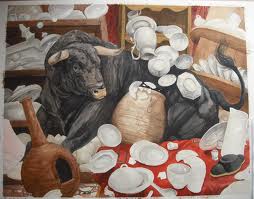
My China Shop Needs No Bulls

Too many corporations put “bulls” in executive roles, and surprisingly hope for good things. Hard-nosed tactics may produce some short-term gains. Under the surface, employee engagement often suffers, which can spur greater turnover and undesirable business performance. Peter Friedes, founder of the management think tank Managing People Better, offers a parable to illustrate (below):

Roger the Bull

Roger always “tells,” rarely “asks.” He knows what he wants, demands it, and pushes everyone to adapt to his schedule and expectations. He believes that every second counts and does not view relationship-building as time well spent or a necessary activity for getting great work done.

He is not empathetic or understanding. He rarely changes his mind, even with new information. He operates solely on his own agenda, showing little or no interest in his employees’ opinions. He rejects suggestions quickly, as he knows others’ ideas won’t work. He easily confronts people, often using words that are harsh, strong, or judgmental. He can be arrogant, as if to say he has all the answers. He doesn’t trust his employees to do a good job, so he hovers and corrects them.

Roger doesn’t include others before making decisions. While he thinks he coaches his employees, his “coaching” comes across as demands. No one would call him nurturing or encouraging. His language and tone exude frustration and anger. He is extremely unpleasant to work for.

bull in china shopFriedes writes that, while Roger may have flourished as a department of one in the past, his lack of understanding of how to motivate others is a huge drawback to managerial effectiveness. What is recommended are two key skill sets:

  • Relating, which includes relationship-building activities such as asking, listening, including, coaching, and encouraging.
  • Requiring, which encompasses results-oriented activities such as setting expectations, focusing on goals, insisting on excellence, establishing appropriate controls, confronting performance issues, and asserting your views.

Read about Friedes’ experiences in trying to coach Roger-types:

Bulls are the hardest managers to coach. They typically don’t listen well. They often think they have the answers already. Over the years, I’ve tried the following messages, with limited success:

  1. “You are a results-oriented manager. But you would get far better results by asking, listening, including, coaching, and encouraging your people more often, and lowering the volume on how you demand and require of your people.”

  2. “You were an excellent, hard-working individual achiever. But now your success is measured by how well you let others achieve. This takes a different set of skills. Unless you develop these skills, you cannot be effective as a manager.”

  3. “Your goal is fine…to do a lot of excellent work and meet productivity objectives. But the manner you use to get results is damaging our business and sabotaging your career.”

  4. “Our top employees will not work for an over-Requiring, under-Relating manager very long. They will seek a more reasonable manager and leave or transfer. That will require you to start over with new people, lowering your productivity. Over time, the company will not want to give you any new people.”

  5. “You have taught your people to give you exactly what you want, but they no longer give you new ideas or suggestions for how to do things better. You have demotivated them, which is why you see them lacking.”

  6. “I know you don’t need to be liked. But you do need people to appreciate and respect being managed by you. You are not on track to get that respect.”

Since Bulls feel justified in their treatment of others, none of these statements are likely to produce changed behavior. However, being straightforward, according to Friedes, and saying “You are failing as a manager” or “You will be fired if this over-Requiring, under-Relating behavior continues.” may have the desired impact.

(Want to see how Bullish you are? Take a free assessment !)