Entrepreneurial Twists and Misfortune

Anyone who has read my blog for more than one sitting knows that I began my career doing turnarounds, mixed in some strategy added to marketing and nonprofit, started some businesses, and now help startups and SMEs. Invariably, some of the companies I run across or that you may read about in an epitaph simply do not pan out. Megan Kauffman posted a blog entry today that features the thoughts of Wen-Szu Lin, a Wharton grad whose entrepreneurial venture in China was unsuccessful. Lin’s thoughts are below:

When our business in China did not work out as hoped, I could not believe that I failed at something I set out to achieve.  Four years of my life were gone.  The emotional scars and physical ailments resulting from the stress were real enough.  I couldn’t believe that I had lost money for my investors (who were friends and family).

Few people discuss the details about such periods in their lives.  Most entrepreneurs that we hear about succeed.  Or else they fade into oblivion.  Older entrepreneurs occasionally discuss the multiple failures that they experienced to reach success.  Yet, those painful memories are long past.  The younger a successful entrepreneur is, the more he or she is featured and sought after in stories.Venture failure

So, what happens with the majority of the entrepreneurs who, like myself, have experienced a major setback?  By far, this period was the most challenging in my life, and I was the most unprepared for the moment.  All of the business cases that I had studied in school, read in books, and heard first hand from entrepreneurs focused on how to handle business success.  How would I deal with failure emotionally and mentally?

Range of Initial Reactions

In China, I saw a lot of failed businesses, both from local Chinese and foreign entrepreneurs.  Through my years in Beijing, I have met many entrepreneurs and witnessed their responses when their businesses fail.

Based on my un-scientific observations, initial reactions fall into a few categories:

  • Reflect and move on
  • Disappearing Act
  • Denial (negative energy)
  • Oblivious (optimistic)

There are probably many other common responses to a failed business venture, but these were the ones that I encountered most often.

What happens now?

My foolish pride was quickly replaced by an immediate concern:  I needed to support my family, as my wife had just given birth to our first child.  Perhaps this urgency snapped me out of a potential downward spiral into depression. I had to quickly figure out how to generate an income for my family.

I experienced many mixed emotions as I evaluated my options and next steps.  Here were some of my main take-aways:

  • Personal reflection:  I started writing anecdotes, detailing each of the memorable stories from our four years.  I relived them in my mind and tried my best to put them on paper with the same intensity as I experienced them.  That was how I learned to move on from my experience.

Bottom line, I wrote a book (The China Twist) that reflected my experience.  The book contains the most vulnerable moments in my career, so I am facing my fears and my ‘shame’ head-on.  I am proud of what I wrote and what I have experienced. 

  • Job opportunities:  I did not realize that my degrees and background experience in consulting and technology were such a strong security blanket.  My options were actually quite varied and better than I had expected when the business ended.  
  • Another shot at entrepreneurship:  Growing up, I could think of nothing else I wanted to do except start something from the ground up.  My priorities definitely have changed but my dreams have not. One thing I know for sure is that I will be back in the entrepreneurship game sooner or later.

Some great advice from someone else who has lived the highs and lows. Take it to heart…stick a copy of it in a file and read his book –“just in case” you ever need the encouragement!


Take Away 10 and Add 6 For Innovation


Preparing for a monthly webinar on intrapreneurship has led me to literature searches for resources that represent thought leadership on intrapreneurship and innovation. Most of the literature recognizes the inherent dichotomy between organizations wanting to be cutting edge for the sake of competition, but not wanting the risks and change necessary to go there. Consequently, many stumble in their pursuit of innovation. The book, The Innovative CIO: How IT Leaders Can Drive Business Transformation (CA Press/Apress), addresses practical suggestions to overcome some common barriers to successful innovation. Dennis McCafferty writes that “it also demonstrates how to take advantage of your human and tech resources to effectively evaluate, track and “sell” the value of innovation within your company. The Innovation CIO coauthors Andi Mann, George Watt and Peter Matthews discuss the following 10 Ways to Kill Innovation:


1. Unhealthy Internal Competition  Healthy competition encourages achievement. But when employees focus more on beating each other than benefiting their organization, it’s unhealthy competition.

2. Inconsistency in Rewards  If workers feel there’s no rhyme or reason in performance awards, they’ll grow demoralized and stop trying.

3. A Culture of Intimidation  Bosses who ridicule “dumb” ideas to present themselves as “the smartest person in the room” ultimately choke innovation through fear and ridicule.

4. No Organizational Framework for Innovation  Without a companywide framework for fostering innovation, it’s difficult for lower-level managers to leverage innovation as it happens.

5. The Pursuit of Perfection  Perfectionists tend to “hide” work until they feel it’s 100% ready. But innovation thrives from collaboration and dialogue while work is in progress.

6. Protection Obsession  Company “protectors” are often guilty of shooting down any proposals that they feel will harm their organization or department.

7. Inbox Overload  A relentless barrage of emails, meetings and phone calls–many of them unnecessary–keeps CIOs and their teams preoccupied with the mundane and urgent instead of something fresh, new and valuable.

8. Voluntary Isolationism  IT teams will often “go dark” and bury themselves in projects while closing off contact with stakeholders, customers and others who can help greatly via feedback.

9. Clinging to Legacies  Outdated IT systems and processes hinder innovation. However, too many CIOs stick with them because they cost money and/or they don’t want these deployments to be perceived as “failures.”

10. No Strategic Focus  Innovation teams must always keep concrete, business-benefiting goals in mind during collaboration. Otherwise, it’s just a fun but ultimately pointless “creativity exercise.”

What is true in IT circles is true, to some extent, in any kind of business. The environment and culture have so much to do with successful innovation. Agility Innovation and Ovo Innovation, in a joint whitepaper, provided a list of 6 key capabilities needed by executives to foster the skills and capacities for innovation in their companies:

  • creating alignment,
  • deploying trusted methods and tools,
  • effective communication and engagement,
  • empowering people, providing skills,
  • refocusing attitudes, perspectives and rewards ,
  • defining a corporate “governance” for innovation

The whitepaper authors argue that  these skills or capabilities can be developed in an appropriate strategic manner when applying the Executive Innovation Workmat (shown below).  They believe that executives can be trained to both understand how to innovate and how to acquire and inspire the skills requisite to do it well. Beginning with establishing a language for innovation, complete with agreed upon definitions of key terms, a systematic approach serves organizations best. When corporate strategy and innovation have linkage, the likelihood of success goes way up!

Executive Innovation Workmat


Entrepreneur Faith – Future, Attitude, Improvisation, Timing and Help

Reading outside one’s usual list of publications, blogs, and websites can be very eye-opening. Perspective emerges as familiar subjects are addressed in differing ways. When worldview is, in fact, only hemispheric or nationalistic, it is incomplete to say the least. Asia is exciting in the business world today, as can be parts of Europe. One European publication draws my occasional attention: Entrepreneur Country.

Entrepreneur Country recently held a forum in, of all places, the Royal Institution of Great Britain. (Same location where the first Industrial Revolution began.)  Contrast this austere setting with the arrival of Madonna as a guest lecturer and you get the sense that this was not “business as usual!”

Writing about the event, Peter Cook commented that “the day was characterized by entrepreneurs telling real life stories of their hopes, fears, successes and failures.” below he shares some of his observations and take-aways, with a few musical references (Cook is the leader of the Academy of Rock) for good measure:

iTrigga(Much) discussion was .. around what entrepreneurs do to avoid burnout. Ed Bussey of iTrigga was a prime example, having come to the conference after an all night vigil at hospital on the occasion of his wife giving birth! He did however point out the importance of pressing the OFF button from time to time to avoid the possibility of crash and burn entrepreneurship.  Others talked of rituals and routines such as working out in the gym, taking forced holidays, running the London Marathon, going to the North Pole (that’s hardly chilling out!) and so on. Seemingly obvious advice, yet not always taken by busy entrepreneurs.

Several speakers also gave witness to the importance of maintaining naivety if you are to succeed as an entrepreneur. Madonna’s contribution to this area is via her blockbuster hit “Like A Virgin”, which translates to the need to treat each new business situation like it’s the very first time. In particular, Sir William Sargent of Framestore painted a picture of the importance of intuition, creativity and the ability to remain adaptive and flexible as your company grows, saying, “If I stand still for 12 months, I will be out of business 12 months later.”

Entrepreneur Country Founder Julie Meyer and Dr Mike Lynch (offered opening remarks.) Julie presented her ideas about entrepreneurship clearly, concisely and without apology for wanting to create an enterprise economy, which produces both economic and social benefit. Business gets enough hard knocks and we need to start seeing it as an engine of improvement, rather than an evil empire as it is frequently portrayed by Governments and a self-righteous public sector. Mike Lynch extended Julie’s strident start to the day by giving us some home truths on entrepreneurship:

“Without good marketing you can have something amazing and no one will know.  Marketing is not cheating”

“Avoid the myth of doing things properly”

Another speaker, Stephen Linnecar, suggested that we gotta have FAITH – Not an allusion to George Michael, but the summary of his presentation which focused on five factors which he regarded as key to success as an entrepreneur: Future, Attitude, Improvisation, Timing and Help. Improvisation featured strongly throughout the day, a point that resonated personally with me, having taught creativity, improvisation and innovation for the Open University MBA for 18 years. However, what impressed me most of all about the speakers at the event was a real and unusual sense of authenticity.  Truths were told about successes. Much more importantly, we gained an insight into mistakes and outright failures. It’s much more important for an entrepreneur to learn from their mistakes than their successes and many speakers were candid about their regrets. 


anti-Innovation Sentiment and Intrapreneurship Collide

In order to stay current in a subject area that is constantly changing, one must be well read and, beyond that, follow the bets though leaders around. Last week, I had the opportunity to discuss intrapreneurship in person with one of my favorite innovation bloggers, Jeffrey Phillips. Tonight, I read a blog post by one of my other favorites, Gijs van Wulfen.

Gijs tackles the subject of anti-innovators in his recent post.  His writing echoes some of what Jeffrey and I discussed last week. As we  looked at different models for commercializing business ideas last week, we camped out for a while on what stultifies innovation. While many leaders acknowledge that innovation is a top priority, they would also be quick to add that implementation of innovative practices can be a challenge. The consequences, according to Phillips, include: 

 Poor execution of innovation goals
 Failure to achieve strategic goals
 Limited organizational design to sustain innovation
 The growth of disbelief or cynicism when innovation isn’t pursued.

Stubborn personvan Wulfen describes personnel as a main hindrance. He writes of employees who “are stuck in their habits.. ignorant the world is changing fast and (thinking) they have nothing to fear.” He goes on to describe the anti-innovator as a (negative) contributor to team culture:

There are often quite a few anti-innovators. Everybody knows this extravert guy or woman who is anti-everything. They have “the biggest mouth” at the lunch table in the company restaurant. Their influence on the company’s culture is often quite substantial. Don’t underestimate their impact. The herd goes as fast as the slowest animals. If the anti-innovators lean back nothing moves. So how do you get them up and running. That’s the question.

You can try to convince them. Unfortunately that often fails because they are experts in coming up with idea killers like: “We are too small for that… There is no budget… We need to do more research… We don’t have time… It’s too risky… That’s for the future. Everything is OK now.”

You can try to do it without them. But that won’t work either. You need an awful lot of colleagues and bosses to share your vision before a big change can truly take place. You need R&D engineers, production managers, IT staff, financial controllers, marketers, service people and salesmen to develop the product, produce it, get it on the market and service it. You can’t do it without them: you can’t innovate alone.

The way to get anti-innovators up and running is to respect them, to understand them, to connect with them and to let them experience change is necessary. They will only change their attitude if they get new insights themselves. So, you have to give them a chance to discover what’s happening out there. Invite them to join your innovation team and take them out on an expedition to discover how markets, customers, competitors and technology are changing.

If they, as the slowest animals of the herd, find out there’s a group of hungry lions following the herd they stop leaning backwards. They start running too as necessity is the mother of invention. They will spread the urgency to innovate among their colleagues. And that’s good news because If the slowest animals start running, your organization’s innovation power really gets up to speed.

Think about the anti-innovators in your organization. What motivates them? Do they travel in herds? How can innovators infiltrate their ranks yet respect them and build bridges for collaboration? As a mentor in an upcoming venture challenge competition, I will be working with teams that must have creatives and analysts. Often, including an anti-innovator on your launch team can bring helpful perspective. Stew on it!


Run Your Business Better With Games For the Mind

Owning a business is not a game. Seemingly, playing games is also irrelevant to running a business. Yet, there are skills requisite to entrepreneurship that may require development through practice. Whether one struggles with memory, focus, recall, or eliminating distractions, there may be a game to help you strengthen your mental capacity.

PositscienceThere is a growing number of “brain games” that help with decision making and memory improvement. Lumosity.com, which makes games for these needs, reached 35 million users earlier this year. Joe Hardy, PhD and Vice President of Research and Development for Lumosity, believes brain games are ideal for business owners. “Owning a business is one of the most cognitively challenging jobs,” Hardy says.

Lindsay LaVine, writing for Entrepreneur.com, says that, “Business owners have to process information accurately, balance projects, switch between tasks quickly and efficiently, divide their attention among tasks, and remember customers’ names. We took a look at three popular brain game providers to find out what the buzz is about:”

Lumosity.com

LumosityThe largest provider of brain games, the site works to train your brain in five categories: speed, memory, attention, flexibility and problem solving. “Each exercise is designed to train a different cognitive function of the brain,” Hardy explains. The games are based on neurological research performed by researchers from various institutions, including Columbia University and the University of California-Berkeley.

Lumosity’s in-house team of developers creates games based on what research shows exercises various parts of the brain. For example, Memory Matrix requires players to remember which tiles appear in a matrix and recall the pattern from memory, which helps improve spatial recall and working memory. “Think of it as a personal trainer for your brain,” Hardy says. He recommends that users spend 10-20 minutes every day playing brain games, as opposed to spending two hours one day and skipping out on the rest. “It’s like going to the gym,” Hardy says. “The more training you do, the better. The goal is to create a habit that’s sustainable and keeps you engaged.”

Lumosity offers a free limited membership that allows users to participate in some games, while the paid membership provides full access to the site and tracks your BPI (Brain Performance Index, a measure of cognitive performance) progress over time. Paid memberships range from monthly to lifetime options ranging from $15 a month to $80 a year.

Positscience.com

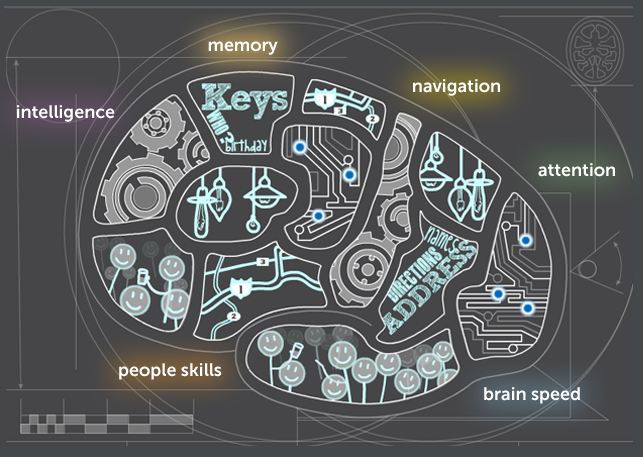
Positscience logoPositscience offers brain training in five categories: attention, brain speed, memory, people skills and intelligence. (A new category, navigation, will be available on the site soon.) Posit Science games include enhancing a user’s ability to read facial expressions, from easy (happy or sad) to the more difficult (puzzled or embarrassed). Its games also help users improve facial recognition as well as matching names with faces and remembering facts about people you meet, an important skill in networking and business.

Posit Science has developed games in collaboration with researchers from nearly a dozen universities, including Yale and Stanford. You can try some of the games out for free without having to sign up. Posit Science offers memberships at $14 a month or $96 a year.

Cogmed.com

CogmedCogmed is designed to improve working memory to allow users to learn new skills in academic or professional endeavors. Users are encouraged to spend up to 30 minutes a day, five days a week on training exercises over a five week period. Training is only available through programs offered by accredited coaches who monitor user results and provide motivation. Many programs are supervised by doctors or psychologists who specialize in attention problems.

Prices vary according to the program selected and the professional coach’s fees. The program is best for people who have working memory issues caused by ADHD, anxiety in social settings, or adjusting quickly to new tasks.