Crank Up Content Marketing For 2013

One of the leading developments in marketing has been the increased importance of content management strategies. With the proliferation of communication via the internet, companies of all sizes who are serious about engaging their target audience are looking to content as a significant tool. Clare McDermott, writing for the Content Marketing Institute today, took the opportunity to speak to to Amanda Nelson recently about how her organization creates content that is compelling, fresh, and engaging. Amanda manages content for Salesforce’s Marketing Cloud platform. Her job is to create and curate content for the Salesforce Marketing Cloud community. She manages everything from the blog and eBooks to webinars and infographics — with the help of a content team, of course.Newsjacking
Excerpts from Clare’s interview with Amanda appear below:

CMI: What issue do you think your content solves for your audience?

Amanda: Businesses want to become social, but they don’t always know where to start. What we do is create content to educate these organizations in the hope that when they are ready for social media monitoring, engagement, or publishing software, they will think of us. 

What kinds of content tactics are you using?

What we do is develop a content engine. A content engine starts with a central focus. In our case, it’s an eBook, but it could be a case study or any other piece of content that a company might have. From there, we publish the content by recycling and reusing it on multiple media:

  • We’ll read the eBook aloud and make it an audio book.
  • We’ll interview the customer for a quote in the eBook and then put that up as a video.
  • We’ll take the audio from the video and make a podcast.
  • We’ll create a presentation from the eBook with highlights.

What results have you gotten since you started using the “content engine”?

We’ve  had significant increases — about a 300 percent year-over-year increase in our eBook shares and downloads. I believe social shares of our blog posts increased by about 150 percent. What challenges have you run into?

A lot of people want to plan and curate, but at the end of the day, we need writers.. I sometimes have a need for (outside) writers..I’ll go out to the community and get guest bloggers. 

What’s your favorite tool used to communicate with the team?

We use Google Hangout because we’re actually all spread out across the country and Canada.. it is great because it’s video and it can hold up to 10 people. There are also fun things that you can do. You can do screen share or overlay funny faces. Whoever is talking is displayed predominately so it constantly changes. It’s in real-time, easy to use and free. The hangout is public so anyone else can join. People can see that you’re hanging out. It’s very social.

What are the most exciting examples of content marketing that you’ve see outside of your own business?

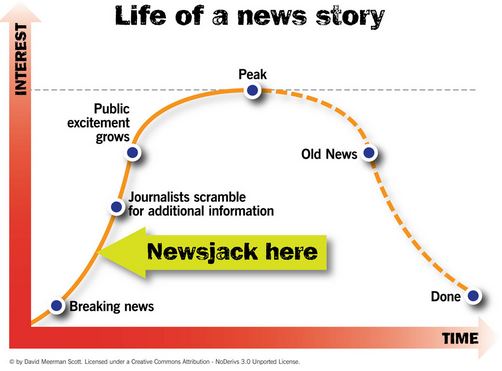
“News-jacking:” you see what’s going on in the media and they’re able to create content around it that becomes really shareable because it’s sitting where it’s hot. 

As you read through Amanda’s comments, take note of what she has done (with plenty of resources including a team of people) and think through how to interpret it and implement similar concepts in your business. We suggest the following:

  1. Think through your audience, where they hang out, and what your main message to each segment may be.
  2. Create a content engine that is your prescribed way of being consistent.
  3. Think about ways to use free, crowdsourced help for additional content.
  4. Investigate Google Hangout as a tool for enhanced collaboration.
  5. News-jack something interesting to supplement your original content. (Like we just did with this excerpt!)


Measure Marketing For Better Results

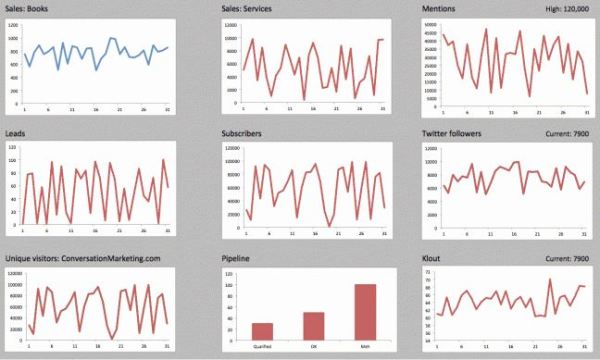
Marketing is the main subject of this week’s blog posts–in case you hadn’t noticed the pattern yet. One of the biggest challenges in marketing is to prove that efforts are generating results–and at a reasonable ROI to boot! We know that marketing can be used to initiate relationships–it is also about nurturing them and providing great leads to the sales side of the house. Being able to measure how much positive attention you are able to attract is key for a marketer to justify the marketing budget, and (in a recession, her role.)Mktg Dashboard

Leanne Hoagland-Smith, Chief Results Officer for Advanced Systems in Chicago, IL writes that,

With the Internet, the ability to measure your marketing efforts is far easier now than ever before. Websites can include Google Analytics or their own customized statistics dashboard. Then others sites and tools provide additional metrics to measure current marketing campaigns. Even WordPress has a plug by Yoast to measure Search Engine Optimization (SEO). This is a great tool for measuring the SEO effectiveness of your blog posts. I know because I have been using it for the last three years. 

Inbound Marketing Measurements

Each morning, the first action I take beyond deleting all the SPAM from my email accounts is to measure my inbound marketing through more than 20 metrics. Some of these measurements include:

• Unique Visitors to my website

• RSS feed from my website

• Twitter followers

• LinkedIn

• Alexa Ranking


Additionally, I also have another 10 weekly metrics plus another 15 monthly metrics.

I am currently expanding into delivering some webinars and Eventbrite provides additional statistics as does Citrix Go to Webinar. All of this data is crucial if I wish to use my limited resources of time, energy, money and emotions to increase sales.

..These numbers allow ..me.. to see trends, what is working ..and what is not working. The time investment averages around 10 minutes each day with another 10 minutes for the weekly data capture. At the end of the month, this adds another 20-30 minutes for updating and analysis.

Outbound Marketing Measurements

During the course of the last 10 years, I have identified some key benchmarks for the more traditional marketing efforts. For example, when I speak, I usually receive a client from that presentation within six months. Lately, that statistic has changed with two to four months being the average. What has also changed due to the economy is the average sales value of that client has dropped.

Another marketing effort was something I gleaned from Robert Middleton specific to sending pertinent articles to potential customers. When I employ this marketing campaign, my first time appointment rate is around 50 percent compared to the usual cold calling rate of 25 percent. As I am selective when I do engage in cold calling, my success rate is probably higher than most…

One simple action is to always ask how a potential customer discovered you. Sometimes these prospects will tell you without asking. Just this past month, I earned my first client from a YouTube video. Efficient and effective marketing is hard work. To not measure the efforts of all those actions is not probably the smartest course of action.

The role for small business owners have expanded to include measuring marketing efforts. Without knowing the results from all marketing efforts both inbound and outbound, the small business owners to even crazy busy sales professionals are missing significant opportunities to maximize their profits, reduce costs and increase sales.

As you look at what LeAnne does in her business, what ideas come to mind? Check out the tools she recommends. Determine your own marketing dashboard. Think through how to collect data, analyze it, and make adjustments. As you begin to apply some science to the art of marketing, you can calculate the metrics of success that drive revenues and profitability. Isn’t that why we all started businesses?

Changes in Marketing You Need to Know For 2013

In advising my clients on marketing and related business development issues, it is often difficult to get them focused on integrated marketing approaches. Many have been sold marketing services by an agency that is not necessarily coordinated with either the overall business strategy or other marketing strategies and tactics. With the advent of a new year come a series of questions regarding the future and direction of marketing given the increased importance of the internet. Recently, Uri Bar-Joseph, director of marketing at Optify, in a blog post on the Marketing Profs website, addressed what his firm sees as trends in marketing for 2013. His opinions are offered below:

Digital-Marketing-Picture

1. Digital marketing will continue to grow

It’s pretty obvious to just about everyone that digital marketing is becoming the main channel for demand generation. But despite the adoption levels of digital marketing, there’s still a lot more upside. In 2013, digital marketing will continue to see huge adoption rates as businesses of all sizes implement all manner of digital marketing tactics.

2. Digital marketing services will surge

Subsequent to digital marketing’s mass adoption, adoptions, digital marketing services will spike. Consultants, agencies, and new services will surge to support new users and meet their demand for assistance.

3. Content creation services and software will proliferate

Content marketing is becoming the core of just about every marketing initiative for B2B marketing as well as B2C. In 2013, we will see a host of software and services solutions for content creation and syndication emerge as companies try to use content for more demand- and lead-generation results.

4. Integrated marketing will gain popularity

After new channels stabilize as standalone, consistent lead-gen options (social media, content marketing) and new channels and tactics emerge with enormous promise (mobile, re-targeting), 2013 will become the year of integrated marketing campaigns. Marketers will try to combine tactics to make use of the compounded effect of multiple channels’ working in unison. The market will react as more solutions will come to offer the ability to manage and measure integrated campaigns in one place, marking a decline in the adoption of one-dimensional solutions.

5. Direct mail will make a return

While digital marketing rises, sophisticated marketers will recognize the potential of direct mail coupled with an online connection to break through the noise. Solutions and services that offer integrated—offline and online—approaches will emerge and gain traction as a result of being affordable and highly measurable.

6. Big Data applications will emerge

Big Data has been the hot topic in the media for the last 18 months, and big companies such as HP, IBM, Microsoft, and other software conglomerates have been developing solutions to tackle Big Data. In 2013, we will see solutions emerge and adopted that offer big data applications for day-to-day marketing campaigns.

7. The immeasurable will become measurable

In 2012, we noticed a lot of talk about measurement and the ability to justify marketing efforts. As ROI becomes essential to the broad adoption of any marketing tactic, in 2013 solutions and services will find ways to measure previously immeasurable tactics and evaluate their contribution to the bottom line.

8. PPC will decline as budgets move to other paid solutions

In 2012 we’ve seen the first signs of decline in PPC usage for B2B companies. In the next year, more budgets will move away from PPC to new and more affordable channels and tactics.

9. Marketing spend on software will increase

As more software and infrastructure for marketing is required, Marketing’s budget will match IT’s.

10. Sales responsibilities will move to Marketing

The expansion of lead generation responsibilities in B2B marketing is resulting in the moving of more sales-related tasks to Marketing. In 2013 we will see marketing teams take over more sales tasks, such as lead qualification, inside sales team management, and sales operations.

How about you and your company? As you think about your strategy for business growth for 2013, which of these trends have you thought about? For me, the top 3 things I want my clients to focus on are integrated marketing, metrics, and a digital marketing (including content) strategy.


Trends to Watch in Small Biz For 2013

In mid-December, small business owners are thinking about year end numbers and whether their companies will meet the annual goal(s). Advisers to small business owners are thinking about tax liabilities, the expiration of certain programs favorable to their clients, and whether the upcoming year will be better for their own businesses. What is little discussed but super important is what the future holds. In preparing to answer that very significant question, the small business leadership team is thinking proactively about strategy, innovation, and how to turn today’s customers and competitive advantages into a plan for sustainable success.

American Express publishes a blog under the OPEN Forum brand. One of its leading bloggers is John Jantsch of Duct Tape Marketing. A few weeks ago, he identified the following top 5 trends in business for 2013:Futuristic conference room

1. “Crowdsolving” becomes a hot innovation trend. Some of the greatest challenges we face in the world..are being tackled in unique ways. Instead of relying on the existing machines and organizations to address problems, innovative organizations such as the X Prize Foundation are creating competitions that reward disparate groups of individuals to collaborate and create innovative solutions in ways that had not previously been possible..This form of what is being called “crowdsolving” will make its way into the mainstream of business innovation. Asking our customers, vendors and employees to act as a community think tank will become one of next year’s hottest innovation trends.

2. Technology evolves to assist human contact. ..Instead of a world lacking human connections, these.. innovations have actually made it easier for some to create real human contact—one-to-one. For example, medical-monitoring devices provide the opportunity to create better doctor patient relationships and care; new scheduling and meeting services make it easier to connect in real life; and sharing ideas in virtual space leads to a greater desire to connect offline in social settings.

3. Content-filtering becomes a significant marketing practice. ..Moving forward valuable content must include insight, and filtering should be a central practice in order to help people and prospects get what they need when they need it. Service providers will be chosen based on their ability to find and share the good stuff in addition to making sense of the changing stuff.

4. Visual simplicity becomes the desired communication method. From a design standpoint you don’t need to look beyond sites and services such as Pinterest, Pinvolve and The Fancy to see that people want visual content. The current trend in Web design takes a cue from this desire for visual scanning and marries it with the need for simplicity and white space. 

5. Tablet optimization becomes the mobile standard. ..The new generation of mini tablets are going to impact responsive design and what we’ve been calling mobile devices. Tablets and mini tablets will see a tremendous jump in server logs and become the de facto design standard for mobile content. That doesn’t mean mobile phone size browsers aren’t important, it means there will eventually need to be a divide in how we address tablets vs. phones.

How you apply these trends to your own business is a big decision. Let’s take the trends in reverse order. If you have a website, it is simply inexcusable any more to not have it prepared to be read on multiple platforms/types of devices. Secondly, please take a look at your website and consider how to make it more simple, visually appealing, and written with the mindset of the user in mind. Everyone has content available–come up with a strategy of how you are going to share it with others professionally, opportunistically and systematically. Work with your leadership team to use technology to make your business more personable. When you encounter problems that need solving or innovation that needs to occur, outsource the brainstorming to others related to your business–they will be glad you thought to involve them and your ideas will be stronger as a result!


Becoming an Overnight Artisan Success in Only 5 Years

When someone is touted as a wunderkind in any line of work, many line up to try and figure out how success was achieved. So many become disheartened when their passion or education does not produce immediate results. While most recognize that success does not come over night, it is not at all uncommon for an artist or artisan to go from unknown to well known in a short amount of time. Achieving recognition, however, is a cumulative process. How does one go about doing so on a shortened time horizon?

Fundamentally, an entrepreneur in this space must be willing to undergo wholesale change. It’s not enough to become masterful at creating great designs; without the corresponding strategies to maximize business operations and processes, success will be hard to come by. Too few artisan entrepreneurs take the time and make the effort to understand that sweet convergence of operational, artistic, and marketing opportunities. Those who do create value that is appreciated by the target market.

If you seek to identify and serve target buyers with relevant offerings, create cross promotions with other artisans and handmade entrepreneurs, and craft an airtight plan to execute your strategies, you will be far ahead of the average artisan. Hopefully, your artisan start-up will resonate with the target market, sales revenues will provide the opportunity to grow your team, and you can become strategic about roles and responsibilities. In addition to your design, production, and sales efforts, you will need to task team members with the following responsibilities:

  • strategy
  • vision
  • marketing
  • advertising
  • social media
  • partnerships
  • scheduling
  • logistics

artisan potterObviously, one person cannot handle all of these important roles for very long. That’s precisely why a focus on sales, production, and design early will help create the capital structure to build a team.

If the skill sets listed above are foreign to you as an artisan, you are not alone. Those with degrees in the fine arts, and related disciplines have been prepared to pursue a skill, but not necessarily a business. More importantly, planning, confidence, and diligence go a long ways towards helping you execute on your idea. Since many artisans are not prepared through educational instruction to be proficient in such things as negotiation and team work, they have to learn these things from a mentor. Please find a suitable mentor with a background different form your own who understand business principles well enough to guide you into disciplines that are needful but likely unfamiliar!

Basic business principles in marketing, communications, customer service, selling, and relationship management are undervalued in the art and design community. Disciplining yourself to learn and apply nest practices in each of these principles will yield wonderful results. Very, very few artisan entrepreneurs are able to transition from hobby to avocation to employing others. For you to be more successful, you must work on the business side of your brain, engaging more left brain convergent thinking.

Friends who have been successful in the arts community have told me that, not unlike big businesses, change is hard for an artist. The willingness to tinker with what you make, how you describe it, who you make it for, how you determine who will buy it, how you promote your wares, how you replicate success, and how to transition from sole proprietor to small business are all based on being able to hold your talent with an open palm. Objectively stepping back from your creations to seriously consider who may appreciate them will, by nature, cause you to think differently about what you are making, how you are making, and what it will take to sell enough to pay not just yourself but others.

Best wishes on your journey!