Run Your Business Better With Games For the Mind

Owning a business is not a game. Seemingly, playing games is also irrelevant to running a business. Yet, there are skills requisite to entrepreneurship that may require development through practice. Whether one struggles with memory, focus, recall, or eliminating distractions, there may be a game to help you strengthen your mental capacity.
PositscienceThere is a growing number of “brain games” that help with decision making and memory improvement. Lumosity.com, which makes games for these needs, reached 35 million users earlier this year. Joe Hardy, PhD and Vice President of Research and Development for Lumosity, believes brain games are ideal for business owners. “Owning a business is one of the most cognitively challenging jobs,” Hardy says.

Lindsay LaVine, writing for Entrepreneur.com, says that, “Business owners have to process information accurately, balance projects, switch between tasks quickly and efficiently, divide their attention among tasks, and remember customers’ names. We took a look at three popular brain game providers to find out what the buzz is about:”

Lumosity.com

LumosityThe largest provider of brain games, the site works to train your brain in five categories: speed, memory, attention, flexibility and problem solving. “Each exercise is designed to train a different cognitive function of the brain,” Hardy explains. The games are based on neurological research performed by researchers from various institutions, including Columbia University and the University of California-Berkeley.

Lumosity’s in-house team of developers creates games based on what research shows exercises various parts of the brain. For example, Memory Matrix requires players to remember which tiles appear in a matrix and recall the pattern from memory, which helps improve spatial recall and working memory. “Think of it as a personal trainer for your brain,” Hardy says. He recommends that users spend 10-20 minutes every day playing brain games, as opposed to spending two hours one day and skipping out on the rest. “It’s like going to the gym,” Hardy says. “The more training you do, the better. The goal is to create a habit that’s sustainable and keeps you engaged.”

Lumosity offers a free limited membership that allows users to participate in some games, while the paid membership provides full access to the site and tracks your BPI (Brain Performance Index, a measure of cognitive performance) progress over time. Paid memberships range from monthly to lifetime options ranging from $15 a month to $80 a year.

Positscience.com

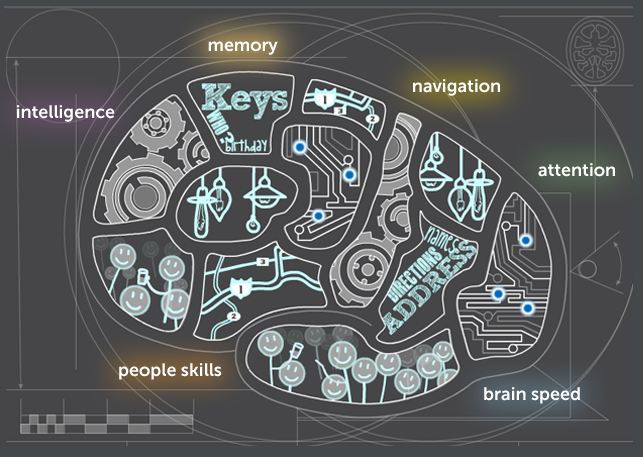
Positscience logoPositscience offers brain training in five categories: attention, brain speed, memory, people skills and intelligence. (A new category, navigation, will be available on the site soon.) Posit Science games include enhancing a user’s ability to read facial expressions, from easy (happy or sad) to the more difficult (puzzled or embarrassed). Its games also help users improve facial recognition as well as matching names with faces and remembering facts about people you meet, an important skill in networking and business.

Posit Science has developed games in collaboration with researchers from nearly a dozen universities, including Yale and Stanford. You can try some of the games out for free without having to sign up. Posit Science offers memberships at $14 a month or $96 a year.

Cogmed.com

CogmedCogmed is designed to improve working memory to allow users to learn new skills in academic or professional endeavors. Users are encouraged to spend up to 30 minutes a day, five days a week on training exercises over a five week period. Training is only available through programs offered by accredited coaches who monitor user results and provide motivation. Many programs are supervised by doctors or psychologists who specialize in attention problems.

Prices vary according to the program selected and the professional coach’s fees. The program is best for people who have working memory issues caused by ADHD, anxiety in social settings, or adjusting quickly to new tasks. 

 

Free is Costly and Cost is Freeing

As a consultant to small businesses, I have had to fight the trend of owners wanting something for nothing. In the start-up world, it is almost unheard of for something to not be free. Yet, I see organizations like EntreDot introduce business models that ask entrepreneurs to invest in themselves and wonder why that is not the norm. Mike McDerment, co-founder of FreshBooks, concurs in an article he recently wrote entitled, “Why Free is Bad: Businesses Should Be Happy to Pay For Key Services.”

McDerment noted that, late last year Google Apps for Business eliminated its free version (see Google Dares Businesses To Switch To Microsoft Office). He acknowledged that, while some may have thought the decision to be a bad thing for small business owners, he did not. In fact, McDerment lists several downsides to free:

1. Free things are never really free. When we don’t fork over dollars for products or services, we think of them as free. But we always give up something. When it comes to online services, that something is usually personal data or content you’ve created — think Facebook and Instagram, whose privacy policies obscure the line between what you own vs. what they own. For consumers, that might be an acceptable bargain. But for small businesses that trade may be unacceptable.

2. Free services don’t serve you. Free services can’t provide great customer service. You know this to be true if you’ve ever sent an email to a free service to get help. Imagine relying on one of those free services to run your business!. What happens when you need help, and you need it now?

3. Free services for small businesses don’t last. Free services for small businesses come and go. Google Apps used to be free, now it isn’t. Free services don’t last for the small businesses because the market is so challenging to reach and serve. My guess is that understanding the market challenges is the key to why Google Apps for Business going paid is a good thing for small businesses.

Google Apps For BusinessMcDerment also goes on to argue how “Free” stifles competition:

In the dot com era, companies were terrified to do anything that Microsoft might be interested in, and venture capitalists would stop a hundred businesses before they could start with one simple question: “Why won’t Microsoft do this?”

Similarly Google has scared people out of doing things, because thanks to the significant advantage created by its search business, the company can afford to lose money on other activities, starving the competition and limiting innovation.

Fact is, Google can always return to the free model, but it’s a good signal that it has started to charge for things. Wall Street will be happy, and small business owners should be too. That’s because I expect Google’s paid model to give entrepreneurs the confidence to step in and start innovating more for the small-business market.

This innovation will encourage services tailored for the long-underserved small businesses of the world. Sure, those services won’t be free, but they will be affordable, just as Google Apps remains affordable at $50/year.

Just as important, these new services won’t come with all the downsides of “free.” In exchange for services they need, businesses will trade dollars, not their data or their content.

I’m hoping this signals the start of a new era, one where for the first time ever, competition, innovation and choice are healthy in the small business market.

After discussing the competitive effects, McDerment then offers his insights into the upside of payments for services by small businesses:

…Why should small businesses care about their vendors’ problems? Why is it a good thing for them that Google Apps For Business went paid? How are small businesses going to benefit by paying for something they used to get for free?

The answer: innovation and the arrival of services tailored to meet their needs. Just think of how many things small business owners run on Word and Excel and you get a sense of how under-served this market really is. Google Apps for Business going paid makes serving the small business market more attractive – for everyone. As long as all Google Apps were free, smart entrepreneurs and competitors were inclined to avoid investing in innovation for small businesses for fear Google could step in and wipe them out with a free service.

Entrepreneurs With Too Much Passion Are Challenged

Diana Ransom is a contributing editor to Entrepreneur.com and queried in an article today whether lack of focus is an issue in startup failure. She cites the usual suspects (inadequate capitalization, poor market timing, and “founder fatigue”), but then notes that there’s no plausible explanation in other situations. Ransom’s case in point is the decision by founder Campbell McKellar to close the doors of New York City based Loosecubes in November after what seemed to be an incredible run. While McKellar was praised as articulate and poised, Ransom went on to postulate that maybe she had too many passions and it became her undoing.

LoosecubesThe 2.5 year journey attracted 25,000 subscribers in 60+ countries in an office-sharing play that has been copied by Desktime in Chicago. Ransom said she felt the idea was taking off, as evidenced by $9 million in venture capital funding and a staff of 16, all run by a phenomenal young entrepreneur. The sudden decision to close up shop with no media interviews by the founder gives rise to Ransom’s observation that there must be an underlying cause such as too many competing interests:

Like novelists who write several books, entrepreneurs often harbor multiple business ideas, and they love all of them. This is where problems arise; rather than building and running one business for decades, they’re itching to give the next idea a try. In fact, selling or shutting down a business can serve as a form of catharsis.

Naturally, there’s a financial loss associated with failure, but there’s also a sense of closure that people in the career world don’t really ever get to feel. That business (aka your baby) is gone. And while employees who get laid off often look for a new job in the same field, entrepreneurs can consider something entirely different. They can break new ground, explore undiscovered territories. While fraught with uncertainty, it’s also exciting. It’s the thrill of the launch. I suspect this is what happened to McKellar.

Ransom has interviewed many entrepreneurs and has experience identifying with their motivations. She writes that, “If you can identify with these flights of fancy–and you’re aware that they’ve become an impediment to your business trajectory–let me offer a suggestion: Instead of seeking your bliss by creating specific products or services, fall for something that can work across any business. Tony Hsieh (the serial entrepreneur and CEO of Zappos) has a (well-known) major crush on customer service. That’s his thing no matter what business he’s in. His long-held belief that quality customer service will make or break consumer companies helped him create a beloved online retailer, which Amazon.com acquired in 2009 for an estimated $1.2 billion. Now, customer service may be Hsieh’s cup of tea, but yours may differ. And that’s OK. Just make sure there’s something in your entrepreneurial passion that will hold your focus well after your initial idea has matured. Your eventual success depends on it.”

While identifying a strong suit and core value like customer service that can transcend products and services ideas is a good idea. I would argue that there is nothing wrong with being the other kind of entrepreneur. One key proviso: find a way to build a superstar team around yourself sooner than later so that you can effectively delegate responsibilities that draw you into the doldrums of running a business instead of the excitement of launching an idea. 

Those who are able to build teams that function without their requisite involvement are freed to do more of what they wish–even becoming a serial entrepreneur like Tony Hsieh!


Nurture Networking Relationships and You Will Prosper

As a former business development executive, I miss my expense account. Seriously–it has always been a ton of fun to mingle with people and get paid to do it. Now running my own consulting firm, volunteering some time at a non-profit, and helping several other founders get their businesses off the ground, I have less time and budget to do one of the things I love: networking. Jeff Hoffman, a member of the founding teams at Priceline.com and uBid.com, and now launching ColorJar, gets this. In a blog post for Inc.com today, Jeff shares with other entrepreneurs what he has learned about the value of networking, as well as some tips to the uninitiated.Networking

Launching and growing a business is hard.  You need to find those relationships (that will help), and then cultivate and nourish them, to keep them alive and healthy.  When you are trying to go from point A to point D in business…people act as bridges from point B to point C, saving you valuable time and money.

… tips:

1. Identify people who could help you and your company. 

Make a list of potential relationships you’d like to forge, either by individual’s names, or by companies and positions.  You can’t pursue your targets until you know who and what they are…write down next to each name precisely what you think the person can do to help your business.

2. Contact these people on a regular basis, and stay in touch with them. 

The most important part of this regular communication is to make sure you are acutely aware of their needs, not just yours.  Ask them what they are trying to accomplish and how you can help.  And then do it when you can.

3. Find ways to give back to them. 

Make a list of the interests of the people on your go-to list…Let each individual know you remember and care about those interests.  Interesting article? Send it to the appropriate contact.  Meet a smart person in that field? Make an introduction.  (Cool, relevant) event? Invite (them) to attend.  Provide a value to your contacts, if you expect to receive it in return.

4. Acknowledge them in your social media. 

Discuss their work, congratulate their accomplishments, and keep them in your discussions.  Show them that you are not only aware of the importance of their work, but that you follow it and celebrate it.  

5. Schedule a time in your calendar to think about and research each contact. 

Once you make this relationship list, it needs maintenance and updating.  Set a periodic time to review the list, update it, and think again about how these people can help you and how you can help them.  Your needs have changed and so have theirs.

6. Make them feel 10 feet tall from time to time. 

Send out handwritten notes.  Or fruit baskets.  Make sure the people in your network know that you appreciate them and recognize their importance in your life.  A little gratitude goes a long way.

Great advice from someone who has obviously helped many other people along the way. Now that I am in the role of advising others, I frequently encourage them to “pay it forward,” helping someone else with their needs before asking for hep with your own. Go out of your way to make introductions for all kinds of solutions–that kind of capital is priceless! 

I also like Jeff’s suggestions on how to keep the conversation alive–good stuff! Remembering to do the personal touches mentioned above is not just good etiquette–it’s great business practice! Smart networking follows these best practices.


Foster Intrapreneurial Activity

Today I had the opportunity to attend an Innovation Symposium culminating a 125 year anniversary celebration at North Carolina State University. While NC State is the arch rival of my alma mater, UNC, it is a great university located in my hometown.  One of the recurring themes today as presidents of other land grant universities took their position at the  podium was how many schools have done a good job of incorporating the business community into campus life–particularly as it relates to launching novel startups with a research basis made possible by the work of faculty and students. An outgrowth of that theme was the concept that more corporate citizens needed to catch the entrepeneurial spirit and turn it into intrapreneurial initiatives.

When I did an internet search for examples of universities partnering with businesses in intrapreneurship, one of the results was a story from Louisville, Kentucky. Beth Avey, the Executive Director of the Kentucky Indiana Exchange said in a blog post on their website, “Over the years I’ve often heard people talk about how the corporate culture stymies creativity and new ideas, and how companies lose their most talented people in pursuit of more innovative opportunities. Well, in our region there are employers doing just the opposite.”

Health intrapreneurshipWhat a great idea! Companies who are tuned into the need of workers to have their ideas heard and implemented–regardless of whether the workers hold a management or traditional R&D role. Would that all companies embraced the challenge to foster intrapreneurial activity! Avey goes on to illustrate:

The Kentucky Indiana Exchange (Kix) has long sought to showcase the great entrepreneurial spirit of our region, but what about the “intrapreneurial” spirit of our employers? Maybe it’s a concept that some of you are aware of, but it was unknown to me until a recent visit to Signature HealthCARE as a member of the 2013 class of Leadership Louisville.

When we arrived for our monthly gathering, we were given the opportunity to select one of several regional employers, and I chose Signature. I had heard so much about the company — the decision its leaders made to move the headquarters to the region; the work they were doing with the University of Louisville to foster innovation and business start-ups in the long-term care industry; and about their leader, CEO Joe Steier, a Louisville native who guided the company’s move to Kentucky.

We spent much of the morning with our host Joe Barimo, the VP of Corporate Learning. His passion for the company was quite apparent. We then visited with what seemed to be the entire senior leadership team, including Joe Steier. We had a terrific exchange, learning about the company, their move to Louisville and Signature’s three organizational pillars – Learning, Spirituality and Intrapreneurship. Learning and Spirituality were certainly two concepts with which I was familiar, but not “Intrapreneurship.”

It’s the idea of acting like an entrepreneur within a larger organization where employees are expected to be innovative, to take risk and pursue the development of innovative products or services within the company. This style of management allows the employees to feel as if they’re part of something bigger, as well as something they have a stake in. Traits like conviction, zeal and insight are encouraged. As a result, employees become more likely to try the kinds of approaches they might take if they were running their own business. The end result can be a breakthrough technology or a new and profitable product line.

What a great lesson in visionary leadership. How can it be applied to your organization? Your alma mater? Your business community?