Consultative Solutions Beat Hard Closes

In times past, “good” salespeople  had a method to close out a meeting with a prospect that was successful in getting them to “sign on the dotted line.” In some industries, the sales function is described as business development because of stereotypes of sleazy salespeople who use high pressure techniques to cajole an uncertain buyer into a (sometimes regrettable) decision. This is especially true in business services firms, where there is a stigma in many cases about seeking out new business at all.

The biggest development of the past few decades has been the consultative selling approach. Yet, even this shift is not satisfactory for people who just do not like the word “sales.” When I have been working alongside attorneys and CPAs, for instance, the terms “client development” or “business development” are much preferred. In general, these practitioners provide offerings that have long sales cycles or are perceived as commodities. So…to unlock the motivation of my clients to do the development that is needful for practice growth, I usually have a series of conversations and trainings around the concept that client service requires a similar approach. Few argue that client service is needful.

Rich Grehalva writes and speaks about the array of sales/business development models:

CLOSING SALES MODEL
The 1950’s introduced this model, which concentrated on the product being heavily emphasized.
Key Elements:
✗ Presentation Skills
✗ Trial Closing
✗ Overcoming Objections
✗ Final Close
This model is still in use today, usually in high-pressure sales.

PRODUCT/SERVICE PUSHING THROUGH
PERSONALITY, PERSISTENCE AND PRICE
➲ The salesperson is tenacious, persistent and usually has a low-cost item and works on a numbers game.
➲ The natural born salesperson enjoys interfacing with people and usually has an engaging personality.

RELATIONSHIP SALES MODEL
➲ The salesperson builds a relationship, over time, with repeated visits.
➲ The buyer and seller get to know each other on a personal and professional level.

PROBLEM-SOLVING SALES MODEL (1960’s)
Focusing on:
➲ Open-ended questions – Role-playing is used with students to get them to understand how to get clients or prospects to talk about the things that are important to them.
➲ Closed-ended questions – Closed-ended questions require a yes or no response.
➲ Listening skills is a key component.
➲ The salesperson takes the information and then presents solutions.

VALUE ADD SALES MODEL (appeared in late 1960’s).
Price objections raised by the “Problem-Solving Sales Model” can be countered by adding additional services. In this way, adding these services to the base product/service gives a perception of the value received versus the price.

CONSULTATIVE SALES MODEL (surfaced in early 1970’s)
➲ Determines how to lower the clients costs and/or
➲ Determines how to increase the client’s revenues The company requires a depth of understanding of their clients’ business, as well as a solid track record in delivering proven results. Start-ups find it difficult to compete in this
type of sales model.

PARTNERING
This model became the buzzword used by salespeople–not in creating a legal entity, but in building a joint plan for
creating an opportunity. The sale is conducted at the highest level of the company and an output is a business plan
targeted at a niche within the clients’ market. The term partnering became highly overused and misused. Clients and
prospects soon tired of hearing the word.

TEAM SELLING MODEL
Though not new, the Team Selling Model became increasingly more integrated into the sales model. The salesperson
in this model must coordinate all of the activities within the organization and external to the organization, in order to
win the business.

COMPLEX SALES MODEL
✗ Large ticket sales
✗ Multiple decision makers
✗ Extensive coordination, both internal and external
✗ Long lead times
The role of the salesperson involves taking on a strategic role in developing win themes, internal politics, competitor
analysis, and legislation, as examples.

It is important to think about your client base, your reputation and brand, your team–whether they are salesmen or technical people who happen to need to bring in business, and what your goal is. (Hint: a sale that is undone a year later when the client is not retained is not an accomplishment.) In general, it is best to educate and involve the prospect, help them feel good about choosing your company, and guide them through letting the current provider go. When we consistently approach prospects with consultative solutions rather than hard closes, then we are developing business rather than selling.
Resist the Urge to Resist Change!

Innovation is a word that is bantered about unwittingly by many. From its Latin root, it generally means to renew or change. Yet, many reduce innovation to invention—as in product-specific concepts come to fruition and production. If we faithfully apply the definition, innovation may be seen to pertain to any ideas to effect positive change that go from origination to transformation to implementation to systemization within an organization.

To make the mental transition from viewing innovation as invention to what it really is, one must see innovation as culturally transformative. What was can no longer be what is, and certainly not what shall be. Change is hard for many people. Making a commitment to continuous change can be downright overwhelming. Yet, choosing to take action when others are stagnant can create tremendous strategic advantage. Look at Steve Jobs and Apple after the dotcom bust of the new millennium.  As others shrank from R&D, fearful that the technology boom was forever dead, his group increased investment in innovation and they have prospered for it. Think Apple and technology are an isolated company/industry? Explain away the following mix of companies founded during poor economies: Disney, CNN, Hyatt, Burger King, FedEx, Gillette, AT&T, Merck, Coors, IHOP, Fortune, GE, and the Jim Henson Company.

During the agricultural age, the asset everyone wanted was land and the critical success factor was yield. Agriculture gave way to industry with manufacturing and processing facilities and their efficiency defining success. As information became a greater commodity than industry, computers and their speed became the yardsticks. Today, in the creative age, innovation is the key asset and, as a means of differentiation, determines ultimate success.

If your organization is to remain/become competitive in the current world economy and proliferation of information sharing, it is unlikely to do so without making a commitment to continuous improvement. Again, so as to not confuse this phrase with the Deming’s work in documenting kaizen approaches to manufacturing in Japan, let’s define what is meant. We are speaking here of a core value within an organization to not accept the status quo—to not become complacent.

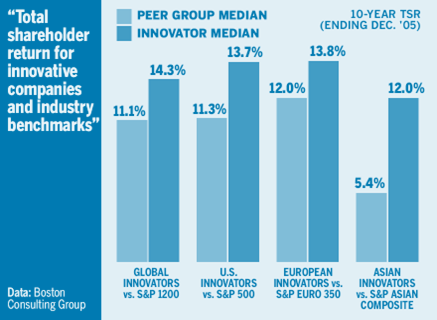
In a Business Week survey conducted in conjunction with the Boston Consulting Group in 2008, it was noted that total shareholder return (TSR) was greater over a three, five, and ten year period among business model innovators versus their industry peers.  Notice that it was those who innovated their business model rather than those who tried to hold onto their old one who prospered! TSR was greater among global innovators than the S&P 1200, greater among U.S. innovators than the S&P 500, greater among European innovators than the S&P Euro 350, and greater among Asian innovators than the S&P Asian composite.

“Wealth flows from innovation not from optimization.  Wealth is not created from perfecting the known, but imperfectly seizing the unknown.”

-Kevin Kelly, founding editor of Wired


In 1989, Smith Corona had annual sales of $500 million, producing typewriters. Word processing and computerization overtook their market position and they could not innovate fast enough to ride the wave. Jeremy Gutsche of trendhunter.com says, “Be wary of your strengths; success leads to complacency.” He maintains that, over time, most people stop trying. Need convincing?

  1. “We own that market.”
  2. “He’s been a client forever.”
  3. “She’s already my girlfriend.”

Gutsche cites each of these statements as examples of a pervasive attitude of entrenchment. Since most people are risk averse, we have learned to polish the “spin” on our actions and speak glibly of “tweaking” and “optimizing.” Instead, successful people and organizations must learn to pursue that which is splendid, unique, and paradigm-changing.

The secret, though, is to not just produce an innovative product or service; to not just culturally innovate, but to commit to innovation and change continuously. Daunting? You bet it is! How can you lead yourself and others to protect the value that innovation has created? How can change be “maintained?” This is a rhetorical question—it can’t! Change cannot be maintained—it must itself be changed to remain responsive, relevant & vibrant!!!

Is LinkedIn a Tool of Choice?


With all the raving about Facebook, Twitter, and Google+, the redheaded stepchild is often LinkedIn. Too few business folks know how to make good use of this powerful tool. Some have a profile because they have been told it is a good idea. Others, because they have heard it is a good job search tool. Yet, there are so many ways that LinkedIn can help you become a better marketer.

As the leading social media tool aimed at business executives, LinkedIn boasts 150 million users. As indicated in the infographic, most users subscribe only to the free version, with only about 8% who use the paid version with additional bells & whistles. Much has been written about the almost addictive level of engagement social networks enjoy; 12% of LinkedIn users spend 5-6 hours a week on the system, 26% are moderately engaged at 3-4 hours/week, and about 48% fall into the 0-2 hours category.

When people use a social media tool, one of the primary motivators is to connect and network. However, about 30% of subscribers have 100 connections or less. Another 30% have 300 or more; approximately 40% have between 100 and 300. While we could get into a point/counterpoint discussion for hours on the value of quality versus quantity of contacts, that conversation would seem to apply only to the choice of LinkedIn strategy between the two groups with the largest number of connections. The larger question looms as to why some, claiming that they have created a profile on LinkedIn in order to connect, have only made 100 connections or less.

Among favorite features, the Groups capability ranks highest, followed by the ability to search for people and the ability to be reminded of people we may know. Again, of those who join groups, fully 45% are members of 10 groups or less. It is important here to distinguish between members and participants. Most who are not “power users” of LinkedIn do not make the most of the Groups feature. By choosing not to read and respond to discussion board posts, the user decreases the value of the tool to themselves. When someone does use the search or people known features, they may not take the next step and ask for an introduction by someone who is able to help build the “triangle of trust” to the targeted contact.

The ways that LinkedIn has been most helpful to subscribers are numerous, but the top three are:

  1. Researching people and companies
  2. Reconnecting with past associates
  3. Networking to find prospects

If it is not your habit of using LinkedIn for these important business functions, you are missing out on a great opportunity. LinkedIn is a tool of choice for those who understand its value. For it to become powerful for you, learn it better and explore ways to make the features work for you.

Root Causes of Executive Failure

Smart leaders make dumb decisions. This statement should come as no surprise. The questions we should ask, though, are why? when? and how? By attacking the root causes and attempting to understand the character issues, we can “peel the onion” and see what is so potently wrong when poor decisions are made and executives fail.

Do you know a leader who sees himself and the company dominating its environment? If so, they collectively are set up for a fall. The basic fallacious assumption is that success in one domain can be infinitely translated into every other domain.

Similarly, the executive who treats the business as a private empire blurs the necessary distinctions between the personality and the entity. Beware the (wo)man who uses position to attempt to carry our personal ambitions. Those who see themselves as stewards of a resource as opposed to royalty seem to avoid this trap.

Know-it-alls are another type of failure waiting to happen. Those who feel they must look polished and do not invite the input of others suffer from hubris that is unhealthy. Being decisive without considering alternative views and related outcomes is not a sign of executive skillfulness.

Slash & burn is not just a rain forest dangerous practice–it is also bad for a talent management policy. We’ve all seen mobster movies where opposing viewpoints are literally snuffed out. When an executive does this inside a business, it shows a lack of appreciation for objectivity. More than likely, decisions will be weaker and mid-course corrections will be missed.

Is the top executive an attention hog? Choosing appearance over substantive management can be a fatal character flaw. Hyper-focus with image can also mean that underlying, important issues like financial performance are not getting the attention they should.

Trying to vision-cast one’s way around a hurdle instead of approaching it head-on is almost always a huge mistake. Shrugging off a problem or pretending it is inconsequential shows immaturity and a lack of executive responsibility. It’s more than okay to admit a problem exists–in doing so, we invite others to help us resolve it and the organization benefits.

Fascination with the past as opposed to staying in the moment is a final way executives doom their organizations to failure. As we’ve heard it said, “what got you here won’t get you there!” Embracing innovation is a good habit of top leaders.

Sydney Finkelstein addresses many of these issues in greater depth in Why Executives Fail, a book published a few years ago that examines case studies of companies that once thrived and then took a nose dive. Similar to Good to Great in its treatment of lessons learned, the book highlights problems with mindsets, information management, and habits.


How Do You Show Value to Customers?

Most companies that I know are frustrated that they cannot get customers to appreciate what they do. The real rub lies in not being able to monetize what we believe sets us apart from the competition. Unfortunately, we find ourselves competing on unfavorable terms instead of the ones we’d prefer. How does one go about turning this scenario around to one that delivers superior results via customers who see the value in what is being offered? How do you show value to customers? Can you demonstrate savings in dollars, time, or some other resource? If so, you have a competitive advantage!

Take the time today to write out how your company makes the customer’s life easier, produces more opportunity, or decreases their costs. Do you provide complimentary training? As a result of doing business with you, do they have better control over quality–how can that be measured? Is your logistics solution extra convenient for them–what is that worth to them? How about the way you package your product–any advantage for them/how can you quantify it? All of these factors are significant to the customer if you find a way to communicate the value.

The story is told of a supplier to the apparel industry who found a way to get their customers to articulate the value proposition. As a provider of zippers, trim, buttons, lining, hangers, and garment bags, H.B. Trim was looking for a way to communicate how valuable it was versus the competition. Ross Nadelman, the owner, told his consultant “I do everything better than my competition. I offer more. I understand the business more, and I can deliver better.” Do you feel this way about your business? Guess what? None of this matters if you don’t find a way to monetize your value to the customer! What Ross did to turn the corner was to send a cover letter and an attachment to two prospects he’d been trying to reach for years. In the letter, he listed his company’s competitive advantages; the attachment was a worksheet that he asked the prospects to fill out estimating their current costs and anticipated savings if they did business with him. Not only did he pick up the two prospects, but enough others to increase his business by 60% Would you like to increase your business by 60%?

If you are not in the manufacturing world, but perhaps in a services business, then it is likely that your differentiation will be slightly different. Speak to your customers/clients about information–how you collect, manage, and wield it to their advantage. If you are doing a lot of work for small to medium sized businesses, they often lack access to key statistics and trends for their industries. You have some of that information just from your interaction with them, their competitors, and peers in related industries. All you have to do is summarize what you know and share it to show how much you care. The next step would be telling a new prospect that you will help them avoid costly mistakes or find new opportunities because of what you share by way of information. Be ready with a story of how an existing customer benefited from your thoughtfulness. This is how you build an unassailable customer base!