Fly High, Entrepreneur, With 3 Key Skills

There are great minds aplenty when it comes to individual business disciplines (marketing, finance, quality, social media, etc). Rare is the individual whose thought leadership spans effortlessly from one to another. Seth Godin, however, is one of those truly bright minds who “gets it” on many fronts. His Twitter posts are very interesting to read and his books are well respected. Godin’s most recent, The Icarus Deception (Portfolio, 2013), is described below by Amazon.com:

The old rules: Play it safe. Stay in your comfort zone. Find an institution, a job, a set of rules to stick to. Keep your head down. Don’t fly too close to the sun.
 
The new truth: It’s better to be sorry than safe. You need to fly higher than ever.
 
In his bravest and most challenging book yet, Seth Godin shows how we can thrive in an econ­omy that rewards art, not compliance. He explains why true innovators focus on trust, remarkabil­ity, leadership, and stories that spread. And he makes a passionate argument for why you should be treating your work as art.
 
Art is not a gene or a specific talent. It’s an atti­tude, available to anyone who has a vision that others don’t, and the guts to do something about it. Steve Jobs was an artist. So were Henry Ford and Martin Luther King Jr.
 
To work like an artist means investing in the things that scale: creativity, emotional labor, and grit. The path of the artist isn’t for the faint of heart—but Godin shows why it’s your only chance to stand up, stand out, and make a difference.
 
The time to seize new ground and work without a map is now. So what are you going to do?

Fall_of_Icarus_Blondel_decoration_Louvre_INV2624In a blog post last week for Entrepreneur.com,  blogger Bryan Elliott cites three essential skills Godin mentions in the new book as being critical for every great entrepreneur:

1. Quiet your lizard brain.
We all have what Godin refers to as a lizard brain. He says, “The lizard is a physical part of your brain, the pre-historic lump called the amygdala near the brain stem that is responsible for fear and rage and reproductive drive.”  

Godin has written a lot about this in previous books including Linchpin and Poke the Box and cites author Steven Pressfield for further explanation — “As Pressfield describes it, the lizard brain is the resistance. The resistance is the voice in the back of our head telling us to back off, be careful, go slow, compromise. The resistance is writer’s block and putting jitters and every project that ever shipped late because people couldn’t stay on the same page long enough to get something out the door. The resistance grows in strength as we get closer to shipping, as we get closer to an insight, as we get closer to the truth of what we really want. That’s because the lizard hates change and achievement and risk,” Godin says in The Icarus Deception.

2. Think like an artist.
In The Icarus Deception, Godin challenges us to think beyond the norm and become artists. “It’s not art if the world (or at least a tiny portion of it) isn’t transformed in some way. And it’s not art if it’s not generous. And most of all, it’s not art if there’s no risk. The risk isn’t the risk of financial ruin (though that might be part of it). No, the risk is the risk of rejection. Of puzzlement. Of stasis. Art requires the artist to care, and to care enough to do something when he knows it might not work.”

3. Connect the disconnected. 

Godin writes about “The Connected Economy” and explains that the era where we needed to care about catering to the masses is gone. It’s about connecting people who are disconnected — then connection becomes a function of art. The opportunity in the Connection Economy is about finding the problem (where are people disconnected).

Can you make the transition to reduce resistance, seek to transform, and connecting others to solutions? If so, you have assets that will serve you well as an entrepreneur!

 

anti-Innovation Sentiment and Intrapreneurship Collide

In order to stay current in a subject area that is constantly changing, one must be well read and, beyond that, follow the bets though leaders around. Last week, I had the opportunity to discuss intrapreneurship in person with one of my favorite innovation bloggers, Jeffrey Phillips. Tonight, I read a blog post by one of my other favorites, Gijs van Wulfen.

Gijs tackles the subject of anti-innovators in his recent post.  His writing echoes some of what Jeffrey and I discussed last week. As we  looked at different models for commercializing business ideas last week, we camped out for a while on what stultifies innovation. While many leaders acknowledge that innovation is a top priority, they would also be quick to add that implementation of innovative practices can be a challenge. The consequences, according to Phillips, include: 

 Poor execution of innovation goals
 Failure to achieve strategic goals
 Limited organizational design to sustain innovation
 The growth of disbelief or cynicism when innovation isn’t pursued.

Stubborn personvan Wulfen describes personnel as a main hindrance. He writes of employees who “are stuck in their habits.. ignorant the world is changing fast and (thinking) they have nothing to fear.” He goes on to describe the anti-innovator as a (negative) contributor to team culture:

There are often quite a few anti-innovators. Everybody knows this extravert guy or woman who is anti-everything. They have “the biggest mouth” at the lunch table in the company restaurant. Their influence on the company’s culture is often quite substantial. Don’t underestimate their impact. The herd goes as fast as the slowest animals. If the anti-innovators lean back nothing moves. So how do you get them up and running. That’s the question.

You can try to convince them. Unfortunately that often fails because they are experts in coming up with idea killers like: “We are too small for that… There is no budget… We need to do more research… We don’t have time… It’s too risky… That’s for the future. Everything is OK now.”

You can try to do it without them. But that won’t work either. You need an awful lot of colleagues and bosses to share your vision before a big change can truly take place. You need R&D engineers, production managers, IT staff, financial controllers, marketers, service people and salesmen to develop the product, produce it, get it on the market and service it. You can’t do it without them: you can’t innovate alone.

The way to get anti-innovators up and running is to respect them, to understand them, to connect with them and to let them experience change is necessary. They will only change their attitude if they get new insights themselves. So, you have to give them a chance to discover what’s happening out there. Invite them to join your innovation team and take them out on an expedition to discover how markets, customers, competitors and technology are changing.

If they, as the slowest animals of the herd, find out there’s a group of hungry lions following the herd they stop leaning backwards. They start running too as necessity is the mother of invention. They will spread the urgency to innovate among their colleagues. And that’s good news because If the slowest animals start running, your organization’s innovation power really gets up to speed.

Think about the anti-innovators in your organization. What motivates them? Do they travel in herds? How can innovators infiltrate their ranks yet respect them and build bridges for collaboration? As a mentor in an upcoming venture challenge competition, I will be working with teams that must have creatives and analysts. Often, including an anti-innovator on your launch team can bring helpful perspective. Stew on it!


Run Your Business Better With Games For the Mind

Owning a business is not a game. Seemingly, playing games is also irrelevant to running a business. Yet, there are skills requisite to entrepreneurship that may require development through practice. Whether one struggles with memory, focus, recall, or eliminating distractions, there may be a game to help you strengthen your mental capacity.

PositscienceThere is a growing number of “brain games” that help with decision making and memory improvement. Lumosity.com, which makes games for these needs, reached 35 million users earlier this year. Joe Hardy, PhD and Vice President of Research and Development for Lumosity, believes brain games are ideal for business owners. “Owning a business is one of the most cognitively challenging jobs,” Hardy says.

Lindsay LaVine, writing for Entrepreneur.com, says that, “Business owners have to process information accurately, balance projects, switch between tasks quickly and efficiently, divide their attention among tasks, and remember customers’ names. We took a look at three popular brain game providers to find out what the buzz is about:”

Lumosity.com

LumosityThe largest provider of brain games, the site works to train your brain in five categories: speed, memory, attention, flexibility and problem solving. “Each exercise is designed to train a different cognitive function of the brain,” Hardy explains. The games are based on neurological research performed by researchers from various institutions, including Columbia University and the University of California-Berkeley.

Lumosity’s in-house team of developers creates games based on what research shows exercises various parts of the brain. For example, Memory Matrix requires players to remember which tiles appear in a matrix and recall the pattern from memory, which helps improve spatial recall and working memory. “Think of it as a personal trainer for your brain,” Hardy says. He recommends that users spend 10-20 minutes every day playing brain games, as opposed to spending two hours one day and skipping out on the rest. “It’s like going to the gym,” Hardy says. “The more training you do, the better. The goal is to create a habit that’s sustainable and keeps you engaged.”

Lumosity offers a free limited membership that allows users to participate in some games, while the paid membership provides full access to the site and tracks your BPI (Brain Performance Index, a measure of cognitive performance) progress over time. Paid memberships range from monthly to lifetime options ranging from $15 a month to $80 a year.

Positscience.com

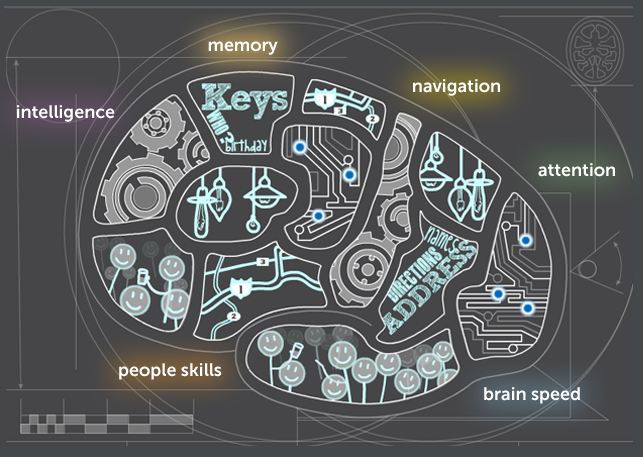
Positscience logoPositscience offers brain training in five categories: attention, brain speed, memory, people skills and intelligence. (A new category, navigation, will be available on the site soon.) Posit Science games include enhancing a user’s ability to read facial expressions, from easy (happy or sad) to the more difficult (puzzled or embarrassed). Its games also help users improve facial recognition as well as matching names with faces and remembering facts about people you meet, an important skill in networking and business.

Posit Science has developed games in collaboration with researchers from nearly a dozen universities, including Yale and Stanford. You can try some of the games out for free without having to sign up. Posit Science offers memberships at $14 a month or $96 a year.

Cogmed.com

CogmedCogmed is designed to improve working memory to allow users to learn new skills in academic or professional endeavors. Users are encouraged to spend up to 30 minutes a day, five days a week on training exercises over a five week period. Training is only available through programs offered by accredited coaches who monitor user results and provide motivation. Many programs are supervised by doctors or psychologists who specialize in attention problems.

Prices vary according to the program selected and the professional coach’s fees. The program is best for people who have working memory issues caused by ADHD, anxiety in social settings, or adjusting quickly to new tasks. 


Free is Costly and Cost is Freeing

As a consultant to small businesses, I have had to fight the trend of owners wanting something for nothing. In the start-up world, it is almost unheard of for something to not be free. Yet, I see organizations like EntreDot introduce business models that ask entrepreneurs to invest in themselves and wonder why that is not the norm. Mike McDerment, co-founder of FreshBooks, concurs in an article he recently wrote entitled, “Why Free is Bad: Businesses Should Be Happy to Pay For Key Services.”

McDerment noted that, late last year Google Apps for Business eliminated its free version (see Google Dares Businesses To Switch To Microsoft Office). He acknowledged that, while some may have thought the decision to be a bad thing for small business owners, he did not. In fact, McDerment lists several downsides to free:

1. Free things are never really free. When we don’t fork over dollars for products or services, we think of them as free. But we always give up something. When it comes to online services, that something is usually personal data or content you’ve created — think Facebook and Instagram, whose privacy policies obscure the line between what you own vs. what they own. For consumers, that might be an acceptable bargain. But for small businesses that trade may be unacceptable.

2. Free services don’t serve you. Free services can’t provide great customer service. You know this to be true if you’ve ever sent an email to a free service to get help. Imagine relying on one of those free services to run your business!. What happens when you need help, and you need it now?

3. Free services for small businesses don’t last. Free services for small businesses come and go. Google Apps used to be free, now it isn’t. Free services don’t last for the small businesses because the market is so challenging to reach and serve. My guess is that understanding the market challenges is the key to why Google Apps for Business going paid is a good thing for small businesses.

Google Apps For BusinessMcDerment also goes on to argue how “Free” stifles competition:

In the dot com era, companies were terrified to do anything that Microsoft might be interested in, and venture capitalists would stop a hundred businesses before they could start with one simple question: “Why won’t Microsoft do this?”

Similarly Google has scared people out of doing things, because thanks to the significant advantage created by its search business, the company can afford to lose money on other activities, starving the competition and limiting innovation.

Fact is, Google can always return to the free model, but it’s a good signal that it has started to charge for things. Wall Street will be happy, and small business owners should be too. That’s because I expect Google’s paid model to give entrepreneurs the confidence to step in and start innovating more for the small-business market.

This innovation will encourage services tailored for the long-underserved small businesses of the world. Sure, those services won’t be free, but they will be affordable, just as Google Apps remains affordable at $50/year.

Just as important, these new services won’t come with all the downsides of “free.” In exchange for services they need, businesses will trade dollars, not their data or their content.

I’m hoping this signals the start of a new era, one where for the first time ever, competition, innovation and choice are healthy in the small business market.

After discussing the competitive effects, McDerment then offers his insights into the upside of payments for services by small businesses:

…Why should small businesses care about their vendors’ problems? Why is it a good thing for them that Google Apps For Business went paid? How are small businesses going to benefit by paying for something they used to get for free?

The answer: innovation and the arrival of services tailored to meet their needs. Just think of how many things small business owners run on Word and Excel and you get a sense of how under-served this market really is. Google Apps for Business going paid makes serving the small business market more attractive – for everyone. As long as all Google Apps were free, smart entrepreneurs and competitors were inclined to avoid investing in innovation for small businesses for fear Google could step in and wipe them out with a free service.

Nurture Networking Relationships and You Will Prosper

As a former business development executive, I miss my expense account. Seriously–it has always been a ton of fun to mingle with people and get paid to do it. Now running my own consulting firm, volunteering some time at a non-profit, and helping several other founders get their businesses off the ground, I have less time and budget to do one of the things I love: networking. Jeff Hoffman, a member of the founding teams at Priceline.com and uBid.com, and now launching ColorJar, gets this. In a blog post for Inc.com today, Jeff shares with other entrepreneurs what he has learned about the value of networking, as well as some tips to the uninitiated.Networking

Launching and growing a business is hard.  You need to find those relationships (that will help), and then cultivate and nourish them, to keep them alive and healthy.  When you are trying to go from point A to point D in business…people act as bridges from point B to point C, saving you valuable time and money.

… tips:

1. Identify people who could help you and your company. 

Make a list of potential relationships you’d like to forge, either by individual’s names, or by companies and positions.  You can’t pursue your targets until you know who and what they are…write down next to each name precisely what you think the person can do to help your business.

2. Contact these people on a regular basis, and stay in touch with them. 

The most important part of this regular communication is to make sure you are acutely aware of their needs, not just yours.  Ask them what they are trying to accomplish and how you can help.  And then do it when you can.

3. Find ways to give back to them. 

Make a list of the interests of the people on your go-to list…Let each individual know you remember and care about those interests.  Interesting article? Send it to the appropriate contact.  Meet a smart person in that field? Make an introduction.  (Cool, relevant) event? Invite (them) to attend.  Provide a value to your contacts, if you expect to receive it in return.

4. Acknowledge them in your social media. 

Discuss their work, congratulate their accomplishments, and keep them in your discussions.  Show them that you are not only aware of the importance of their work, but that you follow it and celebrate it.  

5. Schedule a time in your calendar to think about and research each contact. 

Once you make this relationship list, it needs maintenance and updating.  Set a periodic time to review the list, update it, and think again about how these people can help you and how you can help them.  Your needs have changed and so have theirs.

6. Make them feel 10 feet tall from time to time. 

Send out handwritten notes.  Or fruit baskets.  Make sure the people in your network know that you appreciate them and recognize their importance in your life.  A little gratitude goes a long way.

Great advice from someone who has obviously helped many other people along the way. Now that I am in the role of advising others, I frequently encourage them to “pay it forward,” helping someone else with their needs before asking for hep with your own. Go out of your way to make introductions for all kinds of solutions–that kind of capital is priceless! 

I also like Jeff’s suggestions on how to keep the conversation alive–good stuff! Remembering to do the personal touches mentioned above is not just good etiquette–it’s great business practice! Smart networking follows these best practices.