Intrepid Intrapreneurship, 2012 Style

Have you heard about the League of Intrapreneurs competition going on right now? Ashoka and Accenture are serious about helping companies “build better business from the inside out.”  Early applications were due by October 24; final nominations and entries by January 15, 2013. The top 15 entrants from the competition will form the inaugural class of the League of Intrapreneurs, becoming part of an elite global network of changemakers. These entrants will also receive media and press recognition and will be featured in the publication of a globally distributed intrapreneur toolkit. Of this league, the top four winners will be profiled on Fast Company’s blog, Co.EXIST, and will receive consulting support from Accenture Development Partnerships to further their work.

What is Intrapreneurship? The Wikipedia definition that is quoted on the home page of the Intrapreneurship Conference being held in Paris next month says it is “the act of behaving like an entrepreneur in a bigger organization.”  Their promotional pitch continues: 

Intrapreneurship is a rising concept that tries to gather the natural objective of any organisation in the 21st century to be more innovative with the often non-tapped energy dug into any would-be entrepreneurs. Intrapreneurship create(s) a framework where the latter is granted some freedom to try out a project of his/her own, the benefit being shared with the employer in the case of a successful experimentation.

The… conference, on December 13th, aims to cover this growing trend in corporations’ life, which addresses both the need of companies to produce more innovations and the will of talented people to find achievement opportunities. Experts and representatives of some of the most innovatives companies will share their view on why intrapreneurship is positively impacting their organisation and how they implement it. The conference is designed for human resources managers, chief strategy and chief operating officers, as well as everyone who is interested in the new growing management trends for change.

Ernst & Young has noticed the power of the intrapreneurship trend and, based on recent survey results, offers six guidelines for creating a culture ripe for innovation within larger organizations:

  1. Set up a formal structure for intrapreneurship. Give people enough time away from their “day jobs” to work on creative projects, but provide a formal process for new product development.
  2. Ask for ideas from your employees. They have their fingers on the pulse of the marketplace. Encourage them to contribute to the innovation dialogue.
  3. Assemble and unleash a diverse workforce. It’s no secret that diverse groups come up with more innovative ideas. Tap into this multifaceted source of power.
  4. Design a career path for your intrapreneurs. For the most part, intrapreneurs are mavericks who will quit — and take their best ideas with them — if they don’t see prospects for career advancement.
  5. Explore government incentives for innovation. Ask how these can support your intrapreneurial ventures. Governments all over the world are offering new tax breaks and other incentives for research and development (R&D) — and corporations in turn are urging governments to support innovation.
  6. Prepare for the pitfalls of intrapreneurship. Not all ideas will produce successful new products. Failure is an important part of the process.

Scott Anthony, of Innosight, writing for an HBR blog post earlier this Fall, cited a story of how Medtronic fostered intrapreneurship through a culture of innovation in introducing the Healthy Heart to hospitals. He felt Medtronic had a competitive advantage: 

Medtronic had an internal “corporate catalyst” — someone who marshaled resources both inside and outside the company and built organizational support for the disruptive growth strategy. Medtronic mixed the entrepreneurial approach of a VC-backed start-up with the unique capabilities once housed in corporate labs. Its story illustrates how big companies are powerfully and uniquely suited to tackling large-scale social problems such as hunger, health care, sustainability, and education. These aren’t stand-alone corporate social responsibility efforts — they are strategic initiatives to create profitable businesses that improve the world.

In many ways, Medtronic was applying the E&Y recommended best practices without even having read them. What is your company doing to foster a culture of innovation? Tomorrow, we will tackle the language of intrapreneurship!

 

Growth Through Market Knowledge

Market positioning is won through a combination of market insights, product features, and delivery of “the promise.” Superior use of these three components makes for a winning strategy to outperform the competition. Market insights are critical to determining what to offer, in what way, and how to communicate one’s message effectively. There are two types of insights that should be studied in unison to drive your internal strategies an external tactics–competitor and buyer. 

Researching the Competition

Understanding where your product fits in the market is just good business sense. If you never take the time to study what others are doing, you will likely not be on target. When I was taking a strategy course in my MBA studies, we were treated to a semester long simulator assignment. The simulator was comprised of five teams of students who each organized to make decisions about their unique computer chip company. We were given freedom to make decisions about what size, durability, and other features different models in our product line would have. We also elected financing options, manufacturing capacities and human resources/training choices. Finally, we were able to allocate dollars between marketing and sales activities and each team received market data that showed what buyers were purchasing, along with trend reports showing products likely to be in demand in the future. Observing what changes others were making, and relatively what they were spending for parts of their businesses, then tracking both sales and profitability performance and plotting it against market share and stock price was a very instructional exercise.

What was most valuable for us was to see a glimpse into the decisions that our competitors were making. Much like a game of chess or a soccer match, the tactical maneuvers employed by others were not just to be noticed, but anticipated, planed for, and counter actions developed. Additionally, we would have strategy sessions to think through whether to do something unexpected, stay the course, expand/shrink products based on resource needs and profitability, plus make trade-offs between automation and personnel. 

In your own business environment, research data is compiled form three main sources:

  1. Primary: first-hand interaction with the market and reporting.
  2. Secondary: compiled reference materials outlining primary research others have done.
  3. Tertiary: facts and figures derived from someone else’s summary research statistics.

Surveys, focus groups, interviews, literature searches, online services, and personal observation are all legitimate ways to collect the above data, dependent on your desired level of confidence in the decisions you must make. Industry associations, through conferences and publications, provide a fair amount of secondary and tertiary research information about competitors and buyers.

Buyer Research

Though I have guided many companies in market research projects over the years, these days I try to guide clients to resources when someone is more dedicated to a discipline than I. Jay Nolfo, who writes the blog Pensare, and is a good friend of mine is one such  resource. (By the way, his company uses a rhino rather than a hippo, but at least we’re similar!) Here’s what he had to say in a blog post earlier this year:

  • Introduction of New Product or Service: Any new business, or introduction of a new product or service that the company is thinking of offering, needs market research.  By developing a good understanding of the product by developing a good business plan based on market research helps provide a solid foundation for your offering.
  • Customer Development: Next to understanding the product or service you are offering, understanding the customer who will be buying it is paramount.  In a consumer based business, understanding the demographics and psychographics of a target market can be determined by looking at previous purchase behavior or through a needs analysis.  In a business which sells to other businesses, understanding their needs can be a little more difficult.  However, this can be understood by doing surveys or focus groups.
  • Customer Satisfaction: After your customers have purchased your product or service, following up with them to understand their satisfaction of that purchase is key.  By understanding why they liked or disliked your offering and the reasons why the customer purchased your product or service over the competition can provide a basis of what could be your competitive advantage.

Take the matter to heart…consider how to improve your knowledge of what competitors are doing and what buyers want. You will then, as we did in our MBA class, be better prepared to develop winning business ideas!


5 Ways Creativity Training Accelerates Innovation

“Creativity and innovation training is a highly effective accelerant for business results.”

-Gregg Fraley

Contrary to naysayers’ beliefs, creativity is a skill set for which training can be developed, delivered, and deployed.  In fact, brainstorming is enhanced by training! Those who tout research saying that brainstorming is ineffective are usually quoting studies that were conducted in situations wherein no training was provided in advance.

Another fallacy that people latch onto is the thought that some people are innovative and others are not. Inside larger companies that tend towards bureaucracy and group think, it can be hard to jump start creativity and innovation. Yet, most will acknowledge that analysis sans insight has severe limitations. Fraley advocates for the principle that training can make a big difference in bridging the gap between market knowledge and potential.


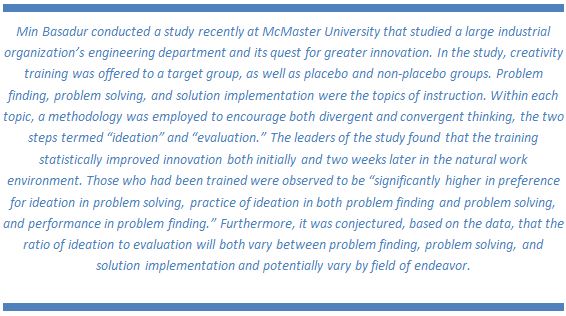
As you can see from the study, creativity training (when done well) can be instructive for employees who need to learn how to think and express ideas in a more positive, focused, and spontaneous way. Breakthrough results often occur when properly fueled by a rapid, flexible, and structured process at the front end of innovation.

Most R&D or innovation initiatives include no budget for training. Since creativity can aid with problem solving and problem finding, organizations need to be awakened to the potential missed from failure to pre-train.  Fraley feels  creativity and innovation training accelerates innovation in five strategic ways:

  1. Improved creative thinking leads to enhanced innovation capacity, and with action, results.
  2. Training helps instill structured creative thinking and innovation process as a cultural value and habit.
  3. Training provides innovation teams with a common language and framework to solve problems, improve communication, expedite complex problem resolution, and moving new business concepts forward.
  4. Training corrects many of the myths that surround creativity and innovation. There is a science to this that is largely ignored. For those that learn and practice the science — it’s a competitive advantage.
  5. Team efficiency improves because a lot of useless chatter, debate, and conflict are eliminated.

Creativity is intimately related to change, decision making, and problem solving — it’s not just artistic self-expression!


SCARF Up Some Change

In an HBR blog post about organizational change this morning, Walter McFarland draws in the role of the brain in defining whether change efforts will meet with success. Some of the casualties of failure to adapt to changing market conditions he mentions include Sunbeam, Polaroid, and Circuit City. While each of these formerly strong companies is no longer in business, proponents of organizational change struggle to define why some are able to reinvent themselves and others are not, other than the nefarious “human element.”

Organizational change as a field of study has long maintained that change can be defined in linear, sequential terms and processes. What we are discovering, largely through examining principles of neuroscience, is that change is neither. Instead, McFarland, the board chair elect of the American Society of Training and Development (ASTD), argues that modern business dynamics would suggest that it is chaotic. It is the chaotic nature of change that creates the need for greater research. We live in a time when the need to constantly change is critical to competitiveness. Neuroscience may be a key to helping us steer organizations through adaptation more effectively.

Thompson and Luthans wrote that typical reactions to change “can be so excessive and immediate, that some researchers have suggested it may be easier to start a completely new organization than to try to change an existing one.” While industrial psychologists refer to this as “human resistance to change,” very few who study the phenomenon have identified how to lower the resistance consistently and pervasively. 

At the NeuroLeadership Summit, being held in New York this week, a panel discussion with senior executives and experts from The Conference Board, the Association of Change Management Professionals, Change Leaders, and Barnard College will explore the connection between neuroscience and organizational change, understanding how we can effectively deal with the human resistance to change. 

A new organizational change model is being proposed that takes into account how successful change functions in a modern organization, where work is conceptual, creative, and relational, and talent is portable. According to McFarland, activities that have contributed to the continuing poor performance of change initiatives include:

  • Perpetual underpreparation: change is always dreaded and a surprise to employees
  • A perceived need to “create a burning platform”: meant to motive employees via expressed or implied threat
  • Leading change from the top of the organization down: only a few individuals are actively involved in the change and either under communicate or miscommunicate with others

Top-down change (the traditional model) can trigger fear within employees because it “deprives them of key needs that help them better navigate the social world in the workplace. These needs include status, certainty, autonomy, relatedness, and fairness” — the foundation of the SCARF model

  • Status is about relative importance to others.
  • Certainty concerns being able to predict the future.
  • Autonomy provides a sense of control over events.
  • Relatedness is a sense of safety with others – of friend rather than foe.
  • Fairness is a perception of fair exchanges between people.

SCARF is a summary of important discoveries from neuroscience about the way people interact socially and is built on three central ideas:

  1. The brain treats many social threats and rewards with the same intensity as physical threats and rewards (Lieberman, & Eisenberger, 2009). 
  2. The capacity to make decisions, solve problems and collaborate with others is generally reduced by a threat response and increased under a reward response (Elliot, 2008). 
  3. The threat response is more intense and more common and often needs to be carefully minimized in social interactions (Baumeister et al, 2001).

Since organizational change is a significant social interaction in the marketplace, it is important to minimize perceived risk. Understanding how people tick, empowering them to vocalize their ideas, and creating better systems to engage them in the change process is best practice. More organizations need to get on board.


Do Your Cultural Diligence in M&A!

Of course the merger was a success. Neither company could have lost that much money on its own.

-Steve Case, Former Chairman of the Board
AOL/Time Warner

Competitive markets create an environment wherein companies strive for revenue growth. When organic (internal) growth is hard to come by, inorganic growth becomes a target. Inorganic is a category that includes merger and acquisition (M&A) activity as a primary strategy.

While business exigencies demonstrate the “need” for change, often the hard facts found in classic due diligence processes have far less to do with ultimate success than the cultural fit of a transaction between parties. Consequently, organizations that understand their core values are much more likely to reach the kind of growth and success that nearly all businesses seek [Gallangher 2003].

Successful M&A has been known to grow markets, build on complementary strengths, and eliminate inefficiency. But what ultimately matters in an acquisition is what happens in the hearts and minds of the people who remain with the new organization and what culture these formerly distinct entities choose to build while moving forward [Gallangher].

The Mercer Consulting Group, in studying M&A activity, finds that, among unsuccessful ones that many of the failures are caused by not conducting the same kind of “due diligence” on the culture, structure, and processes of an acquisition target as they do on the financial balance sheet [Gallangher]. 

Traditional due diligence typically analyzes the following:
– Historical performance,
– Ownership and organizational structure,
– Management team,
– Products and services, 
– Assets and liabilities,
– Information systems and technology, and
– Organizational culture [Bouchard, Pellet 2002].

J. Robert Carleton, management consultant and senior partner of the Vector Group, says, “Unfortunately, little or no time is generally spent analyzing the nature, demeanor, and beliefs of the people who will be involved in carrying out the business plan”. He believes that standard due diligence does not address some of the key questions that must be asked to accurately assess organizational readiness for a major change, such as a merger or acquisition. Even when some of the “right” questions are asked, Carleton argues, they are often limited to brief interviews with key executives, who likely have differing views from the rest of the employee group. The people in the trenches, the ones doing much of the actual work are not even involved. He  finds it interesting that “in financial and legal due diligence no such ‘act of faith’ is acceptable” in terms of the investigative procedure [Bouchard, Pellet].

“Cultural due diligence” is a phrase that more strategists are using  to assess what stumbling blocks may hinder successful integration of entities and their operations. Key factors to be considered include:

– leadership and management practices, styles, and relationships,
– governing principles,
– formal procedures,
– informal practices,
– employee satisfaction,
– customer satisfaction,
– key business drivers,
– organizational characteristics,
– perceptions and expectations, and
– how the work gets done in your organization

[Bouchard, Pellet; see also Carleton, Lineberry 2004].

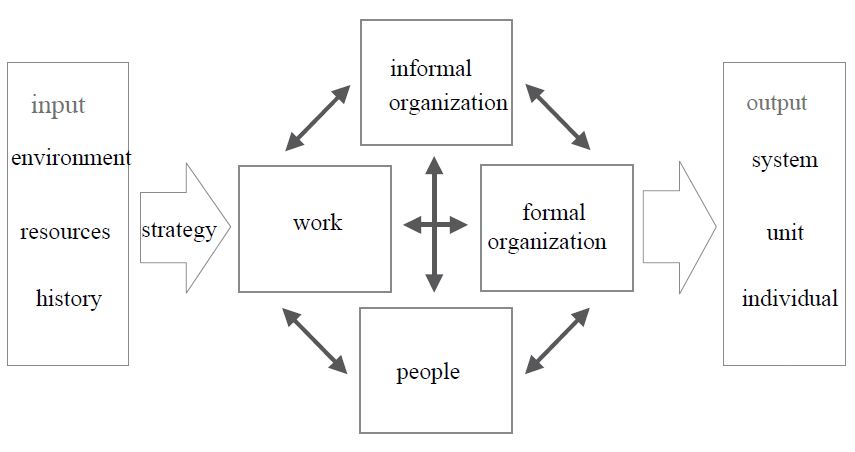
When HP and Compaq decided to combine forces, they used schematics like the one below to help them discuss the salient issues–

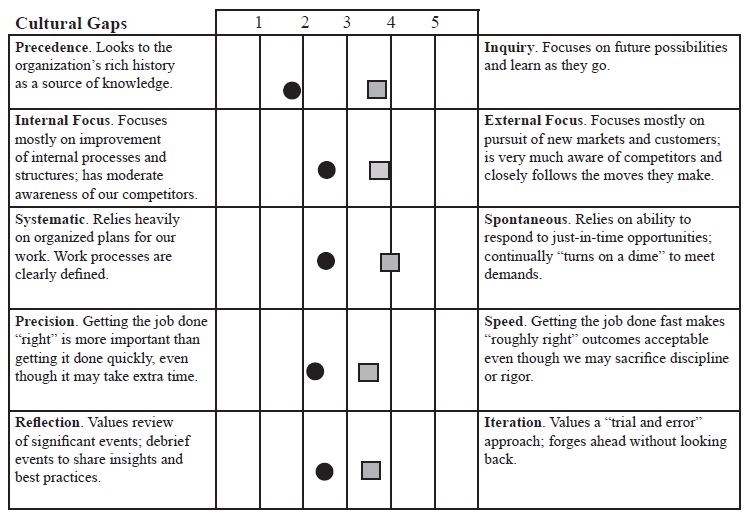
After looking through these issues and discussing each company’s culture, the merger team put together a chart like the one below to begin developing tactics to plan for a smooth post-closing integration.

As you look at this chart, think about key M&A transactions in your industry or local community. Of the ones that did not pan out as planned, do you think they would have stood a better chance had they systematically worked through these type issues during due diligence?

Cultural due diligence is vital to successful M&A processes. If earnest consideration were given to culture as it is to financial and other factors, inorganic growth and increased market share would be a realized outcome far more often!

(Thanks go out to Agata Stachowicz-Stanusch, who wrote of the value of cultural due dilgence and detailed a case study of the HP-Compaq merger in the Journal of Intercultural Management’s April, 2009 edition.)