Are You Doing it “To” or “For” a Prospect?

Many who aspire to increase the top line (revenues) of a business know that sales can seemingly cure a multitude of other problems. With enough money to spread around for paying bills and employees, plus some for marketing, customer service or maintenance, your company can improve morale and your ability to retain top talent as well as existing customers. However, in an effort to develop new business, our sales teams often do a very poor job. Conversion rates are low, so more leads are needed than would otherwise be necessary. In turn, more time is required, more overhead expenses thereby generated, and profits eroded. If we were able to improve the way we secure new clients, our organizations would be vastly more successful!

The biggest challenge a sales (interchangeable with “business development” or “client development” in settings wherein the word is anathema) professional faces is the distrust of the person on the other side of the table. Buyers are often afraid that something is being done to them, and dig in their heels or tune out their minds. Against this type of resistance, it can be extremely difficult to secure new accounts. The conversation must, therefore, disarm the buyer (in a genuine, sincere way) so that the perception changes to one of feeling like the salesperson is doing (well) for the buyer or her organization.

With the  combination of easily accessible information via the Internet and increased competition via globalization, it is incumbent on sales teams to keep their products and services from becoming commodities whereby the only means of competition is price. This objective can best be accomplished through consultative conversations. One of the leading minds on the topic of consultative selling is Mahan Khalsa, author of Let’s Get Real or Let’s Not Play (aka Helping Clients Succeed.) Helping (prospective) clients succeed should be the goal of every sales effort, but rarely is. In fact, hard line sales methods don’t seem to to take the client success into consideration as all, so long as the selling organization’s goals are met. 

Khalsa writes often about two key concepts: “getting real,” and developing an “exact solution.” To be real is to be authentic, truthful, expressing clear intent, and speaking from values. It is a paradigm wherein the seller doesn’t accept the first response without asking clarifying questions–the purpose is to break down false pretenses, move past fears, and to get to core issues as comfortably as possible for all parties concerned. While no solution is perfect unto itself, the goal of creating an exact one is to have a strong urge to leave few stones unturned in order to reduce ambiguity and partner on both identifying problems and the methods of resolving them.

With the right mindset, a salesperson can overcome the following (* taken from Let’s Get Real, chapter entitled “We Both Want the Same Thing”)  inhibitors of client success:

Our issues:

  • we don’t listen
  • we make assumptions
  • we have preconceived solutions
  • we need to make the sale
  • it takes too much time
  • we don’t understand their business
  • we know what they need better than they do, and
  • we don’t talk to the right people.

Client issues:

  • they don’t know what they need
  • the can’t articulate what they need
  • they don’t agree on what they need
  • they won’t give us good information
  • they don’t let us talk to the right people
  • they are unrealistic about time, money, and people needed
  • politics count more than business sense
  • they procrastinate, and
  • they can’t make decisions.

Taking time up front to either determine (jointly with client) that a solution does not exist or create a solid business case is critical for better sales success. When we match client expectations to those of our organization with regards to the people, time, and money needed to achieve success with regards to a given opportunity, we demonstrate shared interests and feasibility. Knowing how decisions are made, by whom, and the timetable removes guesswork and allows us to offer a solution that exactly meets the client’s needs.

Innovating Words Make Healthy Corporate Hearts


Cheryl Heller, Board Chair of PopTech, a laboratory for disruptive innovation focused on technology and social change, says that,

The wealth of jargon used to describe intrapreneurship (itself a bit of jargon), innovation and corporate social responsibility is more exhausting than enriching, and as their importance becomes more evident, the labels and complexities grow. What’s the difference between corporate social responsibility, cause branding, cause marketing, and a triple (or sometimes lately double, as if we can just decide to leave the environment out of it) bottom line? Should companies now stop all their work on sustainability in order to focus on resilience? Has all independent thinking, or even perhaps all generative thinking inside big organizations become intrapreneurship?  What’s the difference between social innovation and innovation? What’s the relationship between design thinking and innovation? What’s the difference between disruptive innovation and incremental innovation? Is some innovation more innovative than others and is more innovation always better? And does anybody else see this as a silly and dangerously circuitous trap of our own devising?

The significance of the debate about the proper terminology is to find a means to communicate disruptive breakthrough ideas as a valuable corporate asset–without simultaneously creating anarchy! Words cited in Heller’s comment (above) evoke values and desired activities that can help an organization create–or sustain competitive advantage.  Yet, if innovation is perceived as an altogether separate category than “ordinary business,”  then it can be argued that no one will want to do what is methodical if they can be celebrated and rewarded for dreaming over practical execution of existing initiatives. Most organizations and their leaders would prefer that employees see the process of introducing initiatives as a normal part of their positions, rather than stand alone activities that become the topic du jour and are jettisoned when times get tough in favor of “that’s the way we’ve always done it here. (TTWWADIH)” 

TTWWADIH can be a pervasive attitude that implies that we can add to what exists, but should not be expected to improve what exists. In this scenario, positions and/or departments are launched rather than tackling sticky, often political issues. Star studded teams are put together many times to represent cutting edge thinking, only to exempt the teams from performance, which ultimately leads to demotivated executive management.

Yesterday, we looked at Scott Anthony’s HBR article about Medtronic, a company well known for innovation, and their efforts to become even more adept at broad scale innovation. The Healthy Heart For All product has been launched towards the rural Indian population target market. Medtronic is large, smart, connected, positioned and incentivized enough to out-hustle upstart competitors. Though they brought in a key intrapreneur, the company was effective in changing the corporate cultural stance on what it takes to be competitive.

No one wants an unmotivated workforce. Nor do we want idealists who are not well grounded. The concept to “innovate properly” is a core value of a former employer of mine who understood that creativity and innate personal responsibility for the benefit of others must work in concert. By including this core value in position descriptions, the leadership team recognized the need to challenge employees to see advanced initiatives as the responsibility of every employee–not an isolated activity. Furthermore, when innovation becomes the expectation, we don’t have to “stop the presses” to encourage innovative thinking and actions.

Find a way to articulate your expectations for intrapreneurship (or innovation if you prefer) (or corporate social responsibility if you are a part of a grandiose cause) inside your environment. Ask people to define what they mean when using these terms. Expect all employees to take initiative!


Intrepid Intrapreneurship, 2012 Style

Have you heard about the League of Intrapreneurs competition going on right now? Ashoka and Accenture are serious about helping companies “build better business from the inside out.”  Early applications were due by October 24; final nominations and entries by January 15, 2013. The top 15 entrants from the competition will form the inaugural class of the League of Intrapreneurs, becoming part of an elite global network of changemakers. These entrants will also receive media and press recognition and will be featured in the publication of a globally distributed intrapreneur toolkit. Of this league, the top four winners will be profiled on Fast Company’s blog, Co.EXIST, and will receive consulting support from Accenture Development Partnerships to further their work.

What is Intrapreneurship? The Wikipedia definition that is quoted on the home page of the Intrapreneurship Conference being held in Paris next month says it is “the act of behaving like an entrepreneur in a bigger organization.”  Their promotional pitch continues: 

Intrapreneurship is a rising concept that tries to gather the natural objective of any organisation in the 21st century to be more innovative with the often non-tapped energy dug into any would-be entrepreneurs. Intrapreneurship create(s) a framework where the latter is granted some freedom to try out a project of his/her own, the benefit being shared with the employer in the case of a successful experimentation.

The… conference, on December 13th, aims to cover this growing trend in corporations’ life, which addresses both the need of companies to produce more innovations and the will of talented people to find achievement opportunities. Experts and representatives of some of the most innovatives companies will share their view on why intrapreneurship is positively impacting their organisation and how they implement it. The conference is designed for human resources managers, chief strategy and chief operating officers, as well as everyone who is interested in the new growing management trends for change.

Ernst & Young has noticed the power of the intrapreneurship trend and, based on recent survey results, offers six guidelines for creating a culture ripe for innovation within larger organizations:

  1. Set up a formal structure for intrapreneurship. Give people enough time away from their “day jobs” to work on creative projects, but provide a formal process for new product development.
  2. Ask for ideas from your employees. They have their fingers on the pulse of the marketplace. Encourage them to contribute to the innovation dialogue.
  3. Assemble and unleash a diverse workforce. It’s no secret that diverse groups come up with more innovative ideas. Tap into this multifaceted source of power.
  4. Design a career path for your intrapreneurs. For the most part, intrapreneurs are mavericks who will quit — and take their best ideas with them — if they don’t see prospects for career advancement.
  5. Explore government incentives for innovation. Ask how these can support your intrapreneurial ventures. Governments all over the world are offering new tax breaks and other incentives for research and development (R&D) — and corporations in turn are urging governments to support innovation.
  6. Prepare for the pitfalls of intrapreneurship. Not all ideas will produce successful new products. Failure is an important part of the process.

Scott Anthony, of Innosight, writing for an HBR blog post earlier this Fall, cited a story of how Medtronic fostered intrapreneurship through a culture of innovation in introducing the Healthy Heart to hospitals. He felt Medtronic had a competitive advantage: 

Medtronic had an internal “corporate catalyst” — someone who marshaled resources both inside and outside the company and built organizational support for the disruptive growth strategy. Medtronic mixed the entrepreneurial approach of a VC-backed start-up with the unique capabilities once housed in corporate labs. Its story illustrates how big companies are powerfully and uniquely suited to tackling large-scale social problems such as hunger, health care, sustainability, and education. These aren’t stand-alone corporate social responsibility efforts — they are strategic initiatives to create profitable businesses that improve the world.

In many ways, Medtronic was applying the E&Y recommended best practices without even having read them. What is your company doing to foster a culture of innovation? Tomorrow, we will tackle the language of intrapreneurship!


5 Ways Creativity Training Accelerates Innovation

“Creativity and innovation training is a highly effective accelerant for business results.”

-Gregg Fraley

Contrary to naysayers’ beliefs, creativity is a skill set for which training can be developed, delivered, and deployed.  In fact, brainstorming is enhanced by training! Those who tout research saying that brainstorming is ineffective are usually quoting studies that were conducted in situations wherein no training was provided in advance.

Another fallacy that people latch onto is the thought that some people are innovative and others are not. Inside larger companies that tend towards bureaucracy and group think, it can be hard to jump start creativity and innovation. Yet, most will acknowledge that analysis sans insight has severe limitations. Fraley advocates for the principle that training can make a big difference in bridging the gap between market knowledge and potential.


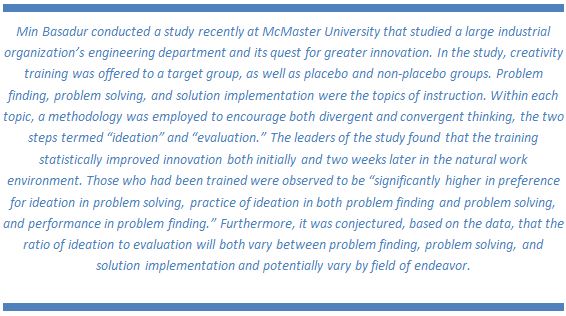
As you can see from the study, creativity training (when done well) can be instructive for employees who need to learn how to think and express ideas in a more positive, focused, and spontaneous way. Breakthrough results often occur when properly fueled by a rapid, flexible, and structured process at the front end of innovation.

Most R&D or innovation initiatives include no budget for training. Since creativity can aid with problem solving and problem finding, organizations need to be awakened to the potential missed from failure to pre-train.  Fraley feels  creativity and innovation training accelerates innovation in five strategic ways:

  1. Improved creative thinking leads to enhanced innovation capacity, and with action, results.
  2. Training helps instill structured creative thinking and innovation process as a cultural value and habit.
  3. Training provides innovation teams with a common language and framework to solve problems, improve communication, expedite complex problem resolution, and moving new business concepts forward.
  4. Training corrects many of the myths that surround creativity and innovation. There is a science to this that is largely ignored. For those that learn and practice the science — it’s a competitive advantage.
  5. Team efficiency improves because a lot of useless chatter, debate, and conflict are eliminated.

Creativity is intimately related to change, decision making, and problem solving — it’s not just artistic self-expression!


Watch Your Asset – It May Not Be a Resource

First, the bad news: making operations, finances, and employees work to maximum value can mean having to eliminate some employees or operations at times. The good news, though, is that many businesses have been able to hold on to existing resources–even during a turnaround situation–by reassigning them to better purposes and uses where required. This is the heart of asset redeployment–the practice of reassigning people, things, and efforts to achieve optimal efficiency. By using capital wisely, your team can make it stretch a lot further. For example, coordinating employee and independent contractor work to produce the greatest amount of work with the fewest number of people working the least number of hours means greater return on efforts and dollars.

Eliminating Operations

Eliminating unprofitable operations–in whole or in part– is a wide-ranging task. Anything that may be termed “waste” in the company needs to be discarded or put to better use. One area that should be addressed is waste due to unnecessary multiple consumption of potentially shared resources. In plain terms, the individual use of items that could be shared is an extravagance that few small businesses can afford. Think of shared printers rather than a printer on each desk as an example. it is highly unlikely that every single person in the office will be printing at the same time. What’s more, high volume printer/copier combination machines use less expensive toner than ink cartridges in smaller units. This initiative may require more cooperation and patience than providing unique units for each employee, but such a move can reduce the amount of money the company must spend to get work done.

Avoiding Duplicate Efforts

A counter problem to the above is too many employees doing the exact same job, either knowingly or unknowingly. Such multiple effort, a clear waste of time, resources, and money, often occurs when someone is fearful of delegation or feels threatened by another’s talents and abilities. Therefore, management should make sure that several people are not doing the same job in differing formats and degrees. 

Non-linked software is a perfect example of this kind of waste; if the secretary maintains supplier addresses and phone numbers, and the accounting group keeps the same information in their files, someone is performing an unnecessary job. Instruct employees in ways to avoid duplication of effort. Look across your organization, document processes by task, and find ways to reduce overlap. This is not to say that your staff should not be cross-trained. It is, in fact, good succession planning and talent management to have people who could do someone else’s job in a pinch!

Managing Capital Resources

Capital resources include facilities, supplies, and work in process. Buying only what is needed when needed (“just in time”) is one way to wisely manage resources. Another way would be to try to have more finished goods inventory than unfinished, because finished goods can be sold quickly to raise cash. At times, you may consider renting or leasing an asset rather than purchasing it–especially if the term of the contract is less than the useful life. You may elect to “turn in” resources that you don’t need very often or convert them to less cash intensive resources through alternate financing. 

Coordinating Human Resources

This is an area often overlooked because it is seen as “just administrative.” When employees, however, have jobs that overlap in requirements, it is up to the executive team in the small business to correct the situation for optimization. When your people are performing jobs that are not their strong suit, they usually take more time and make more mistakes than a better qualified and motivated counterpart.

Develop a competent management team to help you steward resources more efficiently. There are multiple areas for gains in efficiency and profitability if you will commit to the process. Note: process rather than one-time task–follow-through and experience the fruit of your labors!