Relevance in Business is Fleeting

“Focus Not on Protecting What You Have, Instead Obsess on the Next Big Thing.”

While this type of headline may not serve us very well in interpersonal relationships, it has become the watchword in business. Those who rest on yesterday’s accomplishments eventually find themselves with less and less current successes. Since we live in a day and time when ideas are ubiquitous, information plentiful, and communications vastly enhanced, it is incumbent upon every enterprise to remain on the hunt for “wow.”

Jeremy Gutsche of Trendhunter wrote in Exploiting Chaos that the disk drive, computer chip, and word processing markets were all ones that saw enormous changes and the market leaders were often outflanked. Read on:

Borrowing from Clay Christensen’s work in The Innovator’s Dilemma , Gutsche described the progression in the disk drive industry towards constantly smaller drives. Along the way, observe the shift in power:
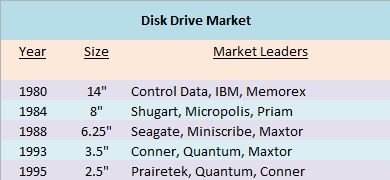
 

Observe how great organizations present in 1980 gave way to more nimble upstart startups over 15 years. Though the only apparent change was size of the drive, it was enough innovation occurring at a rapid enough rate to trip up the “big boys.” Perhaps, one may suggest, disk drives had become commoditized as more PCs were manufactured? This theory seems to hold true in computer chips, then, as well. To note:

Observe that this market experienced a slower rate of change (40 years of upheaval vs. 15), but the net result was the same: market leaders gave up leadership to disruptive alternatives. The fact that semiconductors require very extensive research and development efforts, whose project funding ranged into the billions of dollars, made this a significant economic microtrend. Gutsche points out that RCA was once twice the size of IBM, so the thought process that monetary barriers to entry would protect industry leaders was disproved time and again.

Word processing was once known as typewriting and the market leader was Smith Corona. Smith Corona was extraordinarily innovative, boasting over 100 patents spread over decades. Yet, the company who also invented the first word processor did not continue to reinvent itself in the computing age and lost its market leadership role. It is suggested that the historical accomplishments became blinders to the urgency for continuous improvement. Notice, they understood the concept of reinvention, but underestimated the urgency factor.

Lest you think that Smith Corona had been mismanaged over the course of the 20th century, pay attention to the fact that their annual revenues in 1989 were $500 million! What happened? Let’s look at some of the competition and what strategic decisions they made…Remington recognized the opportunity of computers and made the leap in 1950, only to be too early to that niche, lose money, and the computing division sold off in 1981. Perhaps Smith Corona saw the foibles of a competitor and vowed not to make the same mistake?

Commodore, on the other hand, was a different kind of competitor. Their model 128 was introduced in 1985 with two external floppy drives. The Smith Corona PWP 40 was preferred by buyers by a wide margin for word processing applications. Yet, someone inside the company saw an opportunity to partner with Acer on a computer joint venture. Unfortunately, the plug was pulled before the strategy could run its course.  Smith Corona declared bankruptcy in 1995; Acer became the fourth-largest PC company in the world!

Scott Anthony, writing for Harvard Business Review in an article entitled “Disruption is a Moving Target” observed a clear pattern:

  1. Disruptors enter a market incumbents don’t care about.
  2. Entrants grow as incumbents flee.
  3. The incumbent hits a ceiling.

What should be learned from this insight? Larger companies should not ignore small opportunities simply because they start out small. Smaller companies should plan their strategy and tactics around “nibbling at the edges” of an incumbent’s market share.


Dirty Martini Intrapreneurship

One  of the portals I use to stay abreast of innovation is called Alltop. It is organized by author and an author by the name of Gregg Fraley caught my attention last week. Gregg had written an article entitled, “Do You Want Innovation or a Dirty Martini.” Rather than describe the whole article for you (or violate his copyright), I offer you the following excerpt:

note: Haley references the topic of management engagement in innovation and some “interesting posts lately byPaul Hobcraft

I think many high level executives simply don’t know what they have. Until it’s too late.

There are a lot of smart people out there, with great ideas. Talent is something you need if you really want to innovate. And yet, really, most organizations already have that talent. No, not every employee is Jony Ives and is an impact player at that level, but nearly every company has some people that, under the right circumstances, can hit home runs (score goals, set records, win gold, etc.). Ives himself was locked in a closet before Steve Jobs found the key.

In my travels doing talks and such I often have a chance to chat with line workers and middle managers who are beyond frustrated. They have ideas, they have energy, they care about the company — and none of that goodness is being channeled towards innovation. In fact, it’s being actively suppressed in some cases.

The phenomenon that Haley describes is one in which many organizations, even reading about Google or Cisco, who both encourage creativity and innovation, are faltering. Their people are full of great potential that largely goes untapped because there is not a means to commercialize new ideas (or even pursue new methods) because management is not intentional about cultivating input from others–especially those outside the management side of the building. Haley goes on to argue that even those with creative talent, who are often recruited to organizations that need the proverbial “breath of fresh air,” find that their approach is not valued and they begin looking for their next opportunity too soon after joining an organization that so desperately needs them but is not accommodating to them.

He says, “C-suite types, hear this, if you knew  how much talent is wasting away right under your nose, you’d cry in your martini. Don’t believe it? Ask. Ask a sampling of your people the simple question — where are the hidden gems around here? You’ll find out things you didn’t know. People with secret projects, big ideas they’ve been holding back, crazy ideas that just might work…Want to turn the situation around? Ask another question — what’s holding you back?”

I would add to the questions he asks the following:

What are you doing to foster a culture of innovation?

Here are some suggestions–

  1. Change the way you form work teams. Build diversity of thought into as many teams as possible.
  2. Change your own role from decision maker to facilitator. See yourself as primarily responsible to help others shine and succeed.
  3. Create a knowledge management system that captures lessons learned and best practices to be disseminated broadly and consistently.
  4. Celebrate when an employee takes initiative. Find ways to acknowledge them openly.
  5. Get rid of the traditional research and development process. Instead of a department, create an inter-departmental group that represents not just different disciplines, but also different levels of experience and different demographics.

Intrapreneurship is on the rise among savvy competitors. It does not, however,  come without a price–ego has to be checked at the door and individuals valued for their unique contributions.  Your challenge is to retain creative talent that otherwise would start their own businesses or work for more progressive competitors!

How to Handle Lenders

In dealing with lenders, it is important for executive teams to understand the background of those with whom they transact business. Bankers, for instance, are often conservative by nature, have little experience running their own business, and can be a part of a corporate system that is bureaucratic and slow moving. Realizing from the outset that the word “risk” is a four-letter word to these professionals can prepare you to have better conversations. Furthermore, you must accept that most front-line bankers are not empowered to question the standards they must enforce on behalf of their employer or the banking system as a whole. All of this is especially true after the recent mortgage industry troubles of the 2008 recession genre. By keeping in mind who is on the other side of the desk when a loan request is submitted, you as a management team member can position your request in a way that gives the banker the best ammunition to give you an affirmative response.

How Lenders Think

Understanding how lenders think helps the entrepreneur better understand why lending policies are pragmatic rather than opportunity-driven, standard rather than adaptable, and monitoring rather than recommending. While market opportunities drive the entrepreneur, lenders approach the very same data with caution. The same unpredicted cash shortage that merely surprises a business owner may send a lender into a panic. Lenders are not in the business of selling advice–in fact, they can be held liable if found to be doing so and the business goes under. They are in the business of making money on loans. Therefore, their loyalty is to company profits and a return on their monies borrowed–and noting else! Anyone who wishes to test the strength of this premise should try missing a few note payments.

Consistency is the hallmark of the lender, due in large part to the constraints of a corporate directive of standardization. The seemingly two-sided face that the entrepreneur sees the lender wear is real; the lending officer truly wants to help and has empathy, but is governed by institutional guidelines. Overidentification with the needs of the borrower can cause a lender to lose her job. 

Consequently, the face the business owner sees is not reality but rather a front depicting what the lending institution would like to see happen. Rarely does a borrower learn the true acceptable level of performance that a lender would be willing to accept. Since lenders control the purse strings to the resources that keep the borrower in business, these lenders are impossible to control. Knowing a lender’s true bottom line enables the borrower to influence lending policies that permit operation under the best possible conditions.

How Lenders Act

During tough economic times, lenders are expected to:

  • serve as a flexible yet profitable source of capital,
  • monitor the performance of borrowers in their book of business, and 
  • provide sound references to inquirers on behalf of their clients.

Lenders must be allowed to continue to make money on the loans they have extended, but the borrower may request modifications of the terms of repayment based on business financial performance. Principal payment deferrals, interest accruals, and other methods can be used to create cash within the business operation, but one is ill advised to single-handedly embark on such practices without securing the commitment of the lending institution in advance.

To the extent they are able, lenders should be encouraged to visit the places of business of their borrowers and check things out. Outside assessment of company execution of its plans by this important stakeholder group can prove valuable to the management of the company. Hopefully, an open dialogue creates an environment where the lender reference in credit applications is always a positive one and facilitates smooth operations in your company!


Solve Rather Than Analyze

Is your business underperforming? If so, chances are high that your CFO or you as owner have determined that it is necessary to “manage the business by the numbers.” Reporting systems are put in place and monitored rigorously. I know this to be the pattern because I have observed turnarounds for over 20 years. It is predictable.  For some, the focus is on sales, for others, on leads, expenses, receivables, payables, etc…

What can be lost in the “shuffle” is necessary focus on what actions are necessary to change the patterns. So much effort is dedicated to capturing information, reporting information, and communicating information that not enough is given to improving performance. Simply noting what needs to change without the corresponding strategies and tactics, as well as daily behaviors, is not enough!

When the organization takes time to problem solve, innovation can occur. Instead of doing the same thing and expecting different results (insanity), new solutions need to be developed, new processes tired, new personnel invited to help develop solutions.

Paul Williams invites change managers to ask the question “How Might We…?” How might we drive sales? How might we drive traffic? Determine at least four “how might we” answers. Then, for each of those answers ask again “How might we…” Identifying at least four responses for each.

In his blog for the Idea Sandbox, Williams recommends the tool below to guide the exploratory process:

Let’s use the “How might we drive sales?” as an example.

ROUND 1:

How might we… drive more sales?

Here are four ideas…

  1. By building more awareness.
  2. By charging more to those already coming in. (Raise Prices)
  3. By getting existing customers to visit/buy more frequently. (Increase Frequency)
  4. Get people who come in to buy more than what they normally do. (Add-on Sales)

ROUND 2:

How might we… drive more sales?

Let’s take those first four answers and ask “how might we?” about each.

1) How might we… build awareness?

  • Do advertising.
  • Do PR.
  • Do community events.
  • Word of mouth: get current customers to tell others.

2) How might we… raise prices?

  • Increase prices across the board.
  • Increase price of most popular products.
  • Add perceived higher-tier items – that command a higher price point.
  • Remove lower-priced / smaller sized options from menu.

3) How might we… increase frequency?

  • Add items for a different time of the day / daypart (e.g. add breakfast).
  • Offer special in-store events to encourage non-traditional visits (e.g. art events, live music).
  • Run frequency-building consumer promotion(s).
  • Create / suggest additional uses for your product (e.g. baking soda for cleaning, cranberry sauce – not just for Thanksgiving).

4) How might we… get add-on sales?

  • Put impulse items near the cash register.
  • Offer add-on extended warranty / product insurance.
  • Show customers products that pair with and enhance what they normally buy.
  • Offer specials encouraging families and group sales.

Williams advocates that we continue to ask the “how” question to arrive at possible solutions. By repetition, more ideas surface. Though he stopped after two rounds of brainstorming (problem solving in this case), you need not feel limited except by the creativity of your team and amount of time you are willing to commit to the process. 

Even stopping at the point above, you notice that 16 potential solutions to enhance sales were generated. While not all of them will create the desired improvement, many will and the effort is way more valuable than perseverating on the problem, as organizations and their leadership teams are wont to do.

Move to action rather than “paralysis by analysis” and you will be better off!


What Medium Do You Choose to Publish?

This week marked the announcement of Medium, the newest offering of Evan Williams and Biz Stone. These are the two “rock star” entrepreneurs who successfully created Blogger and Twitter. What they are trying to do with their newest venture is to redefine how and why content is published on the web.

In his first blog post about the new concept, Williams says Medium represents only “a sliver” of what he and his team have learned about publishing and the need for innovation. Blogger pioneered the premise that one could publish for free whenever and wherever desirable and create a reading audience. While the effort was revolutionary at the time, it has become commonplace as other substitutes and competitors have pursued the same target market. To “up the ante,” Williams thinks that collaboration and quality content that is crowdsourced are the new frontier:

“Lots of services have successfully lowered the bar for sharing information, but there’s been less progress toward raising the quality of what’s produced. While it’s great that you can be a one-person media company, it’d be even better if there were more ways you could work with others.”

Pinterest postures as a collaboration platform where favorite objects (mainly photos) from the Web can be saved and shared. Crowdsourcing quality content through reader votes is done in differing ways by Digg, Reddit, and Tumblr. Of these, Tumblr is the best of the bunch for publishing and sharing content. In the dual realm of curation and instant publishing RebelMouse, uses social-networking activity to create a curated page of content that can be organized by preference, and Svbtle is a simplified blog platform with a stripped-down design.

Matthew Ingram, writing for GigaOm, observes that “both of the things Evan Williams is famous for also looked either unnecessary or unimpressive, and in some cases both. Blogger was cool if you were a geek and wanted your own website, but it was far from obvious at the time that self-publishing was going to become something huge or crack open the media industry in a fundamental way. And Twitter looked so ephemeral (not to mention the ridiculous name) that many people dismissed it as a plaything for nerds that would never amount to anything. So as Aaron Levie of Box.net noted on Twitter, it doesn’t pay to underestimate Williams when it comes to this kind of thing.”

Ingram says that Medium looks like a combo of Pinterest & Tumblr, though not proficient at text contributions. Furthermore, he references Josh Benton of the Nieman Journalism Lab as saying that Medium subverts the notion of the author as the most important thing about the content. Medium is focused more on the value of the content, regardless of who is producing it or voting on it. Instead of a blog or collection showing whatever is the newest thing — the typical reverse-chronological format used by most blogs and publishing platforms — Medium sorts according to popularity (similar to Digg.) does (in a similar way, tools like Prismatic sort items based in part on the social activity around that content).

The social media culture demands more from publishing; BuzzFeed and the recently-launched Branch (also incubated by Obvious Corp.) are trying to become viable, popular solutions. Time will tell whether Medium is better than anything else out there. As Levie put it, don’t bet against it!