Nurture Networking Relationships and You Will Prosper

As a former business development executive, I miss my expense account. Seriously–it has always been a ton of fun to mingle with people and get paid to do it. Now running my own consulting firm, volunteering some time at a non-profit, and helping several other founders get their businesses off the ground, I have less time and budget to do one of the things I love: networking. Jeff Hoffman, a member of the founding teams at Priceline.com and uBid.com, and now launching ColorJar, gets this. In a blog post for Inc.com today, Jeff shares with other entrepreneurs what he has learned about the value of networking, as well as some tips to the uninitiated.Networking

Launching and growing a business is hard.  You need to find those relationships (that will help), and then cultivate and nourish them, to keep them alive and healthy.  When you are trying to go from point A to point D in business…people act as bridges from point B to point C, saving you valuable time and money.

… tips:

1. Identify people who could help you and your company. 

Make a list of potential relationships you’d like to forge, either by individual’s names, or by companies and positions.  You can’t pursue your targets until you know who and what they are…write down next to each name precisely what you think the person can do to help your business.

2. Contact these people on a regular basis, and stay in touch with them. 

The most important part of this regular communication is to make sure you are acutely aware of their needs, not just yours.  Ask them what they are trying to accomplish and how you can help.  And then do it when you can.

3. Find ways to give back to them. 

Make a list of the interests of the people on your go-to list…Let each individual know you remember and care about those interests.  Interesting article? Send it to the appropriate contact.  Meet a smart person in that field? Make an introduction.  (Cool, relevant) event? Invite (them) to attend.  Provide a value to your contacts, if you expect to receive it in return.

4. Acknowledge them in your social media. 

Discuss their work, congratulate their accomplishments, and keep them in your discussions.  Show them that you are not only aware of the importance of their work, but that you follow it and celebrate it.  

5. Schedule a time in your calendar to think about and research each contact. 

Once you make this relationship list, it needs maintenance and updating.  Set a periodic time to review the list, update it, and think again about how these people can help you and how you can help them.  Your needs have changed and so have theirs.

6. Make them feel 10 feet tall from time to time. 

Send out handwritten notes.  Or fruit baskets.  Make sure the people in your network know that you appreciate them and recognize their importance in your life.  A little gratitude goes a long way.

Great advice from someone who has obviously helped many other people along the way. Now that I am in the role of advising others, I frequently encourage them to “pay it forward,” helping someone else with their needs before asking for hep with your own. Go out of your way to make introductions for all kinds of solutions–that kind of capital is priceless! 

I also like Jeff’s suggestions on how to keep the conversation alive–good stuff! Remembering to do the personal touches mentioned above is not just good etiquette–it’s great business practice! Smart networking follows these best practices.


Overcoming Business Failures With Mentoring


According to Bill Warner, co-founder of EntreDot, approximately 26,000 new companies are formed each year in North Carolina and, in that same year, over 23,000 companies fail due to poor management and operational mistakes. Warner further states that, “The statistics are worse in rural and minority populations. This means that good ideas go to waste along with the grant and investor funds that helped get these companies started. As a result, the potential growth of revenue and new jobs is lost also.” These comments are very similar sentiments to what Dun and Bradstreet found in some surveys conducted during the period of 2007 – 2010. D&B found that the rate of business failure went up by an average of 40% during the recession years.

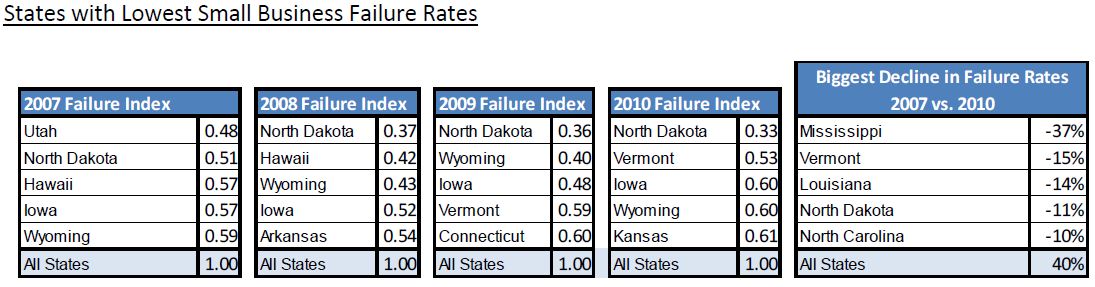
D&B SMB Lowest Failure Rate by State 2010


Many of the states with lower failure rate increases are less heavily populated states. In fact, of all the states that have seen a decline in the rate of small to medium sized business failure, only North Carolina makes the list of 10 most populous states in the country. Of states (below) with large increases in failure rates, only California is heavily populated.  

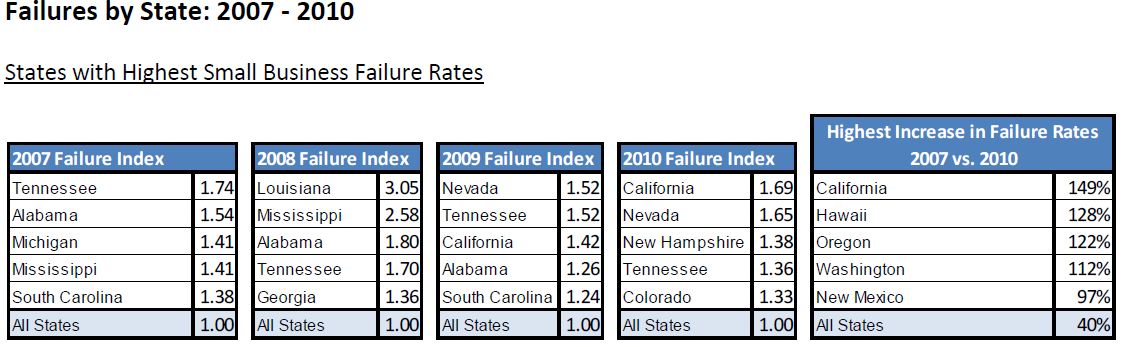
D&B SMB Failure Rate by State 2010


From 2007 through 2010, Western states in the West had the highest increase in failure rates. Reasons D&B provided for the uptick in failures include continued instability in the residential housing market and drop-off in the tourism, travel and hospitality sectors. Interestingly, Tennessee has been home to the highest small business failure rates for four years in a row.  

D&B Largest SMB Industries 2010


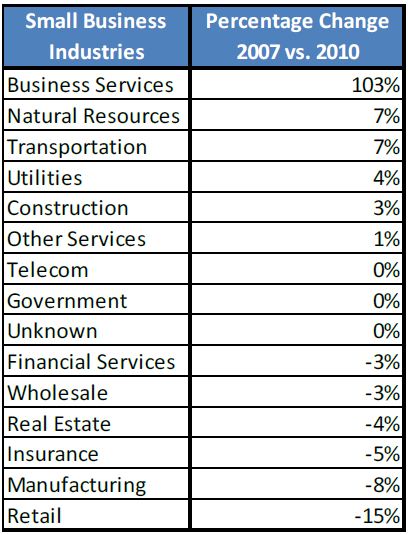
These trends have been occurring at a time when the number of retail establishments and corresponding retail employment have both dropped by 15-20%. On the other hand, the number of SMBs in the Business Services category more than doubled and these businesses experienced a 30% increase in the number of people they employ. The fastest growing industries for SMBs are summarized below:

D&B Fastest Growing Industries 2010


As you can plainly see, nothing else comes close to the growth of  the Business Services category. Bear in mind that many software as a service companies are part of this category and have been launched in only recent years. The macrotrends that become evident are that retail is on the wane, highly populated states are more stable in terms of business failure statistics, and the business services category’s growth will be a key cog in the engine of our economy.

Warner points to the following issues of significance to these small businesses:

  • Business strategy and planning to make sure their business is focused on a viable market with a winning product and/or service that has a competitive edge
  • Forecasting and financing ensuring that sales forecasts are realistic and that revenue, cost, expense and cash are well managed
  • Operational discipline and judgment to increase the chances of success by making fewer mistakes
  • Industry connections that can help accelerate the business and its operations
  • Start-up company experience that can instill the wisdom of what it takes to really start and manage an emerging business


He feels that these companies need the dual combination of basic business know-how and mentoring. The situation in North Carolina, where Warner and I live, is that our state has a comprehensive array of entrepreneurship education programs throughout the community college and university systems including various other private and public organizations. The problem is that we have little help for entrepreneurs once they have completed these programs and actually try to start a business. We recommend assistance for entrepreneurs who are struggling to create successful businesses, the failures should decline considerably. Entrepreneurs should be seeking out business mentors that can help them through the early years of their business.


Get Emails Read – Follow 7 Guidelines

Most businesses rely on emails for the majority of their communications. Yet, most of us are certain that some of our emails are ignored by the recipient. If you are trying to get your emails read, consider the below guidelines offered by Jonathan Borge of ToutApp. (Borge was contacted by Tom Searcy for a recent article for Inc.com on the subject.)

1. Subject lines: Remember that only 20 percent to 40 percent of your emails will actually get opened, though most of your subject lines will be seen. To boost your open rates, think of short, catchy, and informative subject lines. You should try to dangle compelling information (“The future of sales emails”), and you can even try adding some mystery (“Strange question”). We also recommend personalized subject lines, if possible (“Hunter Sullivan suggested I contact you”).]

2. Your tone: Portray yourself as someone that other people can connect to. You’ll want to show your recipients that you care about hearing back from them… so you can’t simply sound like you’re just sending another mass email. Never use “Dear sir or Madam,” and stay away from overly formal language.

3. Email content: Make your emails short, simple, and easy to quickly digest. Your leads are busy people with jobs, too, so you need to maintain their interest. Do your research and find out what resonates for your prospects. Try to get an introduction to them or, if that’s not possible, figure out in more detail what they or their company do. Tell them why you’re emailing them, specifically. Talk about how you can solve a problem for them.

Email

4. Your sign-off: End your emails with a definitive, clear call to action. Make it dead simple for your recipients to say yes—whether it’s to a meeting, phone call, or product demo. Don’t ask them for permission. If you want a phone call, then say “Call me right now at X for more details.”

5. Your timing: Reach out to your leads when they’re not too busy. Make sure you avoid heavy traffic times like Monday mornings. Based on our tracking data, we recommend the middle of the week, mid-day, as the best time to send emails.

6. Your image: First impressions are important both in person and online. The tone and formatting of your email is all your recipients have to judge you by. Make sure you are being professional, clear, and easy to understand. Stay away from over-formatted emails that look gimmicky, but don’t hesitate to call out important information in bold or bullet points.

7. Your homework: Send yourself a sales email. Put yourself in your leads’ shoes. If you were them, would you open this email? Would you spend more than two seconds reading it? If so, what would you do next?

Searcy notes that the list sounds almost too basic. Yet, when he went back and examined the last 10 recent emails he had sent to prospects and clients, he found that he only employed four of these guidelines on average per email. Why don’t you take the same challenge? Hopefully, you can learn from it –as he and I have!


Soft Skills Matter in Business – Even if Not Measurable

Throughout my career, I have had the opportunity to work alongside some brilliant co-workers and clients. Whether it has been inside a public accounting firm, or as an advisor to engineering and construction companies, I am often surrounded by folks with strong technical skills. Since my role has usually involved organizational development, strategy, or marketing and business development, I have heard time and again how “soft and fuzzy” topics such as relationships, emotional intelligence, and creativity and communication are less needful than the technical skills.

Susan Mazza, who writes a blog entitled Random Acts of Leadership, recognizes the dichotomy of “soft” versus “hard” skills in her recent post, “The Power of Soft.” She states in the post that, “the very need to distinguish “soft” vs. “hard” speaks to a paradigm that has long revered hard results as the only ones that really matter. Unless something can be quantified and measured the underlying belief is that it is somehow less valuable and hence of lesser importance.”Soft vs hard skills

Whether I have been in conversations with a CFO, a business owner, or a  VP of operations, I have heard over and again how that which cannot be measured must be insignificant and pale in priority. Mazza references a recent TED Talk by Dr. Brene’ Brown, “Leaning into Vulnerability” in which Brown shares how one of her research professors once stated, “If you cannot measure it, it doesn’t exist.” Mazza observes that many with advanced degrees subscribe to a scientific framework that assumes “measurable” is the only test for “real!”

Dr. Brown’s talk about vulnerability addressed the effort to view “soft” subjects with “hard” data. New insights have prevailed that challenge the long-held distinction within the business world of the value of each category of skills. Mazza’s view of the new awareness is that, “in our relentless pursuit to collect and analyze data, we all too often ignore the most important measure of all – our senses!”

The behavior we see and emotions we feel, according to Mazza, are the source of the most powerful tool we have as leaders and mangers – our ability to observe. She observes the following:

You have probably heard the phrase, “the tension was so thick you could cut it with a knife.” Can’t you feel that tension? How much productive work gets done when that kind of tension is present? Yet we often grind through what we see and feel through simple observation, knowing both the experience and the result are going to be less than satisfying.

Would having a mood Geiger Counter to assign the tension a number really make any difference?

By simply observing the mood and the impact it is having on your ability to fulfill your commitments, you are able to take action to make a difference in any moment. How to take that action is, of course, another subject.

The point here is the real power of soft comes from our innate ability to observe. So perhaps it’s time to give up our attachment to measuring all things and the belief that, “If you can’t measure it it doesn’t exist.”  Why not start  learning to better use the tools we have been born with – our senses – as an access to improving relationships, enhancing performance and creating great places to work?

The ability to navigate through tensions, create win-win scenarios, and build esprit de corps comes not from technical, “hard” skills, but from those soft and fuzzy assets that many C-suite executives and business owners underestimate. Think about your own organization and how greater respect for soft skills could make it a better place to work, where senses are valued equally with data and relationships that build goodwill are put on a pedestal.


Your Online Content Needs a Strategy

Many of my clients have made the jump into the digital age with their marketing. They know that they need to be involved in social media, but often have never heard of content management. While I do not pretend to be a content expert, I have picked up on some best practices over time and try to apply those to my own firm and the clientele I serve. My email inbox receives regular updates to keep me abreast of what thought leaders have to say about content. Over the weekend, I read about “8 Content Marketing Mistakes to Avoid,” a whitepaper that was very well written. The authors/sources quoted include Heinz Marketing’s Matt Heinz, Marketing Interactions’ Ardath Albee, Babcock & Jenkins’ Carmen Hill, The Funnelholic’s Craig Rosenberg, and The Sales Lion’s Marcus Sheridan. 

Excerpts appear below, followed by my own formatting for emphasis, observation and commentary:

1. Don’t neglect to do the groundwork. Before you start any marketing activity, you have to know why you’re doing it. How does this activity translate to immediate or eventual sales and revenue? (Heinz)

You have to know (to) whom you’re talking, what they need and want to know, and where their interests intersect with yours. (Hill)

2. Don’t focus on yourself—focus on the buyer instead. Think like the end user, not like a business owner. Great content marketing is about education.  To be great at content marketing, the focus has to be about the reader, and not the company/writer. (Sheridan)

Our content needs a lot less “we” and a lot more “you.” (Hill).

3. Don’t pitch your product at every stage. Give the people what they want: interesting content that makes their life better. (Rosenberg)

What are your customer’s issues? What do they need help with, right now? That’s the content that will spread like wildfire for you. (Heinz)

Question words4. Don’t overlook calls to action. Every content asset should have a call to action. Build pathways and tell connected stories that help to build momentum through the pipe. (Albee)

5. Don’t forget that effective content marketing is a two-way street. To really accelerate your audience and impact, you must devote time to responding, commenting, engaging questions and so on. (Heinz)

6. Don’t produce content that lacks substance. Audrey Gray of American Express advised that we put our energy into what we’re making rather than the platform: “Create content that makes you feel smarter, celebrates human artistry, or that has with real-world value.” (Hill)

7. Don’t treat content marketing as an afterthought. Content marketing is a practice that integrates all of your content-driven initiative into a consistent and holistic experience for your target markets. Content marketing is at its best when it’s used to pull everything together so that an experience in one channel makes sense or adds value when the audience switches to another channel. (Albee)

8. Don’t underestimate the power of various formats. Written content may be the core of your content strategy, but don’t forget video. Or podcasts. Or short, embedded slide presentations. Or whatever other formats your audience naturally gravitates toward. (Heinz) 

Marketers will benefit tremendously by embracing the Rule of 5. Take one topic and develop 5 different angles to approach it, creating 5 different formats of content. (Albee)

Sound advice from some stellar content curators and marketers. Incorporate these principles into your own business environment. Become engaging, relevant, and indispensable. Doing so will build a loyal following that can be turned into either revenues or referrals that produce revenues. At the very least, your brand gains equity for your efforts and that is no small feat!