Content That Speaks C-Suite Language


Roanne Neuwirth of the Farland Group (http://www.farlandgroup.com/) writes in a post this week for The Content Marketing Institute that McKinsey & Co has mastered the language of the c-suite. McKinsey Quarterly newsletters are read by corporate executives because the subject matter is engaging, relevant, and contains key topics related to global business excellence. Here’s what distinguishes their approach to content that has proven to be so effective:

Data-driven credibility. Whether a survey of hundreds of technology executives or interviews with 15 chief strategy officers, McKinsey starts with peer  insights and gets compelling facts on which to build their content.

Actionable, relevant, timely information. McKinsey focuses on leading-edge management topics that are  top of mind for executives and shares cases, examples and stories of how other executives have taken action on the opportunities and challenges presented. It’s easy to see how to take these ideas into other environments.

Succinct insights. McKinsey extracts the key points, the most relevant highlights and the most provocative  ideas in the layout and design making the key takeaways easily identifiable and consumable.

Channeling their audience. McKinsey moved its  model to a stronger focus on online formats (audio, video, print) and shifted the print publication to quarterly round-ups. It has integrated a strong social and email strategy to ensure that the content gets to executives in formats that matter.

Even though top executives can be challenging to approach, it is well worth the effort. They control the purse strings.  For marketers in the B2B setting, knowing how to attract and engage the attention and commitment of this critical target audience can make a business very successful.


Know that top executives think Return On Investment continuously—whether the investment is their time or the purchasing power they wield. As a rule, the psychographic mindset of the C-suite is to trust a small handful of advisors as subject matter experts. Inherently, most sales approaches are mistrusted and it is very hard to gain enough gravitas to be heard among all the voices clamoring for the right to earn the respect and trust sought.


Farland recommends the following guidelines for their clients to penetrate the C-suite “blockade”:

  1. Hard facts drive credibility… and credibility is key. Content based on data makes an impression on executives; peer-based insights and stories add to the credibility of the data collected
  2. Provide actionable and timely information on issues that matter, in formats that allow ready extrapolation. There has to be a “so what” that comes out of the data and it needs to be up-to-the minute, on topics relevant to the executive’s business, role, and current challenges.
  3. Summarize, summarize, summarize. Deliver your ideas with targeted summaries, succinct points, where the bottom line ideas and actions are easy to extract and consume.
  4. Channel matters. With executives in particular, the content has to be easy for them to access, wherever they are — on their iPad during a flight, in a printed paper to peruse after dinner, or in a short video while waiting for a meeting to start.
  5. Push beyond the common wisdom and top-of-mind trends. Executive content needs to present a provocative vision for future possibilities.
  6. Evolve from technical to strategic. Executives are not interested in reading about technologies and products—those are only a means to an end…Position solutions in terms of the bottom line and what can help grow the business.


A Very Nichey Girl

It’s an old adage, but a true one, that “you can’t be all things to all people” without losing a strong connection to someone specific. In the world of marketing professional services, those who choose not to build an intentional, focused relationship with clients in a niche market segment do so to their own detriment.

Responding to a Jolt

Sally was employed by an AmLaw Top 100 firm about 10-15 years ago when the large firms were targeting vertical markets.  Her firm had targeted the CPA industry and Sally, with prior stints inside CPA firms, was eager to help develop the market.  When her firm shifted priorities from the niche, she had a decision to make.

Instead of trying to take firm clients with her, Sally  opened her own firm, to focus on regional accounting firms in the area where she had attended law school.  This strategic choice was effective for two reasons:

  1. It avoided even the appearance of trying to compete with her former firm, and
  2. It gave her an entree’ to a target group of profitable prospects not being pursued by others

Learning Competitive Advantage

For several years she continued to develop and deliver specialized services offerings tailored to CPA firms, such as partner compensation consulting, strategic planning, partner retreats, organizational restructuring and profit enhancement.  By the 5 year anniversary of being in business for herself, Sally had identified the need to build a team around her with scalable infrastructure that would allow her to focus on client service rather than firm management. She joined a regional law firm with about $7 million in gross revenue and six partners that had begin to see the revenue and profit benefits of pursuing highly specialized niche practices.

For the past decade, Sally has led the firm’s niche practice for CPAs and seen the firm grow to over twice the size it was when she joined.  By getting to know finance executives, CPAs, firms and the industry, she has been able to create a value-added service that goes well beyond compliance into unique complementary offerings.  By choosing to specialize and establish herself as a subject matter expert, she has enjoyed great success.

Not content to only be a service provider, Sally has taken on the coveted roles of a.) trusted advisor and b.) referral source.  Some say she “knows every CPA in town.” Her strong relationships have been maximized to win considerable business for her firm.  While others attend chamber and other networking meetings, she introduces CPAs she knows to firm partners according to their industries and areas of specialty.  Her efforts have developed into a solid channel of business development and referrals for her partners and clients.

Value Proposition

The highly specific niche has permitted the firm to win against many of the area’s most respected law firms that offer the usual corporate business and estate services.  Certainly, the firm can–and does–provide these at the highest level.  But Sally and her colleagues have positioned themselves beautifully – a focused, reputable law firm that can provide the usual suite of legal services and, significantly, knows the industry and its unique challenges and nuances, offering the experience and expertise to help the client become more successful.

Ultimately, specialization is offering a value proposition rather than a reduced-price commodity.  Under Sally’s leadership, her firm has added a tremendous value to traditional legal services by customizing their offerings to keenly understood market segments.


5 Ways ‘treps Maximize Mentor Feedback


Asking a mentor for feedback is a critical step in turning an idea into a successful business. Noted members of the Young Entrepreneur Council share how they feel ‘treps should make the best use of mentors below–

Draft a Summary

Entrepreneurs’ ideas are often most easily “felt” through passion and an intuitive belief that great potential awaits. When expressed verbally, however, the vision can be easily misunderstood. Avoid this by taking some time to write a concise, one-page Executive Summary that you can share with mentors you respect. This will ensure they understand your idea and offer relevant and quality feedback.

Kent HealyThe Uncommon Life

Time Is Valuable

If you’re in a mentoring relationship with someone who is also an entrepreneur, there is one thing that you both know is ridiculously valuable: time. Regardless of whether your next business venture is the greatest or worst idea you’ve ever had, keep the call focused to keep mentors in your life. Have an agenda and stick to it. You can make small talk later. Time is money; spend it wisely.

Sydney Owen3Ring Media

No Hesitation

While preparation is important in pitching a business idea to anyone, the best tip for asking a mentor for feedback is not to hesitate about it. Your mentors are there for you to bounce ideas off. Most mentors are thrilled when you come to them with questions or feedback solicitations, so don’t pause in engaging them in your project. They — and you — will be glad if you don’t wait.

Doreen BlochPoshly Inc.

One Small Step

They’re busy and smart, so treat them as such. Don’t ask for a long term commitment up front and don’t waste their time. Start with a short email with options you’ve thought of to a problem you are facing. Ask them to simply reply with which option they think is the best. Implement, thank them, and show them how their advice got you results.

Josh ShippJSP, Inc.

Ask For Specific Feedback

If you’ve chosen the right mentor, they have a wide body of expertise and experiences to draw on. Too many entrepreneurs present a lot of information to mentors and then ask something akin to, “What do you think about all this?” That gets nowhere. Better to have structured information and ask for specific feedback: “Is this key assumption realistic?” or “Is this an appropriate place to start?”

Charlie GilkeyProductive Flourishing


Start-Up Savvy: Taught & Caught

Image

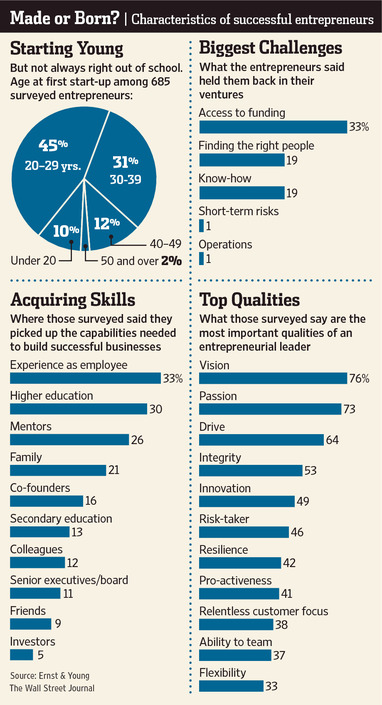
In an article last month entitled, “Can Entrepreneurship Be Taught?,” two sides of the argument were presented that, while equally valid, were at odds with one another. Noam Wasserman, Harvard Business School professor of Entrepreneurship and author of “The Founder’s Dilemmas: Anticipating and Avoiding the Pitfalls That Can Sink a Startup,” takes the position that too many founders have to climb the same steep learning curve as others before them, bereft of insights that could help great ideas become great businesses. Victor Hwang, co-author of “The Rainforest: The Secret to Building the Next Silicon Valley” and managing director of T2 Venture Capital in Silicon Valley, posits that only experience can teach an entrepreneur how to successfully launch a business.

Within the Wasserman camp are educators who believe that documented best practices and potential problem areas can be shared with the entrepreneurs. For instance, the idea that the founder must do the three following things has been challenged with research data to instruct otherwise:

  1. Following one’s gut
  2. Having a “glass half full” view about resources and time
  3. Stay in the top executive role as the company matures

Augmenting the classroom instruction with deliberate opportunities to “try out” a principle in a role play seem to yield good results. Additionally, self assessments are helpful in increasing one’s self awareness and ability to lead others. Notably mentoring is recognized as one of the best ways an entrepreneur can learn how to do the right thing in a myriad of scenarios.

What is also being learned is the need to not just offer principles of management (regardless the field of management–finance, operations, marketing, etc), but to also focus on the soft skills requisite to be an effective leader. Whether the entrepreneur is embracing better social skills, motivational techniques for self and others, or other facets of emotional intelligence, there are competencies to be gained that are simply not intuitive for most.

Hwang and the experiential learning community holds steadfastly to the conviction that entrepreneurship is taught rather than caught and is more of  an impartation than an education. Rather than the typical domain of business schools–resource allocation and risk management, it is argued that the necessary skills fall more into the following categories:

  • Comfort with a high degree of uncertainty
  • Willingness to become a generalist rather than a specialist
  • Abilities in inspiring others through storytelling and personal charisma

Since some programs are heading in the direction of trying to advise start-ups on what actions to avoid, Hwang is concerned that the willingness to try something unconventional may become minimalized. He and others believe that such a mindset is critical to entrepreneurial success. The main thesis behind Hwang’s proposed approach is that entrepreneurs would have the greatest chance of success if communities with resources, counsel and mentoring were available for their growth and development.

The common theme, then, is that mentoring and nurture is the best medicine for someone who “suffers” from entrepreneurial dreams. We wholeheartedly concur with this bottom line approach and advocate innovation centers (incubators with assigned mentors, education, and planned activities to build a sense of community) as a best practice!

Un-Madoff Your SMB

Even if a business has strong financials, talent is not enough – integrity is needed. Master investor Warren Buffett’s position on business performance has been: “In looking for people to hire, you should look for three qualities: integrity, intelligence, and energy. And if they don’t have the first, the other two will kill you.”  Given his track record, good corporate governance seems to be an essential part of long-term business success. Whether we go back to Michael Milken and his securities fraud, or more recently to Enron and Bernie Madoff, we have a wealth of examples of how poor checks and balances led people with intelligence and energy to behave in ways that clearly lacked integrity and cost many other people millions of dollars.

A 2003 joint Harvard and Wharton study entitled Corporate Governance and Equity Prices found that companies with good corporate governance generated superior future returns and higher profits and sales growth. The study created a “Governance Index” (G-Index) for each company based on the number of these 24 anti-shareholder provisions the company possessed. The higher the index score, the worse the company’s stock performed. Using data from 1990-1999, the study found find that companies with a low G-index score (i.e., a “democracy” portfolio) outperformed companies with a high G-index score (i.e., a “dictatorship” portfolio) by a statistically significant 8.5 percent every year. By 1999, a one-point difference in a company’s G-index score was associated with an 11.4 percent drop in a stock’s market value. Further, firms with weak shareholder rights were less profitable and suffered lower sales growth than comparable firms in the industry.

2009 joint Yale-Harvard study finds that the outperformance effect has waned in recent years as investors have learned about the importance of good corporate governance and adjusted the stock prices of good and bad companies accordingly.

In other words, bad corporate governance is now discounted in stock prices. Small-cap stocks and privately held businesses, where data is less available, seem to dodge the scrutiny of the large-cap stocks and purchasers of their stocks can take a “ding” on the regular.


How can we change the pattern in small to medium businesses?

  1. Better corporate governance measures in privately held businesses should include a progression towards true, independent boards.
  2. The boards should be evaluated on an annual basis (check out the Center for Board Excellence.)
  3. Matters such as compensation, family members in the business, succession plans, etc. need to be discussed in board meetings and action plans developed.
  4. Organizational development principles should lead to better talent management and the assignment of shared decision-making outside the CEO’s office.
  5. Internal controls need to be examined and improved to mimic best practices of a public company in a Sarbanes-Oxley environment.
These are a start–what would you recommend?