Too Many Houses Are Us

Most businesses face unforeseen circumstances while in pursuit of their sales and other goals. The way these situations are handled will quite often determine the degree to which the company’s efforts are successful. A useful method to see what others have tried and what principles we can learn from their experience is the case study. When your business produces products, it creates inventory. When the inventory is too large for the demand, it becomes a problem. Let’s take a look:

A speculative home builder on the West Coast discovered to his chagrin that the market in his local area was inundated with homes very similar in style and price to those he was building in large numbers. There was both a general glut, and a specific one related to this company. As his lender began to point out, an inventory level that has escalated out of control presents severe cash flow problems among a variety of other concerns. The lender was also quick to point out that the builder was in jeopardy of defaulting on construction loan interest payments a couple of months down the road if he did not begin selling some of his inventory–and soon.

How could this builder (and others in a similar situation) end this problem of increasing inventory? First, the problem can normally be attributed to one or more of the following factors:

  • an overbuilt market in the builder’s product offering
  • incorrect, incomplete, or absent market research
  • an inability to revise product in terms of plans, elevations, and prices to meet buyer demands.

Once a builder has determined the existence of increasing inventory levels–and their cause–it is time to stabilize the situation. Selling off an old unit for every new unit constructed is a bare minimum requirement. It is not wise to continue building simply to try to fund aging inventory interest payments out of new construction loan draws. As older homes are sold, new construction can be considered. Due consideration includes understanding the problems that led to former inventory level increases well enough to avoid the same errors in the future.

In addition, an inventory reduction plan should be initiated immediately, making sure to target the oldest inventory with the worst gross margins first in any type of incentive offer. The use of incentives can be gradually lessened as the builder moves through the oldest inventory into newer inventory with better margins. Sales staff can be of great help in determining what may help to move homes. If qualified buyers are hard to come by, it may be advantageous to work with local mortgage lenders and offer a program for qualifying buyers at lower monthly payment levels in the early years of a home purchase. Also, it is always helpful to walk all inventory and make lists of all items that need to be repaired, replaced, or cleaned up.

Finally, a builder can prevent uncontrolled increases in inventory levels by performing more careful, thoughtful research, making revisions to product as soon as buyer tastes are known to have changed, and offering ongoing, automatic incentives for aging inventory to be sold. It is often helpful to “re-research” current projects to make sure that the original research findings remain valid and informative. Periodic product updates and revisions are necessary even in a stable, conservative market. Buyers are always looking for small things that make one home purchase better than another. By catering to buyers’ particular tastes and requests, a builder can offer a better home and still make money.

Even if you are not in the homebuilding business, but in some other business that has inventory, these principles are important to observe. Think through ways to reduce inventories–better yet how to prevent them from ever becoming a problem!

Locating the Buyer Need

Is your organization in the habit of finding unresolved problems? If not, chances are high that you are currently–or will be soon–losing market share to more nimble competitors who are “tuned in” to buyer habits and frustrations. Many industries suffer from the slow and steady move to products and services that have largely become commoditized. Once your offering is viewed as a commodity, you are no longer competing on value; the playing field is reduced to price only (or at least as a primary decision criteria.)

One of the categories that suffered this fate about 15 to 20 years ago was televisions. Appliance stores (as opposed to the modern day consumer electronics big box specialty retailer or boutique provider) were where people shopped. When looking for a TV, most consumers would walk down the aisles of sets in their beautiful shades of grey or black. Sales staff may follow or approach and offer to explain or demonstrate features of a model you may have paused near. Most buyers, however, came in to the store armed with some knowledge about prices or consumer ratings and were planning to buy a certain model…until they came across a TV with a sticker that asked the simple question, “Ever lose your remote control?”

How did Magnavox determine that the Remote Locator function (in which pressing the power button causes the lost remote to beep several times) was a missing ingredient in the TV viewing experience of many viewers? Did they simply ask, “What problems do you have with your current TV?” No; instead, they asked penetrating questions about how the TV fit into the lives of consumers. They looked at family dynamics and how TV viewing paralleled relationships with other daily activities. What they discovered was that 80 percent of Americans admitted to losing the remote control; over half of the viewers lost their remote more than five times per week. Inanimate objects like sofas, pantries, and refrigerators swallowed up the devices when the owner wasn’t watching!

The typical consumer may never have offered up that losing the remote was a problem associated with TV viewing. The TV manufacturers were not responsible for the loss of the remote (though family members and friends were certainly thought to be culprits!) Yet, when asked if the loss of remote was a problem, most readily agreed that it was.

Note that the technology used in the Locator was not novel or cutting edge. But, Magnavox had created a temporary competitive advantage among buyers of TVs for whom keeping track of the remote control was now seen as a problem that technology could solve. While some may argue that the company was fortuitous in “stumbling upon” this idea, in fact, it was very deliberately planned.

Magnavox published survey data to validate the problem. Some of the key findings included:

  • 55 percent of respondents admitted losing the remote control 5+ times/week.
  • Of those who lost the remotes, 63% said that their average search to regain the device was about 5 minutes.
  • The remote was most likely to show up in/under a piece of furniture (38 percent), in the kitchen or bathroom (20 percent), or in the refrigerator (6%)

What was the process of discovery and meeting a previously unstated need?

  1. Magnavox tuned in to a problem that TV buyers really had.
  2. They created a product experience to solve it.
  3. They shared the powerful idea with the market. (Through survey results)
  4. They communicated to the market in ways the target audience wanted to hear.

Instead of taking a traditional, worn-out R&D approach, consider changing how your company develops and commercializes product ideas. Send team members out to collect data that can drive design, packaging, messaging and other aspects of product positioning. You will be better off for the new approach!

Don’t Mess With…the Customer Perspective

A deep understanding of your target audience is the only way to create ideas that resonate and break through the noise of modern life. Being able to connect authentically and directly to a buyer persona’s culture is an effort in alignment. Alignment is not just for vehicles–it is critical to business success! When people begin to see your product or service as a part of their identity, then you have built a connection with stickiness to it!

Keep America Beautiful launched a campaign years ago aimed at deterring littering. In it, an actor made to look like an Indian cries when he sees trash detracting from an otherwise majestic scene. While an emotional memory was built through the public service announcement, a cultural connection was not formed and very few behaviors were changed. Littering is still a problem today. (In fact, one of the things that irks many are cigarette butts all over the ground, thrown out car windows, and piled up at entrances to office buildings.) Why smokers can’t keep their butts to themselves is a mystery! 

A market research project in Texas sought to understand who litters. What they found in terms of demographics were that 70 percent of “litterbugs” were males, who also usually had the following characteristics:

  • they are young
  • they drive trucks
  • they drink beer
  • they have a “king of the world” attitude

The research project led to a marketing campaign recommendation to engage culturally with these young males. Ever heard the slogan, “Don’t Mess With Texas?”  In the mid 1980s, actors and athletes were recruited as spokespeople for a new breed of PSA in which the stars shouted out the now famous slogan. For instance, two burly defensive football players from the Dallas Cowboys team during that era are depicted roadside, picking up trash and vowing that they want to give litterers a personal message!

Megastars like Matthew McConaughey, Jennifer Love Hewitt, George Foreman, Owen Wilson, Chamillionaire, and Chuck Norris all did cameo endorsements for the campaign. YouTube videos show that it went viral. When a leading research organization suggested that a 10% reduction in littering would be good and 15% stellar, its team had no idea what a campaign that truly connected could do. In the first five years after the slogan was launched, litter in Texas was reduced by 72%!!!

Something else that really connected was Cadillac’s launch of is Escalade SUV. Escalades became iconic in hip hop culture, appearing in music videos, lyrics, and becoming the ride of choice for many to demonstrate status. John Manoogian, who oversaw external design at Cadillac, was asked why it became the bestselling full sized SUV for a number of years.  Rather than attributing success to something like product placement, he admitted that Cadillac missed its target audience with the Escalade. It was intended for  older affluent males. When it didn’t sell as planned, he visited a dangerous neighborhood in Detroit to see who else might be in the market for the luxury SUV. While the “business” that the owners of Escalades appeared to be in was not what bigwigs at headquarters may have wanted, he realized they had a winner. From there, it was a matter of building a strong marketing approach to reach the target audience and tweak the product based on feedback–just like any other niche!

What can be learned from these two “case studies?” Simply that we must not try to educate people into taking another perspective that is conducive to our personal or corporate success. Instead, we should find out what is important to the target and meet them culturally with an offering that resonates with their environment, way of living, and motivations.


SCARF Up Some Change

In an HBR blog post about organizational change this morning, Walter McFarland draws in the role of the brain in defining whether change efforts will meet with success. Some of the casualties of failure to adapt to changing market conditions he mentions include Sunbeam, Polaroid, and Circuit City. While each of these formerly strong companies is no longer in business, proponents of organizational change struggle to define why some are able to reinvent themselves and others are not, other than the nefarious “human element.”

Organizational change as a field of study has long maintained that change can be defined in linear, sequential terms and processes. What we are discovering, largely through examining principles of neuroscience, is that change is neither. Instead, McFarland, the board chair elect of the American Society of Training and Development (ASTD), argues that modern business dynamics would suggest that it is chaotic. It is the chaotic nature of change that creates the need for greater research. We live in a time when the need to constantly change is critical to competitiveness. Neuroscience may be a key to helping us steer organizations through adaptation more effectively.

Thompson and Luthans wrote that typical reactions to change “can be so excessive and immediate, that some researchers have suggested it may be easier to start a completely new organization than to try to change an existing one.” While industrial psychologists refer to this as “human resistance to change,” very few who study the phenomenon have identified how to lower the resistance consistently and pervasively. 

At the NeuroLeadership Summit, being held in New York this week, a panel discussion with senior executives and experts from The Conference Board, the Association of Change Management Professionals, Change Leaders, and Barnard College will explore the connection between neuroscience and organizational change, understanding how we can effectively deal with the human resistance to change. 

A new organizational change model is being proposed that takes into account how successful change functions in a modern organization, where work is conceptual, creative, and relational, and talent is portable. According to McFarland, activities that have contributed to the continuing poor performance of change initiatives include:

  • Perpetual underpreparation: change is always dreaded and a surprise to employees
  • A perceived need to “create a burning platform”: meant to motive employees via expressed or implied threat
  • Leading change from the top of the organization down: only a few individuals are actively involved in the change and either under communicate or miscommunicate with others

Top-down change (the traditional model) can trigger fear within employees because it “deprives them of key needs that help them better navigate the social world in the workplace. These needs include status, certainty, autonomy, relatedness, and fairness” — the foundation of the SCARF model

  • Status is about relative importance to others.
  • Certainty concerns being able to predict the future.
  • Autonomy provides a sense of control over events.
  • Relatedness is a sense of safety with others – of friend rather than foe.
  • Fairness is a perception of fair exchanges between people.

SCARF is a summary of important discoveries from neuroscience about the way people interact socially and is built on three central ideas:

  1. The brain treats many social threats and rewards with the same intensity as physical threats and rewards (Lieberman, & Eisenberger, 2009). 
  2. The capacity to make decisions, solve problems and collaborate with others is generally reduced by a threat response and increased under a reward response (Elliot, 2008). 
  3. The threat response is more intense and more common and often needs to be carefully minimized in social interactions (Baumeister et al, 2001).

Since organizational change is a significant social interaction in the marketplace, it is important to minimize perceived risk. Understanding how people tick, empowering them to vocalize their ideas, and creating better systems to engage them in the change process is best practice. More organizations need to get on board.


Relevance in Business is Fleeting

“Focus Not on Protecting What You Have, Instead Obsess on the Next Big Thing.”

While this type of headline may not serve us very well in interpersonal relationships, it has become the watchword in business. Those who rest on yesterday’s accomplishments eventually find themselves with less and less current successes. Since we live in a day and time when ideas are ubiquitous, information plentiful, and communications vastly enhanced, it is incumbent upon every enterprise to remain on the hunt for “wow.”

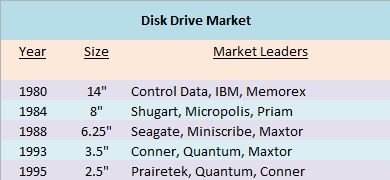
Jeremy Gutsche of Trendhunter wrote in Exploiting Chaos that the disk drive, computer chip, and word processing markets were all ones that saw enormous changes and the market leaders were often outflanked. Read on:

Borrowing from Clay Christensen’s work in The Innovator’s Dilemma , Gutsche described the progression in the disk drive industry towards constantly smaller drives. Along the way, observe the shift in power:


Observe how great organizations present in 1980 gave way to more nimble upstart startups over 15 years. Though the only apparent change was size of the drive, it was enough innovation occurring at a rapid enough rate to trip up the “big boys.” Perhaps, one may suggest, disk drives had become commoditized as more PCs were manufactured? This theory seems to hold true in computer chips, then, as well. To note:

Observe that this market experienced a slower rate of change (40 years of upheaval vs. 15), but the net result was the same: market leaders gave up leadership to disruptive alternatives. The fact that semiconductors require very extensive research and development efforts, whose project funding ranged into the billions of dollars, made this a significant economic microtrend. Gutsche points out that RCA was once twice the size of IBM, so the thought process that monetary barriers to entry would protect industry leaders was disproved time and again.

Word processing was once known as typewriting and the market leader was Smith Corona. Smith Corona was extraordinarily innovative, boasting over 100 patents spread over decades. Yet, the company who also invented the first word processor did not continue to reinvent itself in the computing age and lost its market leadership role. It is suggested that the historical accomplishments became blinders to the urgency for continuous improvement. Notice, they understood the concept of reinvention, but underestimated the urgency factor.

Lest you think that Smith Corona had been mismanaged over the course of the 20th century, pay attention to the fact that their annual revenues in 1989 were $500 million! What happened? Let’s look at some of the competition and what strategic decisions they made…Remington recognized the opportunity of computers and made the leap in 1950, only to be too early to that niche, lose money, and the computing division sold off in 1981. Perhaps Smith Corona saw the foibles of a competitor and vowed not to make the same mistake?

Commodore, on the other hand, was a different kind of competitor. Their model 128 was introduced in 1985 with two external floppy drives. The Smith Corona PWP 40 was preferred by buyers by a wide margin for word processing applications. Yet, someone inside the company saw an opportunity to partner with Acer on a computer joint venture. Unfortunately, the plug was pulled before the strategy could run its course.  Smith Corona declared bankruptcy in 1995; Acer became the fourth-largest PC company in the world!

Scott Anthony, writing for Harvard Business Review in an article entitled “Disruption is a Moving Target” observed a clear pattern:

  1. Disruptors enter a market incumbents don’t care about.
  2. Entrants grow as incumbents flee.
  3. The incumbent hits a ceiling.

What should be learned from this insight? Larger companies should not ignore small opportunities simply because they start out small. Smaller companies should plan their strategy and tactics around “nibbling at the edges” of an incumbent’s market share.