Retool for Catalytic Success

Business macrotrends are illuminating. With sufficient data, organizations like BCG, McKinsey & Bain can advise their clients better as to thought leadership positions, best practices, and optimization. As the national economy has improved from recession to stagnation or slow growth, businesses have shifted their focus from expense reduction to growth. Increasing revenues is important to companies providing goods, services, or non-profit benefits.

When Bain performed a study last year, 80 percent of the executives believed innovation to be important than cost reduction for long-term success. Also, 68 percent of respondents believed that taking care of customers and employees should come before shareholders. Bain’s interpretation: executives realize that growth depends on having happy, productive employees and satisfied customers. Shareholder returns will be the natural byproduct.

Growth Catalysts:

In the Bain survey, popular management tools were rated by respondents. Of 25 total tools, the top 3 were:

  • open innovation (expanding the sources of breakthrough products)
  • scenario and contingency planning (testing the “what ifs” to plan for the future/minimize risks) &
  • price optimization (addressing rising commodity prices). 

Social media was seen as an additional emerging tool of choice. Whether websites, micro-bogging, or online communities, there has been a growing commitment to explore the value of the medium to enhance relationships–internally as well as externally. “While only 29 percent of all respondents say they used social media in 2010, usage is expected to surge to 56 percent in 2011. Even so, executives tell us they’re uncertain about how to measure the effectiveness of this tool.”  

The standard approach with the introduction of new tools is to make a limited investment to vet the value of the tool, then make a more sizable commitment if it proves to have merit. Bain study leaders felt that this approach presented two risks:

First, while it’s understandable that companies do not want to make major investments before they fully understand how a tool will work, we have found that using tools on a limited basis consistently leads to lower satisfaction, so caution may inadvertently result in failure. The second risk we have found: companies start using a tool because their competitors are using it, or because it’s the hot topic in the business press, but if they do not fully understand how and why to use it, the experience ends up in failure.

Think of business process reengineering, where we witnessed an inverse relationship between usage and satisfaction rates when it was the hot tool of the 1990s. We witnessed reengineering drop from the tool with the fifth highest satisfaction rate in 1993 all the way to 21st in the late 1990s. It was only after usage rates declined that satisfaction began to improve again. Any time we see high usage but low satisfaction, there is cause for concern.

What Tools Work & What to Degree?

Benchmarking made a comeback a couple years ago and displaced strategic planning, a perennial No. 1, as the tool of choice. In addition to benchmarking, the most widely used tools during the recession period were strategic planning and mission and vision statements. These tools have rated in the Bain top 10 for usage over the years, regardless of the economic climate.

The survey found the least used tools included open innovation, decision rights tools and rapid prototyping. One tool that was surprisingly unpopular was mergers & acquisitions. During a downturn, M&A deals often create bargains that give the acquiring company increased scale and broadened scope. Yet in each recession we see relatively few deals. 

Among the  preferred tools, strategic planning was the tool with the highest satisfaction rating. Other tools with above-average satisfaction scores included mission and vision statements, total quality management, customer segmentation and strategic alliances. On the other end of the spectrum, downsizing, outsourcing and shared services centers–despite being seen as expense reduction tactics–were three of the five tools with below-average satisfaction scores. The other two tools with low satisfaction ratings were knowledge management and social media programs.


Shark Tips For Second Career Entrepreneurs

“The best advice I would give to somebody is, don’t ever start a business that you are not incredibly and deeply passionate about,” said Robert Herjavec, one of the “sharks” on ABC’s hit TV show, Shark Tank. “It is hell, and you will spend more hours with your business than you will with your family and friends. You will have horrible days that will make you want to quit and question everything you have ever learned. Along that journey, if you don’t absolutely love what you do there is no way you will survive.”

Many people who are looking at starting a business as a second career are intrigued that, if it works out, they can create a new source of income in addition to the retirement income sources they’ve worked on for years. True entrepreneurs, however, don’t start businesses to produce money. What?

“The biggest mistake I see people do is they start a business to make money,” said Herjavec. “The problem with that is on those cold days, money doesn’t keep you warm at night. For me, it is impossible to expend the effort required to start a great business because you want to make more money.”

Passion is what is critical to successful entrepreneurship. Some would even label it fanaticism. When one is in the midst of a dogged pursuit of what is primal, success looms in the not too distant future. It is as though a deep seated conviction drives one to pursue what is the convergence of talent, inspiration, and motivation. Not everyone, though, even considers that starting a business is a possibility. Some were just not raised to think entrepreneurially.

“When I was younger, I didn’t know that people could start a business, and I always say now that if I knew what I know now, I would have dreamed bigger,” said , CEO of Canadian-based information technology company The Herjavec Group. “I don’t have an MBA, or a business degree, and I wasn’t very good at accounting. I remember when I wanted to start a business; everybody said to me, ‘you can’t do it.’ Fundamentally, I owe my success in business to the fact that I really love what I do.”

“It was really interesting because, where I came from, we lived on a farm and my grandmother raised me and everybody lived like us,” said Herjavec. “Then, we came to North America and it was my first impression of not being well off. I realized that compared to everybody else, we were really poor.”

To make a living, Herjavec began working as a newspaper deliveryman and waiter in the early 1990s.  He was able to make ends meet and learn important business lessons at the same time.  The biggest, perhaps of all, was noticing what was on the mind of his customers.

“The most important relationship in business is the one between you and your customers. All my experience is customer-related. When I was delivering newspapers, you used to have to collect the money,” Herjavec said. “When I was a waiter, it was all about maximizing a tip and ensuring enough turnover. All these odd jobs always related in different ways to customers.” 

Knowing what customers want and creating a strategy to meet their needs is critical path stuff. What else is desirable in terms of an entrepreneur’s worldview? Flexibility and good analytical skills rate highly for Herjavec.

“People ask me if there is a quality or characteristic for entrepreneurs, are they born or made?” he says. “The one characteristic that I find in most people who start a business is, they are very comfortable and adaptable to change. I always say my greatest skill is if you throw me in the middle of the forest, I’ll figure out the game.”

Finally, it is crucial that a business founder have a distinct competitive advantage. Whether taking on the 100 ton gorilla (market leader) or a local competitor, it is key to know how you are differentiated from the others. One of the best ways to stake your claim is through unique knowledge or processes.

“The other thing I notice is that lots of other entrepreneurs make the mistake of changing fields all the time and start businesses where their knowledge level isn’t very high,” said Herjavec. “I always say to my kids, become an expert at something and become such an expert at it that you can walk into a room and people will pay you for your knowledge.”

In summary, here are lessons we can learn from Robert Herjavec, aka the Shark:

  • Be extaordinarily passionate
  • Start a business because you believe you were meant to, not for income only
  • Know what the customer wants and deliver
  • Be flexible 
  • Hone your analytical skills
  • Be a lifelong learner and master of a unique subject matter

Due Diligence Must Include Culture

60% of mergers, acquisitions, and joint ventures fail to perform up to expectations in their first year, often because of cultural incompatibilities between the two prospective partners. The losses in shareholder value are in the hundreds of millions of dollars in many of these star-crossed liaisons. Cultural Due Diligence is a technique for keeping both eyes wide open when approaching an attractive prospect, whether for a merger, joint venture, or offshore vendor.

-Wayne State University, Institute for Information Technology and Culture

When two companies agree to join forces in some type of agreement, cultural fit is usually the last factor considered-if at all! Instead, many numbers are crunched, recrunched, and analyzed ad nauseum. Market impact, anticipated back office savings, etc receive the lion’s share of the secondary consideration after financial statement items. “Culture” is perceived as too soft an issue to justify the time and attention of high-powered executives. Big mistake!

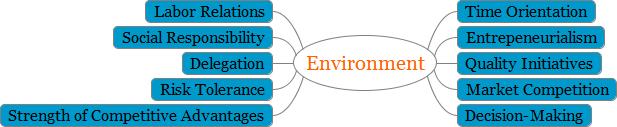
At the very minimum, the operating environment and organizational structure of each entity needs to be explored. When we are working with a client, we use the following two charts to help us ask solid questions about these two components of culture. From the answers received, we make value judgments and recommendations as to the degree of “fit” between organizations and what to do about it.

In considering the operating environment, we look at whether the company has a long-range or short-term approach to management. We ask questions to determine whether the organization is more entrepreneurial or bureaucratic. Quality initiatives are a good indicator of what aspects of performance are most important to management. The degree an strength of market competition for each party is important. How decisions are made is another leading indicator of what it may be like to work alongside the other team.

How management handles relationships with employees, (unions), and contractors is important to search out. Is giving back to the community and having respect for the environment a value of the other organization? Do meaningful tasks get delegated effectively, or are there barriers to professional development , shared responsibility, and growth through the contributions of many? Discovering how the other party perceives risk and builds strategy accordingly is a key conversation. When one’s competitive advantages are articulated, it is vital to verify how strong they are in the eyes of the buyers.

In addition to the operating environment, it is critical to understand the organizational structures that represent the philosophy of your intended. Do employees have direct access to top executives, or must they work through a layered management team? Understand whether the employees feel that they are protected to the point of not being allowed to make any mistakes. Examine whether generalist skills are valued versus everyone having a narrow scope. Look at the board of directors to see whether it is comprised of objective, strong leaders. Pay attention to the diversity of the employees and management team.

If the other company has a multi-office system, is it managed out of corporate, or are those in the field given autonomy? Notice whether task or relationships seem to carry more weight. Analyze the turnover rate among management and key positions. Is the human resources department deep enough to undertake complex issues like training and development, talent management, succession planning, coaching and the like, or compliance focused? Ask for examples of how technology is used to solve problems and enhance work flow.

The careful review of these “soft” factors can save you some headaches and hardships–do it! (We would love to help.)


Gifts Aren’t Us

You know how difficult it can be to come up with an idea for a present when you’re down to the wire? If not, you may not appreciate the business concept of the cover story of Entrepreneur Country this month–unless you know someone who suffers from the malady. Like a guy. Or a lot of guys. Many guys opt for the classic gift card solution when faced with such a dilemma. With Man Buys Present, however, one can come off looking great–even when the only good idea was to outsource what is usually a painful, unimpressive task.

Rachael Robertson (a former HR exec with Hewlett Packard in the UK) and Kate Rider (a very successful property developer) met at school and soon launched their idea. One (Rachael) is an ideas person, the other strong on management and implementation. Key observations influenced their decision to go into business:

  • a good reputation is hard to earn and easy to lose
  • having a really smart husband who gave gifts that showed no sensitivity or understanding
  • a solutions mentality is very different than trying to be thoughtful

With these factors in mind, they developed a web-based business with mass customization features. In addition to a sourcing strategy that aimed to procure products from exclusive suppliers, the duo had a website built with nifty “bells & whistles”:

  1. A “Get Out of Jail” concept to buy restitution gifts on short notice,
  2. The “Buy One, Get One Free” option to buy something cute or funny to complement a serious gift,
  3. Assistance for dads buying gifts for their spouse to be given by their children,
  4. Facebook downloads of birth dates,
  5. Gift suggestions, and
  6. Tracking of prior gift purchases.

Kate seems to really like the entrepreneurial pursuit, noting that big business has taken it on the chin in the UK and around the world. Rachael says that the stress  she feels is offset by having fun. Both women enjoy the flexibility to work remotely, while simultaneously juggling child-rearing and spouse time.

When asked to comment on how they feel about the role of the education system in Britain in preparing their children (or others) to launch successful businesses, they lamented that traditional jobs are still the focus of skill development. Access to adequate capital for those who are not born into money is cited as a big challenge. Kate recommends that students in all subject areas learn finance (distinct from “math”) as a critical life skill. Further, she offers that all fields of study would benefit from seeing their talent or skill through the lens of running a business for oneself. Learning how to explain a business concept and position both the business and yourself as credible are great life skills.

Learning how to not let perfection control your life is an acquired mindset they recommend. Receptivity to different approaches gives the leadership team the ability to grow themselves and the company well beyond what they would have thought. Finally, the ladies have each learned how to turn aspects of their personality that they don’t like into strengths in a collaborative environment.

A few thoughts, then, in reaction to this heartwarming story:

~ American education is in a similar rut to British–we need to do something about it!

~ We all observe problems that need fixing, but rarely start a business to solve the problems.

~ Offer solutions after being thoughtful!


Soccer, Fighter Planes, and Strategy

In most other countries around the world, soccer (“futbol”) is the national past time and a great source of the good kind of pride. It inspires its observers to sing national anthems, set differences aside, and salute efforts where one or many “put it on the line.” During the course of the weekend, I have been observing UEFA 2012, the European tournament held on the same four year schedule as the Olympic games.

One of the interesting things that occurs in the format of the tournament is the pairing of teams against one another wherein one appears–on paper–to have far superior credentials to another. In many cases, a starting lineup for one side can be stacked with players who have 100+ games (matches) on the international stage. With such vast experience, the veteran side enjoys a presumed advantage over the opposition. Often, the more veteran team enjoys an additional upper hand due to the superior ball-handling, striking, and passing skills of its players.

The scenario is analogous to young or smaller businesses trying to compete against prohibitively endorsed large, mature businesses. Yet, whether in futbol or in business settings, we see the underdog come out on top often enough that we realize competition is not decided through analysis and predictions. What, then, are some of the reasons that a presumably out-manned competitor emerges victorious?

If I may bring in yet another comparison without losing the train of thought, I’d like to reference the story of the Tuskegee Airmen, revived through the recent Red Tails movie produced by George Lucas. In the movie, the African-American pilots are disdained by both their own armed forces as well as the haughty Luftwaffe (German Air Force). The heroes are initially perceived as being less intelligent, having slower reflexes, and lacking the experience to get the job done of protecting U.S. bomber squadrons during the second World War strategic air campaigns to reach Berlin and help the Allied forces achieve victory. What the featured pilots bring to the air battles (at least in the movie version) are the following distinctives:

  1. They were not fighting for individual glory,
  2. They were not afraid to take reasonable risks,
  3. They were (for the most part) disciplined in their consistent approach.

In business, it is very important to observe how applying these distinct characteristics would benefit a company’s performance–whether going against peers or seemingly over-matched foes. In order to build the “esprit de corps” requisite to compete will require emotional intelligence. More self-awareness and significant amounts of empathy and self-regulation are traits that are uncommon in the masses, but very evident in those who are not selfish.

Risk taking and management of the risk-rewards trade-off is a nuance rather than the exact science some would have us to believe. As depicted both in the movie and in a game between Spain and Italy this weekend, there is a “right time” to go for the gusto. Italy was successful playing quick attacks over the top of the Spanish defense and the Red Tails had success in attacking peripheral targets after primary targets were taken out. Business strategies that include both a primary objective and additional (discretionary) targets are wise.

Finally, the commitment to the plan–a resolute determination to dismiss the criticism of others and stay focused–is vital. Don’t mistake this focus, however, for sticking to a bad idea too long. Strategies must be proven to be successful before being implemented far and wide and held up as the “best practice.” Once featured, the strategy should be re-evaluated based on results and feedback. While being pursued, however, there can be no dissension among the ranks.