What Raleigh Can Learn From Chengdu

Many groups of people have been trying to spur innovation in Raleigh, North Carolina. One in particular, Innovate Raleigh, has sought to unite the educational community with economic development and entrepreneurship. Conferences, forums, and meetups all have been convened to help identify what needs to be done to create an ecosystem that is comparable to other areas of extreme innovation across the United States. What about overseas? What can be learned from places like Chengdu?Innovation ball

Chengdu, with a population of 14 million, is the capital of Sichuan province. It is the city where paper money — a colossal innovation — first appeared in 1024. The printing of the Buddhist canons “Four Books” and “Five Classics” made Chengdu the early center in the art of printing.Rowan Gibson, the co-founder of Innovation Excellence, describes Chengdu’s spirit this way: “Innovative thinking is part of its history, and it is shaping its future.”

John and Doris Naisbitt, who are well known for global trends and futuristic studies, have recently written a new book, Innovation in China: The Chengdu Triangle.  They make the following observations:

Innovation in Chengdu is growing out of a strategically planned nourishing business environment and an entrepreneur-friendly administration in a stable social climate. Following the principles of a well-run company, Chengdu’s leadership combines management and business acumen with social consciousness and, to a much greater extent than we have ever seen in a Western local government, a service-oriented administration. A good example of innovative service are the quarterly meetings the  mayor holds, and in which every problem, request or complaints must be solved or dealt with within three days. The first meeting was held in March 2003 and meetings have been held without interruption since that time.

The first pillar of Chengdu’s reform is its wider focus which is not exclusive on industrial development, but on a whole range of investment attractions. 

The second pillar of Chengdu’s innovation model is to seek to enhance the allocation and efficiency of “intangible assets.” 

The third pillar of the Chengdu model is bilateral exchange.  

Chengdu is dedicated to beat its innovation drums faster, louder and more insistently on all fronts. But Chengdu is only one of China’s many ambitious and competitive cities. High Tech Parks are growing like mushrooms after a warm summer rain and lure with high wages and $150,000 moving grant for top executives. Top-talents find support in Incubation Centers. Mentors, seed capital, offices and technological equipment are part of the package. China’s “Thousand Talents Program” aims to bring back 2,000 talented Chinese paying salaries between 60,000 and 360,000 Euro. Up to the year 2020 China is dedicating 15 percent of its GDP to human resources.

As we look at ways to broaden the Raleigh economy to capitalize on the success of the Research Triangle Park, the major research institutions, and a highly educated workforce, the Chengdu model is enlightening. We have witnessed the high tech park approach as a key economic driver in our history, and are hopeful that the next evolution of RTP will benefit Raleigh as strongly as the first few decades. The emphasis on Incubation Centers is important. Raleigh needs many such centers of innovation. Thankfully, organizations like the HUB and EntreDot are addressing this need. EntreDot is, in fact, expanding beyond its Kindred Boutique for artisan entrepreneurs and opening a new innovation center in Lafayette Village tomorrow (January 17, 2013).

Innovation centers that offer programs that do not include a strong mentoring component do not prepare entrepreneurs and existing businesses to optimize their talents. Seed capital is needed, as are offices and access to the right equipment. However, the entrepreneurial education and mentoring are key. Finding a way to attract talent back to the area is another idea whose time has come. Even in biotechnology and emerging, fast-growth sectors, study after study has stated the need for more top talent to run world class organizations. Let’s apply some of the principles of Chengdu to our own market and spur even greater innovation!

Consider 8 Ways to Start a Business

Through the non-profit EntreDot, I have the opportunity to work with entrepreneurs on a daily basis who are trying to commercialize a business idea. Yet, some people are concerned about their ability to generate original ideas. Last week I had the opportunity to attend a book club meeting in Charlotte, courtesy of BiG Council. The book being considered was entitled Idea Stormers, written by Bryan Mattimore. Bryan shares ideas for brainstorming that can help most anyone in any situation generate new ideas. While some of his methods are whimsical, others are more structured–something for everyone!

In a blog post for Entrepreneur.com earlier today, Jane Porter tackles the challenge of coming up with good ideas to start a business. She cites Stephen Key, the cofounder of inventright.com, and author of One Simple Idea for Startups and Entrepreneurs: Live Your Dreams and Create Your Own Profitable Company as an authority on the subject.

Porter considers the following 8 methods significant from Key’s work:

Ask yourself, “What’s next?”
Think about trends and technologies on the horizon and how you might move into those areas, says Sergio Monsalve, partner at Norwest Venture Partners, a Palo Alto, Calif.-based venture capital group. He suggests, for example, thinking about innovations related to the living room and home entertainment systems now that companies like Apple are developing new television technologies. “What can that mean in terms of new ways to live in your house and be entertained?” he says.

Do something about what bugs you.
When Colin Barceloux was in college, he thought textbooks cost far too much. In 2007, two years after graduating, he decided to take action and founded Bookrenter.com, a San Mateo, Calif.-based business that offers textbook rentals at about a 60 percent discount. What began as a one-man operation created out of frustration now has 1.5 million users and 200 employees. “You just have to look at what frustrates you,” he says. “There’s your business idea right there.”

Look for new niches.
Take a look at what some of the big players in an industry are missing and figure out if you can fill the gaps, Key says. In 2003, for instance, he started the company Hot Picks, now based in San Jose, Calif., after realizing the major brands in the guitar pick industry weren’t offering collectible novelty picks. Key designed a skull-shaped pick that filled an empty niche and was sold in 1,000 stores, including Wal-Mart and 7-Eleven. 

Apply your skills to an entirely new field.
Think about your skills and whether they might be useful in a new area, suggests Bill Fischer, professor of innovation management 
at IMD
, the top-rated Swiss business school, and co-author of The Idea Hunter: How to Find the Best Ideas and Make them Happen (Jossey-Bass, 2011). Consider, for example, JMC Soundboard, a Switzerland-based company that builds high-end loudspeakers. Jeanmichel Capt invented the speaker by applying his experience building guitars as a luthier, using the same resonance spruce to create a loudspeaker that produces a high-quality sound and looks like a sleek wood panel. 

Find a category lacking recent innovations.
For example, when he realized there were few new developments in the product information label business, he created Spinformation, a label consisting of two layers—a top layer that rotates with open panels through which you can see, and a bottom label that you can read by spinning the top layer over it. Companies needing to fit more information about a medication, for example, could use the extra label space for the details.

Make a cheaper version of an existing product.
Take Warby Parker, an eyeglasses company launched in 2010 by four business school friends. The New York-based business sells prescription glasses, which are typically priced at $300 or more, for $95. Since its launch, it has grown to 100 employees.

Talk to shoppers.
If you are interested in mountain bikes, hang out in the aisles of sports and bike shops and ask customers what they wish they could find in the marketplace. If you’re interested in developing an e-commerce business, consider sending an online survey to potential customers to learn about their needs and interests.

Play the mix and match game.
Walk up and down the aisles of a drug, hardware or toy store combining two products across the aisle from each other into one, Key says. That should spark quite a few ideas, but be prepared for most of them to be bad. “You will come up with all these horrible ideas, and every once in a while you will find some brilliant idea out there,” he says.
 

Do these concepts stir your creativity? Great! Go start a business – EntreDot would love to help!


Do You Have an Innovative Strategy?


After a very long (10 days+) break from blogging, we are back on the job for the New Year today. The time away was refreshing and helped to restore focus. One of the reasons I began writing this blog last year was to develop a discipline for getting observations about small business management and strategy out of my head and into a “written” format. At some point in 2013, we will attempt to cull through last year’s blog posts, sort and organize them, and format all of the content into a cohesive story that should make a good book. It has been over 20 years since I published my last book and it will be fun to be in print again.

Back to the matters of management and strategy…I’d like to run through a few scenarios I’ve encountered with clients recently in an effort to highlight some of the ways business owners get “stuck” in their approach. One client is in the midst of a family business transition–none of which are what one would call a “piece of cake.” As with any business worth laboring over, this one has experienced enough success in its history that all parties think it has enduring value. All parties would be right–and wrong! 

Business valuations derive enhanced magnitude from observed plans for managing risk. The risk of the owner getting hit by a bus is, for instance, substantial. With no business continuity plan for such a horrible occurrence, the company that has taken years to build can be undone in a very short amount of time. Insurance is seen as a way to mitigate the impact of such an event on the financial performance of a business and its stakeholders. However, no amount of insurance can replace institutional knowledge. Most companies are operated based on lessons learned the hard way. When the person who remembers all the lessons is no longer around, others must climb the same painful learning curve and waste precious resources in the process. Taking the time to document what you have learned and how you apply that knowledge in daily management makes your company worth way more money–even if you never plan to sell it!

hourly billing agreementAnother client is a professional services firm that is struggling with the industry standard of billing fees on an hourly basis and all the timekeeping and dysfunction associated with this antiquated practice. In addition to the record keeping requirements, there are collection processes that are time consuming, result in write-downs, and become demoralizing. What we are implementing, then, is a change in the way business is done. We will begin to charge clients a retainer and a success fee. The retainer is some minor amount that basically allows this specialized practice to recoup some monies for overhead obligations while the team works on client issues. It is meant to encourage more calls from clients to discuss everyday items so that we become an extension of their management and leadership teams. The success fee is structured up front to be awarded to us for doing a better than average job. We work with clients when they are prospects to identify    how success will be measured before an engagement begins. we put the feedback responsibility in the hands of the client, and adjust our final payouts based on results.

These two examples illustrate how matters of strategy can be brought into the regular operations of any business. In every business we’ve encountered, there are things that are overlooked or left un-addressed because they are accepted rather than challenged. What are those things in your business that need to be tackled in 2013? How will you tackle them?

Create a Stronger Brand Through Research and Leadership

As an adviser to SMBs, we frequently are in the role of addressing branding issues in an organization either looking to jump start growth or figure out how to combine forces with a merger partner. In any such scenario, the effort to rebrand is a challenge. To take a known corporate identity and recast it in the minds of a target audience requires research data, creativity, and commitment.

Overture NetworksOverture Networks in the Research Triangle area of North Carolina merged with another competitor, who happened to be located in the same town. Both Overture and Hatteras Networks competed in the telecommunications equipment sector. After the merger, the new company had a broader product line, bigger sales distribution channel, and deeper expertise. Mark Durrett, Overture’s marketing director, and Alicia Smith, the communications director, shared seven lessons from their rebranding experience via the Marketing Profs website this morning:

1. Executive buy-in is critical

Our executive team recognized that our rebranding project had the power to help grow the business and change buying behavior. With the CEO’s support, every executive leader, a member of our board of directors, and other company leaders became involved. Vested in the project’s success and expecting measurable results, they all cleared their calendars to participate.

2. Set internal and external goals

The merger brought together two companies with complementary products, but different operating cultures. By marrying the objectives of our rebranding work with the company’s strategic business and growth goals, we helped ensure that everything we did drove business value and focused on growing the bottom line. We learned to be realistic with our timing, knowing that ships don’t turn on a dime, and gave ourselves time to define and then “live” our new brand.

3. Research can inform and guide

There’s tremendous power in asking questions—and in listening. Diving deep, we asked everyone—customers, analysts, internal stakeholders—what they thought we did, how we did it, how we could do it better (or different or easier or with more impact), what they wish we did, how they prefer to work with… you get the idea. After we created a safe forum to receive candid, useful responses, the input poured in. In any such exercise, you must be prepared to get quality feedback; you must listen carefully, evaluate honestly, and decide what really matters.

4. Collaboration (and outside experts) can bring you together

A valued and trusted partner will use your research, extract ideas from the entire team, and empower key leadership to make quality decisions. And just because you’ve expanded the circle of collaboration doesn’t mean you make decisions by committee. With everyone invested (and involved) in the process, our leadership made decisions that the other collaborators readily accepted.

5. Establish a foundation, then build on it

Before beginning any creative exercise—from your new logo to a datasheet—your team needs to have agreed on all the elements that define you as a company. Armed with those foundational brand elements, you can effectively build out the language, design elements, stories, and guidelines that allow your brand to grow in the direction you desire.

6. Convert collaborators to evangelists

Executives and other leaders have a unique role in sharing your brand story with customers, analysts, employees, and key stakeholders. Ideally, they will transition from collaborators to evangelists. 

7. Keep walking the walk: You have to live the brand

Once the launch party fades, the hard work begins. Hopefully, by now, your entire company agrees that your brand consists of everything that has anything to do with your company, and that your brand goes everywhere. Your stated values must become reality. Anyone who interacts with your people or your products, receives an invoice, or sees your logo—really anyone in any circumstance—expects an experience that aligns with your brand attributes. 


Even if you have not undertaken a rebranding project, you and your company can benefit from the advice offered above.  Think through how you can solicit and implement feedback from customers. Incorporate their input into your messaging, involve executive management in the process, and seek to build collaboration into brand evangelism.

Crank Up Content Marketing For 2013

One of the leading developments in marketing has been the increased importance of content management strategies. With the proliferation of communication via the internet, companies of all sizes who are serious about engaging their target audience are looking to content as a significant tool. Clare McDermott, writing for the Content Marketing Institute today, took the opportunity to speak to to Amanda Nelson recently about how her organization creates content that is compelling, fresh, and engaging. Amanda manages content for Salesforce’s Marketing Cloud platform. Her job is to create and curate content for the Salesforce Marketing Cloud community. She manages everything from the blog and eBooks to webinars and infographics — with the help of a content team, of course.Newsjacking

Excerpts from Clare’s interview with Amanda appear below:

CMI: What issue do you think your content solves for your audience?

Amanda: Businesses want to become social, but they don’t always know where to start. What we do is create content to educate these organizations in the hope that when they are ready for social media monitoring, engagement, or publishing software, they will think of us. 

What kinds of content tactics are you using?

What we do is develop a content engine. A content engine starts with a central focus. In our case, it’s an eBook, but it could be a case study or any other piece of content that a company might have. From there, we publish the content by recycling and reusing it on multiple media:

  • We’ll read the eBook aloud and make it an audio book.
  • We’ll interview the customer for a quote in the eBook and then put that up as a video.
  • We’ll take the audio from the video and make a podcast.
  • We’ll create a presentation from the eBook with highlights.

What results have you gotten since you started using the “content engine”?

We’ve  had significant increases — about a 300 percent year-over-year increase in our eBook shares and downloads. I believe social shares of our blog posts increased by about 150 percent. What challenges have you run into?

A lot of people want to plan and curate, but at the end of the day, we need writers.. I sometimes have a need for (outside) writers..I’ll go out to the community and get guest bloggers. 

What’s your favorite tool used to communicate with the team?

We use Google Hangout because we’re actually all spread out across the country and Canada.. it is great because it’s video and it can hold up to 10 people. There are also fun things that you can do. You can do screen share or overlay funny faces. Whoever is talking is displayed predominately so it constantly changes. It’s in real-time, easy to use and free. The hangout is public so anyone else can join. People can see that you’re hanging out. It’s very social.

What are the most exciting examples of content marketing that you’ve see outside of your own business?

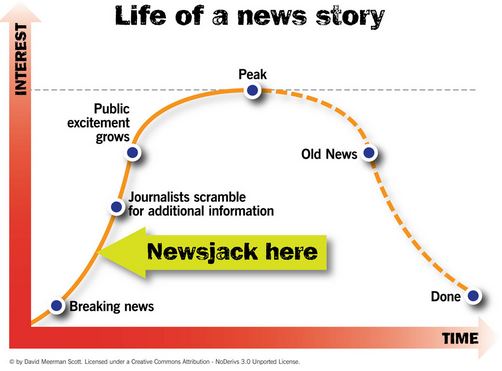
“News-jacking:” you see what’s going on in the media and they’re able to create content around it that becomes really shareable because it’s sitting where it’s hot. 

As you read through Amanda’s comments, take note of what she has done (with plenty of resources including a team of people) and think through how to interpret it and implement similar concepts in your business. We suggest the following:

  1. Think through your audience, where they hang out, and what your main message to each segment may be.
  2. Create a content engine that is your prescribed way of being consistent.
  3. Think about ways to use free, crowdsourced help for additional content.
  4. Investigate Google Hangout as a tool for enhanced collaboration.
  5. News-jack something interesting to supplement your original content. (Like we just did with this excerpt!)