What Matrix Guides the Artisan Entrepreneur?

Recently, I read the story of a graduate student in her first arts entrepreneurship course. She recounts that the first assignment her class had to complete was to analyze The Matrix with a view towards entrepreneurship. The instructor wanted the students to analyze a.) four key components that converged, and b.) the value created as a result of the convergence. The four components were:

  1. factors within our control,
  2. ones outside our control,
  3. inspiration, and
  4. time.

MatrixUnderstand that the paradigm from which the class was operating had far less to do with the thought of a start-up business venture than the combination of behaviors, attributes, qualities, propensities, and actions requisite to think entrepreneurially. Prior to the assignment, the students had come to a place of agreement that key qualities of the mindset would likely include innovation, discipline, vision, and leadership.

In yesterday’s blog post, we studied the comparative mindset of artisan versus opportunist entrepreneurs. Clearly, the ability to recognize an opportunity is critical to either group to attain optimal revenues. In like manner, organizational skills with regards to people, tasks and ideas are important to possess or acquire. Planning, which is envisioned differently in the mind of some, is a discipline that helps the entrepreneur anticipate and become prepared. Thinking of both conventional and unconventional ways to fund the pursuit of the idea is also generally agreed to be important.

As you look at the paradigm, mindset, skills, and habits listed above, a system emerges. Yet, the system relies on the artisan entrepreneur’s ability to observe a competency model that is unlike any at work in corporate HR circles. This competency model values:

  • intellectual and personal entrepreneurial skills,
  • basic professional skills, and 
  • a general understanding of arts culture, policy, and management.

Students in the class mentioned above pursued their respective competency models through a series of exercises administered by the professor. They were encouraged to develop a vision, produce a comprehensive feasibility plan, write a series of process papers, and prepare “pitches” of their proposed ventures to mock audiences of various forms. The assignments became more challenging when the students found out that they had to work interdependently with one another for the work products. For the average participant, this was an unwelcome wrinkle, as most artisans enjoy their individualism. This is not unlike other types of entrepreneurs, but is a personality trait that we documented in the artisan versus opportunist dichotomy that becomes significant when you think about the components the students had to analyze in their Matrix project.

In order to address factors outside one’s control, there has to be a letting go that is ever so hard for an entrepreneur. Without admitting defeat, one must admit the need for help. Realizing that help may be needed forces the individual to think in terms of team development–not just development, but additional sub-processes like recruiting, training, nurturing, and vision casting. If you’ve had no prior experience doing these types of things, they can become your undoing in an enterprise.

The factors that appear to be within one’s control seem not to present a problem. Yet, as we think about these factors, we realize that we must be delusional to honestly think that, as complexity arrives on the scene in terms of additional team members, the external demands upon the enterprise, and the need to divest ourselves of tasks that don’t match out motivated ability, even the internal environment becomes dicey.

Inspiration seems to come naturally to the creative mind. Finding a way to balance newness and executing on prior thoughts is significant, because being able to do so can determine ultimate success versus floundering. Time is an asset that gets swallowed up despite out best intentions. As we build teams, boards, advisory experts, etc, we are able to free up time to focus on the truly important. 

Value has been created, but not without some proverbial “blood, sweat, and tears.” Please don’t be dismayed. You can do this–but you need to embrace a competency model that guides the members selected for your team to collectively represent the diversity you will need to pursue your vision!

Ingenuity Expressed in Art(isan) Entrepreneurship

John Bogle, founder of Vanguard mutual funds, attended Princeton University and was fascinated with entrepreneurship. In his senior thesis in 2006, he cites Joseph Schumpeter as the first economist to recognize how start-ups are so vital to the national economy. Schumpeter was understood to advocate for the fact that entrepreneurs are motivated by the following two characteristics (more so than materialism):

  1. “The joy of creating, of getting things done, of simply exercising one’s energy and ingenuity,”  and
  2. “The will to conquer: the impulse to fight,…to succeed for the sake, not of the fruits of success, but of success itself.”

Certainly, these characteristics are resonators for many entrepreneurs; perhaps most especially so for art(isan) ones. What? Art(isan) entrepreneurs? What is meant by this juxtaposition of terms? Heretofore, many have considered the creative types to be an island unto themselves, rather that a subset of he entrepreneurial movement that is sweeping our land. Yet, if we were to characterize creative types as right brain entrepreneurs and those who pursue STEM education, career opportunities, and new enterprises as left brain, we can create a new construct that is helpful to understand how to encourage the greater number of people to flourish in what is generally regarded as the Creative Age, successor to the Information Age.

Creative thought processes may be said to represent divergent thinking at its essence–the ability to hold an idea without passing judgment of any type. Systematic and analytical processes, therefore, tend towards convergent thinking-a deliberate effort to arrive at a conclusion based on facts and data. In the Research Triangle Park area of North Carolina, we are seeing nothing short of an epic surge of entrepreneurial fervor, much of it trumpeted as helping our economy–both local and beyond–to improve through enhanced job creation, capital flow, and value creation. Yet, virtually all of the media attention is on savvy technology start-ups that seem to rely almost exclusively on the left brain mindset.

Thankfully, there are overlaps such as the digital art required for serious gaming that brings the two sides of the brain together. Outside of such obvious blends of thinking modes, most who inhabit the incubators, accelerators, and entrepreneurial playgrounds of our region are tuned out as to how art(isan) talent can establish entrepreneurial enterprises. 

The art(isan) population has been challenged to find itself, both locally and nationally, as economic recession has caused many galleries, academies, and the like to cut back on programs, space, and staff. Those who have graduated with degrees in various creative fields from design to fashion, studio arts to music, have found employment hard to come by. In times past, many graduates became instructors in the arts or pursued employment in businesses that served entertainment venues. In order for the creative class to find optimal professional engagement, however, new ways will need to be discovered to help art(isan) entrepreneurs convert their passions into their professions. Like a hero on a journey (think of epics like The Odyssey), artists and artisans must set out to manifest her ideals in her creation. 

Creative types do not need skills training from career development types in order to become successful (and more readily accepted) entrepreneurs. What they need is to find people who appreciate their contributions. Just as indie music has shown huge demand for music that is not recorded in an album format, carried on mainstream radio, and performed in huge concert venues, there exist niches for virtually every type of created expression if the artist/artisan will labor to identify the target market. 

The opportunity to showcase one’s talent in a coffee shop, a multi-artisan boutique, or a street show are all vital to artisan entrepreneurship. By inviting others to experience one’s proof of concept, feedback can be gleaned that shapes the creative offerings going forward. Once enough traction is gained within a target market, the artisan can make decisions about what part of the production and delivery of talent she wants to play without fear of being unable to earn a living just as powerfully as any other entrepreneur.

Artisan holiday support

5 Ways Creativity Training Accelerates Innovation

“Creativity and innovation training is a highly effective accelerant for business results.”

-Gregg Fraley

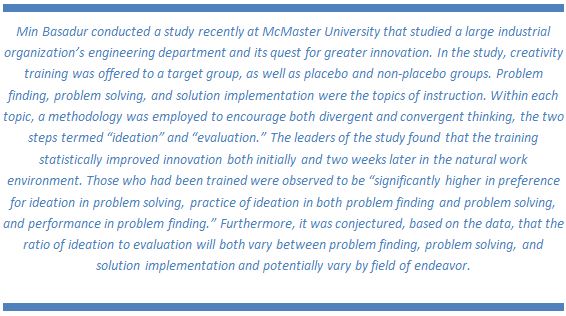
Contrary to naysayers’ beliefs, creativity is a skill set for which training can be developed, delivered, and deployed.  In fact, brainstorming is enhanced by training! Those who tout research saying that brainstorming is ineffective are usually quoting studies that were conducted in situations wherein no training was provided in advance.

Another fallacy that people latch onto is the thought that some people are innovative and others are not. Inside larger companies that tend towards bureaucracy and group think, it can be hard to jump start creativity and innovation. Yet, most will acknowledge that analysis sans insight has severe limitations. Fraley advocates for the principle that training can make a big difference in bridging the gap between market knowledge and potential.


As you can see from the study, creativity training (when done well) can be instructive for employees who need to learn how to think and express ideas in a more positive, focused, and spontaneous way. Breakthrough results often occur when properly fueled by a rapid, flexible, and structured process at the front end of innovation.

Most R&D or innovation initiatives include no budget for training. Since creativity can aid with problem solving and problem finding, organizations need to be awakened to the potential missed from failure to pre-train.  Fraley feels  creativity and innovation training accelerates innovation in five strategic ways:

  1. Improved creative thinking leads to enhanced innovation capacity, and with action, results.
  2. Training helps instill structured creative thinking and innovation process as a cultural value and habit.
  3. Training provides innovation teams with a common language and framework to solve problems, improve communication, expedite complex problem resolution, and moving new business concepts forward.
  4. Training corrects many of the myths that surround creativity and innovation. There is a science to this that is largely ignored. For those that learn and practice the science — it’s a competitive advantage.
  5. Team efficiency improves because a lot of useless chatter, debate, and conflict are eliminated.

Creativity is intimately related to change, decision making, and problem solving — it’s not just artistic self-expression!


Experimental Failure Leads to Success

We’ve all heard the Thomas Edison quote that he “successfully discovered 1000 ways to not make a light bulb.” He didn’t consider the 1000 attempts as failures, but rather experiments from which he collected data that guided the innovative process. Who else lays claim to so many failures? Cisco grew to be one of the largest technology companies in the world after being rejected for funding by 76 venture capital firms. Michael Jordan, in the minds of many (including yours truly) the greatest basketball player of all time, was cut from his high school basketball team. John Grisham, award winning novelist, was rejected by a couple dozen  publishers before getting his first sizable deal. Slumdog Millionaire won 8 Academy Awards after Warner Brothers gave up on it and sold the property to Fox Searchlight. In short, each of these is a story about finding a positive way to apply lessons learned.

Why is it that workers go from being starry eyed, curious and energetic to automatons after working for a company for an extended period of time? Usually, by the time these numbed brains “check out” mentally, they have already been promoted to a managerial level. We value visionary leaders, but all disdain lethargic managers. What’s the difference between the two? The loss of intellectual creativity and desire to take risks leads to bureaucracy. The market demands innovation. Those who will lead are challenged to not become shut off to progress and new ideas.

Paul Arden wrote It’s Not How Good You Are, It’s How Good You Want To Be. The former executive creative director of Saatchi & Sattchi said, people “will say nice things rather than be too critical. Also, we tend to edit out the bad so that we hear only what we want to hear…If, instead of seeking approval, you ask, ‘What’s wrong with it? How can I make it better?’ You are more likely to get a truthful, critical answer.”

Jeremy Gutsche concurs with Arden, writing that “a culture that openly discusses imperfection is more likely to accept the failure that comes from acceptable risk.”

Michael Jordan, mentioned above as the greatest basketball player in history, said the following about taking risks, 

“I’ve missed more than 9,000 shots in my career. I’ve lost almost 300 games. 26 ti,es I’ve been trusted to take the game winning shot and missed. I’ve failed over and over and over again in my life and that is why I succeed.” 

Most companies, however, spend a lot of time in performance appraisals celebrating successful outcomes and critiquing efforts that don’t appear to meet expectations. Think for a minute, however, about how to inspire your employees to be clever and progressive. Put measures in place to help them feel protected. It must be understood that trying new things, even if failure is the outcome, is a better business decision than undertaking safe projects constantly.

It is said that Steven Ross would fire employees for not making mistakes when Warner was launching its MTV subsidiary. He and his leadership team were trying to debut new programming and needed as much innovation as possible. Similarly, Microsoft used to have the mentality that a leader was not ready for promotion if he had not had a highly publicized, big flop. Thomas Watson, Sr., founder of IBM, once received a phone call from an employee who wanted to resign after making a $10 million mistake. Watson refused to let him follow through with his intended action, telling the manager that IBM had just spent $10 million educating him.

How much money and time are you willing to spend in your organization to educate people and give them the chance to pioneer something great? Probably not enough. 

Can Generalists Thrive in the Conceptual Age?

One of the questions I get most often is: “what do you do?” The answer to that question is not an easy one, as my work with companies ranges from start-ups to those almost middle market size, and the services I offer from advisory board member to turnaround artist. Yet, when my role is marketing consultant, I advise others to be able to answer the very same question crisply, concisely, and in a compelling way. What is poignant is that, as we gain more skills over the years, it becomes harder and harder to specialize. That is not to say, however, that I have not met people in business who are extremely specialized and who succeed in their field. For the moment, though, I want to write for others who have adapted to competitive market demands to embrace new skill sets, become masterful enough that others hire them to provide those new skills, and now are the proverbial “generalists.”

Don’t confuse “generalist” with “General,” however, as many generalists struggle to stay with one organization long enough to rise to the rank of top officer. Furthermore, a generalist has challenges in the unique realm of trying to keep up with evolution in many more topical areas, all of which are changing at a faster rate than at perhaps any time in history. The good news is that, as Daniel Pink points out in A Whole New Mind, we are now living in the Conceptual Age, having evolved from the Information Age to a day and time when creativity will be valued highly. Maybe that is not such good news for left brain folks who are not able to adapt, but for those (for whom the learning of new information was merely a means to an end, the end being to connect emotionally with others, build relationships, and find success while doing so) who embrace right-brained living, it is a brand new day!

Here are the new skills that are needed in the Conceptual Age:

  1. Design – the ability to create something that has significance as well as usefulness.
  2. Story – the ability to put facts into context and deliver them with emotional impact.
  3. Symphony – the ability to see the big picture, connect the dots, combine disparate things into something new.
  4. Play – sense of humor and laughter plus other components to balance the psyche.
  5. Empathy – standing in someone else’s shoes, feeling with his or her heart, seeing with his or her eyes.
  6. Meaning – working for something in which one believes with others who have similar values.

As you can see from the list, the emphasis and value will be placed on original thought rather than automatable routines. Computer power has now rendered many repeatable acts less valuable (not unnecessary, mind you, just worth less than previously because either low wage earners or machines can perform them admirably). What will come to be increasingly important is the ability to think up a new concept, develop it sufficiently, and share it so that it resonates with the heart of another. 

What’s the role of the generalist in this new economy? That depends–can you adapt, or are you trying to pour new wine into an old wineskin? Those of us who can adapt will be able to answer questions like “what do you do?” with less of an elevator pitch and more of a carefully crafted story that captures the mind, will, and emotions of the intended audience, hopefully in a multi-sensory way!

Cheers to you as you embark on the journey to greater relevance, enhanced value to others, and — I sincerely hope — a much greater sense of doing something truly meaningful (other than just adding to your repository of information.)