Don’t Mess With…the Customer Perspective

A deep understanding of your target audience is the only way to create ideas that resonate and break through the noise of modern life. Being able to connect authentically and directly to a buyer persona’s culture is an effort in alignment. Alignment is not just for vehicles–it is critical to business success! When people begin to see your product or service as a part of their identity, then you have built a connection with stickiness to it!

Keep America Beautiful launched a campaign years ago aimed at deterring littering. In it, an actor made to look like an Indian cries when he sees trash detracting from an otherwise majestic scene. While an emotional memory was built through the public service announcement, a cultural connection was not formed and very few behaviors were changed. Littering is still a problem today. (In fact, one of the things that irks many are cigarette butts all over the ground, thrown out car windows, and piled up at entrances to office buildings.) Why smokers can’t keep their butts to themselves is a mystery! 

A market research project in Texas sought to understand who litters. What they found in terms of demographics were that 70 percent of “litterbugs” were males, who also usually had the following characteristics:

  • they are young
  • they drive trucks
  • they drink beer
  • they have a “king of the world” attitude

The research project led to a marketing campaign recommendation to engage culturally with these young males. Ever heard the slogan, “Don’t Mess With Texas?”  In the mid 1980s, actors and athletes were recruited as spokespeople for a new breed of PSA in which the stars shouted out the now famous slogan. For instance, two burly defensive football players from the Dallas Cowboys team during that era are depicted roadside, picking up trash and vowing that they want to give litterers a personal message!

Megastars like Matthew McConaughey, Jennifer Love Hewitt, George Foreman, Owen Wilson, Chamillionaire, and Chuck Norris all did cameo endorsements for the campaign. YouTube videos show that it went viral. When a leading research organization suggested that a 10% reduction in littering would be good and 15% stellar, its team had no idea what a campaign that truly connected could do. In the first five years after the slogan was launched, litter in Texas was reduced by 72%!!!

Something else that really connected was Cadillac’s launch of is Escalade SUV. Escalades became iconic in hip hop culture, appearing in music videos, lyrics, and becoming the ride of choice for many to demonstrate status. John Manoogian, who oversaw external design at Cadillac, was asked why it became the bestselling full sized SUV for a number of years.  Rather than attributing success to something like product placement, he admitted that Cadillac missed its target audience with the Escalade. It was intended for  older affluent males. When it didn’t sell as planned, he visited a dangerous neighborhood in Detroit to see who else might be in the market for the luxury SUV. While the “business” that the owners of Escalades appeared to be in was not what bigwigs at headquarters may have wanted, he realized they had a winner. From there, it was a matter of building a strong marketing approach to reach the target audience and tweak the product based on feedback–just like any other niche!

What can be learned from these two “case studies?” Simply that we must not try to educate people into taking another perspective that is conducive to our personal or corporate success. Instead, we should find out what is important to the target and meet them culturally with an offering that resonates with their environment, way of living, and motivations.

 

SCARF Up Some Change

In an HBR blog post about organizational change this morning, Walter McFarland draws in the role of the brain in defining whether change efforts will meet with success. Some of the casualties of failure to adapt to changing market conditions he mentions include Sunbeam, Polaroid, and Circuit City. While each of these formerly strong companies is no longer in business, proponents of organizational change struggle to define why some are able to reinvent themselves and others are not, other than the nefarious “human element.”

Organizational change as a field of study has long maintained that change can be defined in linear, sequential terms and processes. What we are discovering, largely through examining principles of neuroscience, is that change is neither. Instead, McFarland, the board chair elect of the American Society of Training and Development (ASTD), argues that modern business dynamics would suggest that it is chaotic. It is the chaotic nature of change that creates the need for greater research. We live in a time when the need to constantly change is critical to competitiveness. Neuroscience may be a key to helping us steer organizations through adaptation more effectively.

Thompson and Luthans wrote that typical reactions to change “can be so excessive and immediate, that some researchers have suggested it may be easier to start a completely new organization than to try to change an existing one.” While industrial psychologists refer to this as “human resistance to change,” very few who study the phenomenon have identified how to lower the resistance consistently and pervasively. 

At the NeuroLeadership Summit, being held in New York this week, a panel discussion with senior executives and experts from The Conference Board, the Association of Change Management Professionals, Change Leaders, and Barnard College will explore the connection between neuroscience and organizational change, understanding how we can effectively deal with the human resistance to change. 

A new organizational change model is being proposed that takes into account how successful change functions in a modern organization, where work is conceptual, creative, and relational, and talent is portable. According to McFarland, activities that have contributed to the continuing poor performance of change initiatives include:

  • Perpetual underpreparation: change is always dreaded and a surprise to employees
  • A perceived need to “create a burning platform”: meant to motive employees via expressed or implied threat
  • Leading change from the top of the organization down: only a few individuals are actively involved in the change and either under communicate or miscommunicate with others

Top-down change (the traditional model) can trigger fear within employees because it “deprives them of key needs that help them better navigate the social world in the workplace. These needs include status, certainty, autonomy, relatedness, and fairness” — the foundation of the SCARF model

  • Status is about relative importance to others.
  • Certainty concerns being able to predict the future.
  • Autonomy provides a sense of control over events.
  • Relatedness is a sense of safety with others – of friend rather than foe.
  • Fairness is a perception of fair exchanges between people.

SCARF is a summary of important discoveries from neuroscience about the way people interact socially and is built on three central ideas:

  1. The brain treats many social threats and rewards with the same intensity as physical threats and rewards (Lieberman, & Eisenberger, 2009). 
  2. The capacity to make decisions, solve problems and collaborate with others is generally reduced by a threat response and increased under a reward response (Elliot, 2008). 
  3. The threat response is more intense and more common and often needs to be carefully minimized in social interactions (Baumeister et al, 2001).

Since organizational change is a significant social interaction in the marketplace, it is important to minimize perceived risk. Understanding how people tick, empowering them to vocalize their ideas, and creating better systems to engage them in the change process is best practice. More organizations need to get on board.


Don’t Make a Monkey Out of Innovation


The story is told of five monkeys who were a part of an experiment studying group theory. Inside the cage wherein they were placed, a ladder led to a bunch of tantalizing bananas. What the test subjects initially did not know was that a high-pressure water hose was attached to the ladder.

One eager monkey raced up the ladder, reaching for one of the tasty bananas, only to cause the entire cage to be deluged with water. Undeterred, another monkey made her own attempt to reach the top. When she ascended the ladder, all the monkeys were again treated to a downpour. The lesson began to sink in–if any one of us tries to reach for the banana bunch, we are all going to get soaked, and that is unpleasant.

As the original test group was substituted out for individual newcomers, one by one the new arrival would make an effort to scale the ladder for the tasty treat. However, the existing group, fearing the dousing, would beat the newcomer down before he could make it to the top. The cycle was repeated, with the same result, until all the original monkeys had been replaced.

When the water hose was removed, it didn’t affect the curiosity of the monkeys–they had learned to avoid the bananas.

In most organizations, there is a built-in resistance to trying new things–particularly if hard lessons had been learned that discourage innovation. It is as though the expectation of risk bringing failure or reprimand begins to thwart spontaneity and creativity, until “group think” has overtaken individual expression. As you think about your own organization, to what degree does this thought process embed itself in your company culture?

Organizations who want to improve their organizational culture need to go to work on the four dynamics above. Perspective, defined as the way we look at the future and the problems we are trying to solve, determines destiny. If it is one’s approach to always be logical, for instance, that is a matter of perspective–not necessarily a reality for all player’s in a niche market. Lou Gerstner, in speaking about his turnaround of IBM, said, “I came to see in my time at IBM that culture isn’t just one aspect of the game–it is the game.” Some of the changes he made seemed like semantics, but his commitment to them made a huge difference:

  • Shift the focus from product to customer
  • Shift from “value me” (silo) to “value us” (the whole)
  • Shift from analysis paralysis to making decisions with 80% knowledge and moving forward

Experimental failure means creating a safe environment in which ideas can be tested and allowed to fail without the idea person being labeled a failure. Instead of making minor adjustments to what exists today, we need to foster an attitude that looks for tomorrow’s breakthroughs. Often, complacency is the doom of a department, division, or business. It has been said that we grow most in the valleys. If you are a part of an organization that only wants to play “king of the hill” through entrenchment, you should look for your next opportunity today!

Disruptive innovation begins with a deep understanding of the needs of your target audience. Customer obsession is an intentional effort to connect and engage..especially on an emotional level. When the connection is made, your product or service resonates with the customer in such a way that she cannot imagine a world without your offering as a part of her life.

Breaking down worn-out structures and processes that hinder our vision of market dynamics allows us to adapt effectively. Intentional destruction challenges the assumption that a strong titular leader makes an organization high-performing. Instead, ideology becomes the unifying factor. Empowered employees can react more quickly and build greater team capabilities that those languishing under an unwieldy reporting structure.

As you look at these recommended area to improve your organizational culture (thanks, by the way, to Jeremy Gutsche, again, for articulating many of these ideas in his writings), determine one thing you can obtain buy-in to change this week and do it!


Relevance in Business is Fleeting

“Focus Not on Protecting What You Have, Instead Obsess on the Next Big Thing.”

While this type of headline may not serve us very well in interpersonal relationships, it has become the watchword in business. Those who rest on yesterday’s accomplishments eventually find themselves with less and less current successes. Since we live in a day and time when ideas are ubiquitous, information plentiful, and communications vastly enhanced, it is incumbent upon every enterprise to remain on the hunt for “wow.”

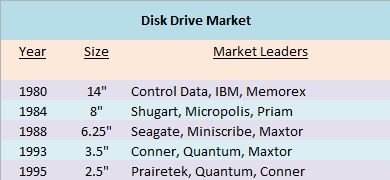
Jeremy Gutsche of Trendhunter wrote in Exploiting Chaos that the disk drive, computer chip, and word processing markets were all ones that saw enormous changes and the market leaders were often outflanked. Read on:

Borrowing from Clay Christensen’s work in The Innovator’s Dilemma , Gutsche described the progression in the disk drive industry towards constantly smaller drives. Along the way, observe the shift in power:


Observe how great organizations present in 1980 gave way to more nimble upstart startups over 15 years. Though the only apparent change was size of the drive, it was enough innovation occurring at a rapid enough rate to trip up the “big boys.” Perhaps, one may suggest, disk drives had become commoditized as more PCs were manufactured? This theory seems to hold true in computer chips, then, as well. To note:

Observe that this market experienced a slower rate of change (40 years of upheaval vs. 15), but the net result was the same: market leaders gave up leadership to disruptive alternatives. The fact that semiconductors require very extensive research and development efforts, whose project funding ranged into the billions of dollars, made this a significant economic microtrend. Gutsche points out that RCA was once twice the size of IBM, so the thought process that monetary barriers to entry would protect industry leaders was disproved time and again.

Word processing was once known as typewriting and the market leader was Smith Corona. Smith Corona was extraordinarily innovative, boasting over 100 patents spread over decades. Yet, the company who also invented the first word processor did not continue to reinvent itself in the computing age and lost its market leadership role. It is suggested that the historical accomplishments became blinders to the urgency for continuous improvement. Notice, they understood the concept of reinvention, but underestimated the urgency factor.

Lest you think that Smith Corona had been mismanaged over the course of the 20th century, pay attention to the fact that their annual revenues in 1989 were $500 million! What happened? Let’s look at some of the competition and what strategic decisions they made…Remington recognized the opportunity of computers and made the leap in 1950, only to be too early to that niche, lose money, and the computing division sold off in 1981. Perhaps Smith Corona saw the foibles of a competitor and vowed not to make the same mistake?

Commodore, on the other hand, was a different kind of competitor. Their model 128 was introduced in 1985 with two external floppy drives. The Smith Corona PWP 40 was preferred by buyers by a wide margin for word processing applications. Yet, someone inside the company saw an opportunity to partner with Acer on a computer joint venture. Unfortunately, the plug was pulled before the strategy could run its course.  Smith Corona declared bankruptcy in 1995; Acer became the fourth-largest PC company in the world!

Scott Anthony, writing for Harvard Business Review in an article entitled “Disruption is a Moving Target” observed a clear pattern:

  1. Disruptors enter a market incumbents don’t care about.
  2. Entrants grow as incumbents flee.
  3. The incumbent hits a ceiling.

What should be learned from this insight? Larger companies should not ignore small opportunities simply because they start out small. Smaller companies should plan their strategy and tactics around “nibbling at the edges” of an incumbent’s market share.


Dirty Martini Intrapreneurship

One  of the portals I use to stay abreast of innovation is called Alltop. It is organized by author and an author by the name of Gregg Fraley caught my attention last week. Gregg had written an article entitled, “Do You Want Innovation or a Dirty Martini.” Rather than describe the whole article for you (or violate his copyright), I offer you the following excerpt:

note: Haley references the topic of management engagement in innovation and some “interesting posts lately byPaul Hobcraft

I think many high level executives simply don’t know what they have. Until it’s too late.

There are a lot of smart people out there, with great ideas. Talent is something you need if you really want to innovate. And yet, really, most organizations already have that talent. No, not every employee is Jony Ives and is an impact player at that level, but nearly every company has some people that, under the right circumstances, can hit home runs (score goals, set records, win gold, etc.). Ives himself was locked in a closet before Steve Jobs found the key.

In my travels doing talks and such I often have a chance to chat with line workers and middle managers who are beyond frustrated. They have ideas, they have energy, they care about the company — and none of that goodness is being channeled towards innovation. In fact, it’s being actively suppressed in some cases.

The phenomenon that Haley describes is one in which many organizations, even reading about Google or Cisco, who both encourage creativity and innovation, are faltering. Their people are full of great potential that largely goes untapped because there is not a means to commercialize new ideas (or even pursue new methods) because management is not intentional about cultivating input from others–especially those outside the management side of the building. Haley goes on to argue that even those with creative talent, who are often recruited to organizations that need the proverbial “breath of fresh air,” find that their approach is not valued and they begin looking for their next opportunity too soon after joining an organization that so desperately needs them but is not accommodating to them.

He says, “C-suite types, hear this, if you knew  how much talent is wasting away right under your nose, you’d cry in your martini. Don’t believe it? Ask. Ask a sampling of your people the simple question — where are the hidden gems around here? You’ll find out things you didn’t know. People with secret projects, big ideas they’ve been holding back, crazy ideas that just might work…Want to turn the situation around? Ask another question — what’s holding you back?”

I would add to the questions he asks the following:

What are you doing to foster a culture of innovation?

Here are some suggestions–

  1. Change the way you form work teams. Build diversity of thought into as many teams as possible.
  2. Change your own role from decision maker to facilitator. See yourself as primarily responsible to help others shine and succeed.
  3. Create a knowledge management system that captures lessons learned and best practices to be disseminated broadly and consistently.
  4. Celebrate when an employee takes initiative. Find ways to acknowledge them openly.
  5. Get rid of the traditional research and development process. Instead of a department, create an inter-departmental group that represents not just different disciplines, but also different levels of experience and different demographics.

Intrapreneurship is on the rise among savvy competitors. It does not, however,  come without a price–ego has to be checked at the door and individuals valued for their unique contributions.  Your challenge is to retain creative talent that otherwise would start their own businesses or work for more progressive competitors!