How Do Successful Businesses Manage Their Operations?

After working hard on the marketing plan and the financial plan, successful executive teams develop operating plans to implement them. These are the plans that ultimately result in successfully bringing one’s idea into the marketplace–and profits into the owner’s pocket. Staffing, office administration, and work flow supervision are the primary needs. Successful businesses anticipate problems and take steps immediately to improve workflow efficiency. Supervisors and budgets are assigned to control costs. If necessary, outside fractional help is secured to make sure that appropriate resources are allocated to the best potential outcomes. In addition, the top executive may recommend steps financial and marketing teams can take to enhance overall productivity–and, by extension, profitability. For example, organizations that offer and sell the same or similar goods or services over and over usually see fewer cost overruns and therefore generate more profit per unit of sale.

Staffing a business with the correct number and types of employees makes your workplace both productive and more enjoyable. Sprinkle in some training and development and you demonstrate care and concern for your people. Create feedback loops and engagement will soar. Successful organizations increase or decrease staff levels as operating plans require. Outsourced human resources–whether through independent contractors, fractional professional staff, or subcontracting–allows your company to optimize human resources for any level of work necessary. Making preparations to finish existing projects while beginning new ones and documenting how the work will be accomplished will focus your efforts.

Administering a variety of initiatives simultaneously places certain demands on office staff as well. A successful executive team thinks through the documentation needs of the organization and assigns responsibilities to appropriate personnel. Institutional knowledge is thereby captured for the benefit of all and adjustments become easier to make. Well-organized files–physical and electronic–are another vital component to smooth business operations and can eliminate wasted time and effort, as well as reinforce best practices!

Successful supervision of field (or plant or billable or development) personnel involves more than simply the “management by walking around” approach of yore. Think about technology as a means to do more with less. Creatively brainstorm as to how to maximize the benefits of being face-to-face versus virtual–it’s a trade-off of time, money, and precious additional resources. Recruiting and hiring should reflect an effort to add to the team those who are the best cultural fit rather than simply strong technicians who may undermine the esprit de corps. Compensation and performance management systems should reinforce your value system–not stand separate from it. Think of processes like equipping, quality management, customer service, coaching, mentoring, motivating as key factors in your success. When you do, plans can be made to enable your organization’s operations to become efficient and profitable.
Do Your Cultural Diligence in M&A!

Of course the merger was a success. Neither company could have lost that much money on its own.

-Steve Case, Former Chairman of the Board
AOL/Time Warner

Competitive markets create an environment wherein companies strive for revenue growth. When organic (internal) growth is hard to come by, inorganic growth becomes a target. Inorganic is a category that includes merger and acquisition (M&A) activity as a primary strategy.

While business exigencies demonstrate the “need” for change, often the hard facts found in classic due diligence processes have far less to do with ultimate success than the cultural fit of a transaction between parties. Consequently, organizations that understand their core values are much more likely to reach the kind of growth and success that nearly all businesses seek [Gallangher 2003].

Successful M&A has been known to grow markets, build on complementary strengths, and eliminate inefficiency. But what ultimately matters in an acquisition is what happens in the hearts and minds of the people who remain with the new organization and what culture these formerly distinct entities choose to build while moving forward [Gallangher].

The Mercer Consulting Group, in studying M&A activity, finds that, among unsuccessful ones that many of the failures are caused by not conducting the same kind of “due diligence” on the culture, structure, and processes of an acquisition target as they do on the financial balance sheet [Gallangher]. 

Traditional due diligence typically analyzes the following:
– Historical performance,
– Ownership and organizational structure,
– Management team,
– Products and services, 
– Assets and liabilities,
– Information systems and technology, and
– Organizational culture [Bouchard, Pellet 2002].

J. Robert Carleton, management consultant and senior partner of the Vector Group, says, “Unfortunately, little or no time is generally spent analyzing the nature, demeanor, and beliefs of the people who will be involved in carrying out the business plan”. He believes that standard due diligence does not address some of the key questions that must be asked to accurately assess organizational readiness for a major change, such as a merger or acquisition. Even when some of the “right” questions are asked, Carleton argues, they are often limited to brief interviews with key executives, who likely have differing views from the rest of the employee group. The people in the trenches, the ones doing much of the actual work are not even involved. He  finds it interesting that “in financial and legal due diligence no such ‘act of faith’ is acceptable” in terms of the investigative procedure [Bouchard, Pellet].

“Cultural due diligence” is a phrase that more strategists are using  to assess what stumbling blocks may hinder successful integration of entities and their operations. Key factors to be considered include:

– leadership and management practices, styles, and relationships,
– governing principles,
– formal procedures,
– informal practices,
– employee satisfaction,
– customer satisfaction,
– key business drivers,
– organizational characteristics,
– perceptions and expectations, and
– how the work gets done in your organization

[Bouchard, Pellet; see also Carleton, Lineberry 2004].

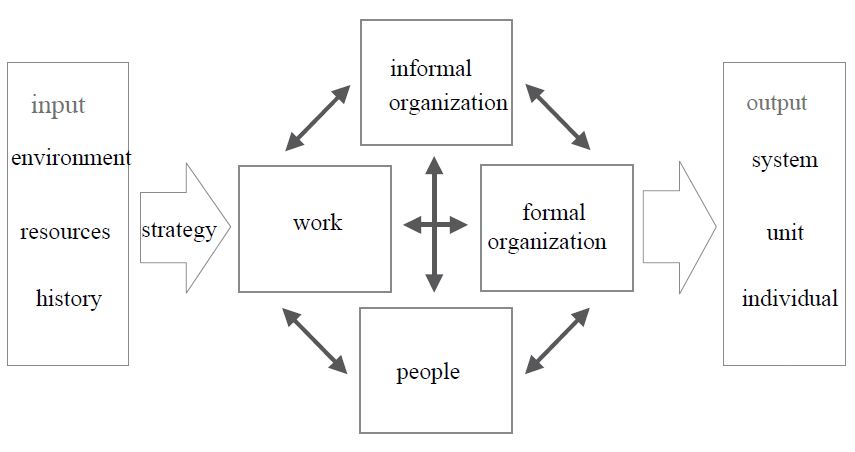
When HP and Compaq decided to combine forces, they used schematics like the one below to help them discuss the salient issues–

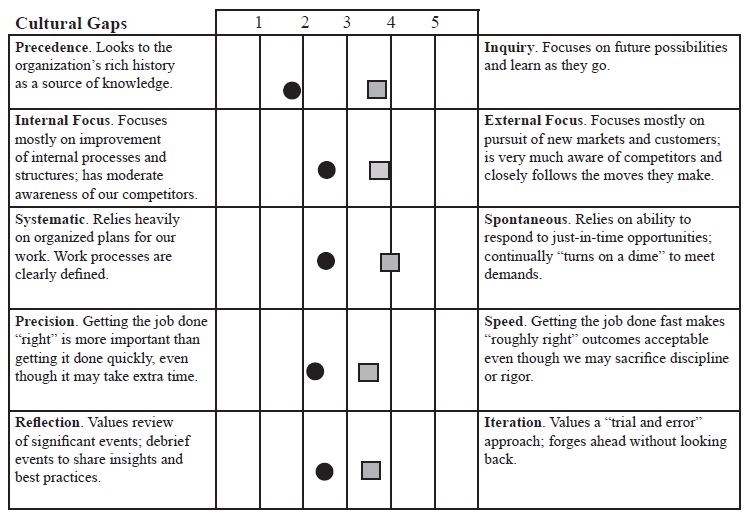
After looking through these issues and discussing each company’s culture, the merger team put together a chart like the one below to begin developing tactics to plan for a smooth post-closing integration.

As you look at this chart, think about key M&A transactions in your industry or local community. Of the ones that did not pan out as planned, do you think they would have stood a better chance had they systematically worked through these type issues during due diligence?

Cultural due diligence is vital to successful M&A processes. If earnest consideration were given to culture as it is to financial and other factors, inorganic growth and increased market share would be a realized outcome far more often!

(Thanks go out to Agata Stachowicz-Stanusch, who wrote of the value of cultural due dilgence and detailed a case study of the HP-Compaq merger in the Journal of Intercultural Management’s April, 2009 edition.)

European Media Incubators PepsiCo Style

Recently, we have noted that intrapreneurship is an emerging trend, perhaps even hotter than entrepreneurship. One of the hybrid expressions of these category leaders is the incubator inside the larger business. In the media industry in particular, the struggle to keep up with digital competitors creates a huge need for innovation. Chip Lebovtiz, writing for Fortune online, describes what two media companies across the Atlantic are doing.

The Irish Times and the BBC’s commercial arm, BBC Worldwide, are establishing intercompany startup incubators to harness young businesses’ disruptive energies. The (Irish Times Digital Challenge).. is akin to the plot of a Hollywood movie: a young up-and-comer works with a grumpy old mentor to overcome a problem, learning a valuable life lesson in the process. In this case, the problem is how to better monetize a company’s online presence and the life lesson is the experience startups get by working with a large company, says TheIrish Times Chief Innovation Officer Johnny Ryan.

Ryan is the brains behind (the competition), in which five early-stage companies  — 81 applied — spend eight weeks working at the Times to translate their pitch into virtual reality. While their ideas widely vary, their end goal is the same, to win €50,000 (about $61,000) from venture capital fund DFJ Esprit. The winning team must prove to the Times that its product provides the largest revenue potential and improvement to reader experience.

This is an interesting competition because large revenues and improved reader experience may be mutually incompatible. One has to wonder whether the intrapreneurs have the latitude to recommend strategies that may cannibalize longstanding business practices at the publisher.

BBC Worldwide Labs, a new business accelerator for startups, takes a similar but distinct tack. There is no competition between the fledgling companies and no prize money, but the six-month program offers a trophy of a different sort: the startups get a first client worth billions.

“The BBC can be a great first customer,” says BBC Worldwide Labs Head Jenny Fielding. The broadcasting giant can be “a partner at the point of commercialization for these companies.”

This approach is intriguing because of the built-in customer aspect. Many start-up companies struggle with defining a target market that is both large enough and profitable enough to serve as the fledgling enterprise scales. Yet, by becoming a captive supplier, does the intrapreneur become prejudiced against other viable market development opportunities?

What makes these programs distinctive is that the startups operate just down the hall from the people implementing their products. This proximity to the client is designed to overcome obstacles usually found in interactions between startups and large corporations.

Working with big companies is difficult for fledgling businesses. Fielding, in her role as the head of Digital Ventures at the BBC, often has to personally guide startups through the BBC’s diverse ecosystem. By situating the program in the BBC’s London Media Center headquarters, she expects the smaller startups to more quickly acclimate to and efficiently work with the larger BBC.

Neither the BBC nor The Irish Times will take equity stakes in the young companies they incubate. Instead, the media companies hope to establish a relationship with these startups that is ultimately scalable into a larger, future partnership…

Director of Global Digital and Social Media at PepsiCo Josh Karpf isn’t too surprised to see media companies adopt the (PepsiCo10 incubator approach)…”Technology is affecting every industry today, and media is no different, he says in an email to Fortune. “Companies that are trying to find technologies that will impact their businesses three to five years down the line are the ones who will win in the future.”


Helping Companies Innovate On Purpose


Organizations large and small have teams that are responsible for executing business objectives. In some cases, the objective is to overcome a challenge; other times to re-engineer a process; still others are tasked with the commercialization of new ideas.  Regardless the initiative, the net result is that change will need to occur in order for a new, preferred outcome to be realized. Instead of the top executive in a group owning the need to introduce change, it is usually better to get a team involved for buy-in and swift implementation as well as diverse viewpoints.

Every team has inherent strengths, unique capabilities, passionate individuals with keen insights, and the opportunity to succeed. Invariably, however, time seems to work against innovation and helping teams find the time to do something uniquely significant can be tough work. Culture can impede team progress. It is important to provide the permission, resources, and support for teams to feel it is okay to brainstorm, invent, and implement new ideas.

Bulldog Drummond of San Diego uses a five step process to guide teams through innovation:

STEP 1:  WHAT’S THE PROBLEM? 

While it sounds obvious, framing the challenge clearly is the first step to take. Use the power of “Why?” to ensure the challenge is clearly stated and that everyone on your team understands the problem or the opportunity. Frame the challenge as a question. 

STEP 2: UNLEASH CROSS-FUNCTIONAL TEAMS

Brilliant minds inside companies are often under-utilized because there isn’t a venue to bring them together. These minds don’t get enough time with their peers and are rarely put into environments designed to produce them with enough time to attack a single issue. When solving a challenge, don’t just have marketing or product development teams attack the problem. Instead, unleash the power of cross-functional teams and, if possible, more than one. 

STEP 3: PUT THE CONSUMER (AND KEY INSIGHTS) INTO THE MIDDLE OF THE CHALLENGE

Millions of dollars are flushed down the drain because people aren’t paying attention to the data and the knowledge it contains is not organized in a manner that tells a compelling story. Bringing the consumer to life as people, not just as data, places the consumer and key scenarios into the middle of the challenge in an organized and insightful approach.

STEP 4: DESIGN AND FACILITATE AN AMAZING PROJECT EXPERIENCE

When attacking a challenge, envision the entire experience from beginning to end so that the teams can focus on solving the challenge. We begin by defining success with the project leaders and then choose an inspiring offsite venue and bring 5 to 10 cross-functional teams together. We make sure there is homework completed in advance preparing the teams for their time together, including gathered research, trends, and suggested work in the field. Next, we design the experience—from music and food, to a range of carefully facilitated exercises—and we model a passionate curiosity to solve the problem. At the end of the one or two days we always have amazing, actionable outcomes. 

STEP 5:  ACT QUICKLY ON THE OUTCOMES 

The key to success is to ensure that the ideas are not lost because they haven’t been framed correctly, or they don’t get the time and attention due to the day-to-day activities. Make sure that post the summit, the learnings and outcomes are synthesized in a compelling way, and that a project champion is chosen to lead the ideas into development.

Well-designed innovation summits are characterized by creativity, fun, and enthusiasm. Your organization can empower its teams with resources, support, and approval to dream big dreams and develop ideas that will benefit the organization. It is then incumbent upon leaders to move quickly to implement the ideas.


Endurance Runners Are Like Entrepreneurs

In writing for Inc magazine, Patricia Fletcher draws a comparison between entrepreneurs and marathon runners. In addition to being a little crazy, she says both have a plan to follow that prepares them for success. The performance for which you are judged is predictable from the “practice” that leads up to it. Here are Fletcher’s observations about the right mindset both need–

Get comfortable being uncomfortable for long periods of time.  Believe it or not, this will become a badge of honor.  Most of your work as an entrepreneur requires you to try new approaches, to push yourself beyond your limits. This means that you will fail a lot. You will struggle for funding–a lot. You will lose customers and opportunities–a lot. It’s all part of the training process. Your response to rejection is as good a determinant of your entrepreneurial ability as your response to success.

Adopt a resilient mindset. You are going to have some tough days; days when you question your own sanity and want throw in the towel.  Much like a marathon, the entrepreneurial experience is long, twisting, and filled with ups and downs. Every successful entrepreneur and marathoner I have talked with believes mindset is either your biggest asset or your biggest barrier. The pros handle it by maintaining an objective mindset that looks at setbacks as opportunities for improvement.

Embrace others like you. Working in a vacuum is not going to help you finish the race. Runners find running partners or join running clubs. They get faster because they push each other. They become stronger because they share tips for nutrition and avoiding injury. You can do the same thing. 

Connect with other entrepreneurs. Get together to practice your pitches, test your demos, and talk about go-to-market strategies. Working together will give you practice and insights while creating the relationships that will push you forward.

Don’t over-train. In my first few years as a runner and professional, I over-trained, thinking it would make me stronger and better, and prove that I belonged. Instead, I burned out. You will not succeed if you have 10 No. 1 priorities. Identify your top three goals. Don’t do anything that won’t make a big impact on your progress toward those three.

At conferences, I have heard several speakers tell up-and-coming women entrepreneurs and executives that they should say yes to any high-profile opportunities. I disagree. Go after new opportunities only if they’ll help you achieve one of your three big goals.

Measure. A good plan incorporates key performance indicators to track your progress. It also helps lessen risk by proactively addressing problems. What measurements will tell you that you are making progress?  How often should you track your progress?  What are your biggest obstacles?  Which do you need to address and which can be ignored? 

As someone who has been a distance runner for over 30 years, I can relate to each of these. When I was competing, I had a mental edginess honed from the daily effort I put into psyche and development of my skills. As an entrepreneur, I have  been more successful when I have brought my “A” game to what I do. How about you?