Personal Marketing Plans Outperform Rainmakers

Organizations that depend on their staff to only fulfill orders are short-sighted. Whether those orders are for products or services is not the issue; how they are sold is what is critical. Let’s assume for the moment that products are sold through a variety of sales channels and that services are primarily sold face-to-face. It is not uncommon for the services organization to have an aversion to using the term “sales” because it seems transactional. So, in an all-out effort to avoid being “salesy,” cloaked in a mantra that one’s organization is only concerned with great customer service, services firms create a culture that is averse to engaging new prospects.

There are, however, exceptions to most every business “rule” or stereotype. Enter The Rainmaker. The Rainmaker is both the organization’s greatest asset and liability. Employees understand that the creation of need for their intellectual contributions is usually a feat reserved for The Rainmaker. With considerable aplomb, this individual networks with ease, establishes strong referral networks, is well-known and is most appreciated by those who have a fear of ever being asked to copy what she does.

                When organizations rely on The Rainmaker—be that one or multiple—to generate enough work for everyone else to be paid competitive wages regardless of whether they ever successfully bring in a new account, they create a long-term liability. Like the temptation to live large off credit cards today in one’s personal life or to distribute earnings and share profits but not reinvest into a business, this practice of overreliance on The Rainmaker is precarious. Reckoning Day will arrive and most organizations realize that they have created a monstrous succession problem. Some are successful in delaying the inevitable by hiring a business development professional (read: salesman in any other context) who augments current revenue growth, but is not a viable replacement of the DNA of The Rainmaker, who is usually a 40 plus year old equity owner of the company.

Why is it that an executive who has strong technical skills is perceived as even more valuable when possessing business development skills? Is it because the firm administrator has calculated the number of employees that The Rainmaker can keep employed? While revenue generation and the ability to cover overhead expenses are important to success in business, this is not what sets The Rainmaker apart. Rainmakers are special because they inspire! The inspiration comes from fulfilled promises, a sense of hope and optimism and the ability to understand client needs.

Focus on EQ Rather Than IQ

While one may not be able to improve IQ, the ability to improve one’s Emotional Quotient has been shown effective in enhancing management decision-making.     EQ Mentoring is most successful when directed management team members who support an organization’s executives.

“Emotional intelligence isn’t a luxury tool you can dispense with in tough times. It’s a basic tool that, deployed with finesse, is the key to professional success.”

~Dan Goleman in The Harvard Business Review

What is Emotional Intelligence (EQ)?

Effective and timely decision-making is at the heart of good performance. To improve performance, we need to understand how to make better decisions. At the most basic level, our ability to make good decisions and, in turn, perform well is captured by our competencies. Competencies are the things we know how to do and what we are good at are capabilities. Most performance management processes are built on the concept that competencies are the direct antecedent or predecessor to good decision making and high performance. What determines our competencies?

Preceding our competencies are our behaviors. Behaviors include our day-to-day activities that determine where we focus our time and where we focus our energies. Cognition precedes behavior. Slightly oversimplifying this concept, cognition refers to one’s intellectual capacities, thoughts, knowledge, and memories. This is the rational part of our brain. What finally precedes cognition in this physiological sequence to high performance is one’s EQ—a body of personal characteristics and social abilities that are closely tied to success in both our professional and personal lives.

How is EQ Improved?

In order to establish a baseline, an EQ Assessment is taken at the inception of the competency improvement process by each team member individually. The mentoring process is explained to the group and some recurring group meetings are held (minimum of once/month) to reinforce concepts in a team environment. Primarily, however, the mentoring  occurs individually and the scheduling of weekly meetings with each team member (half hour ea.) creates an environment for concepts to “grow legs” and become implemented.

The mentoring is administered by a professional certified in the process and competent to interpret the assessment results into a personal development program. The five competencies (self-awareness, self-regulation, motivation, empathy and social skills) that constitute one’s EQ scores are evaluated and a plan created to improve the mentee’s lowest area(s) first.

During the weekly sessions, hypothetical scenarios are discussed between mentor and mentee to identify thought processes, offer alternatives, and learn better decision-making styles. After six to eight weeks, the hypothetical gives way to actual work examples and on-the-job learning occurs. Generally, it is at this point that executives can see early signs of improved management skills.

As the mentee becomes more enlightened, additional tools and assessments are introduced to keep the free flow of information positive, eye-opening, and stimulating. Generally, a follow-on assessment is administered at the six month point and a joint decision is made as to how to proceed.

NOTE: For EQ improvement to become part of the culture, it is generally advisable that the owner/CEO/etc also submit to the process and go through their own mentoring. After such, there is opportunity to learn new methods of interaction that reinforce principles and better habits learned.

Guide the Culture to Continuous Innovation

As your company expands, don’t forget what has led you to this success. Make sure you embrace your company’s history and that your new employees do as well. Your employees will see the success that you have previously attained and will look to fit in and add to that success. Include mission-vision-values elements in new-employee orientations. ake responsibility within your domain for personal growth, AND enlist help from other managers to keep the momentum going across the company. Consider collaborating on the following:

  • Add flexibility to planning & budgeting

Many times, rituals are demotivating to employees. Think about recurring activities—particularly important ones such as planning and budgeting—and how you may get more enthusiastic participation if the process became more flexible. For instance, in balanced scorecard environments, one often does quarterly or monthly review of performance against plan rather than waiting until year-end. Consider going off-site. Consider hiring a third-party facilitator. How can you “shake things up” and make the tedious more engaging?

  • Design interactions across organization

One of the biggest hindrances to innovation is structure. Make it a new practice to collaborate across departmental lines, across multiple layers, and among newly arrived and long-tenured alike. Seek out different viewpoints, structure teams in creative ways, and generally think, “how can I get objective, insightful input?”

Once the management team is effectively collaborating, then strategies can be put into place to move from considering the right motives to change to cultural innovation. Successful organizations deconstruct themselves in order to grow and become more responsive. At IBM, Lou Gerstner inherited a company losing almost a billion dollars per month. He realized that “culture isn’t just one aspect of the game—it is the game.”

Gerstner had heard that one of IBM’s chief rivals had made the comment that, “IBM? We don’t even think about those guys anymore. They’re not dead, but they’re irrelevant.”  When he shared this comment with his senior leadership group, there was instant motivation, but the skills and creativity were six years in coming. During that time, IBM became hugely profitable, and share price increased more than tenfold. What drove the turnaround was a change in internal communications. An internal memo by Gerstner to all employees instructed everyone on the new agenda:

FROM: TO:
Product (focus) Customer (focus)
Do it my way Do it the customer’s way
Manage to morale Manage to succeed
Decisions based on anecdotes and myths Decisions based on facts and data
Relationship-driven Performance-driven
Conformity (politically correct) Diversity of ideas and opinions
Attack the people Attack the process
Rule-driven Principle-driven
Value me (the silo) Value us (the whole)
Analysis paralysis (everything must be proven 100%+) Make decisions & move forward with urgency (80%/20%)
Fund everything Prioritize
   

If your market-leading competitor were to make a comment about your business, would they say that you are irrelevant? How can you keep that from ever being the case? By making a commitment to continuous innovation!

Lukewarm Defenders of Change

Inside every company there is a culture. In order to remain competitive, companies need to make cultural and process changes that are holding them back. How the employees respond is a critical predictive factor in the achievement of the desired outcome.


“There is nothing more difficult to take in hand, more perilous to conduct, more uncertain in its success, than to take the lead in introducing a new order of things; because the innovator will have for enemies all who have done well under the old conditions and only lukewarm defenders in those who may do well under the new.”

-Machiavelli

As Machiavelli points out, leading others to a new order is tough work. Here are some management suggestions on how to make it a part of your culture:

Know your people

  • What is the thing they like most about their position? What would they change?
  • Have them explain why they are on this particular career path.
  • What do they think about the company and its management? What do they believe should be done differently?
  • Ask them who have been the greatest influences in their lives/careers. Listen intently and ask follow-up questions.
  • Ask what they like to do away from work.  Don’t make them uncomfortable. Make it known you are interested in getting to know them as people.
  • Share what values are important to you and why. Provide some stories where appropriate—people relate to stories.
  • Find out about their personal and career goals; share your own.
  • Become vulnerable. Ask what you could do better to serve them and the department/company.

Please remember to respond with empathy.  Demonstrate sincere interest in what your people say, significance to them, and how they feel about it.

Assign properly

1.    Delegate those things that would be helpful to you and to their development.

2.   Select the most strategic person to complete the task(s).

3.   When possible, get the employee to create a plan to complete the task(s).

4.   Ask the employee to repeat back their understanding of the desired outcome and process.

5.   Have a mid-point check-in on complex tasks.

6.   Follow up in a positively.

7.   Consider the rotating tasks.

8.   Delegate tasks that enhance cross-training.

9.   Try to include some delegation to everyone in the group.

10. Ask for input at the end of each task.

Motivate

Internal Motivation:

Have the employee ask himself these three questions—

  • Do I have awareness about my passions?
  • What would I ideally like to look forward to each morning?
  • How do I make this ideal happen?

Discuss how the answers to these questions must factor into job responsibilities and performance.

External Motivation: How do you reward your employees?

The columns below offer employee types, potential felt needs, and some suggested rewards. For each employee, think about needs and rewards. (You may pull from categories more than once).

EMPLOYEE DESCRIPTION

NEEDS

REWARDS

1. Employee feels disconnected from others.

Likely Need:

Appropriate Rewards:


2. Solid worker boasts of recent accomplishments.

Likely Need:

Appropriate Rewards:


3. Someone who displays a knack for learning and innovation.

Likely Need:

Appropriate Rewards:


4. Turnover in a department causes an employee to withdraw.

Likely Need:

Appropriate Rewards:


5. A shining star complains about the lack of opportunity for advancement.

Likely Need:

Appropriate Rewards:


a. Security

b. Socializing

c. Esteem

d. Achievement

e. Power


1. A letter of praise sent to the CEO and a copy of it given to the employee.


2. The right to select and manage a project.


3. A dress-down day.


4. An opportunity to gain some training & development.


5. An extra vacation day.


6. Involvement in a new committee/team.


7. Peer “attaboys” posted in lunch room.


8. Opportunity to lead a presentation/team.


9. Reassurance that his/her position is vital.


10. Role in developing a new company program.

Resist the Urge to Resist Change!

Innovation is a word that is bantered about unwittingly by many. From its Latin root, it generally means to renew or change. Yet, many reduce innovation to invention—as in product-specific concepts come to fruition and production. If we faithfully apply the definition, innovation may be seen to pertain to any ideas to effect positive change that go from origination to transformation to implementation to systemization within an organization.

To make the mental transition from viewing innovation as invention to what it really is, one must see innovation as culturally transformative. What was can no longer be what is, and certainly not what shall be. Change is hard for many people. Making a commitment to continuous change can be downright overwhelming. Yet, choosing to take action when others are stagnant can create tremendous strategic advantage. Look at Steve Jobs and Apple after the dotcom bust of the new millennium.  As others shrank from R&D, fearful that the technology boom was forever dead, his group increased investment in innovation and they have prospered for it. Think Apple and technology are an isolated company/industry? Explain away the following mix of companies founded during poor economies: Disney, CNN, Hyatt, Burger King, FedEx, Gillette, AT&T, Merck, Coors, IHOP, Fortune, GE, and the Jim Henson Company.

During the agricultural age, the asset everyone wanted was land and the critical success factor was yield. Agriculture gave way to industry with manufacturing and processing facilities and their efficiency defining success. As information became a greater commodity than industry, computers and their speed became the yardsticks. Today, in the creative age, innovation is the key asset and, as a means of differentiation, determines ultimate success.

If your organization is to remain/become competitive in the current world economy and proliferation of information sharing, it is unlikely to do so without making a commitment to continuous improvement. Again, so as to not confuse this phrase with the Deming’s work in documenting kaizen approaches to manufacturing in Japan, let’s define what is meant. We are speaking here of a core value within an organization to not accept the status quo—to not become complacent.

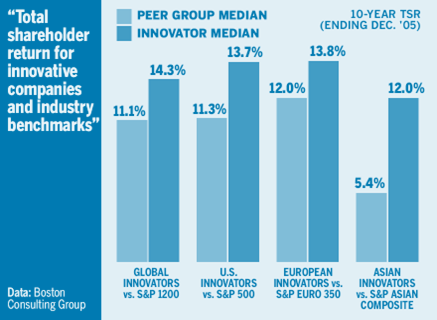
In a Business Week survey conducted in conjunction with the Boston Consulting Group in 2008, it was noted that total shareholder return (TSR) was greater over a three, five, and ten year period among business model innovators versus their industry peers.  Notice that it was those who innovated their business model rather than those who tried to hold onto their old one who prospered! TSR was greater among global innovators than the S&P 1200, greater among U.S. innovators than the S&P 500, greater among European innovators than the S&P Euro 350, and greater among Asian innovators than the S&P Asian composite.

“Wealth flows from innovation not from optimization.  Wealth is not created from perfecting the known, but imperfectly seizing the unknown.”

-Kevin Kelly, founding editor of Wired


In 1989, Smith Corona had annual sales of $500 million, producing typewriters. Word processing and computerization overtook their market position and they could not innovate fast enough to ride the wave. Jeremy Gutsche of trendhunter.com says, “Be wary of your strengths; success leads to complacency.” He maintains that, over time, most people stop trying. Need convincing?

  1. “We own that market.”
  2. “He’s been a client forever.”
  3. “She’s already my girlfriend.”

Gutsche cites each of these statements as examples of a pervasive attitude of entrenchment. Since most people are risk averse, we have learned to polish the “spin” on our actions and speak glibly of “tweaking” and “optimizing.” Instead, successful people and organizations must learn to pursue that which is splendid, unique, and paradigm-changing.

The secret, though, is to not just produce an innovative product or service; to not just culturally innovate, but to commit to innovation and change continuously. Daunting? You bet it is! How can you lead yourself and others to protect the value that innovation has created? How can change be “maintained?” This is a rhetorical question—it can’t! Change cannot be maintained—it must itself be changed to remain responsive, relevant & vibrant!!!