Dissimilarity Creates Innovative Thinking

How often does your organization examine ways to apply a concept from one part of the business to an entirely different component? I’d like to suggest that you do it far more often. Many innovative ideas flow from simultaneously considering two thoughts that, on the surface, seem to have little connection. For instance, what do you think of design mixed with meeting planning? Dennis Shiao, Director of Product Marketing at INXPO and author of the book “Generate Sales Leads With Virtual Events,” thinks this juxtaposition is an interesting one. After watching a 60 Minutes episode recently that featured an interview with David Kelley, founder of both IDEO and Stanford’s d school, Shiao was inspired:

Overview: Design Thinking
The design thinking process can be broken down into three components: inspiration, ideation and implementation. To quote a design thinking article co-authored by Mr. Brown:

  • Inspiration: “Think of inspiration as the problem or opportunity that motivates the search for solutions.”

  • Ideation: “Ideation as the process of generating, developing, and testing ideas.”

  • Implementation: “Implementation as the path that leads from the project stage into people’s lives.”

Corporate events

Incorporating Design Thinking into Meetings and Events

I’ve (Shiao) taken a look at the tenets and methodologies of design thinking and considered how they could be applied to meetings and events. Let’s consider some.

Attend Your Own Event (Empathy)

Meeting and event planners should take off their “planning hats” and attend one of their events solely with their “attendee hats” on. That means that you can have no part in planning the event. Go through the entire cycle of registration, travel, sessions, workshops, social events, etc. Practice further empathy by understanding how fellow attendees are experiencing the event.

Deepen (and Broaden) Your Team Roster

Design thinking introduces the notion of “multidisciplinary teams,” in which people of assorted backgrounds (and schools of thought) ideate, iterate and collaborate. You need a group that creates divergent thinking, which, according to Mr. Brown of IDEO, “is the route, not the obstacle, to innovation.” I’d recommend adding folks from Finance, HR and Engineering. 

Where No Idea is a Bad Idea
If you make an early judgment on the quality of an idea, you may have just squashed a “germ” that would develop into a breakthrough. The ideation process is critical in creating the next breakthrough event. Instead, design thinking teaches you to build upon each other’s ideas, sort of like the “yes, and..” methodology in improvisational theater. 

Meeting and Event Prototypes
Recall that part of the ideation phase is “testing ideas.” It’s an iterative process in which you deploy a prototype, collect “real user feedback,” determine what you learned, then ideate on product refinements (repeating the cycle all over again).

Let’s say you’re planning next year’s 5,000 person sales kick-off meeting and you have innovative new ideas for it. Create a prototype using 50 sales people and actually implement those ideas in a “real prototype” (event). Determine what worked, make adjustments, then plan another prototype. When the “real thing” comes around, you’ll have a much better “product.”

This type approach is both novel and holds promise for adaptation to a variety of other tasks, disciplines and situations. What dissimilar business processes can be combined in a brainstorming session to help you approach your customers, employees, or suppliers differently? What may be the outcome of such crazy thinking? Does your culture support such “frivolous” exercises, or disdain them? While the temptation would be to apply the concept only to new product development, the value is cross-functional!


Foster Intrapreneurial Activity

Today I had the opportunity to attend an Innovation Symposium culminating a 125 year anniversary celebration at North Carolina State University. While NC State is the arch rival of my alma mater, UNC, it is a great university located in my hometown.  One of the recurring themes today as presidents of other land grant universities took their position at the  podium was how many schools have done a good job of incorporating the business community into campus life–particularly as it relates to launching novel startups with a research basis made possible by the work of faculty and students. An outgrowth of that theme was the concept that more corporate citizens needed to catch the entrepeneurial spirit and turn it into intrapreneurial initiatives.

When I did an internet search for examples of universities partnering with businesses in intrapreneurship, one of the results was a story from Louisville, Kentucky. Beth Avey, the Executive Director of the Kentucky Indiana Exchange said in a blog post on their website, “Over the years I’ve often heard people talk about how the corporate culture stymies creativity and new ideas, and how companies lose their most talented people in pursuit of more innovative opportunities. Well, in our region there are employers doing just the opposite.”

Health intrapreneurshipWhat a great idea! Companies who are tuned into the need of workers to have their ideas heard and implemented–regardless of whether the workers hold a management or traditional R&D role. Would that all companies embraced the challenge to foster intrapreneurial activity! Avey goes on to illustrate:

The Kentucky Indiana Exchange (Kix) has long sought to showcase the great entrepreneurial spirit of our region, but what about the “intrapreneurial” spirit of our employers? Maybe it’s a concept that some of you are aware of, but it was unknown to me until a recent visit to Signature HealthCARE as a member of the 2013 class of Leadership Louisville.

When we arrived for our monthly gathering, we were given the opportunity to select one of several regional employers, and I chose Signature. I had heard so much about the company — the decision its leaders made to move the headquarters to the region; the work they were doing with the University of Louisville to foster innovation and business start-ups in the long-term care industry; and about their leader, CEO Joe Steier, a Louisville native who guided the company’s move to Kentucky.

We spent much of the morning with our host Joe Barimo, the VP of Corporate Learning. His passion for the company was quite apparent. We then visited with what seemed to be the entire senior leadership team, including Joe Steier. We had a terrific exchange, learning about the company, their move to Louisville and Signature’s three organizational pillars – Learning, Spirituality and Intrapreneurship. Learning and Spirituality were certainly two concepts with which I was familiar, but not “Intrapreneurship.”

It’s the idea of acting like an entrepreneur within a larger organization where employees are expected to be innovative, to take risk and pursue the development of innovative products or services within the company. This style of management allows the employees to feel as if they’re part of something bigger, as well as something they have a stake in. Traits like conviction, zeal and insight are encouraged. As a result, employees become more likely to try the kinds of approaches they might take if they were running their own business. The end result can be a breakthrough technology or a new and profitable product line.

What a great lesson in visionary leadership. How can it be applied to your organization? Your alma mater? Your business community? 


Are You Aggressive Innovators, or Defenders of Status Quo?

Our world has sped up. The demand for faster, “instant,” responsive products and services drives business competition for customers. A computer, for instance, with a faster processor is worth more than one with a slower one because faster page loads mean either a more enjoyable gaming experience or work productivity. Consequently, a higher price can be charged for a faster computer. In many markets, people are willing to pay a rush charge for added convenience or quicker availability. Why is the need for speed, then, missing in typical product development efforts? My friend, Jeffrey Phillips, addressed this issue with a recent blog post:

Three innovation clockspeeds

The pervasive lack of enthusiasm or even awareness of time in regards to innovation is a constant source of amazement for me.  In organizations transfixed by time, speed and efficiency, innovation and product development are often the slowest out of the gate, the longest efforts to accomplish and seem completely unrelated to the real world. There are, of course, reasons why innovation is slow:
  1. Innovation is uncertain and risky, so organizations try to move slowly to reduce risk
  2. Innovation (if done well) is often ahead of the market, so organizations try to time innovation to market needs and demands
  3. Innovation requires tools and techniques that are unfamiliar, which slows the process
  4. Innovation and subsequent product development processes are sclerotic, like blood vessels full of plaque, stuffed with unimportant but time consuming activities.

My stipulation is that you should do innovation as fast as humanly possible, even at the risk of skipping steps or bypassing checkpoints, because your internal clockspeed is almost certainly out of synch with the market’s clockspeed.

Your internal clockspeed

Your clockspeed (how fast your organization works) was set by management – this means that your clockspeed is relatively high when working on (the) familiar … and very slow otherwise.  Your operating models slow innovation down at exactly the time that they should be speeding up.  The strange thing about internal clockspeed is that it is similar to the weather – everyone complains about it but few do much about it.  

Clockspeed

External market clockspeed

Your markets are likely moving faster than your internal processes, since the markets are subject to competition, new entrants, substitutions and other factors that Porter and others made famous.  The real problem is innovation clockspeed.

Innovation clockspeed

If you compete in a lucrative market, there are a host of firms innovating right now, seeking to disrupt your market, create substitutes for your product or to simply replace the need for your product or potentially your market.  Clockspeed isn’t simply about bringing a new product to market faster, but about making the product or market obsolete or unnecessary.  

Getting obsolete faster 

Nobody cares about how efficient or fast your existing processes are to provide existing products and services.  What will differentiate firms in the future is an accelerated ability to innovate, at least as a fast follower if not an innovation leader, carefully tracking the external market clockspeed and anticipating innovation clockspeed.  

The challenge — should you choose to accept this mission, is to synchronize the clocks! Within your organization, take a long hard look at impediments to rapid prototyping. Examine systems that disincentivize risk taking and experimentation. Determine how to reject more ideas faster so that your organization is known for the rate of idea generation and implementation rather than the amount of time taken to vet one idea at a time. 

Private Equity Challenges in Family Businesses

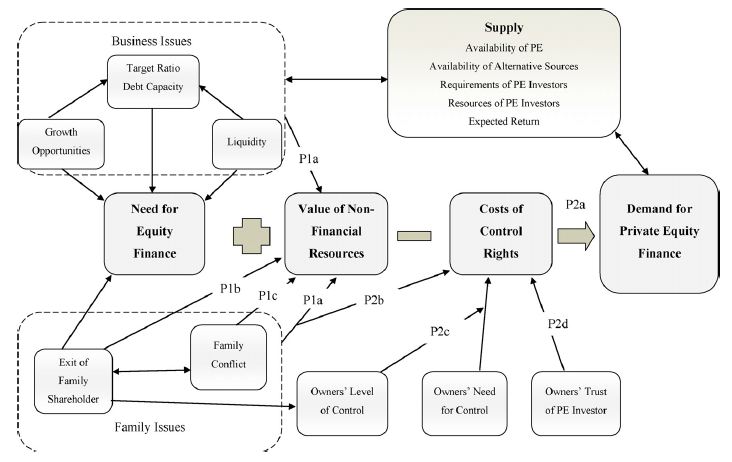
Most family owned businesses survive through the ingenuity, hard work, and resourcefulness of the founder(s) in the first generation. As the founders grow older and the business hits certain barriers to growth, often there is a need for a capital infusion to satisfy the goals of the founders and the other stakeholders in the continued growth and success of the business. Private equity, while a viable option for many privately owned businesses, can be perceived as a solution that is unworkable for the typical family owned business because of the fear of loss of control. In an article last year in the Journal of Family Business Strategy (Volume 3, Issue 1, Pages 38-51, March, 2012), authors Florian Tappeiner, Carole Howorth, Ann-Kristin Achleitner, and Stephanie Schraml describe some research they performed on a group of family firms in Germany. The research focused on issues these firms faced in soliciting private equity investment. Excerpts are provided below, along with a diagram, and accompanied by some commentary:

Under the pecking order hypothesis, private equity is a finance of last resort. Tests of the pecking order and its assumptions have provided conflicting results. For family firms, the pecking order hypothesis is incomplete because it ignores family effects. Case studies of 21 large family firms in Germany are analysed. Testable propositions are derived. Family firm owners balanced financial and non-financial resources of private equity with the need to cede control rights. Non-financial resources were valued more highly when resolving family issues. The observed pecking order was driven by control rights. Important implications for family firms and investors are discussed.

The authors articulate that private equity is perceived as a final option for owners of family businesses. No surprise there. Control is seen as the most important factor in determining what outside resources to enlist. Private equity is seen as less widely used than non-financial resources when the goal is to resolve family issues.

Family and business influences are equally important in terms of the demand for private equity in large family owned firms. Private equity was sought out for reasons that included the exit of a sibling, parents’ wealth diversification and business growth. The authors note an “interdependence of demand and supply in financing decisions, most noticeably in the negotiation of control rights, which featured strongly in the interviews. (Sometimes the underpinning reason for seeking an investor was to consolidate control, for example, buying out a family member with conflicting views or concentrating ownership in one branch of the family, which, it was argued, would free up decision making within the family firms.)”PE Finance in Family Firms

Minority private equity investments provided study participants with needed finance while allowing the family owners to maintain family control. Private equity also provides managerial resources. The presence of outside money and potential ensuing leverage in executive decision making illustrates the potential for better corporate governance practices and enhanced expertise to pursue business opportunities, such as IPOs or globalization. Said the authors, “Firms with family issues may value the non-financial resources that private equity investors may provide. In particular, family firms wishing to reduce family conflicts may value the neutral or professional role of a private equity investor.”

It was noted that business performance issues led to loss of control in two of the family firms receiving private equity infusions. Still others negotiated control rights guidelines aggressively because of their concerns over the potential of such an occurrence. The investors, for their part, acknowledged that dealing with family firms presented a unique set of challenges usually not experienced in other deals.

Creative – or Not? Characteristics to Consider

Innovation and intrapreneurship rely on creativity. How do you know whether you or others in your organization are creative? We’re not talking only about artists when the term “creative” is used. By examining behavior and thoughts, it is possible to get a feel for what a broad audience my agree constitutes creative talent. Jeffrey Baumgartnerauthor of the book, The Way of the Innovation Master, believes that two behavio(u)rs are predictive of creativity:

Behaviour One: Make More Use of Their Mental Raw Material

It seems that when highly creative people are trying to solve a problem or achieve a goal, particularly when the goal is related to their area of creative strength, they use much more of their brains than do ordinary people or, indeed, even themselves when not focused on a creative task. If the average person is asked to draw a picture of a cat, she will most likely think about the physical appearance of a cat and replicate it as best she can with pen and paper. The creative artist, on the other hand, will think in much more depth. She’ll think not only about the cat, but the placement of the cat; what the cat is doing; the lighting; the kind of lines to use and much more. She may decide to humanize the cat and give it emotions. Perhaps she’ll decide to draw a sexy cat with a human body wearing an evening gown. Maybe she’ll simply draw a blur representing a cat in motion.

By using much more of her brain to achieve her goal, the highly creative person in effect provides herself with more raw material from which to construct ideas than the average person. The average person thinks only about drawings of cats and the basic characteristics of cats. This limits the level of creativity she can achieve. The highly creative person thinks about much more — all the while retaining some connection to cats. It is not surprising that, with so much raw material, she is able to be more creative in the realization of her ideas.

They Think Before They Act
It takes time to run through all that raw material in the brain. This is why creative people tend to think before they act. The play with the issue in their minds for a time, looking at a range of possibilities before choosing a direction. I see this when I work with creative people. When you give an average person a creative challenge, she tends immediately to try and come up with ideas. But because her mind is too focused on the issues of the challenge, her ideas are limited in scope as well. 

Incidentally, the highly creative person does not focus on her left brain or right brain for a simple reason: it’s a myth (Christian Jarrett (June 2012) “Why the Left-Brain Right-Brain Myth Will Probably Never Die”; Psychology Today.) Creative people use a lot of their brains, not one hemisphere or the other!

Curiosity Is Creative Play
Rather than simply collect information, their brains play with it. One person might see a horse standing in a field and think it is a magnificent looking animal. Another, more curiously creative person, might wonder what the horse thinks about all day in the field. She might wonder how the horse can cope for long hours of inactivity without a book to read. 

Spontaneous Ideas
For instance, it is by asking what use could be made of not very sticky glue that some people discovered Post-Its. Pablo Picasso wondered how he could depict three dimensional reality, as viewed from different perspectives, on a two dimensional canvas and came up with cubism.

Creative mind
Behaviour Two: Less Intellectual Regulation

The dorsolateral prefrontal region of the brain is responsible for, among other things, intellectual regulation (Simon Ross (2008) “Dorsolateral prefrontal cortex”; Psychlopedia). It includes the brain’s censorship bureau; the bit of the brain that prevents us from saying or doing inappropriate things. It seems that in highly creative people, this part of the brain becomes much less active than normal during the period of creation. It is not that highly creative people are not afraid of ridicule or criticism (indeed, many artists are highly sensitive). Rather, it never occurs to them that others might ridicule their ideas.

Creative People Are Not as Rebellious as You Think
Instead, they follow their own rules or systems for evaluating ideas and deciding whether to move forward with those ideas. These rule systems are often logical, at least to the creative thinker. An artist, for example, will not make a name for herself by studiously copying current trends. Rather, she will become famous by being unique. 

Creative People Are Logical
That logic may be based in part on emotions and feelings — especially in some artists. If anything, by not feeling compelled to fit the demands of popular culture, the creative artist needs to be even more logical than the average person who assumes that if everyone wears and buys a particular style jacket, then it is safe to buy and wear such a jacket.

Creative People Tend to Be Less Honest
Research by Francesca Gino and Dan Ariely (Francesca Gino, Dan Ariely (2011) “The Dark Side of Creativity: Original Thinkers Can be More Dishonest”; Harvard Business School Working Paper) confirms that, in general, highly creative people are less honest than averagely creative people. The reason for this seems to be that creative people can use their creativity to justify their actions in ways that less creative people cannot do.