Nurture Networking Relationships and You Will Prosper

As a former business development executive, I miss my expense account. Seriously–it has always been a ton of fun to mingle with people and get paid to do it. Now running my own consulting firm, volunteering some time at a non-profit, and helping several other founders get their businesses off the ground, I have less time and budget to do one of the things I love: networking. Jeff Hoffman, a member of the founding teams at Priceline.com and uBid.com, and now launching ColorJar, gets this. In a blog post for Inc.com today, Jeff shares with other entrepreneurs what he has learned about the value of networking, as well as some tips to the uninitiated.Networking

Launching and growing a business is hard.  You need to find those relationships (that will help), and then cultivate and nourish them, to keep them alive and healthy.  When you are trying to go from point A to point D in business…people act as bridges from point B to point C, saving you valuable time and money.

… tips:

1. Identify people who could help you and your company. 

Make a list of potential relationships you’d like to forge, either by individual’s names, or by companies and positions.  You can’t pursue your targets until you know who and what they are…write down next to each name precisely what you think the person can do to help your business.

2. Contact these people on a regular basis, and stay in touch with them. 

The most important part of this regular communication is to make sure you are acutely aware of their needs, not just yours.  Ask them what they are trying to accomplish and how you can help.  And then do it when you can.

3. Find ways to give back to them. 

Make a list of the interests of the people on your go-to list…Let each individual know you remember and care about those interests.  Interesting article? Send it to the appropriate contact.  Meet a smart person in that field? Make an introduction.  (Cool, relevant) event? Invite (them) to attend.  Provide a value to your contacts, if you expect to receive it in return.

4. Acknowledge them in your social media. 

Discuss their work, congratulate their accomplishments, and keep them in your discussions.  Show them that you are not only aware of the importance of their work, but that you follow it and celebrate it.  

5. Schedule a time in your calendar to think about and research each contact. 

Once you make this relationship list, it needs maintenance and updating.  Set a periodic time to review the list, update it, and think again about how these people can help you and how you can help them.  Your needs have changed and so have theirs.

6. Make them feel 10 feet tall from time to time. 

Send out handwritten notes.  Or fruit baskets.  Make sure the people in your network know that you appreciate them and recognize their importance in your life.  A little gratitude goes a long way.

Great advice from someone who has obviously helped many other people along the way. Now that I am in the role of advising others, I frequently encourage them to “pay it forward,” helping someone else with their needs before asking for hep with your own. Go out of your way to make introductions for all kinds of solutions–that kind of capital is priceless! 

I also like Jeff’s suggestions on how to keep the conversation alive–good stuff! Remembering to do the personal touches mentioned above is not just good etiquette–it’s great business practice! Smart networking follows these best practices.



Belief, Hereticism, and Innovative Leadership


“Tribes are about faith – about belief in an idea and in a community.” -Seth Godin

Mike Henry of the Lead Change Group chose to enter the social media world by focusing on leadership. He says that he  started reading what others wrote about leadership and he tweeted and re-tweeted their posts. Guy Kawasaki, according to Henry, suggested that your own content be 10% or less of what you plugged online. 

As Henry went into the Twitterverse, he found many leadership gurus working as individuals. Consequently, he perceived there to be an opportunity to create a model that could actually move the global leadership needle through collaboration. He felt that real change would take “a movement; an army of leaders willing to address the need for a new leadership model.” Henry founded the Lead Change Group as a means of addressing the need to amass an army:

On Twitter, I could find a small army of people committed to making a difference about leadership. Sure, there are people who are more interested in promoting themselves, and there have been many who tried Twitter but couldn’t remain engaged.  But there were (and continues to be) a growing number of people sincere about addressing a global leadership problem; and one that Godin was writing about.

“So here we are. We live in a world where we have the leverage to make things happen, the desire to do work we believe in and a marketplace that is begging us to be remarkable. And yet, in the middle of these changes, we still get stuck.” -Seth Godin, Tribes

He goes on to say that the status quo and our systems and habits make us stuck. We’re stuck in a “factory” which he describes as any system that forces us to reinforce the status quo. The antidote is people who believe in what they’re doing. He calls them heretics.Pioneer

“Heretics are the new leaders. The ones who challenge the status quo, who get out in front of their tribes, who create movements.” -Seth Godin, Tribes

I don’t want to simply be a heretic. I want to encourage leadership heretics.

Lead Change would be something different; not your mama’s leadership group. We went so far as to claim the intention “instigating a leadership revolution.” We didn’t start the revolution, but many of us recognized we were all in it. So we decided to band together.

Lead Change Group is based on the ideas:

  1. Anyone can lead. Leadership is an attitude, a decision.
  2. You don’t need permission. You simply need to start.
  3. Your greatest influence comes from who you are, not what title you have.
  4. The world needs you to bring your best self and make a positive difference.
  5. Others believe in your leadership if you start with yourself.
  6. If you’re going to do something, do it with everything you have.

What Godin advocates and Henry describes resonates very deeply with me. Being heretical just for the sake of drawing attention is a misguided notion. However, taking initiative to inspire others, having the courage to pursue a dream, and embracing the perseverance requisite to see results is a kind of heresy that captures my heart!

When I describe my business model for Hippotential, I describe it as helping business owners get unstuck. This is congruent with Godin’s challenges to be remarkable and make things happen while we do that which beckons us. Every entrepreneur should feel so moved–or stop being an entrepreneur! Every intrapreneur should feel the same way:)


Overcoming Business Failures With Mentoring


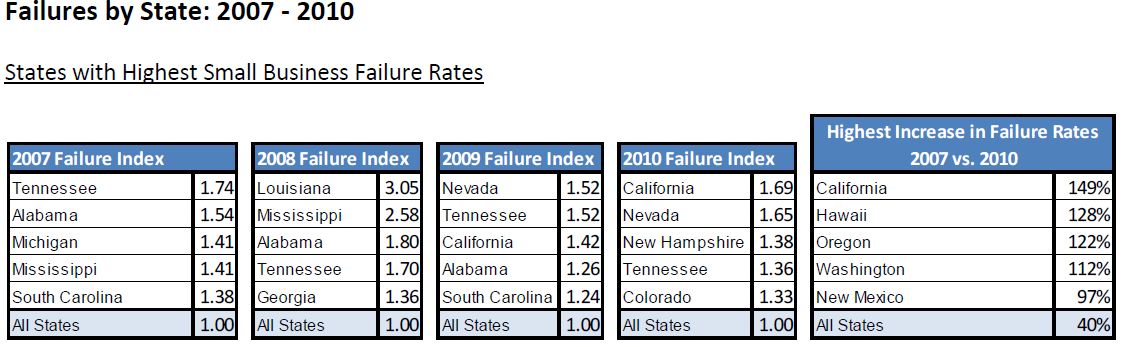
According to Bill Warner, co-founder of EntreDot, approximately 26,000 new companies are formed each year in North Carolina and, in that same year, over 23,000 companies fail due to poor management and operational mistakes. Warner further states that, “The statistics are worse in rural and minority populations. This means that good ideas go to waste along with the grant and investor funds that helped get these companies started. As a result, the potential growth of revenue and new jobs is lost also.” These comments are very similar sentiments to what Dun and Bradstreet found in some surveys conducted during the period of 2007 – 2010. D&B found that the rate of business failure went up by an average of 40% during the recession years.

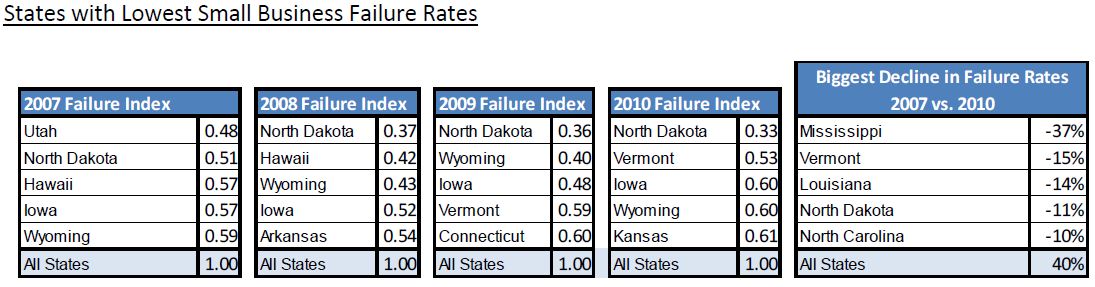
D&B SMB Lowest Failure Rate by State 2010


Many of the states with lower failure rate increases are less heavily populated states. In fact, of all the states that have seen a decline in the rate of small to medium sized business failure, only North Carolina makes the list of 10 most populous states in the country. Of states (below) with large increases in failure rates, only California is heavily populated.  

D&B SMB Failure Rate by State 2010


From 2007 through 2010, Western states in the West had the highest increase in failure rates. Reasons D&B provided for the uptick in failures include continued instability in the residential housing market and drop-off in the tourism, travel and hospitality sectors. Interestingly, Tennessee has been home to the highest small business failure rates for four years in a row.  

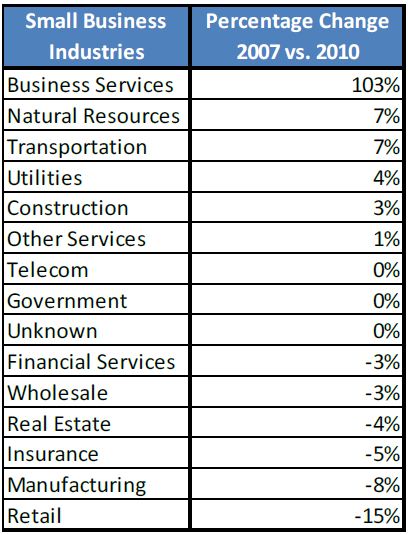
D&B Largest SMB Industries 2010


These trends have been occurring at a time when the number of retail establishments and corresponding retail employment have both dropped by 15-20%. On the other hand, the number of SMBs in the Business Services category more than doubled and these businesses experienced a 30% increase in the number of people they employ. The fastest growing industries for SMBs are summarized below:

D&B Fastest Growing Industries 2010


As you can plainly see, nothing else comes close to the growth of  the Business Services category. Bear in mind that many software as a service companies are part of this category and have been launched in only recent years. The macrotrends that become evident are that retail is on the wane, highly populated states are more stable in terms of business failure statistics, and the business services category’s growth will be a key cog in the engine of our economy.

Warner points to the following issues of significance to these small businesses:

  • Business strategy and planning to make sure their business is focused on a viable market with a winning product and/or service that has a competitive edge
  • Forecasting and financing ensuring that sales forecasts are realistic and that revenue, cost, expense and cash are well managed
  • Operational discipline and judgment to increase the chances of success by making fewer mistakes
  • Industry connections that can help accelerate the business and its operations
  • Start-up company experience that can instill the wisdom of what it takes to really start and manage an emerging business


He feels that these companies need the dual combination of basic business know-how and mentoring. The situation in North Carolina, where Warner and I live, is that our state has a comprehensive array of entrepreneurship education programs throughout the community college and university systems including various other private and public organizations. The problem is that we have little help for entrepreneurs once they have completed these programs and actually try to start a business. We recommend assistance for entrepreneurs who are struggling to create successful businesses, the failures should decline considerably. Entrepreneurs should be seeking out business mentors that can help them through the early years of their business.


Get Emails Read – Follow 7 Guidelines

Most businesses rely on emails for the majority of their communications. Yet, most of us are certain that some of our emails are ignored by the recipient. If you are trying to get your emails read, consider the below guidelines offered by Jonathan Borge of ToutApp. (Borge was contacted by Tom Searcy for a recent article for Inc.com on the subject.)

1. Subject lines: Remember that only 20 percent to 40 percent of your emails will actually get opened, though most of your subject lines will be seen. To boost your open rates, think of short, catchy, and informative subject lines. You should try to dangle compelling information (“The future of sales emails”), and you can even try adding some mystery (“Strange question”). We also recommend personalized subject lines, if possible (“Hunter Sullivan suggested I contact you”).]

2. Your tone: Portray yourself as someone that other people can connect to. You’ll want to show your recipients that you care about hearing back from them… so you can’t simply sound like you’re just sending another mass email. Never use “Dear sir or Madam,” and stay away from overly formal language.

3. Email content: Make your emails short, simple, and easy to quickly digest. Your leads are busy people with jobs, too, so you need to maintain their interest. Do your research and find out what resonates for your prospects. Try to get an introduction to them or, if that’s not possible, figure out in more detail what they or their company do. Tell them why you’re emailing them, specifically. Talk about how you can solve a problem for them.

Email

4. Your sign-off: End your emails with a definitive, clear call to action. Make it dead simple for your recipients to say yes—whether it’s to a meeting, phone call, or product demo. Don’t ask them for permission. If you want a phone call, then say “Call me right now at X for more details.”

5. Your timing: Reach out to your leads when they’re not too busy. Make sure you avoid heavy traffic times like Monday mornings. Based on our tracking data, we recommend the middle of the week, mid-day, as the best time to send emails.

6. Your image: First impressions are important both in person and online. The tone and formatting of your email is all your recipients have to judge you by. Make sure you are being professional, clear, and easy to understand. Stay away from over-formatted emails that look gimmicky, but don’t hesitate to call out important information in bold or bullet points.

7. Your homework: Send yourself a sales email. Put yourself in your leads’ shoes. If you were them, would you open this email? Would you spend more than two seconds reading it? If so, what would you do next?

Searcy notes that the list sounds almost too basic. Yet, when he went back and examined the last 10 recent emails he had sent to prospects and clients, he found that he only employed four of these guidelines on average per email. Why don’t you take the same challenge? Hopefully, you can learn from it –as he and I have!


Midlife Entrepreneurs Better Prepared Than Younger

One of the most gratifying things I get to do is work with entrepreneurs and business owners to optimize their businesses. In the area where I live, most of the media attention is focused on technology startups usually run by people in their 20s. What I find interesting about the new businesses in our area is that the founders who are willing to rent an office and hire a consultant or take some classes tend to be mid-life entrepreneurs. These older entrepreneurs actually are more prevalent than the younger ones. Dane Spangler, a researcher at the Ewing Marion Kauffman Foundation wrote in a 2009 report, “in every single year from 1996 to 2007, Americans between the ages of 55 and 64 had a higher rate of entrepreneurial activity than those aged 20-34.” Also, according to the 2011 Global Entrepreneurship Monitor U.S. Report — a survey of a representative sample of the U.S. adult-age population — 15.4 percent of Americans aged 55-64 and 12.8 percent of Americans aged 45-54 run their own business, compared with 0.8 percent of Americans aged 18-24 and 4.9 percent of Americans aged 25-34.midlife entrepreneur

Bureau of Labor Statistics data on both incorporated and unincorporated self-employment show an even more extreme pattern. The rate of self-employment is higher among people in their 60s than even those in their 50s, let alone those in their 20s or 30s. In fact, the bureau’s surveys of American workers reveal that people aged 65 to 69 are self-employed heads of corporations at four times the rate of people aged 25 to 34. 

The Small Business Administration reports in its recently released publication Small Business Economy that, from 2000 to 2011, self-employment among people under 25 dropped 9 percent. Among those aged 25 to 34, it fell 8 percent, and for those between 35 and 44, it declined 24 percent. By contrast, self-employment among those aged 55 to 64 rose 54 percent, while it increased 36 percent among those over 65.

Scott Shane (A. Malachi Mixon III professor of entrepreneurial studies at Case Western Reserve University) shares an interesting observation that, even in high technology, entrepreneurs are much more likely to be over 50 than under 25. Research by Vivek Wadhwa, Richard Freeman and Ben Rissing shows that these older entrepreneurs, while they fly under the media radar, are very prolific and on the rise.

Shane asks (as you might), “Why are baby boomers more likely than their kids to be entrepreneurs?” He goes on to answer his own question:

Researchers have two hypotheses, the second more plausible than the first. The first explanation is a cohort effect: Today’s young people don’t want to run their own businesses as much as their parents did were when they were young. The more plausible explanation is an age effect.

The reason Shane provides for the cohort effect being a weaker argument is a body of research conducted at UCLA within the Cooperative Institutional Research Program (CIRP). CIRP points to a trend over the past quarter century whereby college freshmen are less likely to want to be a “business executive,” “accountant,” or “actuary.” Instead, a higher percentage want to own a business now than previously.

So, while more freshmen want to be business owners, fewer people in their early twenties are actually starting businesses. This is where the age affect provides an explanation. Those who prefer this argument would say that the experience gained and savings accumulated over a period of fifteen years or more give one more confidence to start a business later in life. While there are certainly more responsibilities for the stereotypical midlife entrepreneur on the home front, this age group appears to have figured out how to address those responsibilities and still be willing to start businesses at a higher rate than the younger counterparts.

What’s holding you back? Start a business as a second career!