Does Your Marketing Reflect These 5 Social Media Inputs?

Do you use social media to enhance the customer intelligence of your target market? If not, your marketing is incomplete. Part of establishing a brand is to know what buyers are thinking. What better way to engage than to have a dialogue? Yet, many businesses only have monologues–they don’t listen to what the other party is saying and adjust their conversation accordingly.

When you embrace the power of social media, you tap into the competitive intelligence that enables you to minimize risks associated with media buys, new product development, and misguided sales efforts. As you gather insights into the thoughts of your prospective audience, you are able to make decisions in real time. Molly Gallatin reports an Association of National Advertisers survey which finds that 90% of companies are using social media as part of their digital marketing efforts, but 62% report they are concerned about measuring ROI—indicating at least some difficulty in deriving useful intelligence from their social media efforts.

Gallatin’s article illustrates how you can tie the kind of rich, actionable customer intelligence you can glean from social media into five overarching marketing decisions.

1. Retail Partner Valuation
At Compass Labs, we recently executed a campaign for a major consumer packaged goods brand, in the process unearthing a simple yet extremely significant fact: Its customers had more affinity for one mass market retailer than for others–in fact, much more affinity. The company used this information to drive more sales through that particular retailer by steering more overall advertising dollars its way.

But that’s not the only way that information could have been used. For example, the company could have used the information to build business at a secondary retailer, or it could have used the information to affect pricing and packaging. As it is, that little piece of information paid huge dividends and informed critical decisions.

2. Customer Acquisition Strategies

Especially now that social media networks are connected to ad exchanges and real-time bidding (RTB) technology, brands have access to real-time customer intelligence,  not just to what their fans and followers said about them yesterday. You can get a complete profile of users who are interested in your brand that tells you who they are, what they like, and the things they do. Social intelligence reveals what websites they visit, what events they attend, and their favorite fashion brand.

Use such information to establish a relationship and two-way dialogue with users and acquire them as customers. Rely on your most engaged “fans” as brand advocates and use the interactivity of social to acquire customers through word of mouth. Discover an entirely new segment of users ripe for conversion that extends the audience you initially sought.

Customer acquisition has reached a whole new depth and level of interconnectivity. When considering growth strategies in a tough economy, intelligence you gain from social media is crucial in driving customer segmentation, audience targeting, and even off-social marketing.

3. Brand Sentiment

We’ve been in the middle of the election, and it’s been especially easy to see how brand sentiment can be understood and effectively managed across social media. What’s played out before us is a head-to-head brand battle the likes of which we haven’t seen since Coke and Pepsi’s taste-test wars.

For example, one presidential candidate’s messaging focuses on job creation; the other candidate’s messaging is about lower taxes. Seeing a positive reaction to these different points of view, the candidates’ campaigns immediately positioned messaging around “tax reform” (Romney) and “no off-shoring” (Obama). Don’t think the candidates and their advisors don’t know how these messages play.

This kind of sentiment strategy is not limited to politics. Social media intelligence can feed brand sentiment analysis and enable you to quickly execute your corresponding marketing strategies. On the flip side, negative brand sentiment can also be quickly detected and remedied by harnessing social media as a CRM strategy.

4. Media Placement and Value

You don’t have to guess which media are most effective at engaging your customers. You can track the actions a user takes on Facebook after seeing or clicking on your ad, and attribute off-site conversions to ad views or clicks. This allows you to make creative ad placements and strategically optimize them.

Plus, knowing your engaged audience’s favorite TV shows and websites allows you to take this kind of optimization off-social.

5. Competitive Evaluations

Let’s go back to the retailing analysis that we did for the CPG company, but let’s flip it around and analyze the retailers. If a set of five retailers were in this competitive picture, the retailers themselves could use the natural-language processing technology that drives sophisticated social media intelligence to understand one another’s fan base and social standing.

At the most basic level, each brand’s number of Facebook “likes” serves as a measure of customer engagement. But the retailers could go further and look at actual engagement levels via Facebook’s People Talking About This (PTAT) metric. Comments and shares, different affinity markers, and common interests are some other good ways to measure and predict competitive success.

Get More Sales on Purpose

To support your team and finance operations, an executive team must be able to generate large volumes of revenue throughout the year. This revenue generation takes place through a combination of marketing, sales, and service. The customer has to

  • know that a product is available (marketing)
  • be convinced to buy that product (sales), and
  • be pleased with the purchase (service).

We have been discussing how research leads to better product positioning, and that is certainly an important part of marketing. We will zero in on the other components of revenue generation in this edition.

Many companies assume that all they have to do is make a product or offer a service and everything else will fall into place. Nothing could be farther from the truth! If no one knows who your company is, what the offering is, and how/why to buy it, you will either have inventory (goods) or idle workers (services). Similarly, if buyers know your business has something to offer but have no reason to purchase your offering over another’s, you will not make sales critical to business survival and growth. Providing a quality product in a timely manner an correcting defects quickly translates into repeat sales in any industry. 

Sales

Sales depend on three critical elements:

  1. the quality of leads
  2. the quality of the sales team
  3. buyer perceptions

The three need to converge into transactions built on relationships. Buyers are like pupils in an educational system–the sales team and the marketing team are the teachers. The marketing team must supply enough information so that the target buying market can learn about your offering. What is supplied to the sales team is information to reinforce the message: these products or services meet a distinct need in the mind of the buyer. As feedback is collected from target buyers, those conversations become a means to qualify leads that are much easier to convert.

Marketing

Inform the general buying public both directly (in face to face situations) and indirectly (in various forms of media, including social). Failure to reach either audience results in insufficient leads for the sales team–both in quality and in quantity. If your marketing team is not accountable for lead generation, it should be. Those who do not perform the lead generation function well should be replaced with others who are tuned into what makes your business continue to exist: revenues. The marketers can improve effectiveness by paying attention to statistics–whether it is website inquiries, newsletter subscribers, store visitors, or something comparable. There has to be several metrics in your setting that you can identify that make the conversations very professional an on point all the time.

Selling

Think through things like your incentive programs for your sales team, but don’t neglect to think through how to equip the individuals for success with well produced collateral, clear messaging and selling tactics, and sufficient training to overcome potential objectives smoothly and respectfully. Appreciation notes to customers are an art that has lost ground, but that demonstrate a personal touch that often leads to new customers. In your training sessions, emphasize product or service features, how and why they are important, how you have positioned your offering versus the competition, what your perceived competitive advantage is, what common objectives are, and how you want prospects to be treated when in a consultative sales conversation.

Buyers

Buyers also need to be instructed about what they encounter. Make an effort through both marketing and selling activities to run through the competitive advantage positioning messages that you have developed. Be consistent. Be passionate. Be sensitive. Emphasizing your research findings as to what potential buyers want and how you have tailored your offering will go a long ways to build identification with your company and its product or service. Think about where the buyers hang out and “meet” them with a compelling invitation.

Service will be tackled in the next post!

Discovering Financial Keys to Higher Profits

Keeping a finger on the pulse of the company is essential; financial reports and management information provide vital signs of business performance. The accuracy and timeliness of financial and management information is, therefore, critical for maximizing profits. 

Systems Management

The person managing your company’s management information systems is a key ally for the business owner. With responsibilities encompassing data collection, entry and analysis, this employee must have a solid grounding in accounting and information technology. In addition, the manager must be able to implement solutions to problems discovered during review and analysis of the information generated. 

Reporting Systems

Three areas affect the way reports can be used to enhance company profitability:

  1. how information is entered and maintained
  2. how results are read, and
  3. how the reports are used to influence business decisions.

The daily tasks of information entry and data maintenance are the building blocks of any management information system. Since it does not accurately reflect the true operating and financial conditions of the business, incorrectly entered or antiquated information can lead a company to ruin if used to make important decisions. The systems manager should employ systems, then, that are relatively easy to use and allow for daily but controlled data entry; menu-driven systems are easiest to use. The system should be selected based on designed checks and balances of the data to prevent reliance on incorrect information. Review of information to catch any errors or omissions and make corrections is a best practice.

Be sure that management team members all know how to use the system. If only the systems manager can use the system, it is useless because one person begins to wield too much  influence and indirect control over the company’s direction. Take care not to fall into a trap of the system driving the company rather than the other way around. 

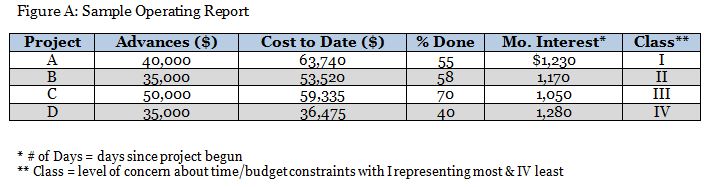
Reading reports requires more than a casual glance; a thorough study of a report’s essential indicators gives the owner and other key executives in-depth knowledge of operating performance. The figure below is an example of such a report:


An effective system must be able to generate this kind of information. For example, reading Figure A prepares an executive to question issues of timeliness in production scheduling, loan advances, and interest rates.


Figure B is a job costing report. The way in which the report is read and interpreted will affect every decision made–or not made–with regard to the job listed. Comparing this report with a similar report for a project either in progress or completed, the relationship between the materials and labor for specific designs can be determined. The goal of the report is to establish standards for purposes of comparison; current projects are compared to the standards to analyze their performance.

Figure C shows a sample income statement for a growing small business ($3-5 million in sales). The income statement reports prior activity and should therefore be used to modify future business operations to maximize profits.  The statement needs to be even more detailed than the sample below to help determine how the profits or losses are being generated. One can be profitable and still not have cash. Cash flow projections, incorporating actual expenses, show the sources and uses of cash and are a good complement to the income statement and balance sheet.


The ability to read and understand reports and statements prepares the executive team member to use the information to influence business decisions. After reviewing Figure B, you should be equipped to establish workable production schedules. Subsequent production meetings should highlight areas to reduce costs and improve production deadlines.

Figure B should be discussed with all managers, who in turn implement  the schedules and budgets with subs and vendors. The resulting scheduling and budgeting systems ensure timely, cost-efficient job completion. Managers also need to assist in keeping the information current.

In Figure C, data is presented comparing the current year to the prior year in order to analyze trends and ratios. Tracking composite numbers such as gross profit takes on meaning when it serves as a basis for comparison, rather than being viewed in isolation. Deviations from the norm should be discussed in management meetings. So, if sales and profits are lagging,  the group should investigate any underlying causes and develop alternative production and sales methods–and implement them immediately.

Keeping Costs Under Control

If expenses are simply allowed to fluctuate, with no way of monitoring where they will be, optimal profitability will be hard to come by. Cut out as much fat as possible and keep the company lean. Clearly, certain expenditures are necessary and unavoidable. There are ways, however, to limit their influence on company profitability. For example, taking advantage  of any offered cost savings an creating efficient procedures to save time and project financing overruns will cut costs significantly. A purchasing requirements program is a start for reducing many hard costs. Most soft costs, however, can be decreased through effective scheduling.

An effective requirements program includes the following steps:

  • using purchase orders 
  • inspecting all deliveries
  • taking advantage of discount incentives
  • implementing invoice verification procedures
  • scheduling efficiently

Using Purchase Orders

Purchase orders are seen as a relic of old business practices by some. Others view them as an indispensable management tool. Somewhere in between the extremes there is a fit for every organization. Their usefulness is in getting reliable quotes upon which invoices can be checked later.

Inspecting all Deliveries

Inspecting all deliveries is essential to make sure orders are shipped according to the quantities and quality specifications provided on the purchase orders. Many managers complain that they do not have the time to physically inspect every item delivered to a work place. Inasmuch as doing so would require a huge time commitment, they are right.  However, for containing cost overruns, these same managers could not be more wrong in their assumptions.  Inspecting samples  from every delivery when delivered and figuring quantities by up close, visual inspection are necessary steps to ensure that suppliers are responding to the company’s needs.

Taking Advantage of Discounted Materials Prices

When suppliers make discounts available on purchases, your team should try to make the most of them. In addition, verify all invoices against delivery inspection reports, checking  the invoiced amount against the total amount delivered, and unit prices against the purchase order. This procedure will help ensure that a supplier’s negligence is not costing the company money.

Scheduling Efficiently

Time constraints are of utmost importance in eliminating inventory carrying costs–whether your business produces goods or services. If a product line or project is slow to be completed, many extra costs begin to accumulate. Alternative uses of profit margins are foregone. Had your team been able to finish sooner and collect within a finance cycle closer to the one in which work began, there would have been profit margin to discuss how to allocate. With margins, choices exist that don’t otherwise–suppliers can be kept happy and bankers and investors can too! If yours is a business that uses work in process assets, insuring those assets is an ongoing cost for the company. Theft and obsolescence of design and features due to carrying raw inputs too long further eat away at margins. The cost to repair items damaged over time also rings up expenses. All of these combine to make inventory (due to delayed delivery) costly.

Proper scheduling is not limited to getting one work team to immediately follow another onto the job. By ordering raw inputs in bulk through purchase orders, trips to supply houses are reduced, resulting in cost savings through lower fuel costs and less time away from actual work. As these employees spend more time on the job and less time running around town picking up materials, their projects are completed faster. Getting teams to succeed one another promptly with slight overlaps can also tighten production schedules and help reduce costs.

By tying your project financing to interest rates in a market where rates are rising, you and your team can make the most of prompt completion of projects. If you operate efficiently, you can move before rates rise consistently. Finally, scheduling vacations with as little overlap as possible will help with your production efficiency, and thereby improve margins.


What to Do When Financing Fails

Having been in business in the same town for almost twenty years, a Midwest company was accustomed to expansion and going after market opportunities. The owner had kept her business competitive by continuously improving product offerings and learning from the input of both customers and target customers. With a loyal, experienced operations team, she felt that she had the recipe for long-term success. However, when the recession of 2008 hit, she was unable to obtain a renewal of her line of credit by which she had historically been able to normalize cash flows.

The case study above illustrates a business principle–that we must always as business owners prepare for the unexpected and have the flexibility to adapt to changing market conditions. If we seem surprised when an action that we did not anticipate occurs, then it follows that either: 1.) our planning is incomplete, 2.) our systems and processes are too unresponsive to key indicators, or 3.) we have not established a feedback loop that provides us as small business executives with vital, timely information. Regardless the reason, it is poor management to not have a contingency strategy or tactic in mind for situations that may arise.

What should an executive team do when financing from lenders or investors falls through? First, the reason  for such a collapse in financing is normally attributable to one of the following:

  1. Partners or new regulations restricted the financing source from making (continuing) the deal.
  2. A more attractive alternative was available to the lender/investor from another source at the same time.
  3. The company failed to read the market conditions and adjust the financing request accordingly.

To stabilize the business in response to one of these situations, the owner and top finance executive should always seek new sources of funds–even if today’s source has been very reliable. If you have built relationships with other providers of financing, you may be able to reduce the risk any one player undertakes by spreading it among several. Alternately, you may find that some institutions have differing standards for new clients than for existing ones and may want the entire financing facility.  In either scenario, it is incumbent upon you and your team to perform due diligence. Find out how the bank (or alternate source) has shown commitment to other borrowers. In many cases, your accountant or attorney may be able to recommend new sources for you. Others in your trade group may have similar referrals to provide.

Being able to lay out both your best case scenario and a worst case one will show a new source your planning strengths and help to establish credibility. Ask questions about how credit facilities could be expanded as you hit milestones. Offer your plan for reporting your financial and operating performance. Discuss what the loan covenants may look like and have frank conversations about how your team will accommodate the request to demonstrate creditworthiness.

To avoid a recurring financing problem, owners should try to over-finance their operating needs whenever possible. It is extremely valuable to have credit available that is not being used–this cannot be overstated! Given that this funding source may dry up at any point, you never want to have to go back to the lender or investor because you failed to anticipate growth. 

The other recommendation is that you look at different types of credit. If you traditionally have only taken out installment loans, look for lines of credit–and vice versa. There are additional types of financing that may also be advantageous to consider–accounts receivable, factoring, purchase order financing, contract or project financing, asset based lending, leasing, etc. By using more than one type of funds from more than one source, you are diversifying your vulnerability to a credit restriction that could be deleterious to your business success.