Fail to Research; Fail to Secure Market Share

As companies seek to gain a competitive market position and execute on their business objectives, various problems can crop up. In the last post, we examined a case study on inventory control as one issue that needs addressing. In this installment, we will look at a case study involving loss of market share:

A company in the Northeast had always been able to sell enough product to secure a 15-20 percent local market share within the primary price range and portfolio of designs. As other competitors began to outsell this company in the local market, the owner commissioned some research to determine what percentage of the market share had been lost. Upon discovering that their share had dropped to 9-11 percent, the executive team became worried.

Why would this company’s–or any company’s–market share deteriorate to this point? Experience shows that one common reason for the decreased market share might be increased competition. As other competitors, whether established or new businesses, begin to offer viable or even more attractive alternatives, your business may begin to lose a percentage of share  in the local market. Another possible reason for declining market share could be perceived poorer quality in the products offered. Rumors of a company’s demise can fuel such a perception and scare buyers away, allowing other businesses to take advantage of this image problem.

The solution to declining market share varies according to the source of the problem. If bad image and rumors appear to be hurting the business, the owner must move quickly to dispel any rumors and improve company image through a bold and highly visible public relations campaign. For example, companies can generate goodwill by meeting with influential members of the local community to let them know that any perceived problems are being taken care of and that the company plans to be making products in the community for some time to come. This exposure can often be gained through attendance at chamber of commerce and other local business group meetings.

To overcome competitive advances, the executive team must aggressively outmarket and outproduce competitors in each niche market. By beating them in head-to-head competition, the problem is solved while the company’s reputation for high quality products is enhanced. In terms of quality initiatives, management should devise ways of improving quality in all projects, passing the word along to all employees, suppliers, and subcontractors that quality is becoming an issue and that only those who can produce quality work will remain a part of the team.

Stabilizing and regaining market share demands that the team know the local market inside and out. While calculated risks are allowed if the executive team feels confident that they can get product manufactured and sold quickly, the potential success of any such project must be measurable in terms of researched demand for the product line the company plans to produce. Clearly, companies must target opportunities that allow them to make their best products at competitive prices. By keeping abreast of new developments and new competitors attempting to make an entry into a particular market, the team can revise plans–and keep buyers from running to the competition.
 

Urgency in Turnarounds

When a team has tried everything in their power to solve a dilemma and is unsuccessful, the turnaround manager must step in. The buck stops with him; if a third party cannot reach resolution with company staff, someone with more clout must reestablish credibility. Use of a consistent complain resolution process can prove quite effective. It frees the team up to not have to stress relationships with those with whom they have either had long term relationships or with whom they must transact business once the turnaround is complete. Even managers should appeal to the business owner or turnaround executive if a third party will not accept their efforts to resolve issues.

Doing the Job Effectively

Encouraging employees to perform their jobs thoroughly, to the point they exceed performance standards, is most easily done by providing responsibility and reward. Treat employees as peers, recognizing that they too have responsibilities and commitments. Offering them the opportunity to wield more authority is rarely rejected. Promote a diligent working atmosphere wherein employees want to go the extra mile.

Ask all employees to document any problems with suppliers, customers, or service providers. Often, taking it a step further and documenting issues with sales teams, distributors and governmental agencies (where appropriate) can provide a paper trail to  help the executive team and turnaround artist in their work to remove roadblocks. When relevant facts are understood, appropriate actions can be taken.

Dealing With a Lack of Resources

When a company is in the middle of a turnaround, certain items that would make work easier are not going to be available due to a lack of funds. Using skills and abilities creatively to overcome this lack of resources or other unpredicted occurrence as an example for employees to follow. In tough situations, executives should look for a way to overcome the situation rather than dwelling on the inconvenience caused.

Successful turnarounds are a tribute to employees who strive to overcome limitations and exceed performance standards rather than merely meet them. To bring work projects in early and under budget, everyone must strive to do much better than is required, constantly searching out ways to improve efficiency. No time can be wasted–every minute and every dollar that exceeds schedule or budget extends the distance between a struggling company and its ultimate goal of renewed profitability.

Following the Turnaround Plan

All employees need to be reminded that a plan has been developed to promote optimal recovery and that all actions taken are done so in accordance with the dictates of the plan. United by common objectives, the work force can and will help to implement the turnaround plan. Three essential principles apply:

  • Some short-term gains will be sacrificed for ling-term profitability.
  • Some long-term successes will have to be postponed for short-term cash flow.
  • The means of implementation is always open to suggestion and never open to argument.

Creating a Sense of Urgency

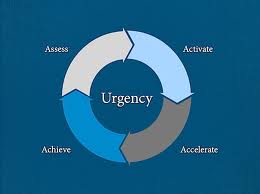
Certain goals, particularly dates and milestones, need to be met without fail. To accomplish these goals, a sense of urgency must prevail. Departures from the schedule can cause the company to lose out on windows of opportunity. The interest carrying cost of financing operations longer than anticipated is an example; if work projects are completed on time, lines of credit can be paid down sooner. Even one foot-dragging employee can impede the progress of the group, and the resulting missed deadlines can mean substantial financial losses.

Meet With Employees

Sit down with your staff and clearly and frankly describe the situation. Inform them that the company is experiencing some short-term problems in meeting its objectives and that actions are being undertaken to minimize long-term  impact. Explain and reiterate throughout the turnaround that company health can be restored through combined best efforts. Explain the turnaround plan, with an emphasis on the valuable role of each and every employee in reaching plan goals.

Meet With Management

Regular meetings with managers will be needed to discuss progress in detail. Begin with twice weekly meetings and progress to biweekly as the situation improves. Update reports should be given on activities since the prior meeting, with input required from managers from each department. Discuss problems and develop plans to resolve them within the meeting. Take advantage of a quorum of opinions to move the company forward in rapid-fire fashion.


Implementing Your Turnaround Plan

A turnaround plan presupposes that someone will be around to implement it. A lack of execution or inappropriate one (timing or lack of adaptation) will quickly undermine all earlier efforts that went into drafting the plan. Control over operations is therefore a must–no single part of the business should monopolize the company’s attention and efforts.

Controlling Operations

Motivation

The motivational skills of a “take charge” leader can enhance job performance in many ways. Many employees complain they are not being used effectively because they don’t have enough to do or their efforts are being applied inappropriately. Management that makes the most of employee work efforts has a knack for spotting actions that, if performed immediately, will have a tremendous, positive impact on company success.

Efficiency

To ensure that operations are monitored and controlled correctly, the individual who reviews system reports must make decisions based on indicators of company efficiency. For example, if variance reports show (project or product) costs exceeding budget, action must be taken immediately to prevent further overruns. Similarly, if non-payment has a vendor worried, the top financial manager must find a way to keep the vendor on board so a return to profitability can occur.

Sound management is exhibited when field operations or internal reports require responses to abnormalities. For example, a business owner in the midst of a turnaround had a new hire (< 2 months) supervisor request on Thursday to take Monday and Tuesday off to pursue some personal matters. The business owner was not in a production crunch and was short on cash, so he approved the time off–particularly since the supervisor was not using vacation (paid) time to take leave. When the supervisor strode onto the job Monday late morning, the owner was surprised. When he requested to work the balance of Monday and all of Tuesday, the owner declined the request, citing that she had to make other arrangements that inconvenienced others and that last-minute notice would not be accommodate in this or future instances.

In this instance, the owner did what was necessary to maintain control over operations. Though it may have ruffled the supervisor’s feathers for a few days, it demonstrated the importance of setting policies and commitments–and living by them. It was also to the owner’s advantage not to have to pay the supervisor for work that had been reassigned to someone else. Proper planning was used to make sure that someone would be able to supervise the work. Additional follow-up was necessary to make sure no problems were slowing down production for those two days. Had the owner failed to exercise sound management, proper planning, or follow-up, she would have lost time, money and credibility with others due to one employee’s circumstances.

Focusing on Common Objectives

Getting employees to focus on common objectives is a difficult task. Executives an managers who are able to motivate their workers to avoid distractions, do their jobs effectively, and remember to follow the turnaround plan do so with tremendous skills/abilities.

Employee Problem Solving

Employees can best avoid distractions and aid in the turnaround process by quickly resolving issues in which they have innate skills and referring all other issues to appropriate personnel. Additionally, employees should report any persisting problems or confrontations to the executive team.

Problem-solving should be a relatively painless process, requiring only that he or she utilize skills learned on the job and “do what seems best” based on prior experience. If an employee has little or no experience in the problem area , she should not hesitate to find someone who is experienced. It is far better to admit a need for help than to take a chance on behalf of the company.

Employees should be reassured that involving others is not “shirking” or “dumping” work into another’s lap. Rather, this process is a way of relieving employees of the likelihood of error in making an uninformed decision. However, employees are not absolved from making sure the problem is resolved. Make it a habit of celebrating when employees help one another out to build camaraderie.


Relevance in Business is Fleeting

“Focus Not on Protecting What You Have, Instead Obsess on the Next Big Thing.”

While this type of headline may not serve us very well in interpersonal relationships, it has become the watchword in business. Those who rest on yesterday’s accomplishments eventually find themselves with less and less current successes. Since we live in a day and time when ideas are ubiquitous, information plentiful, and communications vastly enhanced, it is incumbent upon every enterprise to remain on the hunt for “wow.”

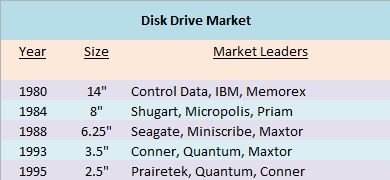
Jeremy Gutsche of Trendhunter wrote in Exploiting Chaos that the disk drive, computer chip, and word processing markets were all ones that saw enormous changes and the market leaders were often outflanked. Read on:

Borrowing from Clay Christensen’s work in The Innovator’s Dilemma , Gutsche described the progression in the disk drive industry towards constantly smaller drives. Along the way, observe the shift in power:


Observe how great organizations present in 1980 gave way to more nimble upstart startups over 15 years. Though the only apparent change was size of the drive, it was enough innovation occurring at a rapid enough rate to trip up the “big boys.” Perhaps, one may suggest, disk drives had become commoditized as more PCs were manufactured? This theory seems to hold true in computer chips, then, as well. To note:

Observe that this market experienced a slower rate of change (40 years of upheaval vs. 15), but the net result was the same: market leaders gave up leadership to disruptive alternatives. The fact that semiconductors require very extensive research and development efforts, whose project funding ranged into the billions of dollars, made this a significant economic microtrend. Gutsche points out that RCA was once twice the size of IBM, so the thought process that monetary barriers to entry would protect industry leaders was disproved time and again.

Word processing was once known as typewriting and the market leader was Smith Corona. Smith Corona was extraordinarily innovative, boasting over 100 patents spread over decades. Yet, the company who also invented the first word processor did not continue to reinvent itself in the computing age and lost its market leadership role. It is suggested that the historical accomplishments became blinders to the urgency for continuous improvement. Notice, they understood the concept of reinvention, but underestimated the urgency factor.

Lest you think that Smith Corona had been mismanaged over the course of the 20th century, pay attention to the fact that their annual revenues in 1989 were $500 million! What happened? Let’s look at some of the competition and what strategic decisions they made…Remington recognized the opportunity of computers and made the leap in 1950, only to be too early to that niche, lose money, and the computing division sold off in 1981. Perhaps Smith Corona saw the foibles of a competitor and vowed not to make the same mistake?

Commodore, on the other hand, was a different kind of competitor. Their model 128 was introduced in 1985 with two external floppy drives. The Smith Corona PWP 40 was preferred by buyers by a wide margin for word processing applications. Yet, someone inside the company saw an opportunity to partner with Acer on a computer joint venture. Unfortunately, the plug was pulled before the strategy could run its course.  Smith Corona declared bankruptcy in 1995; Acer became the fourth-largest PC company in the world!

Scott Anthony, writing for Harvard Business Review in an article entitled “Disruption is a Moving Target” observed a clear pattern:

  1. Disruptors enter a market incumbents don’t care about.
  2. Entrants grow as incumbents flee.
  3. The incumbent hits a ceiling.

What should be learned from this insight? Larger companies should not ignore small opportunities simply because they start out small. Smaller companies should plan their strategy and tactics around “nibbling at the edges” of an incumbent’s market share.


Sacrifice Opens Door to Opportunity for a Leader

You need not to have been on this planet very long before you will encounter adversity. One popular adage states that we become stronger by going through tough times. Yet, not everyone who encounters obstacles is able to surmount them and achieve success. In Obstacles Welcome, Ralph de la Vega recounts his own “pivot points,” born of a challenging early life that shaped and molded him into a very successful businessman (currently, he serves as the President and CEO of AT&T Mobility and Consumer Markets. His positive responses to adversity formed the backbone of a successful values-based management system.

Rather than seeing separation from his parents at the age of four as a bad omen, de la Vega found a way to accentuate the positives in his life. He innately recognized that dwelling on negative thoughts and feelings was counterproductive. After that tough, early life challenge, he moved to Miami and had to overcome a language barrier in the classroom. He adapted again to his environment instead of letting it get him down in the dumps. 

Many people tack a passive approach to setbacks. They hope, wait, and some earnestly pray for a change in circumstances. The course our example provides, though, is one of planning, taking risks, and maximizing opportunities. In the book, he offers up the premise that obstacles should be embraced as a chance for personal growth. In the midst of living life, we come across those “pivot points” personally and professionally that define us–for good or bad. Getting in the right frame of mind can be achieved through his recommended 8 step process:

1. Hope is not a strategy. It is necessary to plan for success.
2. To achieve big goals and dreams, it is necessary to take calculated risks.
3. Big wins in life come from an ability to recognize opportunities. The most significant and important opportunities lie in problems that are waiting to be solved.
4. Embrace and overcome obstacles. Obstacles and adversity make stronger, wiser, and more capable leaders.
5. Be willing to unlearn old habits and relearn old lessons from life experiences.
6. Building winning teams involves effective, honest, and open communication.
7. The greatest successes always involve willingness to make sacrifices.
8. Leadership is not something inborn, but learned and practiced.

As a young executive at  Bell South Latin America, de la Vega experienced everything from military insurgency, economic meltdown, and political revolution, in addition to unstable markets, lack of uniformity in corporate leadership, and nonexistent profits. How did he respond? He took a chance and embraced the challenges as opportunities to lead an entire sector of the international communications market into profitability. What he advocates is to “become comfortable with being uncomfortable,” In order to do that, we may have to set aside what we feel we already know and become flexible in our approach to the challenges set before us.

A key habit to learn is to not allow the past to hinder the future. That is not to say, however, that our past(s) cannot be instructional. Previous experiences can help us deal with new situations only by using them to look backwards and forwards at the same time. It is important to think about how what we have done before might be useful down the road
in similar situations.  

Finally, de la Vega describes what he terms an “Extraordinary” leader, one who is able to consistently deliver excellence in all aspects of personal and corporate leadership. To achieve such status, a leader needs to do the following:

• Set the direction, create the vision.
• Establish values and lead by them.
• Select strategies and key initiatives.
• Build plans to achieve vision.
• Establish goals, priorities, and focus.
• Establish key metrics to measure progress.
• Align and inspire people.
• Empower and enable people to achieve vision.
• Create winning culture.
• Select, recruit, and develop other leaders.