Experimental Failure Leads to Success

We’ve all heard the Thomas Edison quote that he “successfully discovered 1000 ways to not make a light bulb.” He didn’t consider the 1000 attempts as failures, but rather experiments from which he collected data that guided the innovative process. Who else lays claim to so many failures? Cisco grew to be one of the largest technology companies in the world after being rejected for funding by 76 venture capital firms. Michael Jordan, in the minds of many (including yours truly) the greatest basketball player of all time, was cut from his high school basketball team. John Grisham, award winning novelist, was rejected by a couple dozen  publishers before getting his first sizable deal. Slumdog Millionaire won 8 Academy Awards after Warner Brothers gave up on it and sold the property to Fox Searchlight. In short, each of these is a story about finding a positive way to apply lessons learned.

Why is it that workers go from being starry eyed, curious and energetic to automatons after working for a company for an extended period of time? Usually, by the time these numbed brains “check out” mentally, they have already been promoted to a managerial level. We value visionary leaders, but all disdain lethargic managers. What’s the difference between the two? The loss of intellectual creativity and desire to take risks leads to bureaucracy. The market demands innovation. Those who will lead are challenged to not become shut off to progress and new ideas.

Paul Arden wrote It’s Not How Good You Are, It’s How Good You Want To Be. The former executive creative director of Saatchi & Sattchi said, people “will say nice things rather than be too critical. Also, we tend to edit out the bad so that we hear only what we want to hear…If, instead of seeking approval, you ask, ‘What’s wrong with it? How can I make it better?’ You are more likely to get a truthful, critical answer.”

Jeremy Gutsche concurs with Arden, writing that “a culture that openly discusses imperfection is more likely to accept the failure that comes from acceptable risk.”

Michael Jordan, mentioned above as the greatest basketball player in history, said the following about taking risks, 

“I’ve missed more than 9,000 shots in my career. I’ve lost almost 300 games. 26 ti,es I’ve been trusted to take the game winning shot and missed. I’ve failed over and over and over again in my life and that is why I succeed.” 

Most companies, however, spend a lot of time in performance appraisals celebrating successful outcomes and critiquing efforts that don’t appear to meet expectations. Think for a minute, however, about how to inspire your employees to be clever and progressive. Put measures in place to help them feel protected. It must be understood that trying new things, even if failure is the outcome, is a better business decision than undertaking safe projects constantly.

It is said that Steven Ross would fire employees for not making mistakes when Warner was launching its MTV subsidiary. He and his leadership team were trying to debut new programming and needed as much innovation as possible. Similarly, Microsoft used to have the mentality that a leader was not ready for promotion if he had not had a highly publicized, big flop. Thomas Watson, Sr., founder of IBM, once received a phone call from an employee who wanted to resign after making a $10 million mistake. Watson refused to let him follow through with his intended action, telling the manager that IBM had just spent $10 million educating him.

How much money and time are you willing to spend in your organization to educate people and give them the chance to pioneer something great? Probably not enough. 
Relevance in Business is Fleeting

“Focus Not on Protecting What You Have, Instead Obsess on the Next Big Thing.”

While this type of headline may not serve us very well in interpersonal relationships, it has become the watchword in business. Those who rest on yesterday’s accomplishments eventually find themselves with less and less current successes. Since we live in a day and time when ideas are ubiquitous, information plentiful, and communications vastly enhanced, it is incumbent upon every enterprise to remain on the hunt for “wow.”

Jeremy Gutsche of Trendhunter wrote in Exploiting Chaos that the disk drive, computer chip, and word processing markets were all ones that saw enormous changes and the market leaders were often outflanked. Read on:

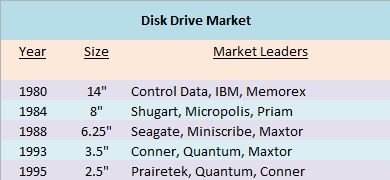
Borrowing from Clay Christensen’s work in The Innovator’s Dilemma , Gutsche described the progression in the disk drive industry towards constantly smaller drives. Along the way, observe the shift in power:


Observe how great organizations present in 1980 gave way to more nimble upstart startups over 15 years. Though the only apparent change was size of the drive, it was enough innovation occurring at a rapid enough rate to trip up the “big boys.” Perhaps, one may suggest, disk drives had become commoditized as more PCs were manufactured? This theory seems to hold true in computer chips, then, as well. To note:

Observe that this market experienced a slower rate of change (40 years of upheaval vs. 15), but the net result was the same: market leaders gave up leadership to disruptive alternatives. The fact that semiconductors require very extensive research and development efforts, whose project funding ranged into the billions of dollars, made this a significant economic microtrend. Gutsche points out that RCA was once twice the size of IBM, so the thought process that monetary barriers to entry would protect industry leaders was disproved time and again.

Word processing was once known as typewriting and the market leader was Smith Corona. Smith Corona was extraordinarily innovative, boasting over 100 patents spread over decades. Yet, the company who also invented the first word processor did not continue to reinvent itself in the computing age and lost its market leadership role. It is suggested that the historical accomplishments became blinders to the urgency for continuous improvement. Notice, they understood the concept of reinvention, but underestimated the urgency factor.

Lest you think that Smith Corona had been mismanaged over the course of the 20th century, pay attention to the fact that their annual revenues in 1989 were $500 million! What happened? Let’s look at some of the competition and what strategic decisions they made…Remington recognized the opportunity of computers and made the leap in 1950, only to be too early to that niche, lose money, and the computing division sold off in 1981. Perhaps Smith Corona saw the foibles of a competitor and vowed not to make the same mistake?

Commodore, on the other hand, was a different kind of competitor. Their model 128 was introduced in 1985 with two external floppy drives. The Smith Corona PWP 40 was preferred by buyers by a wide margin for word processing applications. Yet, someone inside the company saw an opportunity to partner with Acer on a computer joint venture. Unfortunately, the plug was pulled before the strategy could run its course.  Smith Corona declared bankruptcy in 1995; Acer became the fourth-largest PC company in the world!

Scott Anthony, writing for Harvard Business Review in an article entitled “Disruption is a Moving Target” observed a clear pattern:

  1. Disruptors enter a market incumbents don’t care about.
  2. Entrants grow as incumbents flee.
  3. The incumbent hits a ceiling.

What should be learned from this insight? Larger companies should not ignore small opportunities simply because they start out small. Smaller companies should plan their strategy and tactics around “nibbling at the edges” of an incumbent’s market share.


Sacrifice Opens Door to Opportunity for a Leader

You need not to have been on this planet very long before you will encounter adversity. One popular adage states that we become stronger by going through tough times. Yet, not everyone who encounters obstacles is able to surmount them and achieve success. In Obstacles Welcome, Ralph de la Vega recounts his own “pivot points,” born of a challenging early life that shaped and molded him into a very successful businessman (currently, he serves as the President and CEO of AT&T Mobility and Consumer Markets. His positive responses to adversity formed the backbone of a successful values-based management system.

Rather than seeing separation from his parents at the age of four as a bad omen, de la Vega found a way to accentuate the positives in his life. He innately recognized that dwelling on negative thoughts and feelings was counterproductive. After that tough, early life challenge, he moved to Miami and had to overcome a language barrier in the classroom. He adapted again to his environment instead of letting it get him down in the dumps. 

Many people tack a passive approach to setbacks. They hope, wait, and some earnestly pray for a change in circumstances. The course our example provides, though, is one of planning, taking risks, and maximizing opportunities. In the book, he offers up the premise that obstacles should be embraced as a chance for personal growth. In the midst of living life, we come across those “pivot points” personally and professionally that define us–for good or bad. Getting in the right frame of mind can be achieved through his recommended 8 step process:

1. Hope is not a strategy. It is necessary to plan for success.
2. To achieve big goals and dreams, it is necessary to take calculated risks.
3. Big wins in life come from an ability to recognize opportunities. The most significant and important opportunities lie in problems that are waiting to be solved.
4. Embrace and overcome obstacles. Obstacles and adversity make stronger, wiser, and more capable leaders.
5. Be willing to unlearn old habits and relearn old lessons from life experiences.
6. Building winning teams involves effective, honest, and open communication.
7. The greatest successes always involve willingness to make sacrifices.
8. Leadership is not something inborn, but learned and practiced.

As a young executive at  Bell South Latin America, de la Vega experienced everything from military insurgency, economic meltdown, and political revolution, in addition to unstable markets, lack of uniformity in corporate leadership, and nonexistent profits. How did he respond? He took a chance and embraced the challenges as opportunities to lead an entire sector of the international communications market into profitability. What he advocates is to “become comfortable with being uncomfortable,” In order to do that, we may have to set aside what we feel we already know and become flexible in our approach to the challenges set before us.

A key habit to learn is to not allow the past to hinder the future. That is not to say, however, that our past(s) cannot be instructional. Previous experiences can help us deal with new situations only by using them to look backwards and forwards at the same time. It is important to think about how what we have done before might be useful down the road
in similar situations.  

Finally, de la Vega describes what he terms an “Extraordinary” leader, one who is able to consistently deliver excellence in all aspects of personal and corporate leadership. To achieve such status, a leader needs to do the following:

• Set the direction, create the vision.
• Establish values and lead by them.
• Select strategies and key initiatives.
• Build plans to achieve vision.
• Establish goals, priorities, and focus.
• Establish key metrics to measure progress.
• Align and inspire people.
• Empower and enable people to achieve vision.
• Create winning culture.
• Select, recruit, and develop other leaders.


How Successful Businesses Maintain Organizational Morale


Organizational morale builds quality products (and services). Employees who are well-paid, well-trained, and appreciated work harder than those who are merely trying to earn a living. Giving employees more and more responsibility as they develop skills and gain experience makes them feel wanted and valuable. training employees to do their jobs expertly teaches them the value of quality performance. Finally, rewarding an employee for continuing contributions to company profitability reinforces the company’s goals, mission, and objectives.

Some of the benefits to organizational morale include the following:

  • Employees are willing to work longer hours to ensure that a job is done correctly.
  • Customer service and sales are carried out with positive attitudes. As the company makes more money from these quick and repeat sales, the business can afford to hire the cream of the crop in employees. The appearance to anyone outside the operation is that of a well-oiled machine.
  • Rather than fending off mercenary plots and complaints all day long, management can plan for upcoming projects, ensuring the best use of employees’  talents.
  • Striving and bitter rivalries are easily ended when all employees are treated impartially and fairly.
  • Quality control is much easier to enforce with a group of hard-working, motivated workers than with uncaring employees who are simply filling a slot.

Training

Truly effective training and development programs make good employees out of average employees, and great employees out of good ones. When an employer takes the time and effort to teach employees how to perform their jobs better, employees usually respond with increased effort on the job.  Bonds between management and employees are created as an employee gains a greater sense of self worth. The employee begins to feel that his or her contribution to the overall business matters and is important.

Responsibility

Employees in successful companies have two types of responsibility–to their peers and to their bosses. Each is important to a smooth-running company. However, responsibility can prove an albatross around the neck of the employee who lacks the corresponding authority to make decisions. Good employers will therefore not only be creative in assigning work to employees, but also in providing the best possible environment for them–including adequate authority where appropriate–to help them succeed. Reporting to management helps employees feel they must do a good job and that someone is around who can help them if the going gets rough. Being accountable to peers in addition to bosses teaches employees to respect one another’s work and to learn how to work together to reach common goals.

Motivation and Reward

Bonus and incentive compensation programs are the rewards of excellent employee performance. Rather than threatening to discipline or even dismiss a problem employee, it is often better to motivate employees through encouragement. Fear of failing will not lead to successful work attitudes and performance–it will only lead to ultimate failure. On the other hand, building up an employee’s confidence has proven much more effective than criticism in raising performance levels. 

Once an employee has performed at or beyond the established level, successful management teams find a way to reward the employee. Not rewarding someone who has done everything requested and more makes the employee wonder a.) whether he/she has indeed done a good job, b.) whether the supervisor is a good enough manager to recognize the employee’s contributions, and c.) whether a “change of scenery” may be preferable. However, bonuses and incentives must reflect current and projected financial performance. A company experiencing financial loss must have a flexible plan to adjust employee compensation as necessary. 

A successful company becomes a self-perpetuating entity–the more successful it becomes, the more successful it can become. Executive teams who maintain high organizational morale and plan for growth will create positive cash flow from efficient operations. While your business may not be in a position to always do what larger businesses do, remember to run your organization in a professional manner any you will meet with greater success!


How Do Successful Businesses Manage Their Finances?

Once the marketing plan has been developed and the product (service) mix defined, successful executive teams develop a financial plan to determine whether their offerings are economically feasible. Such financial considerations as sources of funding, cash availability, and marketing investment need to be evaluated.

Again, no department or manager can operate in a vacuum during this planning process; it is highly likely that staff in the marketing, finance and operations areas will collaborate on the development of plans for their respective areas, as well as on all aspects of an overall business plan. When a new project, product, or service is contemplated, the finance and accounting staff, in conjunction with the business owner(s), head of marketing, and head of operations should evaluate the company’s ability to:

  • get the initiative off the ground,
  • fund it during development and launch, and
  • continue to support it through sales process and beyond.

Successful businesses are always careful to perform all necessary analysis of these three aspects of innovation. They never assume the financial capability to launch a new idea guarantees success; rather, it is understood that the ability to begin a project is of no value if momentum cannot be sustained through the point of post-sale customer service and satisfaction. The cash required to pay overhead and ongoing obligations when no revenues are coming in from the new initiative can put a company into bankruptcy if not anticipated beforehand.

Securing capital sources is another step in sound business financial planning. The timing and amounts of cash infusions are critical considerations within the overall plan. Sometimes, the lure of a large project or contract can cloud judgment. Without adequate preparation for the cash impact of “ramping up” for new scopes of work, sales volume can become a curse. In fact, some businesses become specific in their growth goals so as to not outstrip precious capital reserve allocation guidelines. (This is not to say, however, that financial instruments such as contract financing are not a way to “have one’s cake and eat it too.”)

Making sure that the business has the wherewithal to “scale” to fit customer demand is important. There will invariably be times when the requirements to pay down payables balances will be instituted by lenders or investors. Likewise, receivables balances cannot become too large too quickly without causing alarm as to the liquidity of the business to meet obligations. Creating a working capital account that is adequately funded to weather fluctuations in business volume–in either direction–is wisdom. How one goes about pre-funding it is “science!”

Businesses that plan for their monetary requirements at every stage of innovation will consistently make more money than those that “fly by the seat of their pants.”  Developing financial plans that support marketing and operational plans is essential for profit maximization. The results of this planning are recommendations to either scrap, revise, or move forward speedily with exciting projects that can lead to increased brand awareness, market share, revenues, and profitability. However, one would do well to remember that no going concern has ever gone broke because its executive team did not start a new project.