Discovering Financial Keys to Higher Profits

Keeping a finger on the pulse of the company is essential; financial reports and management information provide vital signs of business performance. The accuracy and timeliness of financial and management information is, therefore, critical for maximizing profits. 

Systems Management

The person managing your company’s management information systems is a key ally for the business owner. With responsibilities encompassing data collection, entry and analysis, this employee must have a solid grounding in accounting and information technology. In addition, the manager must be able to implement solutions to problems discovered during review and analysis of the information generated. 

Reporting Systems

Three areas affect the way reports can be used to enhance company profitability:

  1. how information is entered and maintained
  2. how results are read, and
  3. how the reports are used to influence business decisions.

The daily tasks of information entry and data maintenance are the building blocks of any management information system. Since it does not accurately reflect the true operating and financial conditions of the business, incorrectly entered or antiquated information can lead a company to ruin if used to make important decisions. The systems manager should employ systems, then, that are relatively easy to use and allow for daily but controlled data entry; menu-driven systems are easiest to use. The system should be selected based on designed checks and balances of the data to prevent reliance on incorrect information. Review of information to catch any errors or omissions and make corrections is a best practice.

Be sure that management team members all know how to use the system. If only the systems manager can use the system, it is useless because one person begins to wield too much  influence and indirect control over the company’s direction. Take care not to fall into a trap of the system driving the company rather than the other way around. 

Reading reports requires more than a casual glance; a thorough study of a report’s essential indicators gives the owner and other key executives in-depth knowledge of operating performance. The figure below is an example of such a report:
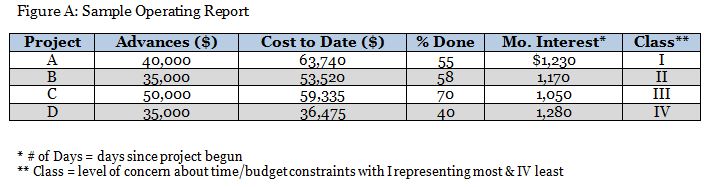
 

An effective system must be able to generate this kind of information. For example, reading Figure A prepares an executive to question issues of timeliness in production scheduling, loan advances, and interest rates.


Figure B is a job costing report. The way in which the report is read and interpreted will affect every decision made–or not made–with regard to the job listed. Comparing this report with a similar report for a project either in progress or completed, the relationship between the materials and labor for specific designs can be determined. The goal of the report is to establish standards for purposes of comparison; current projects are compared to the standards to analyze their performance.

Figure C shows a sample income statement for a growing small business ($3-5 million in sales). The income statement reports prior activity and should therefore be used to modify future business operations to maximize profits.  The statement needs to be even more detailed than the sample below to help determine how the profits or losses are being generated. One can be profitable and still not have cash. Cash flow projections, incorporating actual expenses, show the sources and uses of cash and are a good complement to the income statement and balance sheet.


The ability to read and understand reports and statements prepares the executive team member to use the information to influence business decisions. After reviewing Figure B, you should be equipped to establish workable production schedules. Subsequent production meetings should highlight areas to reduce costs and improve production deadlines.

Figure B should be discussed with all managers, who in turn implement  the schedules and budgets with subs and vendors. The resulting scheduling and budgeting systems ensure timely, cost-efficient job completion. Managers also need to assist in keeping the information current.

In Figure C, data is presented comparing the current year to the prior year in order to analyze trends and ratios. Tracking composite numbers such as gross profit takes on meaning when it serves as a basis for comparison, rather than being viewed in isolation. Deviations from the norm should be discussed in management meetings. So, if sales and profits are lagging,  the group should investigate any underlying causes and develop alternative production and sales methods–and implement them immediately.


What to Do When Financing Fails

Having been in business in the same town for almost twenty years, a Midwest company was accustomed to expansion and going after market opportunities. The owner had kept her business competitive by continuously improving product offerings and learning from the input of both customers and target customers. With a loyal, experienced operations team, she felt that she had the recipe for long-term success. However, when the recession of 2008 hit, she was unable to obtain a renewal of her line of credit by which she had historically been able to normalize cash flows.

The case study above illustrates a business principle–that we must always as business owners prepare for the unexpected and have the flexibility to adapt to changing market conditions. If we seem surprised when an action that we did not anticipate occurs, then it follows that either: 1.) our planning is incomplete, 2.) our systems and processes are too unresponsive to key indicators, or 3.) we have not established a feedback loop that provides us as small business executives with vital, timely information. Regardless the reason, it is poor management to not have a contingency strategy or tactic in mind for situations that may arise.

What should an executive team do when financing from lenders or investors falls through? First, the reason  for such a collapse in financing is normally attributable to one of the following:

  1. Partners or new regulations restricted the financing source from making (continuing) the deal.
  2. A more attractive alternative was available to the lender/investor from another source at the same time.
  3. The company failed to read the market conditions and adjust the financing request accordingly.

To stabilize the business in response to one of these situations, the owner and top finance executive should always seek new sources of funds–even if today’s source has been very reliable. If you have built relationships with other providers of financing, you may be able to reduce the risk any one player undertakes by spreading it among several. Alternately, you may find that some institutions have differing standards for new clients than for existing ones and may want the entire financing facility.  In either scenario, it is incumbent upon you and your team to perform due diligence. Find out how the bank (or alternate source) has shown commitment to other borrowers. In many cases, your accountant or attorney may be able to recommend new sources for you. Others in your trade group may have similar referrals to provide.

Being able to lay out both your best case scenario and a worst case one will show a new source your planning strengths and help to establish credibility. Ask questions about how credit facilities could be expanded as you hit milestones. Offer your plan for reporting your financial and operating performance. Discuss what the loan covenants may look like and have frank conversations about how your team will accommodate the request to demonstrate creditworthiness.

To avoid a recurring financing problem, owners should try to over-finance their operating needs whenever possible. It is extremely valuable to have credit available that is not being used–this cannot be overstated! Given that this funding source may dry up at any point, you never want to have to go back to the lender or investor because you failed to anticipate growth. 

The other recommendation is that you look at different types of credit. If you traditionally have only taken out installment loans, look for lines of credit–and vice versa. There are additional types of financing that may also be advantageous to consider–accounts receivable, factoring, purchase order financing, contract or project financing, asset based lending, leasing, etc. By using more than one type of funds from more than one source, you are diversifying your vulnerability to a credit restriction that could be deleterious to your business success.

Fail to Research; Fail to Secure Market Share

As companies seek to gain a competitive market position and execute on their business objectives, various problems can crop up. In the last post, we examined a case study on inventory control as one issue that needs addressing. In this installment, we will look at a case study involving loss of market share:

A company in the Northeast had always been able to sell enough product to secure a 15-20 percent local market share within the primary price range and portfolio of designs. As other competitors began to outsell this company in the local market, the owner commissioned some research to determine what percentage of the market share had been lost. Upon discovering that their share had dropped to 9-11 percent, the executive team became worried.

Why would this company’s–or any company’s–market share deteriorate to this point? Experience shows that one common reason for the decreased market share might be increased competition. As other competitors, whether established or new businesses, begin to offer viable or even more attractive alternatives, your business may begin to lose a percentage of share  in the local market. Another possible reason for declining market share could be perceived poorer quality in the products offered. Rumors of a company’s demise can fuel such a perception and scare buyers away, allowing other businesses to take advantage of this image problem.

The solution to declining market share varies according to the source of the problem. If bad image and rumors appear to be hurting the business, the owner must move quickly to dispel any rumors and improve company image through a bold and highly visible public relations campaign. For example, companies can generate goodwill by meeting with influential members of the local community to let them know that any perceived problems are being taken care of and that the company plans to be making products in the community for some time to come. This exposure can often be gained through attendance at chamber of commerce and other local business group meetings.

To overcome competitive advances, the executive team must aggressively outmarket and outproduce competitors in each niche market. By beating them in head-to-head competition, the problem is solved while the company’s reputation for high quality products is enhanced. In terms of quality initiatives, management should devise ways of improving quality in all projects, passing the word along to all employees, suppliers, and subcontractors that quality is becoming an issue and that only those who can produce quality work will remain a part of the team.

Stabilizing and regaining market share demands that the team know the local market inside and out. While calculated risks are allowed if the executive team feels confident that they can get product manufactured and sold quickly, the potential success of any such project must be measurable in terms of researched demand for the product line the company plans to produce. Clearly, companies must target opportunities that allow them to make their best products at competitive prices. By keeping abreast of new developments and new competitors attempting to make an entry into a particular market, the team can revise plans–and keep buyers from running to the competition.


Relevance in Business is Fleeting

“Focus Not on Protecting What You Have, Instead Obsess on the Next Big Thing.”

While this type of headline may not serve us very well in interpersonal relationships, it has become the watchword in business. Those who rest on yesterday’s accomplishments eventually find themselves with less and less current successes. Since we live in a day and time when ideas are ubiquitous, information plentiful, and communications vastly enhanced, it is incumbent upon every enterprise to remain on the hunt for “wow.”

Jeremy Gutsche of Trendhunter wrote in Exploiting Chaos that the disk drive, computer chip, and word processing markets were all ones that saw enormous changes and the market leaders were often outflanked. Read on:

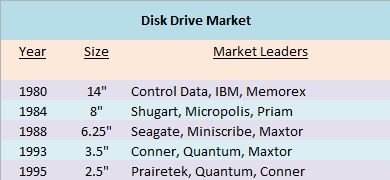
Borrowing from Clay Christensen’s work in The Innovator’s Dilemma , Gutsche described the progression in the disk drive industry towards constantly smaller drives. Along the way, observe the shift in power:


Observe how great organizations present in 1980 gave way to more nimble upstart startups over 15 years. Though the only apparent change was size of the drive, it was enough innovation occurring at a rapid enough rate to trip up the “big boys.” Perhaps, one may suggest, disk drives had become commoditized as more PCs were manufactured? This theory seems to hold true in computer chips, then, as well. To note:

Observe that this market experienced a slower rate of change (40 years of upheaval vs. 15), but the net result was the same: market leaders gave up leadership to disruptive alternatives. The fact that semiconductors require very extensive research and development efforts, whose project funding ranged into the billions of dollars, made this a significant economic microtrend. Gutsche points out that RCA was once twice the size of IBM, so the thought process that monetary barriers to entry would protect industry leaders was disproved time and again.

Word processing was once known as typewriting and the market leader was Smith Corona. Smith Corona was extraordinarily innovative, boasting over 100 patents spread over decades. Yet, the company who also invented the first word processor did not continue to reinvent itself in the computing age and lost its market leadership role. It is suggested that the historical accomplishments became blinders to the urgency for continuous improvement. Notice, they understood the concept of reinvention, but underestimated the urgency factor.

Lest you think that Smith Corona had been mismanaged over the course of the 20th century, pay attention to the fact that their annual revenues in 1989 were $500 million! What happened? Let’s look at some of the competition and what strategic decisions they made…Remington recognized the opportunity of computers and made the leap in 1950, only to be too early to that niche, lose money, and the computing division sold off in 1981. Perhaps Smith Corona saw the foibles of a competitor and vowed not to make the same mistake?

Commodore, on the other hand, was a different kind of competitor. Their model 128 was introduced in 1985 with two external floppy drives. The Smith Corona PWP 40 was preferred by buyers by a wide margin for word processing applications. Yet, someone inside the company saw an opportunity to partner with Acer on a computer joint venture. Unfortunately, the plug was pulled before the strategy could run its course.  Smith Corona declared bankruptcy in 1995; Acer became the fourth-largest PC company in the world!

Scott Anthony, writing for Harvard Business Review in an article entitled “Disruption is a Moving Target” observed a clear pattern:

  1. Disruptors enter a market incumbents don’t care about.
  2. Entrants grow as incumbents flee.
  3. The incumbent hits a ceiling.

What should be learned from this insight? Larger companies should not ignore small opportunities simply because they start out small. Smaller companies should plan their strategy and tactics around “nibbling at the edges” of an incumbent’s market share.


How to Handle Lenders

In dealing with lenders, it is important for executive teams to understand the background of those with whom they transact business. Bankers, for instance, are often conservative by nature, have little experience running their own business, and can be a part of a corporate system that is bureaucratic and slow moving. Realizing from the outset that the word “risk” is a four-letter word to these professionals can prepare you to have better conversations. Furthermore, you must accept that most front-line bankers are not empowered to question the standards they must enforce on behalf of their employer or the banking system as a whole. All of this is especially true after the recent mortgage industry troubles of the 2008 recession genre. By keeping in mind who is on the other side of the desk when a loan request is submitted, you as a management team member can position your request in a way that gives the banker the best ammunition to give you an affirmative response.

How Lenders Think

Understanding how lenders think helps the entrepreneur better understand why lending policies are pragmatic rather than opportunity-driven, standard rather than adaptable, and monitoring rather than recommending. While market opportunities drive the entrepreneur, lenders approach the very same data with caution. The same unpredicted cash shortage that merely surprises a business owner may send a lender into a panic. Lenders are not in the business of selling advice–in fact, they can be held liable if found to be doing so and the business goes under. They are in the business of making money on loans. Therefore, their loyalty is to company profits and a return on their monies borrowed–and noting else! Anyone who wishes to test the strength of this premise should try missing a few note payments.

Consistency is the hallmark of the lender, due in large part to the constraints of a corporate directive of standardization. The seemingly two-sided face that the entrepreneur sees the lender wear is real; the lending officer truly wants to help and has empathy, but is governed by institutional guidelines. Overidentification with the needs of the borrower can cause a lender to lose her job. 

Consequently, the face the business owner sees is not reality but rather a front depicting what the lending institution would like to see happen. Rarely does a borrower learn the true acceptable level of performance that a lender would be willing to accept. Since lenders control the purse strings to the resources that keep the borrower in business, these lenders are impossible to control. Knowing a lender’s true bottom line enables the borrower to influence lending policies that permit operation under the best possible conditions.

How Lenders Act

During tough economic times, lenders are expected to:

  • serve as a flexible yet profitable source of capital,
  • monitor the performance of borrowers in their book of business, and 
  • provide sound references to inquirers on behalf of their clients.

Lenders must be allowed to continue to make money on the loans they have extended, but the borrower may request modifications of the terms of repayment based on business financial performance. Principal payment deferrals, interest accruals, and other methods can be used to create cash within the business operation, but one is ill advised to single-handedly embark on such practices without securing the commitment of the lending institution in advance.

To the extent they are able, lenders should be encouraged to visit the places of business of their borrowers and check things out. Outside assessment of company execution of its plans by this important stakeholder group can prove valuable to the management of the company. Hopefully, an open dialogue creates an environment where the lender reference in credit applications is always a positive one and facilitates smooth operations in your company!