Simple Stories Make Great Pitches


ABC’s hit show, Shark Tank, is one of my very favorites on TV. It attracts entrepreneurs of all ages, levels of experience, and backgrounds to come pitch their business idea for angel investment by one or more of the sharks. One of the young ‘treps who pitched this past year is Joseph Draschil, co-founder of SpyGames.me.  Draschil is currently participating in Start-Up Chile (written about here a few months ago) while enrolled in an MBA entrepreneurship program at Babson College. 

His first major assignment in a Babson course was to create an opportunity storyboard for a business idea, limited to a single PowerPoint slide. The storyboard became a rocket pitch: a three minute, three slide, live pitch in front of his professor and classmates in the entrepreneurship class. Draschil was then encouraged to enter the Babson Rocket Pitch event, to pitch his idea in front of investors, professors, members of the community and the student body.

The following week, his team entered the Big Idea Competition, for which they were required us to upload a three-minute pitch video to YouTube, secure the most “likes” and move to the finalist round to pitch on stage for three judges. Within one week of being named one of two winning teams, Draschil received an e-mail from the director of the entrepreneurship center at Babson. Two of the “sharks” were to visit the school and hear the pitch. Here’s the young entrepreneur’s perspective on the experience:

Although I was terrified of failing in front of entrepreneur celebrities and all of Babson, I committed to participate and the pitch went great. My partner and I stumbled a couple of times during the Q&A session, but that’s okay. You make mistakes, learn from them, and improve — that’s the essence of the startup journey. After the event, Mark Cuban mentioned to us that he believed if we could get the marketing down, we would kill it.

While I continue to work on the business, I have learned a few key lessons about creating a dynamic pitch:

  1. Be visual. Please, no slides full of bullet points. Use simple and clean images that clarify and complement what you’re saying — not complicate it. When slides are cluttered and busy, the audience will be focused on deciphering them instead of focusing on you. Don’t forget that for most investors, the entrepreneur is more important than the product or idea being pitched.
  2. Tell a story. Storytelling lies at the heart of who we are as humans. Remember, you are not a court lawyer trying to amass evidence for the jury as to why your idea is destined to make millions. If your pitch is just a crowd of facts, figures and pie charts, you may lose your audience.
  3. Practice, practice, practice. Get in front of others and pitch — a lot. Don’t worry about your pitch being bad the first few times you do it. It most definitely will be. As you practice, though, you will learn which parts your audience is responding to and which parts need to be adjusted. Over time, your confidence and delivery will improve.

These 3 lessons are important for any entrepreneur. Pay attention to Draschil’s advice to be simple & clear in your slides. Way too much information in the presentations of many. The difference between an engaged audience and a bored one is your ability to weave a compelling story. Finally, the admonition to practice is so practical, fundamental, and predictive of one’s likelihood of success.


Add Value to Your Privately Owned Business

Most corporate governance articles, presentations, and conferences are focused on publicly owned businesses. With corporate and executive scandals galore occurring over the past few years, there have been outcries for better controls, systems, and oversight guidelines. Yet, the same emphasis and attention is grossly lacking in the privately owned business community. One of the areas in which governance best practices could be applied is in the realm of mergers and acquisitions. Nick Miller of Clayton Utz law firm in Australia offers some insights below for this unique situation:

Increasing the level of formal governance can assist in reducing risk, identifying issues that might emerge upon a sale and generally enhancing the credibility with which the business presents itself to potential buyers. Perhaps even more powerfully, governance is a means by which, both in fact and in perception, a business can present as less dependent on the involvement of its founders than it would without governance. This can add very significantly to value.

Many private business owners think that the absence of governance procedures makes them more flexible, more adaptable and more opportunistic. That may be so, but the benefits of that should be weighed against the benefits of formal governance when planning a sale. 

There are a range of ways to adopt some greater formality in governance:

  • without changing the make up of the board of a company, the company could implement a more structured system of monthly meetings. These may or may not be formal board meetings, but should nonetheless involve the directors and those who report into the CEO;
  • a company can set up one or more committees. These can be formal board committees or more informal, but they are set up to address areas of need, to bring in expertise and focus on how risk management can be improved and issues for the business addressed. Examples are an audit and risk committee, a brand development committee and an employee policies committee, to assist in developing those aspects of the business in readiness for sale. These committees might have outsiders on them and they might not, depending upon the need and the expertise available in the business;
  • an advisory board could be established. Properly structured, members of an advisory board will not carry director duties and liabilities and this can be a sensible stepping stone towards a more fully independent board;
  • one or more outsiders can be brought onto the board. This can be very beneficial, but it needs to be right for the business; and
  • governance can also be improved by developing appropriate governance policies and procedures.

Corporate buyers and private equity see many poorly organised privately‑owned businesses. They will take the opportunity to highlight the possible risks to them in undertaking an acquisition of a poorly organized or more risky business. Some investment in governance can dispel most of these apprehensions, and allow private business owners to defend the level of risk in the business and so achieve higher value for a seller. Nonetheless, formal governance should be introduced carefully, to ensure the owner’s ability to drive and control the business is not unduly impeded.

In summary, shareholder value is enhanced in privately owned businesses through better corporate governance. Opinions of value are enhanced by checks and balances, independent processes, and a decreased dependence on the founder(s). Make the necessary adjustments to your business. You will make better decisions, increase the market value of the business, and create an environment wherein others can grow in their roles and responsibilities.


Mainstreet Business Demonstrates Strategy Execution

One of the interesting conversations that keeps coming up  revolved around the hyperfocus on technology based start-ups to the exclusion of virtually every category. When I attend networking events, many of the entrepreneurs that I encounter are articulating the value proposition of their high tech start-up. Almost every single one speaks of the next competition they plan to enter to secure financing to fund their idea.

What seems to be missing in these conversations is a focus on executing a business strategy rather then simply a funding strategy. In the hot pursuit of obtaining seed capital, entrepreneurs  can become blind to what’s happening around them with the other important facets of the business. From human resources to operations, marketing & sales, there are many other aspects of development besides the capital raise that warrant attention.

In companies that do not claim to have a technology focus, it is a little easier to talk to the entrepreneur about business basics. Professional development, personal finance, market research, proof of concept, branding, feasibility, organizational design, supply chain, & sales are front and center topics in most companies. Instead of intellectual property, securities and like topics du jour, most of the companies that contribute to our way of life and represent the fulfillment of the American Dream struggle with these topics.

I fear that, by giving so much attention and publicity to technology companies who may have the outside chance of selling at a favorable multiple, we are failing to give earnest heed to companies with issues that are easier to address and that have a higher likelihood of making it to the five years in business mark. Simultaneously, we become so enamored with the perfection of code or intellectual property that we fail to talk about business basics with the technology companies, though they need to think through all of these issues in addition to theunique issues they face.

Please do not misunderstand my intentions here. This blog post is not about bashing technology companies. Quite the contrary, it is suggesting that all companies are best served by focusing on fundamentally sound business principles. In the very next breath, however, I would argue that non-tech companies not be relegated to second tier/ugly stepsister status simply because the multiples they usually generate are lower. The upsides of a “mainstreet business” is that it has less inherent  risk, requires less capital, and can generate revenues sooner. 

How can we, as the American business community, more effectively support mainstreet businesses? (And not fail to challenge tech companies to also execute on key business fundamentals as well?)


Due Diligence Lip Service

“Culture isn’t just one aspect of the game. It is the game.”                          

 –   Lou Gerstner, former IBM chairman & CEO

Pritchett conducted a study of 135 executives from public and private companies and found that, on a 10 point scale, cultural due diligence rated a mean importance factor of  7.45. Privately held companies and private equity firms generally rated the importance higher than public companies. Yet, the same population rated their organizations’ success in blending cultures as only a 5.62. What does this mean? Have you ever heard the phrase “lip service?” It is one thing to acknowledge the importance, but something altogether difference to act in a way that supports that belief.

The study authors go on to note that, while culture is perceived as a key factor in merger success, there is not a consistent approach to measuring effectiveness, let alone the components that comprise it. Slightly less than half (49%) of organizations make an effort to measure. Privately held mid-cap companies and private equity companies set the pace in this arena. Non-profits and publicly-held large cap companies make far less effort to measure effectiveness post-merger or acquisition. 

Given, again, the relatively high value placed on the importance of culture to integrating two companies, it is dismaying that culture is not normally a part of the due diligence process. Of the executives surveyed, 4% say their teams ask specific questions about culture during vetting. Similarly, only 5% attempt to assess compatibility through some standardized means, with less than half of those administered by an objective outsider.  

It was observed that, when assessment is attempted, it tends towards subjective intuitions rather than a strategic metric. Furthermore, HR is excluded from the cultural discussion 94% of the time. On a high note, organizations that consider themselves savvy with regards to cultural due diligence perform assessments 70% of the time. 

While the results for pre-merger analysis and process are not good, those for post-merger are dismal by comparison. Only 21% of organizations surveyed have an established, repeatable process that is used consistently to facilitate seamless blending of organizations. 

The broad findings of the study were:

  1. Culture should be a more strategic consideration in the merger process. It deserves far more weight in the initial targeting of potential acquisitions or merger partners.
  2. Due diligence should scrutinize cultural aspects of the deal with the same discipline given to financial and legal issues. This simply cannot be done via a traditional culture gap analysis or compatibility survey. 
  3. Culture integration should be driven from the CEO/President level. This initiative cannot be delegated effectively. The architecture of culture strategy, plus the critical first steps of execution, belong to the leader.
  4. Organizations should be more astute in crafting their merger communications relating to cultural issues. Both the substance and timing of these messages are crucial. Management needs to be fine-tuned in managing people’s expectations, all the while shaping workforce behavior in the desired cultural direction.


Due Diligence Must Include Culture

60% of mergers, acquisitions, and joint ventures fail to perform up to expectations in their first year, often because of cultural incompatibilities between the two prospective partners. The losses in shareholder value are in the hundreds of millions of dollars in many of these star-crossed liaisons. Cultural Due Diligence is a technique for keeping both eyes wide open when approaching an attractive prospect, whether for a merger, joint venture, or offshore vendor.

-Wayne State University, Institute for Information Technology and Culture

When two companies agree to join forces in some type of agreement, cultural fit is usually the last factor considered-if at all! Instead, many numbers are crunched, recrunched, and analyzed ad nauseum. Market impact, anticipated back office savings, etc receive the lion’s share of the secondary consideration after financial statement items. “Culture” is perceived as too soft an issue to justify the time and attention of high-powered executives. Big mistake!

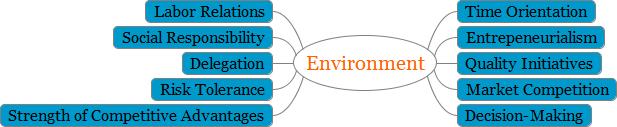
At the very minimum, the operating environment and organizational structure of each entity needs to be explored. When we are working with a client, we use the following two charts to help us ask solid questions about these two components of culture. From the answers received, we make value judgments and recommendations as to the degree of “fit” between organizations and what to do about it.

In considering the operating environment, we look at whether the company has a long-range or short-term approach to management. We ask questions to determine whether the organization is more entrepreneurial or bureaucratic. Quality initiatives are a good indicator of what aspects of performance are most important to management. The degree an strength of market competition for each party is important. How decisions are made is another leading indicator of what it may be like to work alongside the other team.

How management handles relationships with employees, (unions), and contractors is important to search out. Is giving back to the community and having respect for the environment a value of the other organization? Do meaningful tasks get delegated effectively, or are there barriers to professional development , shared responsibility, and growth through the contributions of many? Discovering how the other party perceives risk and builds strategy accordingly is a key conversation. When one’s competitive advantages are articulated, it is vital to verify how strong they are in the eyes of the buyers.

In addition to the operating environment, it is critical to understand the organizational structures that represent the philosophy of your intended. Do employees have direct access to top executives, or must they work through a layered management team? Understand whether the employees feel that they are protected to the point of not being allowed to make any mistakes. Examine whether generalist skills are valued versus everyone having a narrow scope. Look at the board of directors to see whether it is comprised of objective, strong leaders. Pay attention to the diversity of the employees and management team.

If the other company has a multi-office system, is it managed out of corporate, or are those in the field given autonomy? Notice whether task or relationships seem to carry more weight. Analyze the turnover rate among management and key positions. Is the human resources department deep enough to undertake complex issues like training and development, talent management, succession planning, coaching and the like, or compliance focused? Ask for examples of how technology is used to solve problems and enhance work flow.

The careful review of these “soft” factors can save you some headaches and hardships–do it! (We would love to help.)