Relevance in Business is Fleeting

“Focus Not on Protecting What You Have, Instead Obsess on the Next Big Thing.”

While this type of headline may not serve us very well in interpersonal relationships, it has become the watchword in business. Those who rest on yesterday’s accomplishments eventually find themselves with less and less current successes. Since we live in a day and time when ideas are ubiquitous, information plentiful, and communications vastly enhanced, it is incumbent upon every enterprise to remain on the hunt for “wow.”

Jeremy Gutsche of Trendhunter wrote in Exploiting Chaos that the disk drive, computer chip, and word processing markets were all ones that saw enormous changes and the market leaders were often outflanked. Read on:

Borrowing from Clay Christensen’s work in The Innovator’s Dilemma , Gutsche described the progression in the disk drive industry towards constantly smaller drives. Along the way, observe the shift in power:
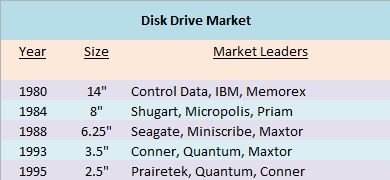
 

Observe how great organizations present in 1980 gave way to more nimble upstart startups over 15 years. Though the only apparent change was size of the drive, it was enough innovation occurring at a rapid enough rate to trip up the “big boys.” Perhaps, one may suggest, disk drives had become commoditized as more PCs were manufactured? This theory seems to hold true in computer chips, then, as well. To note:

Observe that this market experienced a slower rate of change (40 years of upheaval vs. 15), but the net result was the same: market leaders gave up leadership to disruptive alternatives. The fact that semiconductors require very extensive research and development efforts, whose project funding ranged into the billions of dollars, made this a significant economic microtrend. Gutsche points out that RCA was once twice the size of IBM, so the thought process that monetary barriers to entry would protect industry leaders was disproved time and again.

Word processing was once known as typewriting and the market leader was Smith Corona. Smith Corona was extraordinarily innovative, boasting over 100 patents spread over decades. Yet, the company who also invented the first word processor did not continue to reinvent itself in the computing age and lost its market leadership role. It is suggested that the historical accomplishments became blinders to the urgency for continuous improvement. Notice, they understood the concept of reinvention, but underestimated the urgency factor.

Lest you think that Smith Corona had been mismanaged over the course of the 20th century, pay attention to the fact that their annual revenues in 1989 were $500 million! What happened? Let’s look at some of the competition and what strategic decisions they made…Remington recognized the opportunity of computers and made the leap in 1950, only to be too early to that niche, lose money, and the computing division sold off in 1981. Perhaps Smith Corona saw the foibles of a competitor and vowed not to make the same mistake?

Commodore, on the other hand, was a different kind of competitor. Their model 128 was introduced in 1985 with two external floppy drives. The Smith Corona PWP 40 was preferred by buyers by a wide margin for word processing applications. Yet, someone inside the company saw an opportunity to partner with Acer on a computer joint venture. Unfortunately, the plug was pulled before the strategy could run its course.  Smith Corona declared bankruptcy in 1995; Acer became the fourth-largest PC company in the world!

Scott Anthony, writing for Harvard Business Review in an article entitled “Disruption is a Moving Target” observed a clear pattern:

  1. Disruptors enter a market incumbents don’t care about.
  2. Entrants grow as incumbents flee.
  3. The incumbent hits a ceiling.

What should be learned from this insight? Larger companies should not ignore small opportunities simply because they start out small. Smaller companies should plan their strategy and tactics around “nibbling at the edges” of an incumbent’s market share.



Coping With External Elements of Decline

By using tools like promotion, persuasion, buyer education, accelerated product development, process improvements or elimination, growth plans, market development, and adjusted sales practices, business owners can adapt to changes in their external operating environment. Paying attention to the following warning areas is important in coping with external elements of decline:

  1. Economic growth, which gives management an indication of the economic climate and influences expansion plans.
  2. Credit availability and money market activity, which indicates trends in commercial and investment banking affecting financial needs. Changes will affect the cost of funds.
  3. Commodity market movements, which reveal trends in raw material inputs.
  4. Capital market activity, which gives a clear signal of investors’ attitudes toward your industry. 
  5. Business population characteristics, which can advise executive teams on the number of businesses entering and exiting the industry (niche). This signal can be used as an indicator of the expansion and contraction of the market and competitive size of the industry.
  6. Price level changes, which indicate the rate of inflation. This rate influences the consumption and therefore has an impact on the company growth rate.
  7. Changes in the competitive structure of the marketplace, which affect products, pricing, and marketing and sales.
  8. Changing technology, which allows rapid breakthroughs and changes in products, processes, and marketing and sales.
  9. Cultural/social changes, which can alter buyer preferences or the conditions under which a product can be sold.
  10. Legal/political changes, which can adversely affect the marketplace or have an impact on the execution, marketing, or sales of a product/service.

Coping With External Elements

Some  businesses prosper during crises. They plan for changes and create resources that enable them to continue to function. For example, some businesses use substitute products in their processes, and their adaptability allows them to survive. In short, many strong teams do find it possible to both address and influence the external elements.

There is no denying, however, that external elements can have a profound effect on companies. Teams are forced into unique experiences when confronting situations they don’t understand. External elements are usually not a part of most businesses’s planning processes. While many will fail, some are saved–those that are adaptable and able to return to their core products and once again become profitable.

Businesses with less than 50 employees are actually the heart of the economy. Unfortunately, they are also the companies most frequently in need of a turnaround, having the same internal and external problems but lacking the business and human resources of many larger companies.  Consequently, these smaller businesses do fail, just as larger ones do, but without the press coverage.

To effectively cope with the external elements requires that the executive team plan for the unexpected and implement the plan when it occurs. Since management knows it can expect changes in economic conditions that will affect the capital and money markets, it must plan for those changes. The areas that management can control must be prepared for the possibility of external environment changes. Strategic planning that is not flexible is, therefore, useless. For example:

  • Most companies should prepare for increased competition, local, regional, and around the world.
  • Legal and political changes are always on the horizon and should be duly noted; it is not a question of whether they will affect the business, but when.
  • Being aware of cultural and social changes affecting purchasing patterns is predictive of consumer spending and its impact on the entire local business economy.
  • Changes in technology are continual and must be utilized where appropriate.

The main issue to be addressed is whether the business is making the change or being subjected to it. In either event, the management team must adapt to the new environment or be prepared to suffer the consequences.


Early Warning Signals (External) of Business Decline

Early warning signals companies should look for in the external environment include all legal, political, competitive, technological, economic, and social changes that affect them. Regular review of social media, trade periodicals, business publications, and newspapers will help to keep you current. A technological advance, for example, often affects buyer attitudes and expectations, thereby causing social changes that need to be addressed in product/service design and delivery/sales. If your organization is uninformed with regard to the changes–either that they occur or the extent to which they occur–company performance may lag behind competitors. 

Early Warning Signals – External

Management often tends to dismiss the external signals of decline as elements beyond their control. They believe that a downward trend will end when external elements (e.g. economic conditions) improve. Problematic external elements can include the following:

  • increased competition
  • rapidly changing technology
  • unpredictable economic fluctuations
  • cultural/social changes
  • legal/political swings

Within these external elements are market changes, customer preference changes, foreign competition, capital and commodity market movements, legal precedents, and unresponsive political solutions. While these elements cannot be controlled, they can be influenced. Also, since all businesses in an industry are similarly affected by external elements, management’s ability to survive these changes will determine future  viability. Some businesses weather external changes and emerge with increased market share and profitability; others fail.

Two major problems with these elements are their uncontrollable nature as well as their interaction with each other. Upon close scrutiny, it becomes apparent that factors affecting one of them can have a secondary effect upon another. For example, a cultural/social shift can result in a legal/political change. This change can affect the economic environment, which will interact with technological development. the rate of technological development consequently affects the status of competition. This process of action and reaction comes full circle when we realize that the status of competition then affects the economy and cultural/social change.

Businesses fail to realize that they can plan for external changes and safeguard their hard work. Their management teams have the ability to influence the external elements if they can predict their occurrence. Such foresight allows the executive team to influence the elements through the use of promotion, persuasion, buyer education, accelerated product development, process improvements or elimination, unit growth plans, new markets, and adjusted sales practices. 

Adaptation to the change is the result. For example, construction companies that build prefabricated residences have known for years about the external changes affecting the prefab sector of the home building industry. They have been affected by  cultural/social and legal/political changes for the last several decades. In response, they developed new products, such as modular multifamily housing, to offset their declining mobile home product sales. They invested in additional research to determine the number of potential single-family and multifamily buyers who preferred the cost savings that their construction process generates. They invested in new manufacturing capabilities, which would use material specifications offering a competitive advantage. These companies understood the early warning signals of the external elements and acted to offset them through:

  1. promotion and persuasion to keep their customers,
  2. additional market research about market size and buyer profiles,
  3. buyer education based on research findings,
  4. product improvements, and
  5. product elimination.

These tools allowed this segment  of the building industry to adapt to changes in the market. What are you doing in your business to a.) study the external environment, b.) adapt to the changes, and c.) position yourself in the eyes of prospects and existing customers to become more competitive? You can influence your own outcome!


Resurgence of Manufacturing Entrepreneurs


Any study of the world of design reveals that concepts go through cycles of acceptance, falling out of favor, and rebirth. New renditions using different media or materials are brought to market and find life. In the world of entrepreneurship, similar patterns exist. E-commerce stores allow small businesses to compete with acclaimed retailers like Costco. The old-fashioned corner store emphasized personal service. Now, there are customer service “departments” that are outsourced to stay at home mom businesses in the heartlands. Back in the day, before either the industrial or information age, there were many businesses operating out of the home. Now, with internet access, we see a return to “cottage industries.”

One of the sectors that has experienced severe shrinkage and job loss domestically is manufacturing. The decline has been steady over several decades and many have lamented that we can never get back to where we were. What if the principles of design, retail, etc were applied to manufacturing? Could it experience a resurgence that makes it a key economic driver again?  We are living in an age where start-ups are more plentiful and the amount of capital to get into business and keep it afloat is perhaps less than ever before. It stands to reason, then, that we could see a flurry of manufacturing start-ups, but what would have to happen for it to occur?

Bradley Starr writes in a blog for Entrepreneur Country about the (re)new(ed) trend of people who want to make products again, rather than intangible services–he refers to this group as “Makers.” He argues that the Makers are a movement that is good for small business and that many are realizing that they don’t have to become huge to be financially successful. Themes that ignite manufacturing entrepreneurs include technology, networking, and mass customization:

New technology driven tools such as the first of the low cost 3-D printers, numerical manufacturing machines cheap enough for the home and Arduino electronic controllers, enable small organisations and individuals to manufacture components, complete assemblies and machines that were previously the province of large organisations with big machinery.  Collaborating with other Makers, designers and business services amplifies the skills, capability and capacity.

Networked small business is a most powerful force.

So Where’s the Market?

In two places:

1)    Where made to order locally is more efficient than shipping in bulk from the other side of the world
2)    Mass customisation and other small run products

If, for example, you need spare parts for a car, does it make sense to tie up cash and warehousing holding stock?  The new machines can manufacture to order locally at a competitive price, and the low cost of the machines means that an engineer can run their own small business supplying this market.  You just need to hold a relatively small amount of easily available raw material in order to make a wide range of products to order.  Low cost of financing, fast delivery, great service.

The ability to produce small to medium runs of products cost effectively opens up the enormous opportunity of more individual products, giving free reign to design ambition and consumer choice.

Global product uniformity could be on the way out to be replaced by a far more interesting world.

Nothing short of a mini-industrial revolution is on the verge if enough believe what Starr says, in part echoing a Wired magazine article last year celebrating the Maker movement. This may become the “shot in the arm” so needed in former factory towns where “made in America” still carries a swagger and mentors abound with deep manufacturing experience. The potential to pair these experienced mentors with entrepreneurs, utilize new technology tools, benefit from networks and market conditions is an opportunity economic development groups should not ignore. Likewise, our educational institutions and chambers should champion the effort. Who’s game?


American Restaurants Struggle to Stay Alive

Back in the late 1980s, the Turnaround Management Association was birthed out of a research project conducted at the Kenan Institute of Private Enterprise at the University of North Carolina at Chapel Hill. As the lead researcher, I had the opportunity to personally pull together a bibliography of articles about businesses whose travails were significant enough to hit the national headlines in various business publications. From the research, we published a monograph and wrote articles about best practices that appeared in 46 national business periodicals in our first 18 months of existence as a trade association. As I and other involved with the Association moved on to other pursuits, TMA moved off campus, starting gaining momentum in chapter development, and now enjoys international members as well as domestic. One of the publications of TMA is the Journal of Corporate Renewal. The Journal‘s lead article for May discusses the struggle of restaurants in the United States to remain profitable.

Some interesting facts from the National Restaurant Association are cited:

  • Restaurants account for 4% of GDP
  • 10% of the U.S. workforce is employed in the restaurant industry
  • 50% of adults have worked in a restaurant
  • one-third of all workers had their first job in a restaurant
  • 48% of the average household’s food budget goes to restaurants (vs. 25% fifty years ago)

The bankruptcy filings of a number of restaurant chains since the recession began in 2008 is but one indicator of a model that is teetering on the brink of survival. The photo above is taken from a Food Network show entitled Restaurant Impossible, wherein Robert Irvine turns a restaurant around in 48 hours. The menu is revised, customer service issues are addressed, $10,000 of strategic remodeling is performed, the revenue and costs are examined for opportunity, and the restaurant owner is challenged to run the business at a profit going forward.

Macro trends in the recent few years towards buying more groceries or becoming value-conscious have definitely affected the top and bottom lines of many restaurant owners. Franchises, which account for about half of the restaurant revenues produced nationwide, have really taken it on the chin. Franchisees who own one or only a few stores have inadequate access to capital these days. Another big factor is the conflict of interest in most franchise agreements that are based on sales volume. The franchisor can implement discounting programs to increase traffic and sales volume, but the franchisee has less and less profit as a result of the agreements.

What can be done? Turnaround experts recommend a process of performing store-level profitability analysis, followed by benchmarking against peer stores. These analyses can highlight purchasing/inventory issues, training issues that are evidenced by waste, and theft/shrinkage that depletes the operator’s assets needed to produce a return.

There are many good consultants who can help a restaurant owner sort through the challenges and create a plan for growth and renewal.