Due Diligence Must Include Culture

60% of mergers, acquisitions, and joint ventures fail to perform up to expectations in their first year, often because of cultural incompatibilities between the two prospective partners. The losses in shareholder value are in the hundreds of millions of dollars in many of these star-crossed liaisons. Cultural Due Diligence is a technique for keeping both eyes wide open when approaching an attractive prospect, whether for a merger, joint venture, or offshore vendor.

-Wayne State University, Institute for Information Technology and Culture

When two companies agree to join forces in some type of agreement, cultural fit is usually the last factor considered-if at all! Instead, many numbers are crunched, recrunched, and analyzed ad nauseum. Market impact, anticipated back office savings, etc receive the lion’s share of the secondary consideration after financial statement items. “Culture” is perceived as too soft an issue to justify the time and attention of high-powered executives. Big mistake!

At the very minimum, the operating environment and organizational structure of each entity needs to be explored. When we are working with a client, we use the following two charts to help us ask solid questions about these two components of culture. From the answers received, we make value judgments and recommendations as to the degree of “fit” between organizations and what to do about it.
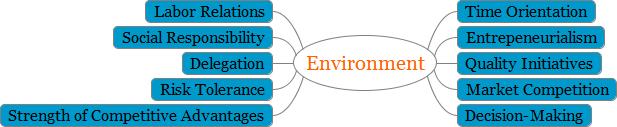
In considering the operating environment, we look at whether the company has a long-range or short-term approach to management. We ask questions to determine whether the organization is more entrepreneurial or bureaucratic. Quality initiatives are a good indicator of what aspects of performance are most important to management. The degree an strength of market competition for each party is important. How decisions are made is another leading indicator of what it may be like to work alongside the other team.

How management handles relationships with employees, (unions), and contractors is important to search out. Is giving back to the community and having respect for the environment a value of the other organization? Do meaningful tasks get delegated effectively, or are there barriers to professional development , shared responsibility, and growth through the contributions of many? Discovering how the other party perceives risk and builds strategy accordingly is a key conversation. When one’s competitive advantages are articulated, it is vital to verify how strong they are in the eyes of the buyers.

In addition to the operating environment, it is critical to understand the organizational structures that represent the philosophy of your intended. Do employees have direct access to top executives, or must they work through a layered management team? Understand whether the employees feel that they are protected to the point of not being allowed to make any mistakes. Examine whether generalist skills are valued versus everyone having a narrow scope. Look at the board of directors to see whether it is comprised of objective, strong leaders. Pay attention to the diversity of the employees and management team.

If the other company has a multi-office system, is it managed out of corporate, or are those in the field given autonomy? Notice whether task or relationships seem to carry more weight. Analyze the turnover rate among management and key positions. Is the human resources department deep enough to undertake complex issues like training and development, talent management, succession planning, coaching and the like, or compliance focused? Ask for examples of how technology is used to solve problems and enhance work flow.

The careful review of these “soft” factors can save you some headaches and hardships–do it! (We would love to help.)


Culture: Key to Performance

Recently, I had the opportunity to address a group of HR leaders on how to improve decision-making within their organizations. (Thank you RWHRMA, Masters Series participants!) The premise of our time together was that better decision-making translates into superior performance and that there are definite ways to improve the quality of decisions. Most of our workshop was used to define the components and use of emotional intelligence (EQ). In order for employees–and managers/executives–to consistently exhibit high EQ, valuing and engaging others is a key.

A focus on others and their needs is a result of purposeful culture development. Paul Spiegelman, founder and CEO of The Beryl Companies, writing for Inc. on June 6, described Beryl’s “10 Cs of Culture:” 

1. Core Values

..when we implemented our values strategy at Beryl about 10 years ago, I began to see how they guided everyday decision-making and how employees referenced them in meetings.  I came to realize they are essential guideposts when developed, communicated, and executed in a consistent manner…We start every big meeting with a conversation about values and tell stories about how our coworkers live by those values on a daily basis.  

2. Camaraderie 

It’s about getting to know colleagues not just as colleagues, but what they’re like outside the office.  To do that, Beryl hosts dress-up days, parties, games, and events all the time..We include not only employees, but also their families.  We publish a bi-monthly full-color magazine called Beryl Life that is sent to the homes of co-workers.  

3. Celebrations 

You can’t underestimate the importance of recognizing your team..we developed a program we call PRIDE (Peers Recognizing Individual Deeds of Excellence).  This allows coworkers to recognize others for living up to Beryl’s core values.  

4. Community

Part of the fabric of a successful company culture is connecting with and giving back to the local community.  

5. Communication

I hold quarterly Town Hall meetings, which includes six meetings over two days..I also have informal “chat and chews” where I bring in lunch for 12 to 15 people and just ask one question–How’s it going?–to get the conversation started.  

6. Caring

Show your employees you genuinely care about them in the totality of their lives..Any manager can explain a situation on an internal website that identifies a coworker, and lists what’s going on (birth, death, injury, wedding, among other things).  That submission generates an email to me that is my trigger to send a personal notecard, make a phone call, or visit someone in a hospital.  

7. Commitment to Learning

Show your employees you’re committed to their professional growth. This can be done in small, incremental steps. 

8. Consistency

Culture is based on traditions..One-time efforts to improve the culture will feel disingenuous.  

9. Connect

Don’t isolate yourself at the top.  Connect with people at all levels of your company.  Get out of your comfort zone.  

10. Chronicles

Does everyone in your organization know how the company started?  Do they know the personal stories of the founders and what led them to build a sustainable business?  People want to know they are part of something special and unique.  

Do you get the feel that, at Beryl, you could fit in and feel engaged in the key conversation(s) that contribute to its success? What about your company? Do you have a culture that is engaging? If not, what can you do about it? What’s holding you back? Talk with your peers and come up with a plan, then implement it!

The Great Urban Entrepreneur

Five years ago, a pair of adventure loving buddies found a way to bring their love of thrills into an urban environment. They since have grown Red Frog Events into an $85 million business that hosts competitions during which teams solve clues and complete mental and physical challenges while discovering their city in a fresh way. Joe Reynolds and Ryan Kunkel have parlayed their $5,000 initial investment into a successful Chicago-based company with more than 60 full-time employees, three signature extreme races and a serious following.

The company’s most popular event, Warrior Dash, a 5K race packed with obstacles like a pond filled with logs, a rock wall, a tunnel of flames and a sinking mud pit, made appearances in 35 cities across the country in 2011 and drew 600,000 participants. This year the company is going international for the second time, taking its events to Ireland and Great Britain. Reynolds says, “When you’re really passionate about your business, you can see lots of tremendous opportunities.”

Nancy Mann Jackson says (in her Entrepreneur magazine article about him) “Reynolds had previously owned a house-painting company, but had no idea how to contend in the event-production business. What he did know was that he loved competing and creating fun experiences–and he wanted to share his passion with the masses. With hard work and dedication, he’s now doing just that. If, like Reynolds, you’d like to turn what you love into a viable business enterprise, start with these six tips:”

1. Don’t count on passion alone.

“Sometimes passion can blind you to the potential downside of your idea,” says John Torrens, a serial entrepreneur and an entrepreneurship professor at Syracuse University. “The one non-negotiable factor for any sustainable business is that they solve a problem for a specific customer segment in a way that is appreciably better than the next best alternative. Get as much feedback from potential customers as possible. No matter how great you think the idea is, you still need to understand what your market thinks.”

Remember the details. There are tons of ancillary functions that go along with running a business that must be performed well for it to succeed.

Dole out responsibility.  You’ll either have to delegate the primary work to others, or you may choose to delegate managing the operation to someone else so you can continue to focus on the primary work yourself.

2. Hire passionate people.

Having employees who share your zeal for the business will help your company succeed. For instance, at the Warrior Dash Louisiana in 2010, a series of tornadoes tore through the landscape during the event. Neither Reynolds nor Kunkel were in Louisiana, but the staffers who were managing the race stayed up through the night to repair the course and get all the obstacles ready again, so the competitors who weren’t able to finish could complete the course the following day.

3. Share your passion.

If you have a hobby, likely there are others out there who share that interest and would like to learn more about it. Sharing your knowledge can be a great way to build your business.

4. Keep the passion alive.

Reynolds and Kunkel make a point to continue competing in races themselves so they can maintain their love for running and recreation. Rather than feeling responsible for thinking of everything and micromanaging their employees, Reynolds and Kunkel empower their staffers to develop solutions to their own problems.

5. Prioritize fun.

Torrens says, “In the authentically passionate companies, everything grows from that passion, including the people, policies, branding and community relations. That obsessive focus on whatever it is that gets you out of bed can’t be faked, but it takes work to create the circumstances under which it can thrive. “

6. Expand your passion.

Reynolds launched Red Frog Events because he wanted to combine his love for adventure travel and competitive runs. But over the past five years, he and Kunkel have realized they are excited about producing recreational events in general, not just runs. This year they plan to enter the music festival industry, starting with their own Firefly Music Festival, which they hope will compete with some of the world’s largest such events.

Refuse to Lose (Investors’ Money)

Clarence Wooten, who sold his start-up Image Cafe to Verisign 7 months after founding for $23 million, told an audience at MIT/Sloan recently that there are keys to the entrepreneurial mindset. Barb Darrow with GigaOm summarized his comments into 12 lessons:

  1. Paycheck is an addiction. Not unlike crack cocaine. Entrepreneurs have to break that addiction to build an asset that will pay off long-term, not in a weekly paycheck.
  2. Beware of naysayers. Because 99 percent of this country works for the 1 percent, they  have risk-averse employee mentalities. Don’t listen to them.
  3. Just do it. Be like Nike. There is no roadmap. If you don’t do it, it won’t get done. Work lean. Corporate people are used to resources — HR departments, assistants but entrepreneurs do it on their own.
  4. Fail fast, fail cheap. You will fail a lot because you’ll need to try a lot things. So do that on the cheap. Instagram’s first product  – Brbn — failed but they distilled that app to its bare essence and it caught fire.
  5. Partner pitfalls. It’s scary to be out there alone. You want someone to share the ups and downs. Often one partner will work harder than the other but share the same upside. Share the downside as well and don’t necessarily split equity equally. Set up reverse vesting:  When you issue founder’s stock, make sure it vests in case someone leaves they don’t leave with all equity just with what has vested.
  6. Be naïve. Unlearn what you learned in corporate America about hierarchy. Being naive means being ballsy. Facebook turned down a $1 billion offer from Google and people thought Zuckerberg was crazy. He wasn’t but he may have been naive. That paid off pretty well.
  7. Business is a team sport. Would you rather own 100 percent of a $1 million-a-year business or 20 percent of a $100 million-a-year business? Everyone needs equity. You need as much brainpower as possible.
  8. Challenge your comfort zone. I knew I had to put myself out there speaking in public. I wasn’t comfortable with it but I did it.
  9. Image matters. People judge you when you talk about your company and you have one chance to make a first impression. If you’re not a design person, don’t do your own logo. Crowdsource if you need to.
  10. Shadow of a leader. You determine what your company culture looks like. Build it as a place you want to work every day. People watch you. At Image Cafe, I brought in a CEO who was religious. I wanted to act like a customer to get competitors’ pricing and she said “absolutely not.” She set the ethical tone.
  11. Investors want their money back. This is important. Investors back you. Your integrity is on the line. So know your exit strategy. I’ve never lost an investor’s money and I carry that chip with me every day.
  12. Cash and customers. Lessons 1 through 11 you can learn on your own but for #12 it helps if you have some education and understanding finance and marketing.

Wooten feels that entrepreneurship is a combination of talent, preparation and hard work. Following the 12 guidelines above will give you as an entrepreneur a chance to be more successful.

American Restaurants Struggle to Stay Alive

Back in the late 1980s, the Turnaround Management Association was birthed out of a research project conducted at the Kenan Institute of Private Enterprise at the University of North Carolina at Chapel Hill. As the lead researcher, I had the opportunity to personally pull together a bibliography of articles about businesses whose travails were significant enough to hit the national headlines in various business publications. From the research, we published a monograph and wrote articles about best practices that appeared in 46 national business periodicals in our first 18 months of existence as a trade association. As I and other involved with the Association moved on to other pursuits, TMA moved off campus, starting gaining momentum in chapter development, and now enjoys international members as well as domestic. One of the publications of TMA is the Journal of Corporate Renewal. The Journal‘s lead article for May discusses the struggle of restaurants in the United States to remain profitable.

Some interesting facts from the National Restaurant Association are cited:

  • Restaurants account for 4% of GDP
  • 10% of the U.S. workforce is employed in the restaurant industry
  • 50% of adults have worked in a restaurant
  • one-third of all workers had their first job in a restaurant
  • 48% of the average household’s food budget goes to restaurants (vs. 25% fifty years ago)

The bankruptcy filings of a number of restaurant chains since the recession began in 2008 is but one indicator of a model that is teetering on the brink of survival. The photo above is taken from a Food Network show entitled Restaurant Impossible, wherein Robert Irvine turns a restaurant around in 48 hours. The menu is revised, customer service issues are addressed, $10,000 of strategic remodeling is performed, the revenue and costs are examined for opportunity, and the restaurant owner is challenged to run the business at a profit going forward.

Macro trends in the recent few years towards buying more groceries or becoming value-conscious have definitely affected the top and bottom lines of many restaurant owners. Franchises, which account for about half of the restaurant revenues produced nationwide, have really taken it on the chin. Franchisees who own one or only a few stores have inadequate access to capital these days. Another big factor is the conflict of interest in most franchise agreements that are based on sales volume. The franchisor can implement discounting programs to increase traffic and sales volume, but the franchisee has less and less profit as a result of the agreements.

What can be done? Turnaround experts recommend a process of performing store-level profitability analysis, followed by benchmarking against peer stores. These analyses can highlight purchasing/inventory issues, training issues that are evidenced by waste, and theft/shrinkage that depletes the operator’s assets needed to produce a return.

There are many good consultants who can help a restaurant owner sort through the challenges and create a plan for growth and renewal.