Sales Shifts Into 21st Century Mode

People wonder what will become of the sales profession in the new, creative economy. Some suppose that most transactions will be done online, without the interpersonal component that has existed since at least the Industrial Revolution. Few expect the demand, however, for sales folks to increase. Yet, in an article for Inc. magazine, Geoffrey James (the Sales Source columnist for the online magazine) shares some findings of a project he has conducted over a two year period with his peer, Howard Stevens. Reports on the project are available for free on the Chally website (HERE), so if you’re interested, you might want to download them (especially since there’s no guarantee they’ll be free forever.)

1. The Web will make salespeople MORE important.

Conventional wisdom says that the ability of customer to research products and buy them online should make salespeople less important. It turns out that the opposite is the case, and companies are hiring more salespeople than ever.

However, customers expect much more of the salespeople who contact and work with them. Customers now expect salespeople to have a expert’s view of the customer’s business, act as a manager of some crucial part of the customer’s business, and be effective at protecting the customer’s interests within the vendor organization.

2: Sales jobs will become further differentiated and specialized.

Conventional wisdom says that the best sales professionals are hard-driving mavericks who can drum up business, develop opportunities, and close deals like crazy. However,  according to Chally’s research, there is no “one size fits all” salesperson any longer.

While some sales jobs may demand the stereotypical “go-getter” behavior, other jobs favor employees with less showy strengths, like strong analytical skills, the ability to empathize with customer problems, or a deep understanding of complex business issues.

3. Universities and colleges will offer more courses on selling.

Conventional wisdom is that top sales professionals don’t need anything other than a high school diploma (if that) in order to sell. However, because selling is becoming more specialized, U.S. firms alone are spend $7.1 billion on sales training every year.

Given the demand, colleges are now ramping up dozens of sales-oriented business classes, many of which are producing exceptional graduates who “ramp up” 50% faster than the average candidate, and are 35% less likely to leave their employer.

4. Selling will be less of an art and more of a science.

Conventional wisdom says that sales is an art (aka “black magic”) that’s only measured by your financial results at the end of the quarter or fiscal year. However, sales-oriented technologies have now made it possible to use science to increase sales performance.

For example, using psychological assessment tests, it’s now possible to create an accurate map of a salesperson’s individual skills, competencies, motivational drivers, work habits and potential for developing new skills. Such metrics make selling (and forecasting sales) more predictable and therefore more manageable.

As you may be able to infer from the comments above, James sees the current flux in sales as monumental. He compares it, in fact, to a revolution, not unlike marketing advances in the 60s or computers in the 80s. The premise that online transactions will fuel the need for more sales is an exciting one. It will be interesting to see whether the need will be for technicians or consultants, or a hybrid. Enhanced consultative skills will be welcomed by purchasing professionals and consumers alike who cringe at the thought of having to interact with the stereotypical pushy salesperson. With a new sales training center, faculty dedicated to sales training, and a growing amount of resources being pledged to course offerings in sales topics, my MBA alma mater, Elon, is an example of a school that has picked up on the executive sales training movement.  Finally, the professionalization of sales through career development tools employed in other roles and fields is another encouraging development that should lead to smoother communication between sales teams and the remainder of corporate departments. What do you think about these trends as James has articulated them?

Entrepreneurs Need Pilgrim Character and Gratitude

Thanksgiving is upon us. As a small business owner, think about the traits that make you successful…can you trace them back to the spirit of the Pilgrims whom we commemorate with gluttony once per year? What was it that set these pioneers apart and made them successful? Alan Hall, a columnist for Forbes, wrote a blog post about 9 behaviors our forefathers embodied that he thinks are significant to remember:

  1. Take Risks: The Pilgrims took a huge risk: they left their homes, got on a ship with few belongings, and set sail for the New World with little idea as to what would happen to them when they got there – if they got there at all.  While we might never take a chance as big as that one, every new business comes with significant risk.  Did you quit a full-time job?Risk. Bootstrap your business with credit cards maxed to the limit? Risk. Hire family members to cut costs? Huge risk. Bet the bank on a previous successful entrepreneur with potential in hopes of leveraging his/her expertise, no matter the costs? More risk. 
  2. Sacrifice: was a key characteristic of the early Pilgrims–homes, relationships with extended family members, money they would have earned in their jobs back home, or in worst cases, their own lives or those of their children. They believed in what they were doing and prayed that they’d be successful. But as William Bradford, the second governor of Plymouth Colony, once said: “All great and honorable actions are accompanied with great difficulties, and both must be enterprised and overcome with answerable courage.”
  3. Set Goals: someone had to make plans and set goals for success. Writing down the goals – and referring to them often – is critical to reaching them. 
  4. Be Flexible: As the Pilgrims quickly learned, though, they had to be flexible.  Their intended destination was (the) Hudson River. As we all know, rough seas and storms moved them far off course near the shores of Cape Cod… If you’re steadfast in your goals (yet flexible in how you reach them), you can overcome most any challenge.
  5. Be Persistent: Those that made it through the first winter were diligent..strong..(and) didn’t give up..You might feel like your struggling business can’t survive another day, but unless there’s really no hope, come back tomorrow and try again. 
  6. Work Hard:  Unfortunately, after the leaders organized a collective farm, without free enterprise, many of the men were unmotivated to work. The crops suffered.. (but) the leaders decided that the land could be divided and each family grow its own corn..Within two years they had a surplus and began trading it with Native Americans and other small settlements for furs to export to England in exchange for supplies. Corn became currency as entire families worked on their own patch of soil.. (E)ntrepreneurs!
  7. Form Partnerships: The Pilgrims learned to partner with each other and with the Native Americans to survive.. (P)artner up with an expert.
  8. Be Teachable: If the Pilgrims hadn’t been willing and humble enough to accept help from the natives, they would never have learned to live off the new land.  As entrepreneurs, we need to be willing to ask for help and be teachable enough to learn and apply the new direction. 
  9. Be Thankful:  After arriving at Plymouth Rock, Governor Bradford wrote in his journal, “Being thus arrived at a good harbor, and brought safely to land, they fell on their knees and blessed the God of heaven who had brought them over the vast and furious ocean and delivered them from all the perils and miseries thereof.”

What a great list! Take the time between now and Monday to thank those who have made your choice of entrepreneurship possible. Be reminded of these character traits of the Pilgrims and use them to develop into the entrepreneur you’d like to become.


Why Ignore the Obvious?

Margaret Heffernan wrote a book last year entitled Why We Ignore the Obvious at Our Peril, a look at how leaders have intentional blind spots. She queries why many people prefer ignorance over being well informed. In examining the Catholic Church, political despots, unethical corporate leaders, financial mismanagement, and the foibles of top military brass, Heffernan makes the tie between a leader’s choices and the impact on the organizations served. using psychology, researched accounts, and some intuition, she has been compared to Malcolm Gladwell and Nicholas Taleb and has received kudos from Dan Pink.

In an article published in Inc, she analyzes the General Petraeus fiasco and makes comparisons between others she covered for her book and the characters in the saga splashed across many websites, newspapers, and journals presently. Heffernan tries to get inside his head as to what he may be thinking about his new dilemma: soon to be unemployed and suddenly having destroyed a very accomplished career that others coveted until the story broke. 

Yet, was it so sudden? Hasn’t this revelation been building since the point of the first indiscretion? Digging more deeply, what was the thought process that led up to the first bad decision? Heffernan says she heard a CNN interview in which a Petraeus friend said that the general “sees this as a failure, and this is a man who has never failed at anything.” She asks the counterintuitive question–did he go wrong by never going wrong? An excerpt from her article:

If you have never failed at anything, then you haven’t been trying hard enough, aren’t very imaginative, or have had such extraordinarily good luck that you have come to believe you are invincible. And that, of course, is the problem.

“Success confers its own blindness,” Emily Brown told me. She’s a marriage counselor who has worked extensively with couples who have had the experience of infidelity.

“Successful people believe they can get away with it,” she says. “I talked once to a group of men who’d all become millionaires before the age of 40, and they’d had affairs. They don’t even see the danger! It isn’t a love of risk. They think: The wives will never know, so where’s the harm? Everything else in their lives has worked out, so they think they have some kind of magic, that their success has meant that they can have everything they want and they’re invulnerable. And they were completely blind to the harm they had done.”

Most of us make mistakes, and we should take some comfort in the fact that these usually remind us that we are fallible. If we are very lucky, we make mistakes from which we can learn and recover. Most of us have the oddly good luck not to imagine that we are infallible.

I’m a big believer in mistakes. Not just because I make lots of them–like everyone, I try very hard not to–but because every mistake contains learning. The best mistakes are the ones from which you learn the most and that you never forget. I would bet Petraeus thought that never failing was a sign of his genius. The truth is probably that he made mistakes, but he didn’t take time to learn from them. Or, hauntingly, he got away with mistakes by benefiting from everyone else’s care and attention, like a man who drinks too much but drives home safely.

No one is infallible. And those who think they are are probably going to be the most disappointed.

As you read about the former general’s mistakes, hopefully you can look at your own and have some perspective. Have you grown from them? Do others cover over your missteps — or do you have a circle close to you who will level with you at the expense of saying something that you may not want to hear in the short run?


5 Ways Creativity Training Accelerates Innovation

“Creativity and innovation training is a highly effective accelerant for business results.”

-Gregg Fraley

Contrary to naysayers’ beliefs, creativity is a skill set for which training can be developed, delivered, and deployed.  In fact, brainstorming is enhanced by training! Those who tout research saying that brainstorming is ineffective are usually quoting studies that were conducted in situations wherein no training was provided in advance.

Another fallacy that people latch onto is the thought that some people are innovative and others are not. Inside larger companies that tend towards bureaucracy and group think, it can be hard to jump start creativity and innovation. Yet, most will acknowledge that analysis sans insight has severe limitations. Fraley advocates for the principle that training can make a big difference in bridging the gap between market knowledge and potential.


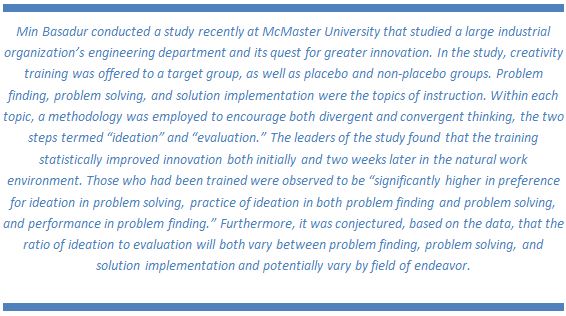
As you can see from the study, creativity training (when done well) can be instructive for employees who need to learn how to think and express ideas in a more positive, focused, and spontaneous way. Breakthrough results often occur when properly fueled by a rapid, flexible, and structured process at the front end of innovation.

Most R&D or innovation initiatives include no budget for training. Since creativity can aid with problem solving and problem finding, organizations need to be awakened to the potential missed from failure to pre-train.  Fraley feels  creativity and innovation training accelerates innovation in five strategic ways:

  1. Improved creative thinking leads to enhanced innovation capacity, and with action, results.
  2. Training helps instill structured creative thinking and innovation process as a cultural value and habit.
  3. Training provides innovation teams with a common language and framework to solve problems, improve communication, expedite complex problem resolution, and moving new business concepts forward.
  4. Training corrects many of the myths that surround creativity and innovation. There is a science to this that is largely ignored. For those that learn and practice the science — it’s a competitive advantage.
  5. Team efficiency improves because a lot of useless chatter, debate, and conflict are eliminated.

Creativity is intimately related to change, decision making, and problem solving — it’s not just artistic self-expression!


Watch Your Asset – It May Not Be a Resource

First, the bad news: making operations, finances, and employees work to maximum value can mean having to eliminate some employees or operations at times. The good news, though, is that many businesses have been able to hold on to existing resources–even during a turnaround situation–by reassigning them to better purposes and uses where required. This is the heart of asset redeployment–the practice of reassigning people, things, and efforts to achieve optimal efficiency. By using capital wisely, your team can make it stretch a lot further. For example, coordinating employee and independent contractor work to produce the greatest amount of work with the fewest number of people working the least number of hours means greater return on efforts and dollars.

Eliminating Operations

Eliminating unprofitable operations–in whole or in part– is a wide-ranging task. Anything that may be termed “waste” in the company needs to be discarded or put to better use. One area that should be addressed is waste due to unnecessary multiple consumption of potentially shared resources. In plain terms, the individual use of items that could be shared is an extravagance that few small businesses can afford. Think of shared printers rather than a printer on each desk as an example. it is highly unlikely that every single person in the office will be printing at the same time. What’s more, high volume printer/copier combination machines use less expensive toner than ink cartridges in smaller units. This initiative may require more cooperation and patience than providing unique units for each employee, but such a move can reduce the amount of money the company must spend to get work done.

Avoiding Duplicate Efforts

A counter problem to the above is too many employees doing the exact same job, either knowingly or unknowingly. Such multiple effort, a clear waste of time, resources, and money, often occurs when someone is fearful of delegation or feels threatened by another’s talents and abilities. Therefore, management should make sure that several people are not doing the same job in differing formats and degrees. 

Non-linked software is a perfect example of this kind of waste; if the secretary maintains supplier addresses and phone numbers, and the accounting group keeps the same information in their files, someone is performing an unnecessary job. Instruct employees in ways to avoid duplication of effort. Look across your organization, document processes by task, and find ways to reduce overlap. This is not to say that your staff should not be cross-trained. It is, in fact, good succession planning and talent management to have people who could do someone else’s job in a pinch!

Managing Capital Resources

Capital resources include facilities, supplies, and work in process. Buying only what is needed when needed (“just in time”) is one way to wisely manage resources. Another way would be to try to have more finished goods inventory than unfinished, because finished goods can be sold quickly to raise cash. At times, you may consider renting or leasing an asset rather than purchasing it–especially if the term of the contract is less than the useful life. You may elect to “turn in” resources that you don’t need very often or convert them to less cash intensive resources through alternate financing. 

Coordinating Human Resources

This is an area often overlooked because it is seen as “just administrative.” When employees, however, have jobs that overlap in requirements, it is up to the executive team in the small business to correct the situation for optimization. When your people are performing jobs that are not their strong suit, they usually take more time and make more mistakes than a better qualified and motivated counterpart.

Develop a competent management team to help you steward resources more efficiently. There are multiple areas for gains in efficiency and profitability if you will commit to the process. Note: process rather than one-time task–follow-through and experience the fruit of your labors!