Turning Around a Company Not in Trouble

Someone once asked John Whitney of Columbia Business School the question, “how do you turn around a company that isn’t in trouble?” John’s reply was classic–

“it is in trouble—it just isn’t in crisis yet. The idea is to avoid a crisis by changing the policies and procedures in the company so it can really compete globally, compete for the long term.”

John went on to say that waiting until a company is in trouble to fix it is management by exception. Over 20 years ago (before globalization and a worldwide economy became the hot topic it is today) Mr. Whitney observed that competition abroad to continuously improve would force companies domestically to keep focused on “management by review.

Companies that have enjoyed success, however, can be reluctant to undertake change through what is termed an operational turnaround. It can be harder, though, without the threat of imminent insolvency, to change company culture and rituals. This type of management change relies far less on historical financial performance than on looking forward to what might be.

How to Know When You Need It

Sometimes, losing a big customer is the trigger point. But, losing one can be explained away. Losing multiple large customers and key employees should definitely raise your antennae. If you begin to take longer to take products to market and the competition keeps introducing new products faster, these patterns should make you consider getting outside help. Look to your customers and suppliers to provide industry feedback and “intel” on trends and patterns. 

While Others Cut Costs, Innovate

Suppliers know what’s happening and can advise how to improve your product. Eliminate layers in your company. Get back to communication in person. Lost time, will and energy to problem solve creatively is the biggest expense in most businesses. Regain respect for the people doing the work—respect their integrity, intelligence and commitment. Eschew over-control. Break down communication issues between departments. Cross-functional management focuses on running a system, each part dependent on  the other.    

John Whitney said that, when he watched Leonard Bernstein conducting Beethoven’s Ninth Symphony, he realized that Bernstein “did many of the same things a good manager does. There were parts of the score where he was deeply involved, working to make sure he got exactly the sound, the nuance he wanted. And he knew what he wanted. But he also knew when the orchestra had it going right, and he wasn’t afraid to lean back and just let it happen, let the musicians do their jobs and listen to the music all come together.”

How about you–are you willing to take a hard look at your organization and determine to become better, even though you are already good? Ever heard the expression, “good is the enemy of great?” Consider ways that you can improve information flow, creativity, problem solving and other soft skills. In addressing these seemingly minor issues while business is good, you prepare the way for an operational turnaround–innovation as some may call it in today’s vernacular!



How Successful Businesses Maintain Organizational Morale


Organizational morale builds quality products (and services). Employees who are well-paid, well-trained, and appreciated work harder than those who are merely trying to earn a living. Giving employees more and more responsibility as they develop skills and gain experience makes them feel wanted and valuable. training employees to do their jobs expertly teaches them the value of quality performance. Finally, rewarding an employee for continuing contributions to company profitability reinforces the company’s goals, mission, and objectives.

Some of the benefits to organizational morale include the following:

  • Employees are willing to work longer hours to ensure that a job is done correctly.
  • Customer service and sales are carried out with positive attitudes. As the company makes more money from these quick and repeat sales, the business can afford to hire the cream of the crop in employees. The appearance to anyone outside the operation is that of a well-oiled machine.
  • Rather than fending off mercenary plots and complaints all day long, management can plan for upcoming projects, ensuring the best use of employees’  talents.
  • Striving and bitter rivalries are easily ended when all employees are treated impartially and fairly.
  • Quality control is much easier to enforce with a group of hard-working, motivated workers than with uncaring employees who are simply filling a slot.

Training

Truly effective training and development programs make good employees out of average employees, and great employees out of good ones. When an employer takes the time and effort to teach employees how to perform their jobs better, employees usually respond with increased effort on the job.  Bonds between management and employees are created as an employee gains a greater sense of self worth. The employee begins to feel that his or her contribution to the overall business matters and is important.

Responsibility

Employees in successful companies have two types of responsibility–to their peers and to their bosses. Each is important to a smooth-running company. However, responsibility can prove an albatross around the neck of the employee who lacks the corresponding authority to make decisions. Good employers will therefore not only be creative in assigning work to employees, but also in providing the best possible environment for them–including adequate authority where appropriate–to help them succeed. Reporting to management helps employees feel they must do a good job and that someone is around who can help them if the going gets rough. Being accountable to peers in addition to bosses teaches employees to respect one another’s work and to learn how to work together to reach common goals.

Motivation and Reward

Bonus and incentive compensation programs are the rewards of excellent employee performance. Rather than threatening to discipline or even dismiss a problem employee, it is often better to motivate employees through encouragement. Fear of failing will not lead to successful work attitudes and performance–it will only lead to ultimate failure. On the other hand, building up an employee’s confidence has proven much more effective than criticism in raising performance levels. 

Once an employee has performed at or beyond the established level, successful management teams find a way to reward the employee. Not rewarding someone who has done everything requested and more makes the employee wonder a.) whether he/she has indeed done a good job, b.) whether the supervisor is a good enough manager to recognize the employee’s contributions, and c.) whether a “change of scenery” may be preferable. However, bonuses and incentives must reflect current and projected financial performance. A company experiencing financial loss must have a flexible plan to adjust employee compensation as necessary. 

A successful company becomes a self-perpetuating entity–the more successful it becomes, the more successful it can become. Executive teams who maintain high organizational morale and plan for growth will create positive cash flow from efficient operations. While your business may not be in a position to always do what larger businesses do, remember to run your organization in a professional manner any you will meet with greater success!


How Do Successful Businesses Manage Their Operations?

After working hard on the marketing plan and the financial plan, successful executive teams develop operating plans to implement them. These are the plans that ultimately result in successfully bringing one’s idea into the marketplace–and profits into the owner’s pocket. Staffing, office administration, and work flow supervision are the primary needs. Successful businesses anticipate problems and take steps immediately to improve workflow efficiency. Supervisors and budgets are assigned to control costs. If necessary, outside fractional help is secured to make sure that appropriate resources are allocated to the best potential outcomes. In addition, the top executive may recommend steps financial and marketing teams can take to enhance overall productivity–and, by extension, profitability. For example, organizations that offer and sell the same or similar goods or services over and over usually see fewer cost overruns and therefore generate more profit per unit of sale.

Staffing a business with the correct number and types of employees makes your workplace both productive and more enjoyable. Sprinkle in some training and development and you demonstrate care and concern for your people. Create feedback loops and engagement will soar. Successful organizations increase or decrease staff levels as operating plans require. Outsourced human resources–whether through independent contractors, fractional professional staff, or subcontracting–allows your company to optimize human resources for any level of work necessary. Making preparations to finish existing projects while beginning new ones and documenting how the work will be accomplished will focus your efforts.

Administering a variety of initiatives simultaneously places certain demands on office staff as well. A successful executive team thinks through the documentation needs of the organization and assigns responsibilities to appropriate personnel. Institutional knowledge is thereby captured for the benefit of all and adjustments become easier to make. Well-organized files–physical and electronic–are another vital component to smooth business operations and can eliminate wasted time and effort, as well as reinforce best practices!

Successful supervision of field (or plant or billable or development) personnel involves more than simply the “management by walking around” approach of yore. Think about technology as a means to do more with less. Creatively brainstorm as to how to maximize the benefits of being face-to-face versus virtual–it’s a trade-off of time, money, and precious additional resources. Recruiting and hiring should reflect an effort to add to the team those who are the best cultural fit rather than simply strong technicians who may undermine the esprit de corps. Compensation and performance management systems should reinforce your value system–not stand separate from it. Think of processes like equipping, quality management, customer service, coaching, mentoring, motivating as key factors in your success. When you do, plans can be made to enable your organization’s operations to become efficient and profitable.

Do Your Cultural Diligence in M&A!

Of course the merger was a success. Neither company could have lost that much money on its own.

-Steve Case, Former Chairman of the Board
AOL/Time Warner

Competitive markets create an environment wherein companies strive for revenue growth. When organic (internal) growth is hard to come by, inorganic growth becomes a target. Inorganic is a category that includes merger and acquisition (M&A) activity as a primary strategy.

While business exigencies demonstrate the “need” for change, often the hard facts found in classic due diligence processes have far less to do with ultimate success than the cultural fit of a transaction between parties. Consequently, organizations that understand their core values are much more likely to reach the kind of growth and success that nearly all businesses seek [Gallangher 2003].

Successful M&A has been known to grow markets, build on complementary strengths, and eliminate inefficiency. But what ultimately matters in an acquisition is what happens in the hearts and minds of the people who remain with the new organization and what culture these formerly distinct entities choose to build while moving forward [Gallangher].

The Mercer Consulting Group, in studying M&A activity, finds that, among unsuccessful ones that many of the failures are caused by not conducting the same kind of “due diligence” on the culture, structure, and processes of an acquisition target as they do on the financial balance sheet [Gallangher]. 

Traditional due diligence typically analyzes the following:
– Historical performance,
– Ownership and organizational structure,
– Management team,
– Products and services, 
– Assets and liabilities,
– Information systems and technology, and
– Organizational culture [Bouchard, Pellet 2002].

J. Robert Carleton, management consultant and senior partner of the Vector Group, says, “Unfortunately, little or no time is generally spent analyzing the nature, demeanor, and beliefs of the people who will be involved in carrying out the business plan”. He believes that standard due diligence does not address some of the key questions that must be asked to accurately assess organizational readiness for a major change, such as a merger or acquisition. Even when some of the “right” questions are asked, Carleton argues, they are often limited to brief interviews with key executives, who likely have differing views from the rest of the employee group. The people in the trenches, the ones doing much of the actual work are not even involved. He  finds it interesting that “in financial and legal due diligence no such ‘act of faith’ is acceptable” in terms of the investigative procedure [Bouchard, Pellet].

“Cultural due diligence” is a phrase that more strategists are using  to assess what stumbling blocks may hinder successful integration of entities and their operations. Key factors to be considered include:

– leadership and management practices, styles, and relationships,
– governing principles,
– formal procedures,
– informal practices,
– employee satisfaction,
– customer satisfaction,
– key business drivers,
– organizational characteristics,
– perceptions and expectations, and
– how the work gets done in your organization

[Bouchard, Pellet; see also Carleton, Lineberry 2004].

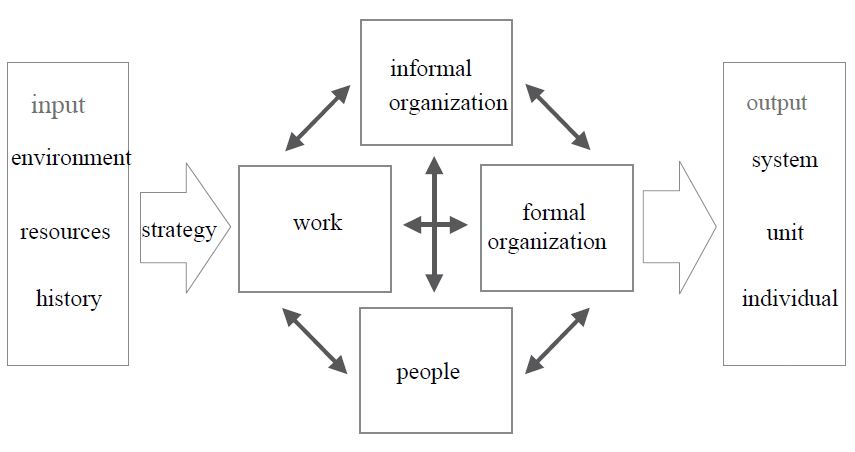
When HP and Compaq decided to combine forces, they used schematics like the one below to help them discuss the salient issues–

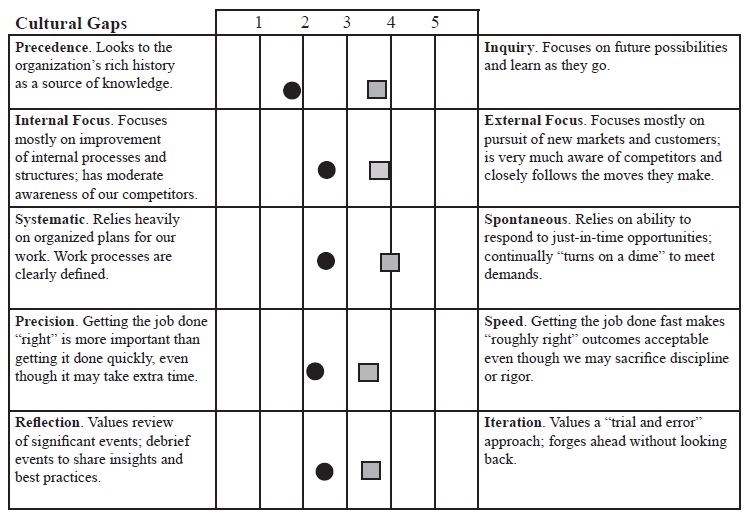
After looking through these issues and discussing each company’s culture, the merger team put together a chart like the one below to begin developing tactics to plan for a smooth post-closing integration.

As you look at this chart, think about key M&A transactions in your industry or local community. Of the ones that did not pan out as planned, do you think they would have stood a better chance had they systematically worked through these type issues during due diligence?

Cultural due diligence is vital to successful M&A processes. If earnest consideration were given to culture as it is to financial and other factors, inorganic growth and increased market share would be a realized outcome far more often!

(Thanks go out to Agata Stachowicz-Stanusch, who wrote of the value of cultural due dilgence and detailed a case study of the HP-Compaq merger in the Journal of Intercultural Management’s April, 2009 edition.)

Social Media Metrics for Your Firm

Professional services firms (law, CPA, architect, engineer, IT services, consulting, etc.) are struggling with modern marketing. Many firms were founded in an era wherein marketing was seen as a “necessary evil.” As marketing (or business development, client development, etc.) has become more essential for improved books of business, firms have begun to hire marketing staff. In most cases, these folks have been tasked with corporate marketing rather than marketing the individual professionals. With the onrush of social media as a marketing discipline, there is a sharp dichotomy between the corporate web presence and the “sum of the parts” of individual professionals’  social media presences.


Michelle Golden, who is  very active in professional services marketing organizations, recommends taking baseline measurements as early in the (any) marketing process as possible, and then identifying very specific objectives as part of an individual’s role in increasing his or her—and ultimately the firm’s—visibility. She writes of the individual versus company promotion trade-off, in a blog postWhy Social Media Rock Stars Are Good For Your Firm.(Sometimes CPA- or law-firm partners get frustrated about the attention an individual “supposedly representing the firm” starts getting when their online visibility increases. This (blog post) helps explain to those partners why they should encourage the individual “fame” and not squelch it.) 

Golden says that “You can rarely truly know exactly where a lead is generated anymore (unless it’s from a specific campaign) and that’s OK. We are looking for overall growth. This is all the ROI that you’ll need.”

Here are some specific ways she suggests to put marketing metrics in place:

BASELINE MEASUREMENTS

To accurately assess growth later, I recommend taking these broad baseline measurements now:

  • number of current clients
  • revenue (average and standard deviation)
  • revenue change % year over year
  • client longevity (length of stay with the firm)
  • frequency of client interactions
  • frequency of transactions (purchases)
  • number of clients lost per month, quarter, or year
  • number of new clients per month, quarter, or year

PLANNING AND GOALS

  • Increase retweets and mentions (by anyone) related to [practice topic] from [baseline #] to [goal #] by [date]
  • Obtain [#] retweets and mentions by target personas including peers and thought leaders in the specialty (i.e., Get on their radar. Knowing exactly who they are in advance is best.) by [date]
  • Receive at least [#] unsolicited invitations from trade organizations to speak or write by [date]
  • Earn [#] appearances as media “expert” in [publication or station] by [date]
  • Receive [#] questions or requests for advice from [define personas] every [frequency]
  • Build up to [#] of [define persona] Twitter (or blog) followers (or subscribers) by [date]
  • Move [# define persona, or specific names] from digital to personal conversations by [date]

TRACKING WORTHWHILE THINGS

  • Where did it appear?
  • Who said it?
  • Was it positive? Y/N
  • What was said? Categorize the nature of the comment and keep a clip file.
  • Was the mention about a particular practice, department, or person?
  • Did the mention include reference to your content or website? If so, to what specific content or page?
  • Who responded and how fast? You may want to keep the response in a clip file, too.

Keep the suggestions above in mind as you develop and refine a social media strategy as a part of your overall marketing plan. Helping your team members become better at their online thought leadership will enhance the brand reputation of the firm. In the process, your best indicator of ROI–increased revenues–should show enhanced performance as well.