Sacrifice Opens Door to Opportunity for a Leader

You need not to have been on this planet very long before you will encounter adversity. One popular adage states that we become stronger by going through tough times. Yet, not everyone who encounters obstacles is able to surmount them and achieve success. In Obstacles Welcome, Ralph de la Vega recounts his own “pivot points,” born of a challenging early life that shaped and molded him into a very successful businessman (currently, he serves as the President and CEO of AT&T Mobility and Consumer Markets. His positive responses to adversity formed the backbone of a successful values-based management system.
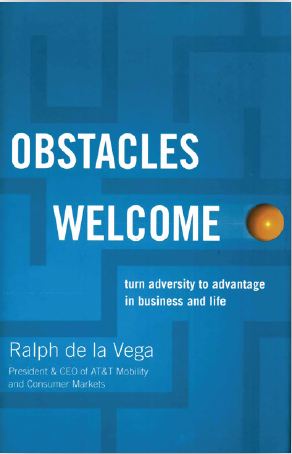
Rather than seeing separation from his parents at the age of four as a bad omen, de la Vega found a way to accentuate the positives in his life. He innately recognized that dwelling on negative thoughts and feelings was counterproductive. After that tough, early life challenge, he moved to Miami and had to overcome a language barrier in the classroom. He adapted again to his environment instead of letting it get him down in the dumps. 

Many people tack a passive approach to setbacks. They hope, wait, and some earnestly pray for a change in circumstances. The course our example provides, though, is one of planning, taking risks, and maximizing opportunities. In the book, he offers up the premise that obstacles should be embraced as a chance for personal growth. In the midst of living life, we come across those “pivot points” personally and professionally that define us–for good or bad. Getting in the right frame of mind can be achieved through his recommended 8 step process:

1. Hope is not a strategy. It is necessary to plan for success.
2. To achieve big goals and dreams, it is necessary to take calculated risks.
3. Big wins in life come from an ability to recognize opportunities. The most significant and important opportunities lie in problems that are waiting to be solved.
4. Embrace and overcome obstacles. Obstacles and adversity make stronger, wiser, and more capable leaders.
5. Be willing to unlearn old habits and relearn old lessons from life experiences.
6. Building winning teams involves effective, honest, and open communication.
7. The greatest successes always involve willingness to make sacrifices.
8. Leadership is not something inborn, but learned and practiced.

As a young executive at  Bell South Latin America, de la Vega experienced everything from military insurgency, economic meltdown, and political revolution, in addition to unstable markets, lack of uniformity in corporate leadership, and nonexistent profits. How did he respond? He took a chance and embraced the challenges as opportunities to lead an entire sector of the international communications market into profitability. What he advocates is to “become comfortable with being uncomfortable,” In order to do that, we may have to set aside what we feel we already know and become flexible in our approach to the challenges set before us.

A key habit to learn is to not allow the past to hinder the future. That is not to say, however, that our past(s) cannot be instructional. Previous experiences can help us deal with new situations only by using them to look backwards and forwards at the same time. It is important to think about how what we have done before might be useful down the road
in similar situations.  

Finally, de la Vega describes what he terms an “Extraordinary” leader, one who is able to consistently deliver excellence in all aspects of personal and corporate leadership. To achieve such status, a leader needs to do the following:

• Set the direction, create the vision.
• Establish values and lead by them.
• Select strategies and key initiatives.
• Build plans to achieve vision.
• Establish goals, priorities, and focus.
• Establish key metrics to measure progress.
• Align and inspire people.
• Empower and enable people to achieve vision.
• Create winning culture.
• Select, recruit, and develop other leaders.


Can Generalists Thrive in the Conceptual Age?

One of the questions I get most often is: “what do you do?” The answer to that question is not an easy one, as my work with companies ranges from start-ups to those almost middle market size, and the services I offer from advisory board member to turnaround artist. Yet, when my role is marketing consultant, I advise others to be able to answer the very same question crisply, concisely, and in a compelling way. What is poignant is that, as we gain more skills over the years, it becomes harder and harder to specialize. That is not to say, however, that I have not met people in business who are extremely specialized and who succeed in their field. For the moment, though, I want to write for others who have adapted to competitive market demands to embrace new skill sets, become masterful enough that others hire them to provide those new skills, and now are the proverbial “generalists.”

Don’t confuse “generalist” with “General,” however, as many generalists struggle to stay with one organization long enough to rise to the rank of top officer. Furthermore, a generalist has challenges in the unique realm of trying to keep up with evolution in many more topical areas, all of which are changing at a faster rate than at perhaps any time in history. The good news is that, as Daniel Pink points out in A Whole New Mind, we are now living in the Conceptual Age, having evolved from the Information Age to a day and time when creativity will be valued highly. Maybe that is not such good news for left brain folks who are not able to adapt, but for those (for whom the learning of new information was merely a means to an end, the end being to connect emotionally with others, build relationships, and find success while doing so) who embrace right-brained living, it is a brand new day!

Here are the new skills that are needed in the Conceptual Age:

  1. Design – the ability to create something that has significance as well as usefulness.
  2. Story – the ability to put facts into context and deliver them with emotional impact.
  3. Symphony – the ability to see the big picture, connect the dots, combine disparate things into something new.
  4. Play – sense of humor and laughter plus other components to balance the psyche.
  5. Empathy – standing in someone else’s shoes, feeling with his or her heart, seeing with his or her eyes.
  6. Meaning – working for something in which one believes with others who have similar values.

As you can see from the list, the emphasis and value will be placed on original thought rather than automatable routines. Computer power has now rendered many repeatable acts less valuable (not unnecessary, mind you, just worth less than previously because either low wage earners or machines can perform them admirably). What will come to be increasingly important is the ability to think up a new concept, develop it sufficiently, and share it so that it resonates with the heart of another. 

What’s the role of the generalist in this new economy? That depends–can you adapt, or are you trying to pour new wine into an old wineskin? Those of us who can adapt will be able to answer questions like “what do you do?” with less of an elevator pitch and more of a carefully crafted story that captures the mind, will, and emotions of the intended audience, hopefully in a multi-sensory way!

Cheers to you as you embark on the journey to greater relevance, enhanced value to others, and — I sincerely hope — a much greater sense of doing something truly meaningful (other than just adding to your repository of information.)


Entrepreneurs: Learn to Delegate to Capable Employees

Delegation

The “take charge” attitude that permeates a builder’s very makeup is easily channeled and tempered with proper direction and focus. Avoiding “one man rule” tendencies is as easy as one word: delegation. The effective executive delegates rather than performing all critical tasks. However, successful delegation requires that responsibility and authority also be delegated. Herein lies a problem for the executive–“hands off” management.

An experienced founder’s abilities and characteristics relate to starting and preserving a good business idea. Chief among those abilities would be creating a vision for the company, which is usually unstated but somehow understood. While it may seem a chore for others in the company, projecting a confident and self-assured image that appeals to prospective buyers  comes naturally to the experienced executive.

Additionally, identification of market opportunities and provision of top notch service to meet customer needs are focal points of the founder’s vision. Unfortunately, the ability to create a workable organization to achieve company goals and objectives may prove more elusive. The business owner who possesses the innate skill to attract others to pursue an unwritten vision may lack the skill to build an efficient organization.

Employees

Clearly, employees are critical to the success of profit maximization in any business; it is their effort that keeps the wheels of progress turning. Most employees have spent careers in similarly sized (small) companies in the same industry setting–be that white collar or blue collar–with limited exposure to alternate environments. Consequently, their frame of reference in employer/employee relationships amounts  to that which the founder and, where applicable, previous employers have provided.  With limited cross-training in other professional disciplines, these members of the team have the least job flexibility and therefore generally welcome changes in work flow patterns that can make their jobs appreciably easier and more effective.

Job Specialization

While cross training or shared skill sets occur as a matter of necessity, job specialization is a focus of many small businesses. A certain “pride of ownership” can arise from this high degree of specialization. Fiercely loyal, most employees would rather sacrifice some temporary perks rather than leave a benevolent employer “high and dry” in a time of financial duress. Since the employees tend to be skill-oriented, they require a great deal of direction in defining work assignments. At the same time, they spend a lot of time observing the founder and mimicking his or her efforts; if the entrepreneur is a go-getter, they will learn to hustle on the job in order to meet production requirements. In short, employees can be extremely valuable in performing the legwork that makes the business optimization a reality.

Employee Responsibilities

Employees are required to adhere to schedules, commit to the strategic plan, be willing to work long hours, and be brand ambassadors of the company in the community. Schedules governing production, documentation, and reporting must be religiously followed to ensure optimal work efficiencies. Time, budget, and administration constraints are to be respected and emphasized among employees and their  supervisors.

Mindful of how they represent the company, your people are the “front line” experience that others have with your brand. Whether buying from suppliers, meeting with customers, or serving in a local non-profit, they have an opportunity to make you look great–or not.

When company plans cause inconveniences for employees, it should be up to the employees themselves to raise the issue with their superiors. Once they have been given the right to voice their opinions and concerns, they should be expected to fall in line with the plan. Failure to follow established guidelines should not be tolerated. Without respect of your core values, your employees should be replaced by those who can carry your banner proudly!


Owner as Entrepreneur vs Manager: Jekyll and Hyde

At the center of every small business management team is the owner, whose primary long-term responsibility is to manage the company effectively. While some companies have several people who function in this capacity, this discussion will assume that an on-site entrepreneur/owner runs the business. Traditionally, this individual oversees the entire operation and personally looks over most company work, both in the office and in the field/plant. Furthermore, the owner is commonly a jack-of-all-trades, wearing the hats of many different employee roles.

The “Jekyll & Hyde” Theory

It is often asserted that the individual who single-handedly runs a company has a certain, identifiable “Jekyll and Hyde” personality. In demeanor and approach to problem-solving, the typical owner ranges from brilliant to tyrannical. An effective strategic plan must therefor encourage brilliance while keeping the owner away from problems that transform him or her into an ineffective manager. The same qualities that have enabled the owner to gain insight into many facets of the business operations are the exact ones that force him or her to be involved in every decision, major or minor. Such overt  care and concern for the company is to be anticipated and applauded. When it results in ineffective management, however, a remedy must be devised.

Entrepreneur or Manager?

Efficient businesses require in-house management. Unfortunately, the skills that make an owner a successful entrepreneur can be at odds with those that make one an effective manager. Excellent entrepreneurs have great sensitivity to market changes. However, when they leave the daily operations to become managers, two things happen: 1) they stop using their innate skills, and 2) they manage ineffectively.

Though the owner may experience periods of fear or apprehension, as a group owners are generally optimistic and opportunistic. Good owners emanate confidence, motivating those around them. For example, by spotting a mismatch between market demand and supply, a good one can inspire employees to work towards meeting that demand. Uniquely able among executive team members  to downplay the importance of minor setbacks, savvy owners emphasize the company’s forward movement in a vision casting mode.

Finally, first-hand knowledge of company history sets the owner apart. Having founded the company, the owner as entrepreneur is an indispensable part of the management team. When questions arise concerning company history or past performance, as they frequently do during times of tension, who better to turn to than the individual who has owned or managed the company all the while?

The Owner’s Vision

In providing vision for the company, the owner is expected to identify opportunities to pioneer new markets and expand the company’s presence in existing markets. Thorough identification of precise product offerings and internal procedures to make the products is a large part of every owner’s job description. The interaction between market research (including trends, buying patterns, and demand) and company vision is a relationship that the effective entrepreneur manages on a regular basis.

The entrepreneur can help the management team by maintaining personal relationships  with key parties such as sales people and lenders. If links have been formed based on good rapport with these parties, it is only fitting that these relationships continue  when they cannot be successfully turned over to another manager. This scenario rings particularly true with regard to negotiations with suppliers. The owner’s involvement in handling these parties is essential to reinforcing profitability.


How Successful Businesses Maintain Organizational Morale


Organizational morale builds quality products (and services). Employees who are well-paid, well-trained, and appreciated work harder than those who are merely trying to earn a living. Giving employees more and more responsibility as they develop skills and gain experience makes them feel wanted and valuable. training employees to do their jobs expertly teaches them the value of quality performance. Finally, rewarding an employee for continuing contributions to company profitability reinforces the company’s goals, mission, and objectives.

Some of the benefits to organizational morale include the following:

  • Employees are willing to work longer hours to ensure that a job is done correctly.
  • Customer service and sales are carried out with positive attitudes. As the company makes more money from these quick and repeat sales, the business can afford to hire the cream of the crop in employees. The appearance to anyone outside the operation is that of a well-oiled machine.
  • Rather than fending off mercenary plots and complaints all day long, management can plan for upcoming projects, ensuring the best use of employees’  talents.
  • Striving and bitter rivalries are easily ended when all employees are treated impartially and fairly.
  • Quality control is much easier to enforce with a group of hard-working, motivated workers than with uncaring employees who are simply filling a slot.

Training

Truly effective training and development programs make good employees out of average employees, and great employees out of good ones. When an employer takes the time and effort to teach employees how to perform their jobs better, employees usually respond with increased effort on the job.  Bonds between management and employees are created as an employee gains a greater sense of self worth. The employee begins to feel that his or her contribution to the overall business matters and is important.

Responsibility

Employees in successful companies have two types of responsibility–to their peers and to their bosses. Each is important to a smooth-running company. However, responsibility can prove an albatross around the neck of the employee who lacks the corresponding authority to make decisions. Good employers will therefore not only be creative in assigning work to employees, but also in providing the best possible environment for them–including adequate authority where appropriate–to help them succeed. Reporting to management helps employees feel they must do a good job and that someone is around who can help them if the going gets rough. Being accountable to peers in addition to bosses teaches employees to respect one another’s work and to learn how to work together to reach common goals.

Motivation and Reward

Bonus and incentive compensation programs are the rewards of excellent employee performance. Rather than threatening to discipline or even dismiss a problem employee, it is often better to motivate employees through encouragement. Fear of failing will not lead to successful work attitudes and performance–it will only lead to ultimate failure. On the other hand, building up an employee’s confidence has proven much more effective than criticism in raising performance levels. 

Once an employee has performed at or beyond the established level, successful management teams find a way to reward the employee. Not rewarding someone who has done everything requested and more makes the employee wonder a.) whether he/she has indeed done a good job, b.) whether the supervisor is a good enough manager to recognize the employee’s contributions, and c.) whether a “change of scenery” may be preferable. However, bonuses and incentives must reflect current and projected financial performance. A company experiencing financial loss must have a flexible plan to adjust employee compensation as necessary. 

A successful company becomes a self-perpetuating entity–the more successful it becomes, the more successful it can become. Executive teams who maintain high organizational morale and plan for growth will create positive cash flow from efficient operations. While your business may not be in a position to always do what larger businesses do, remember to run your organization in a professional manner any you will meet with greater success!