A Cord of Three Strands For Start-Ups

You know the old saying…that a cord of three strands is not easily broken. Yet, a cord with only one strand has much less strength. In the sports world, we see this concept played out most clearly in tournaments or playoffs. During the regular season, a dominant athlete can carry the team on his or her shoulders to seemingly improbable heights. Yet, under the microscope of postseason competition, the stakes are higher, the other team has similar talent, and the group with the most balanced attack with strong chemistry usually wins. Think Michael Jordan early in his career versus mid-career. Or, Robert Griffin III more recently. There are many stories of similar outcomes.

In the world of entrepreneurship, the principle rings true as well. Rare is the company founder who reaches great success who hasn’t enjoyed some substantial help along the way. Sometimes, it can be a co-founder. At other times, key employees. Externally, the founder may rely on a mentor or some key strategic allies. Whatever the dynamic, it is important to recognize our need for objectivity, resources, and expertise that we personally lack. 

Steve Olsher, the author of Internet Prophets, writing for Under30 CEO, espouses the virtue of serving before being served, and explores joint ventures versus alliances as a way to build a company. In the article, “You Can’t Do it Alone,” Steve defines joint ventures as being a more short-term relationship established for mutual benefit. He compares this approach to  the real estate market where someone invests in a condominium development, expecting a return as soon as the unit is built and sold. Alliances, continuing the analogy, are more like apartment investing because the return is longer-term and the fundamental math lends itself to retirement of debt early and increasing profits later.

Olsher offers the following advice on how to build a strong alliance:

Developing and maintaining strong alliances requires understanding the art and science behind the magic.

The first step is to know yourself. Grant yourself time and permission to understand who you are. Devote focused, quiet time to identifying your WHAT—that is, the one thing you were born to do. In order to form powerful alliances, you must know who you are. The reason is simple: an alliance is predicated upon providing value to others. If you’re unclear about what you have to offer, providing meaningful value will be met with consistent incongruities. The successful know exactly who they are and how they can best serve the world.

Before seeking to form alliances, understand who are the most likely beneficiaries of your knowledge and identify partners who can provide access to those who fit your desired profile. Ideally, the more you choose to live like a sniper and takes aim for the center of the bull’s eye, the more success you’ll realize. The successful focus on forging alliances with perfect partners and bring tangible value to the relationship. Like marriage, creating long-term mutually beneficial alliances takes work—a lot of work. The time and effort required for this to happen represents the single biggest difference between a joint venture and an alliance.

The “fiber’ of the strong cord is recognizing that one does not have a corner on knowledge–that there are others who have just as much–if not more–knowledge and/or experience in other areas. Taking the time to truly understand those with whom you need to build a strategic relationship is the “yarn” that is woven into your approach to business, and hopefully, your company culture. If you can systematically seek to know what will make others successful and determine to play a role in their success, you add strength to  their efforts as well as your own. Strands, then, are the individual interactions that you have with these allies, mentors, etc. They are periods of time when a significant exchange of ideas, perhaps monies, occurs and the interaction reaffirms the value of the relationship. While it is more allegorical than empirical, I’d argue that three mutually beneficial “strands” of interaction are a minimum for long-term success. Don’t be in a hurry to get an immediate return, as would a condominium investor–think about who and what you need for the long-term!


Fashion Entrepreneurship Lessons

Last night in Raleigh, North Carolina, there was a great convergence of people interested in fashion and design with others interested in fostering entrepreneurship. The Raleigh Emerging Designers Innovation Incubator (REDii) Launch Party was held at Solas restaurant and lounge on Glenwood South. Approximately 300 people turned out for the three hour event, which featured Kitty Kinin from local radio station 100.7, the River, as emcee. During the course of the gala, there was a fashion show with over 20 designers featuring their work, a silent auction for a live painting of the event, and much power networking to be enjoyed. The goal of the evening was to raise money for the support of the new REDii space at 131 S Wilmington St and its participants.

EntreDot, the not-for-profit who is responsible for the event and the incubator, seeks to supply retail display space for emerging designers locally in the apparel, jewelry, handbag, and related category niche(s) with a caveat: the designers will be more successful if enrolled in some educational courses on entrepreneurial best practices and paired with a mentor. Accordingly, as is mentioned on the website: www.rediiraleigh.org, those who are approved to exhibit their designs are required to sign up for assistance. The intent is to wed right brain and left brain competencies and mindsets to create something wonderful and, in the process, become a catalyst in the establishment of a Fashion District in Raleigh which, while it may not be as tight geographically as some of the fashion destinations across the country, will unite the community around great design elements and the opportunity to both buy local and support talent that may otherwise migrate elsewhere.

Brigid Sweeney, writing last month in Crain’s Chicago Business, featured the story of the Gilt Groupe and some lessons learned by its founders, Alexis Maybank and Alexandra Wilkis Wilson. Sweeney describes their story as follows:

The two young women, who met as Harvard University undergrads and reconnected at Harvard Business School in 2002, launched Gilt Groupe in 2007 as a way to bring designer sample sales online. In the process, they upended the way women shop and made 11 a.m. Central time (the moment new merchandise goes up daily) a witching hour for corporate women, who click over from Excel sheets and status reports to snag pieces from Carolina Herrera, Dolce & Gabbana, Zac Posen, et al. Ms. Maybank and Ms. Wilson also created a New York-based company that’s now valued at $1 billion, has more than 1,000 employees and runs sales in 36 cities in 14 countries.

In the course of her interview with Ms. Wilson, Sweeney was able to tease out some words of wisdom from her. Wilson feels the lessons below are important to any start-up business, but especially a fashion one:

  1. Relationships matter,
  2. Take calculated risks,
  3. Seek mentors who can help you recognize whether you have the right idea at the right time, and
  4. Seek out partners with complementary, not necessarily similar, personalities.

The folks at EntreDot are attempting to reinforce these principles with the REDii target crowd. During the event, it was noted that not enough well-heeled investor-types were present to maximize either the fundraising effort or the introductions to talented designers who, upon completion of their training, will need access to capital in most cases.  In our community, angel and venture capital has been raised successfully for life science and technology companies. it will be a wonderful day to witness when the same can be said of the local fashion and design entrepreneurship niche! Please support this effort through introductions, volunteering as a mentor or instructor, or sponsorship as you are able.


American Restaurants Struggle to Stay Alive

Back in the late 1980s, the Turnaround Management Association was birthed out of a research project conducted at the Kenan Institute of Private Enterprise at the University of North Carolina at Chapel Hill. As the lead researcher, I had the opportunity to personally pull together a bibliography of articles about businesses whose travails were significant enough to hit the national headlines in various business publications. From the research, we published a monograph and wrote articles about best practices that appeared in 46 national business periodicals in our first 18 months of existence as a trade association. As I and other involved with the Association moved on to other pursuits, TMA moved off campus, starting gaining momentum in chapter development, and now enjoys international members as well as domestic. One of the publications of TMA is the Journal of Corporate Renewal. The Journal‘s lead article for May discusses the struggle of restaurants in the United States to remain profitable.

Some interesting facts from the National Restaurant Association are cited:

  • Restaurants account for 4% of GDP
  • 10% of the U.S. workforce is employed in the restaurant industry
  • 50% of adults have worked in a restaurant
  • one-third of all workers had their first job in a restaurant
  • 48% of the average household’s food budget goes to restaurants (vs. 25% fifty years ago)

The bankruptcy filings of a number of restaurant chains since the recession began in 2008 is but one indicator of a model that is teetering on the brink of survival. The photo above is taken from a Food Network show entitled Restaurant Impossible, wherein Robert Irvine turns a restaurant around in 48 hours. The menu is revised, customer service issues are addressed, $10,000 of strategic remodeling is performed, the revenue and costs are examined for opportunity, and the restaurant owner is challenged to run the business at a profit going forward.

Macro trends in the recent few years towards buying more groceries or becoming value-conscious have definitely affected the top and bottom lines of many restaurant owners. Franchises, which account for about half of the restaurant revenues produced nationwide, have really taken it on the chin. Franchisees who own one or only a few stores have inadequate access to capital these days. Another big factor is the conflict of interest in most franchise agreements that are based on sales volume. The franchisor can implement discounting programs to increase traffic and sales volume, but the franchisee has less and less profit as a result of the agreements.

What can be done? Turnaround experts recommend a process of performing store-level profitability analysis, followed by benchmarking against peer stores. These analyses can highlight purchasing/inventory issues, training issues that are evidenced by waste, and theft/shrinkage that depletes the operator’s assets needed to produce a return.

There are many good consultants who can help a restaurant owner sort through the challenges and create a plan for growth and renewal.

Entrepreneur, Not CEO

Everybody (entrepreneur) calling himself or herself a CEO—listen up, this is for you: stop it. Calling yourself the CEO will label you as either an egoist or someone with confidence compensation issues. That will make people less willing to work with you or help you. Taking the top title in a company also suggests a limited vision of what your company can become. Ask yourself: would you still be CEO if it were a $100 billion business or would you require what’s euphemistically called “adult supervision?”

So stop pretending to have attained a title you didn’t earn and start doing what you need to do to get to where you want to be. Here’s how:

Attract Awesome People

Jobs had Wozniak and later, Markkula. Clark had Andreessen. McNeally had Bechtolsheim, Joy and Khosla. A remarkable CEO should be like the moon, illuminated by the reflected light of all the stars he or she has brought into orbit. Awesome people act as accelerants to whatever you’re doing. They push ideas forward, execute with aplomb and challenge you to new heights.

If you can hire, hire. If you can’t hire, bring them into your orbit as advisors, friends and fellow travelers. Get them to invest their creativity and energy. To get the true benefits of awesome people, focus on diversity. You want to have as many different perspectives on a problem as you possibly can, so bring on the best people from as wide array of backgrounds and from different generations. They’ll learn from each other and the confluence of their experiences will be the basis of company creativity for years to come.

Most importantly, attracting awesome people to your company precludes retreat. You carry too valuable a cargo of energy and confidence invested by others to turn back.

Build an Experience, Not a Product

Eric Ries has put the concept of the minimally viable product (MVP) front and center in the minds of Silicon Valley startups. But this focus is somewhat misguided. Products give you utility and then may be discarded. Products are the one-night stands of business. Experiences give you memories and good experiences will bring you back for more, it engenders a long-term relationship. The best CEOs know this instinctively and do all that they can to create and cultivate an attractive experience for their customers.

Once you’ve got a good experience, cement it with the bond of buying..That price tag is valuable to you too. It focuses the mind tremendously and forces you to deliver a unique and memorable experience of real value. When you offer a product for free, you aren’t forced to justify your existence to customers or show a useful benefit..

Learn Finance

If you wanted to be a rock star, you’d have to learn to read music and if you wanted to be an award-winning novelist, you’d have to learn basic grammar. It should not come as a surprise that if you want to be the CEO of a business you should learn finance. Yet we regularly see founders blowing off finance or outsourcing major financial decisions to hired guns..

For startups, there’s one important financial metric that matters more than any other: months left to live given your current burn rate. Real CEOs know this number and manage it religiously.

Define a Big Goal and Take Small Steps

Plenty of wannabe Silicon Valley CEOs have read Jim Collins and will tell you about their BHAG (That’s their Big, Hairy, Audacious Goal). They’ll tell you that they want to revolutionize the datacenter, or change the face of mobile payments, or create a new paradigm for social sharing, or something equally nebulous. That’s great. But it’s the ability to both set that goal and show how you’re going to achieve it that marks a real CEO.

Successful CEOs balance aspirations with operations. They focus on things that can be done today to secure customers and growth over time—not on the title they put on their business cards.

The quoted text above is from a post by Alexander Haislip that appeared on TechCrunch recently. Thanks to blogger Beverly J. Conquest for posting an excerpt on her blog, Accounting & Small Business|Beverly Shares.

Start-Up Savvy: Taught & Caught

Image

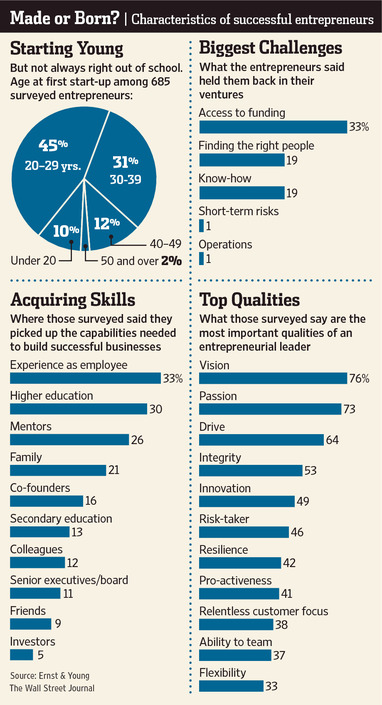
In an article last month entitled, “Can Entrepreneurship Be Taught?,” two sides of the argument were presented that, while equally valid, were at odds with one another. Noam Wasserman, Harvard Business School professor of Entrepreneurship and author of “The Founder’s Dilemmas: Anticipating and Avoiding the Pitfalls That Can Sink a Startup,” takes the position that too many founders have to climb the same steep learning curve as others before them, bereft of insights that could help great ideas become great businesses. Victor Hwang, co-author of “The Rainforest: The Secret to Building the Next Silicon Valley” and managing director of T2 Venture Capital in Silicon Valley, posits that only experience can teach an entrepreneur how to successfully launch a business.

Within the Wasserman camp are educators who believe that documented best practices and potential problem areas can be shared with the entrepreneurs. For instance, the idea that the founder must do the three following things has been challenged with research data to instruct otherwise:

  1. Following one’s gut
  2. Having a “glass half full” view about resources and time
  3. Stay in the top executive role as the company matures

Augmenting the classroom instruction with deliberate opportunities to “try out” a principle in a role play seem to yield good results. Additionally, self assessments are helpful in increasing one’s self awareness and ability to lead others. Notably mentoring is recognized as one of the best ways an entrepreneur can learn how to do the right thing in a myriad of scenarios.

What is also being learned is the need to not just offer principles of management (regardless the field of management–finance, operations, marketing, etc), but to also focus on the soft skills requisite to be an effective leader. Whether the entrepreneur is embracing better social skills, motivational techniques for self and others, or other facets of emotional intelligence, there are competencies to be gained that are simply not intuitive for most.

Hwang and the experiential learning community holds steadfastly to the conviction that entrepreneurship is taught rather than caught and is more of  an impartation than an education. Rather than the typical domain of business schools–resource allocation and risk management, it is argued that the necessary skills fall more into the following categories:

  • Comfort with a high degree of uncertainty
  • Willingness to become a generalist rather than a specialist
  • Abilities in inspiring others through storytelling and personal charisma

Since some programs are heading in the direction of trying to advise start-ups on what actions to avoid, Hwang is concerned that the willingness to try something unconventional may become minimalized. He and others believe that such a mindset is critical to entrepreneurial success. The main thesis behind Hwang’s proposed approach is that entrepreneurs would have the greatest chance of success if communities with resources, counsel and mentoring were available for their growth and development.

The common theme, then, is that mentoring and nurture is the best medicine for someone who “suffers” from entrepreneurial dreams. We wholeheartedly concur with this bottom line approach and advocate innovation centers (incubators with assigned mentors, education, and planned activities to build a sense of community) as a best practice!