Culture: Key to Performance

Recently, I had the opportunity to address a group of HR leaders on how to improve decision-making within their organizations. (Thank you RWHRMA, Masters Series participants!) The premise of our time together was that better decision-making translates into superior performance and that there are definite ways to improve the quality of decisions. Most of our workshop was used to define the components and use of emotional intelligence (EQ). In order for employees–and managers/executives–to consistently exhibit high EQ, valuing and engaging others is a key.

A focus on others and their needs is a result of purposeful culture development. Paul Spiegelman, founder and CEO of The Beryl Companies, writing for Inc. on June 6, described Beryl’s “10 Cs of Culture:” 

1. Core Values

..when we implemented our values strategy at Beryl about 10 years ago, I began to see how they guided everyday decision-making and how employees referenced them in meetings.  I came to realize they are essential guideposts when developed, communicated, and executed in a consistent manner…We start every big meeting with a conversation about values and tell stories about how our coworkers live by those values on a daily basis.  

2. Camaraderie 

It’s about getting to know colleagues not just as colleagues, but what they’re like outside the office.  To do that, Beryl hosts dress-up days, parties, games, and events all the time..We include not only employees, but also their families.  We publish a bi-monthly full-color magazine called Beryl Life that is sent to the homes of co-workers.  

3. Celebrations 

You can’t underestimate the importance of recognizing your team..we developed a program we call PRIDE (Peers Recognizing Individual Deeds of Excellence).  This allows coworkers to recognize others for living up to Beryl’s core values.  

4. Community

Part of the fabric of a successful company culture is connecting with and giving back to the local community.  

5. Communication

I hold quarterly Town Hall meetings, which includes six meetings over two days..I also have informal “chat and chews” where I bring in lunch for 12 to 15 people and just ask one question–How’s it going?–to get the conversation started.  

6. Caring

Show your employees you genuinely care about them in the totality of their lives..Any manager can explain a situation on an internal website that identifies a coworker, and lists what’s going on (birth, death, injury, wedding, among other things).  That submission generates an email to me that is my trigger to send a personal notecard, make a phone call, or visit someone in a hospital.  

7. Commitment to Learning

Show your employees you’re committed to their professional growth. This can be done in small, incremental steps. 

8. Consistency

Culture is based on traditions..One-time efforts to improve the culture will feel disingenuous.  

9. Connect

Don’t isolate yourself at the top.  Connect with people at all levels of your company.  Get out of your comfort zone.  

10. Chronicles

Does everyone in your organization know how the company started?  Do they know the personal stories of the founders and what led them to build a sustainable business?  People want to know they are part of something special and unique.  

Do you get the feel that, at Beryl, you could fit in and feel engaged in the key conversation(s) that contribute to its success? What about your company? Do you have a culture that is engaging? If not, what can you do about it? What’s holding you back? Talk with your peers and come up with a plan, then implement it!
Decision Making is Like Chopping Wood

The Woodcutter’s Story

Simon was a diligent son, but not that bright.  Eventually his mother became exasperated with him lying around the house and urged him to get a job.  Now Simon was good at one thing:  chopping down trees.  So, off he went, his axe over his shoulder, in search of work.

Soon he came upon a clearing in which logging was being carried out.  (Readers of a nervous disposition should be reassured that this logging was a fully sustainable and environmentally ethical operation.) He marched up to the supervisor and asked if there was any work available.  “Well it depends how good you are.  Chop down that tree and I’ll see.” Simon enthusiastically set about the task and completed it to the supervisor’s satisfaction. “You’re hired.  Start right away”, he said.

And Simon started work, applying himself with a commendable zeal.  It was Monday afternoon, and the day soon passed.  As did the following few days. On Friday afternoon, Simon happened to see the supervisor.  “I’m glad I’ve found you” the supervisor said.  “Please collect your cards and leave, your services are no longer wanted.”

Simon was flabbergasted!  “How come?  I am your most productive worker.  And now you’re rewarding me by sacking me!” “Well, it’s true you were the most productive worker on Tuesday.  But by Thursday you had sunk to the least productive.  And you’re doing even less well today.” “But I start early and finish last.  I work through lunch.  I spend all my time chopping down your trees.”

“I agree”, replied the supervisor, “but how much time do you spend sharpening your axe?”

-Anon

What is equivalent to sharpening the axe in your business? Management team and high potential employees choosing to pursue professional development through honing emotional intelligence (EQ) competencies. EQ is the unique intersection of heart and head—the outcome of which is effective use of feelings to enhance thought.

When EQ becomes a priority in an organization, good things happen. Consider:

  • In one study, experienced partners with high EQ in a multinational firm delivered $1.2 million more profitfrom their accounts — 139% — over their cohorts.
  • A study of manufacturing supervisors given EI training saw a reduction of 50% in lost-time accidents, 20% in formal grievances, and plant productivity goals exceededby $250,000.
  • In a cross-cultural study of senior executives, EI competencies outweighed both IQ and experience in top performers.

Superior performance is driven by strong decision making. Strong decision making is a physiological factor of: 1.) competency, preceded by 2.) behavior, preceded by 3.) cognition, preceded by emotional intelligence. EQ is a body of personal characteristics and social abilities that are closely tied to success in both our professional and personal lives. Dan Goleman, quoted in the Harvard Business Review, said, “Emotional intelligence isn’t a luxury tool you can dispense with in tough times. It’s a basic tool that, deployed with finesse, is the key to professional success.”

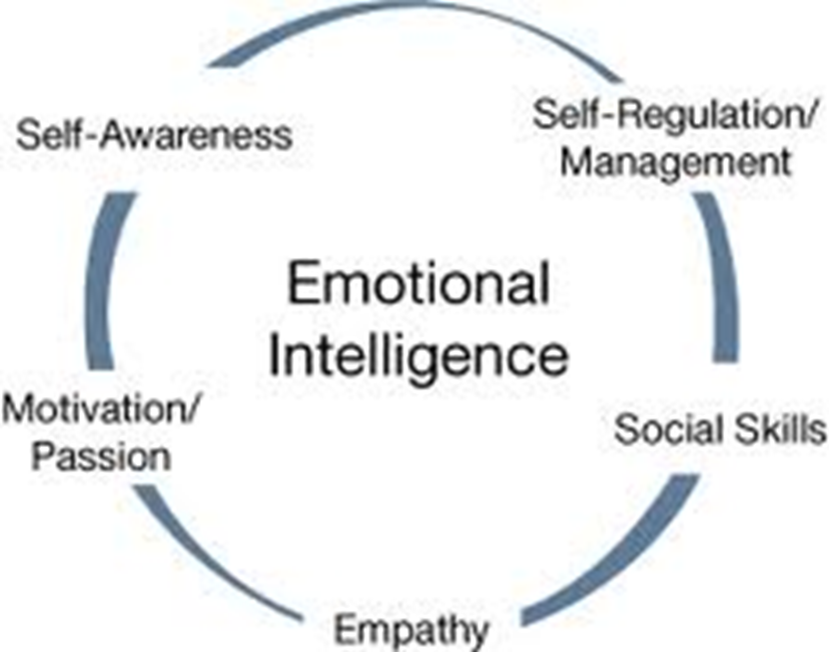
The tool is comprised of five core competencies: self-awareness, self-regulation, motivation (these three comprising the intrapersonal self), empathy and social skills (the latter two representing interpersonal acumen.) Think about bright, skillful people in your organization who are passed over for leadership and/or despised by subordinates. Chances are, these individuals are deficient in at least one of the EQ competencies.

EQ can be learned. What we try to do with clients is identify a small group to work with initially–usually direct reports to the president or high potential leaders. These are assessed individually for their relative emotional intelligence “scores.” The scores lead to individualized professional development plans (“axe sharpening”.) Mentoring occurs during which hypothetical scenarios are discussed in periodic sessions. The hypothetical gives way to the mentees bringing real life situations to discuss. With the mentor’s help, the mentees learn how to process decisions better. Over time, the team gels as its members learn how to “say hard things in soft ways,” and use feelings as an asset rather than a liability. When the team becomes high functioning in this manner, superior performance is likely its traveling partner!


A Cord of Three Strands For Start-Ups

You know the old saying…that a cord of three strands is not easily broken. Yet, a cord with only one strand has much less strength. In the sports world, we see this concept played out most clearly in tournaments or playoffs. During the regular season, a dominant athlete can carry the team on his or her shoulders to seemingly improbable heights. Yet, under the microscope of postseason competition, the stakes are higher, the other team has similar talent, and the group with the most balanced attack with strong chemistry usually wins. Think Michael Jordan early in his career versus mid-career. Or, Robert Griffin III more recently. There are many stories of similar outcomes.

In the world of entrepreneurship, the principle rings true as well. Rare is the company founder who reaches great success who hasn’t enjoyed some substantial help along the way. Sometimes, it can be a co-founder. At other times, key employees. Externally, the founder may rely on a mentor or some key strategic allies. Whatever the dynamic, it is important to recognize our need for objectivity, resources, and expertise that we personally lack. 

Steve Olsher, the author of Internet Prophets, writing for Under30 CEO, espouses the virtue of serving before being served, and explores joint ventures versus alliances as a way to build a company. In the article, “You Can’t Do it Alone,” Steve defines joint ventures as being a more short-term relationship established for mutual benefit. He compares this approach to  the real estate market where someone invests in a condominium development, expecting a return as soon as the unit is built and sold. Alliances, continuing the analogy, are more like apartment investing because the return is longer-term and the fundamental math lends itself to retirement of debt early and increasing profits later.

Olsher offers the following advice on how to build a strong alliance:

Developing and maintaining strong alliances requires understanding the art and science behind the magic.

The first step is to know yourself. Grant yourself time and permission to understand who you are. Devote focused, quiet time to identifying your WHAT—that is, the one thing you were born to do. In order to form powerful alliances, you must know who you are. The reason is simple: an alliance is predicated upon providing value to others. If you’re unclear about what you have to offer, providing meaningful value will be met with consistent incongruities. The successful know exactly who they are and how they can best serve the world.

Before seeking to form alliances, understand who are the most likely beneficiaries of your knowledge and identify partners who can provide access to those who fit your desired profile. Ideally, the more you choose to live like a sniper and takes aim for the center of the bull’s eye, the more success you’ll realize. The successful focus on forging alliances with perfect partners and bring tangible value to the relationship. Like marriage, creating long-term mutually beneficial alliances takes work—a lot of work. The time and effort required for this to happen represents the single biggest difference between a joint venture and an alliance.

The “fiber’ of the strong cord is recognizing that one does not have a corner on knowledge–that there are others who have just as much–if not more–knowledge and/or experience in other areas. Taking the time to truly understand those with whom you need to build a strategic relationship is the “yarn” that is woven into your approach to business, and hopefully, your company culture. If you can systematically seek to know what will make others successful and determine to play a role in their success, you add strength to  their efforts as well as your own. Strands, then, are the individual interactions that you have with these allies, mentors, etc. They are periods of time when a significant exchange of ideas, perhaps monies, occurs and the interaction reaffirms the value of the relationship. While it is more allegorical than empirical, I’d argue that three mutually beneficial “strands” of interaction are a minimum for long-term success. Don’t be in a hurry to get an immediate return, as would a condominium investor–think about who and what you need for the long-term!

Start-Up Key: Sell to Educated Customers

Tom Tunguz of Redpoint Ventures has a WordPress blog I follow, Ex Post Facto. While many of the posts are over my head in terms of technology terms, his posts on carving out a market advantage always catch my attention. Today’s post, “How to Pick Your Start-Up’s Market,” makes the point that the Goldilocks Principle is key–picking a market that is right-sized; neither too big nor too small.

Tunguz credits the Blake Masters blogs, and Peter Thiel’s summary classes in particular, with illustrating what others have learned through expensive market plays. In “The Last Mover Advantage” class, Thiel argues that:

Too small a market means no customers, which is a problem. This was the problem with PayPal’s original idea of beaming money on palm pilots. No one else was doing it, which was good. But no one really needed it done, which was bad.

Markets that are too big are bad for all the reasons discussed above; it’s hard to get a handle on them and they are usually too competitive to make money.

Tunguz attempts to explain major internet successes by combining Goldilocks with Last Mover:

  • Google – last mover in search and search ads. The search market was roughly half of the $8B market– not too big, not too small.
  • Facebook – last mover (at least for now) in social media. Social media ad market was less than $1B when the company started.
  • Dropbox – near last mover in consumer storage. The industry was considered unprofitable by investors given Mozy and Carbonite’s trajectories and was at most $2B at the time the company started.
  • Apple – near last mover in portable music players and computers. What a turnaround we’ve seen.

Common across all these examples is significant market growth driven by one company who brought much better product design, strategic management and effective sales processes. It’s easy to point to the product differentiation – later founders used previous product generations and built something significantly better. But it’s also easy to overlook the importance that sales had on most of these companies.

  • Google had a team which mechanized closing and on-boarding large search partners growing the revenue base dramatically.
  • Dropbox focused significant fractions of their engineering team on optimizing conversion-to-paid funnels. And they maxed out the refer-a-friend program.
  • Apple built the best retail experiences which today drive a huge, but undisclosed fraction of sales.

Significantly, Tunguz goes on to say that each of the example successes were selling to a market that someone else had educated. It is important that the target customers already knew both the Problem and the Solution the product(s) were created to address. In each case, others had been first-to-market, but were not offering premium products. With a premium product and an educated consumer, the start-up enjoys favorable pricing and better selling scenarios. Who wouldn’t want those factors in their favor, right?

Entrepreneur, Not CEO

Everybody (entrepreneur) calling himself or herself a CEO—listen up, this is for you: stop it. Calling yourself the CEO will label you as either an egoist or someone with confidence compensation issues. That will make people less willing to work with you or help you. Taking the top title in a company also suggests a limited vision of what your company can become. Ask yourself: would you still be CEO if it were a $100 billion business or would you require what’s euphemistically called “adult supervision?”

So stop pretending to have attained a title you didn’t earn and start doing what you need to do to get to where you want to be. Here’s how:

Attract Awesome People

Jobs had Wozniak and later, Markkula. Clark had Andreessen. McNeally had Bechtolsheim, Joy and Khosla. A remarkable CEO should be like the moon, illuminated by the reflected light of all the stars he or she has brought into orbit. Awesome people act as accelerants to whatever you’re doing. They push ideas forward, execute with aplomb and challenge you to new heights.

If you can hire, hire. If you can’t hire, bring them into your orbit as advisors, friends and fellow travelers. Get them to invest their creativity and energy. To get the true benefits of awesome people, focus on diversity. You want to have as many different perspectives on a problem as you possibly can, so bring on the best people from as wide array of backgrounds and from different generations. They’ll learn from each other and the confluence of their experiences will be the basis of company creativity for years to come.

Most importantly, attracting awesome people to your company precludes retreat. You carry too valuable a cargo of energy and confidence invested by others to turn back.

Build an Experience, Not a Product

Eric Ries has put the concept of the minimally viable product (MVP) front and center in the minds of Silicon Valley startups. But this focus is somewhat misguided. Products give you utility and then may be discarded. Products are the one-night stands of business. Experiences give you memories and good experiences will bring you back for more, it engenders a long-term relationship. The best CEOs know this instinctively and do all that they can to create and cultivate an attractive experience for their customers.

Once you’ve got a good experience, cement it with the bond of buying..That price tag is valuable to you too. It focuses the mind tremendously and forces you to deliver a unique and memorable experience of real value. When you offer a product for free, you aren’t forced to justify your existence to customers or show a useful benefit..

Learn Finance

If you wanted to be a rock star, you’d have to learn to read music and if you wanted to be an award-winning novelist, you’d have to learn basic grammar. It should not come as a surprise that if you want to be the CEO of a business you should learn finance. Yet we regularly see founders blowing off finance or outsourcing major financial decisions to hired guns..

For startups, there’s one important financial metric that matters more than any other: months left to live given your current burn rate. Real CEOs know this number and manage it religiously.

Define a Big Goal and Take Small Steps

Plenty of wannabe Silicon Valley CEOs have read Jim Collins and will tell you about their BHAG (That’s their Big, Hairy, Audacious Goal). They’ll tell you that they want to revolutionize the datacenter, or change the face of mobile payments, or create a new paradigm for social sharing, or something equally nebulous. That’s great. But it’s the ability to both set that goal and show how you’re going to achieve it that marks a real CEO.

Successful CEOs balance aspirations with operations. They focus on things that can be done today to secure customers and growth over time—not on the title they put on their business cards.

The quoted text above is from a post by Alexander Haislip that appeared on TechCrunch recently. Thanks to blogger Beverly J. Conquest for posting an excerpt on her blog, Accounting & Small Business|Beverly Shares.