Due Diligence Must Include Culture

60% of mergers, acquisitions, and joint ventures fail to perform up to expectations in their first year, often because of cultural incompatibilities between the two prospective partners. The losses in shareholder value are in the hundreds of millions of dollars in many of these star-crossed liaisons. Cultural Due Diligence is a technique for keeping both eyes wide open when approaching an attractive prospect, whether for a merger, joint venture, or offshore vendor.

-Wayne State University, Institute for Information Technology and Culture

When two companies agree to join forces in some type of agreement, cultural fit is usually the last factor considered-if at all! Instead, many numbers are crunched, recrunched, and analyzed ad nauseum. Market impact, anticipated back office savings, etc receive the lion’s share of the secondary consideration after financial statement items. “Culture” is perceived as too soft an issue to justify the time and attention of high-powered executives. Big mistake!

At the very minimum, the operating environment and organizational structure of each entity needs to be explored. When we are working with a client, we use the following two charts to help us ask solid questions about these two components of culture. From the answers received, we make value judgments and recommendations as to the degree of “fit” between organizations and what to do about it.
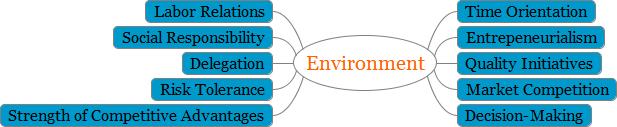
In considering the operating environment, we look at whether the company has a long-range or short-term approach to management. We ask questions to determine whether the organization is more entrepreneurial or bureaucratic. Quality initiatives are a good indicator of what aspects of performance are most important to management. The degree an strength of market competition for each party is important. How decisions are made is another leading indicator of what it may be like to work alongside the other team.

How management handles relationships with employees, (unions), and contractors is important to search out. Is giving back to the community and having respect for the environment a value of the other organization? Do meaningful tasks get delegated effectively, or are there barriers to professional development , shared responsibility, and growth through the contributions of many? Discovering how the other party perceives risk and builds strategy accordingly is a key conversation. When one’s competitive advantages are articulated, it is vital to verify how strong they are in the eyes of the buyers.

In addition to the operating environment, it is critical to understand the organizational structures that represent the philosophy of your intended. Do employees have direct access to top executives, or must they work through a layered management team? Understand whether the employees feel that they are protected to the point of not being allowed to make any mistakes. Examine whether generalist skills are valued versus everyone having a narrow scope. Look at the board of directors to see whether it is comprised of objective, strong leaders. Pay attention to the diversity of the employees and management team.

If the other company has a multi-office system, is it managed out of corporate, or are those in the field given autonomy? Notice whether task or relationships seem to carry more weight. Analyze the turnover rate among management and key positions. Is the human resources department deep enough to undertake complex issues like training and development, talent management, succession planning, coaching and the like, or compliance focused? Ask for examples of how technology is used to solve problems and enhance work flow.

The careful review of these “soft” factors can save you some headaches and hardships–do it! (We would love to help.)


Culture: Key to Performance

Recently, I had the opportunity to address a group of HR leaders on how to improve decision-making within their organizations. (Thank you RWHRMA, Masters Series participants!) The premise of our time together was that better decision-making translates into superior performance and that there are definite ways to improve the quality of decisions. Most of our workshop was used to define the components and use of emotional intelligence (EQ). In order for employees–and managers/executives–to consistently exhibit high EQ, valuing and engaging others is a key.

A focus on others and their needs is a result of purposeful culture development. Paul Spiegelman, founder and CEO of The Beryl Companies, writing for Inc. on June 6, described Beryl’s “10 Cs of Culture:” 

1. Core Values

..when we implemented our values strategy at Beryl about 10 years ago, I began to see how they guided everyday decision-making and how employees referenced them in meetings.  I came to realize they are essential guideposts when developed, communicated, and executed in a consistent manner…We start every big meeting with a conversation about values and tell stories about how our coworkers live by those values on a daily basis.  

2. Camaraderie 

It’s about getting to know colleagues not just as colleagues, but what they’re like outside the office.  To do that, Beryl hosts dress-up days, parties, games, and events all the time..We include not only employees, but also their families.  We publish a bi-monthly full-color magazine called Beryl Life that is sent to the homes of co-workers.  

3. Celebrations 

You can’t underestimate the importance of recognizing your team..we developed a program we call PRIDE (Peers Recognizing Individual Deeds of Excellence).  This allows coworkers to recognize others for living up to Beryl’s core values.  

4. Community

Part of the fabric of a successful company culture is connecting with and giving back to the local community.  

5. Communication

I hold quarterly Town Hall meetings, which includes six meetings over two days..I also have informal “chat and chews” where I bring in lunch for 12 to 15 people and just ask one question–How’s it going?–to get the conversation started.  

6. Caring

Show your employees you genuinely care about them in the totality of their lives..Any manager can explain a situation on an internal website that identifies a coworker, and lists what’s going on (birth, death, injury, wedding, among other things).  That submission generates an email to me that is my trigger to send a personal notecard, make a phone call, or visit someone in a hospital.  

7. Commitment to Learning

Show your employees you’re committed to their professional growth. This can be done in small, incremental steps. 

8. Consistency

Culture is based on traditions..One-time efforts to improve the culture will feel disingenuous.  

9. Connect

Don’t isolate yourself at the top.  Connect with people at all levels of your company.  Get out of your comfort zone.  

10. Chronicles

Does everyone in your organization know how the company started?  Do they know the personal stories of the founders and what led them to build a sustainable business?  People want to know they are part of something special and unique.  

Do you get the feel that, at Beryl, you could fit in and feel engaged in the key conversation(s) that contribute to its success? What about your company? Do you have a culture that is engaging? If not, what can you do about it? What’s holding you back? Talk with your peers and come up with a plan, then implement it!

Like Being in a Rut?

As a business owner, every day brings new challenges and issues that demand our attention. When 100% of our time is given to doing the business (marketing, selling, making, fixing, shipping, accounting, etc.), we’re stuck.  We’re in a rut that (often) leads to failure. Perhaps not failure in the sense of going out of business or having to take a day job, but a missed opportunity to see the business become what it could/should be.

It’s a common trap we can all fall into.  We have something the market wants.  Demand increases and the technical activity associated with getting and filling orders completely fills our schedules.  Forty hours per week becomes fifty and then sixty.  We start taking work home (it’s a sign when what we once enjoyed becomes work).  Everything becomes more mechanical.  We lose balance often at the same time our business is losing steam.

When we’re in the rut, the solution appears to be counter-intuitive and impossible to execute, but we must allocate a portion of our time to work on the business if we want our business to survive.  It’s not optional – it’s essential. You may have heard the admonition to not work in your business at the expense of working on it–the question, though, becomes “how?”

We need to continually infuse creativity into our business–if we want to stay out of the rut.  That won’t happen if we don’t:  1) purposefully allocate time for it and 2) utilize an agenda that maximizes the creative input in the time allocated. The best solution to infuse the most creativity in the shortest amount of time is setting aside 5 days per year with your executive leadership team and 90 minutes or less per week (5% to 6% of your total work hours), using specific agendas to extract creative input to prioritize, solve your issues, maintain focus and advance your company.

Applied faithfully, this regimen will move you and your company to a top performing level. Rather than rehashing worn out frustrations, being stymied in your rate of growth, or feeling like you have to come up with all the answers by yourself, you will find freedom, organization, and synergy flowing from your efforts. Dare to try it!

A special thanks to Don Tinney, who posted many of the concepts above in a blog entry this week at http://www.eosworldwide.com

Entrepreneur, Not CEO

Everybody (entrepreneur) calling himself or herself a CEO—listen up, this is for you: stop it. Calling yourself the CEO will label you as either an egoist or someone with confidence compensation issues. That will make people less willing to work with you or help you. Taking the top title in a company also suggests a limited vision of what your company can become. Ask yourself: would you still be CEO if it were a $100 billion business or would you require what’s euphemistically called “adult supervision?”

So stop pretending to have attained a title you didn’t earn and start doing what you need to do to get to where you want to be. Here’s how:

Attract Awesome People

Jobs had Wozniak and later, Markkula. Clark had Andreessen. McNeally had Bechtolsheim, Joy and Khosla. A remarkable CEO should be like the moon, illuminated by the reflected light of all the stars he or she has brought into orbit. Awesome people act as accelerants to whatever you’re doing. They push ideas forward, execute with aplomb and challenge you to new heights.

If you can hire, hire. If you can’t hire, bring them into your orbit as advisors, friends and fellow travelers. Get them to invest their creativity and energy. To get the true benefits of awesome people, focus on diversity. You want to have as many different perspectives on a problem as you possibly can, so bring on the best people from as wide array of backgrounds and from different generations. They’ll learn from each other and the confluence of their experiences will be the basis of company creativity for years to come.

Most importantly, attracting awesome people to your company precludes retreat. You carry too valuable a cargo of energy and confidence invested by others to turn back.

Build an Experience, Not a Product

Eric Ries has put the concept of the minimally viable product (MVP) front and center in the minds of Silicon Valley startups. But this focus is somewhat misguided. Products give you utility and then may be discarded. Products are the one-night stands of business. Experiences give you memories and good experiences will bring you back for more, it engenders a long-term relationship. The best CEOs know this instinctively and do all that they can to create and cultivate an attractive experience for their customers.

Once you’ve got a good experience, cement it with the bond of buying..That price tag is valuable to you too. It focuses the mind tremendously and forces you to deliver a unique and memorable experience of real value. When you offer a product for free, you aren’t forced to justify your existence to customers or show a useful benefit..

Learn Finance

If you wanted to be a rock star, you’d have to learn to read music and if you wanted to be an award-winning novelist, you’d have to learn basic grammar. It should not come as a surprise that if you want to be the CEO of a business you should learn finance. Yet we regularly see founders blowing off finance or outsourcing major financial decisions to hired guns..

For startups, there’s one important financial metric that matters more than any other: months left to live given your current burn rate. Real CEOs know this number and manage it religiously.

Define a Big Goal and Take Small Steps

Plenty of wannabe Silicon Valley CEOs have read Jim Collins and will tell you about their BHAG (That’s their Big, Hairy, Audacious Goal). They’ll tell you that they want to revolutionize the datacenter, or change the face of mobile payments, or create a new paradigm for social sharing, or something equally nebulous. That’s great. But it’s the ability to both set that goal and show how you’re going to achieve it that marks a real CEO.

Successful CEOs balance aspirations with operations. They focus on things that can be done today to secure customers and growth over time—not on the title they put on their business cards.

The quoted text above is from a post by Alexander Haislip that appeared on TechCrunch recently. Thanks to blogger Beverly J. Conquest for posting an excerpt on her blog, Accounting & Small Business|Beverly Shares.

5 Ways ‘treps Maximize Mentor Feedback


Asking a mentor for feedback is a critical step in turning an idea into a successful business. Noted members of the Young Entrepreneur Council share how they feel ‘treps should make the best use of mentors below–

Draft a Summary

Entrepreneurs’ ideas are often most easily “felt” through passion and an intuitive belief that great potential awaits. When expressed verbally, however, the vision can be easily misunderstood. Avoid this by taking some time to write a concise, one-page Executive Summary that you can share with mentors you respect. This will ensure they understand your idea and offer relevant and quality feedback.

Kent HealyThe Uncommon Life

Time Is Valuable

If you’re in a mentoring relationship with someone who is also an entrepreneur, there is one thing that you both know is ridiculously valuable: time. Regardless of whether your next business venture is the greatest or worst idea you’ve ever had, keep the call focused to keep mentors in your life. Have an agenda and stick to it. You can make small talk later. Time is money; spend it wisely.

Sydney Owen3Ring Media

No Hesitation

While preparation is important in pitching a business idea to anyone, the best tip for asking a mentor for feedback is not to hesitate about it. Your mentors are there for you to bounce ideas off. Most mentors are thrilled when you come to them with questions or feedback solicitations, so don’t pause in engaging them in your project. They — and you — will be glad if you don’t wait.

Doreen BlochPoshly Inc.

One Small Step

They’re busy and smart, so treat them as such. Don’t ask for a long term commitment up front and don’t waste their time. Start with a short email with options you’ve thought of to a problem you are facing. Ask them to simply reply with which option they think is the best. Implement, thank them, and show them how their advice got you results.

Josh ShippJSP, Inc.

Ask For Specific Feedback

If you’ve chosen the right mentor, they have a wide body of expertise and experiences to draw on. Too many entrepreneurs present a lot of information to mentors and then ask something akin to, “What do you think about all this?” That gets nowhere. Better to have structured information and ask for specific feedback: “Is this key assumption realistic?” or “Is this an appropriate place to start?”

Charlie GilkeyProductive Flourishing