Start-Up Savvy: Taught & Caught

Image

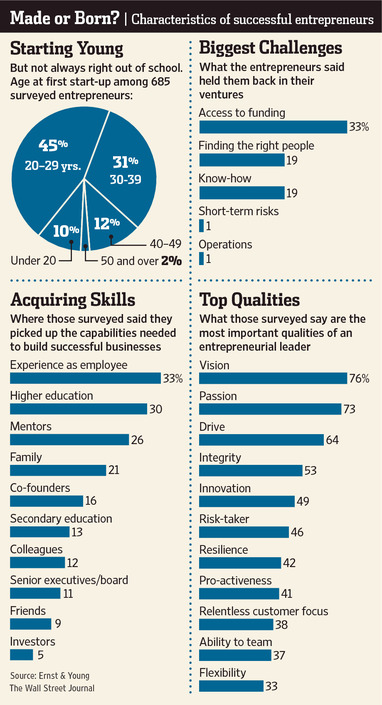
In an article last month entitled, “Can Entrepreneurship Be Taught?,” two sides of the argument were presented that, while equally valid, were at odds with one another. Noam Wasserman, Harvard Business School professor of Entrepreneurship and author of “The Founder’s Dilemmas: Anticipating and Avoiding the Pitfalls That Can Sink a Startup,” takes the position that too many founders have to climb the same steep learning curve as others before them, bereft of insights that could help great ideas become great businesses. Victor Hwang, co-author of “The Rainforest: The Secret to Building the Next Silicon Valley” and managing director of T2 Venture Capital in Silicon Valley, posits that only experience can teach an entrepreneur how to successfully launch a business.

Within the Wasserman camp are educators who believe that documented best practices and potential problem areas can be shared with the entrepreneurs. For instance, the idea that the founder must do the three following things has been challenged with research data to instruct otherwise:

  1. Following one’s gut
  2. Having a “glass half full” view about resources and time
  3. Stay in the top executive role as the company matures

Augmenting the classroom instruction with deliberate opportunities to “try out” a principle in a role play seem to yield good results. Additionally, self assessments are helpful in increasing one’s self awareness and ability to lead others. Notably mentoring is recognized as one of the best ways an entrepreneur can learn how to do the right thing in a myriad of scenarios.

What is also being learned is the need to not just offer principles of management (regardless the field of management–finance, operations, marketing, etc), but to also focus on the soft skills requisite to be an effective leader. Whether the entrepreneur is embracing better social skills, motivational techniques for self and others, or other facets of emotional intelligence, there are competencies to be gained that are simply not intuitive for most.

Hwang and the experiential learning community holds steadfastly to the conviction that entrepreneurship is taught rather than caught and is more of  an impartation than an education. Rather than the typical domain of business schools–resource allocation and risk management, it is argued that the necessary skills fall more into the following categories:

  • Comfort with a high degree of uncertainty
  • Willingness to become a generalist rather than a specialist
  • Abilities in inspiring others through storytelling and personal charisma

Since some programs are heading in the direction of trying to advise start-ups on what actions to avoid, Hwang is concerned that the willingness to try something unconventional may become minimalized. He and others believe that such a mindset is critical to entrepreneurial success. The main thesis behind Hwang’s proposed approach is that entrepreneurs would have the greatest chance of success if communities with resources, counsel and mentoring were available for their growth and development.

The common theme, then, is that mentoring and nurture is the best medicine for someone who “suffers” from entrepreneurial dreams. We wholeheartedly concur with this bottom line approach and advocate innovation centers (incubators with assigned mentors, education, and planned activities to build a sense of community) as a best practice!

No Freakin’, Entrepreneur

In a recent blog post Dharmesh Shah cites 8 examples of  things entrepreneurs freak out about. Do any of them sound familiar?

1. Your lead investor in a funding round backs out in the final stages. (By the way, when this happens, you’re almost never going to hear what the real reason is).

2. You get a certified letter in the mail from some big law firm you’ve never heard of (nobody’s heard of law firms, until they they do). The envelope the letter came in is the nice, creamy, heavy-stock kind. It’s more expensive-looking than the one you used for your wedding invitations. The letter uses a lot of words to basically say “you’re being sued”.

3. Your lead developer leaves. This is about half way into a project to rewrite your product in Scala, which he convinced you to do.

4. A very big customer deal you were just about to close falls through. Normally, this wouldn’t be a big deal, except that you spent a bunch of time and money trying to get this deal done. Time and money you couldn’t really afford to waste.

5. You were about to be acquired, and now the acquirer has “gone dark”. Despite your best intentions, the team and you have been making decisions based on the impending acquisition. “It would be silly to do X, Y and Z when we’re going to be acquired next month…”

6. The production system that hosts all your customers came crashing down. And that live backup system you thought you had isn’t all that live.

7. One of your competitors just went and raised a ton of money. They’re blanketing the industry with PR, marketing, fancy new booths at tradeshows, local events involving a winnebago and taking out ads, seemingly all over the Internet. Potential customers, investors, friends and even your mom ask you about this big, bad competitor. You get tired of saying: “But their product sucks!”

8. Co-founder takes a job somewhere. Feels really badly about it. Promises to help out nights and weekends. You don’t have the heart to say: “Yeah, but it’s the emotional support I’m going to miss the most…”

Any one of these events can cause an entrepreneur to overreact. Rash decisions are often made to the detriment of the business and its team. Instead of knee-jerk reactions, try to remain calm and seek the counsel of your mentor(s). For perspective, consider that many others before you have encountered and survived similar challenges.

Better Feedback Models

Traditionally feedback has been seen as occurring externally between a customer and a provider and internally as flowing from a manager to a direct report. Many changes in the work environment, including self-directed project teams, matrix management, flat organizational structures, and doing more with less resources, lead employees to work more closely with one another and become less dependent on management to provide them with feedback.

The Feedback Cycle graphic below illustrates that, these days, we must recognize that feedback – from project team members, peers, and direct reports – is the primary way to give and provide information and suggestions to each other to improve work output and performance. We must also be certain to listen for emotions and feelings as part of the feedback process. Whether your role is within a multinational corporation or a small start-up, the need to look around you 360 degrees and see yourself and your work product as others see it is critical to charting your own and team success.

Within the field of emotional intelligence, there’s a best practice of trying to see matters from another’s perspective. It is in this ability to “be on the outside looking in,” observing our decisions as a series of choices based on information we have processed, that we gain insight, perspective, and mutually desirable outcomes. Intentionally studying how our actions will affect others, asking for their input, and incorporating a “win-win” scenario into our decisions makes for better management of self, projects, and others.

In the start-up world, the Feedback Model can be used to test and validate “fit” with co-founders, employees, strategic vendors, investors, professional services providers, and so on. If the other party is not incorporating your input into their communication, planning, and execution, they are not a good fit. Likewise, if we are not able to receive feedback from others, we will not be successful in executing our business/departmental/project strategy.

Successful Business Plans: 5 More Keys


EntreDot Executive Director Bill Warner wrote a blog post this week for the Raleigh Emerging Designers Innovation Incubator website about business plans. In it, he shares keys to success.  Yesterday’s post here dealt with 5 keys; 5 more are offered below:

“Have a compelling value proposition.”

  • Solve a truly important problem with an attractive return on investment.
  • Make sure it fits into your buyer’s priorities.

The Challenge: You must fit within your buyer’s priority list for planned purchases. The benefit of your product has to be at the forefront of your customer’s needs. The best way to express the value of your product or service is to present a return on investment (ROI) analysis. You should be providing either higher revenue or lower cost/expense, and it should take less than a year to pay the investment back. Anything else is probably a “nice to have,” and is unlikely to win in a market where buyers are only purchasing “must have” solutions.

“Have a targeted marketing plan.”

  • Know how to reach your buyer to gain awareness
  • Establish a cost effective lead generation plan

The Challenge: Select the right way to deliver your message to your potential buyer: advertising, trade articles, mail or email campaigns, telemarketing, distributors, value added remarkets, dealers or direct sales force. Many companies are over-reliant on franchises as offering a silver bullet strategy for support and getting started. They don’t sufficiently analyze what the franchiser brings to the table that you can’t do for yourself. Franchisees sometimes over-estimate the value of the support from the franchiser; in that, is it worth the franchising fee and the royalty payment? Can those costs be made up by efficiencies offered by the franchiser? Can those costs be passed on to your customer? If not, the franchisee is at a competitive disadvantage. Those with a “brand” that can bring customers in the door on “day one” and provide active business operation assistance, rather than arms length promises, are particularly worth looking into. Once you have generated qualified leads, manage them through the entire sales process.

“Create the most efficient sales channel and excellent customer support.”

  • Ensure the sales approach is affordable
  • Build satisfied customers

The Challenge: Establish a sales forecast. Hoping for sales is not planning. Sales forecasts are based on understanding the buyer in your selected market segment and on the experience of others in it. Many new companies underestimate the time it takes to build a business to the point where it is profitable. As a result, many new businesses are under-financed and have insufficient working capital to sustain themselves in the initial growth period or during seasonal downturns. Being new and small is no excuse for cutting corners in dealing with customers. Would you go into a shop in the mall with cheap looking furnishings and lighting? Don’t try to save money there. Your sales and support efforts should be guided to create a satisfied customer who is willing to be a reference to other potential customers and give you repeat business as well.

“Understand your entire financial model.”

  • Establish realistic sales, cost, capital and expense plans
  • Understand cash flow and profit dynamics

The Challenge: Establish a solid financial plan. Many new companies are unplanned or under-planned. Planning cannot deal with all the surprises in the real world, but why be surprised by things you can anticipate and deal with beforehand? Planning requires a highly detailed and kinetic vision of the future of the business that reduces that vision to the language of business, dollars and cents. A financial plan is required to raise money from banks and investors in addition to helping you set financial objectives. Many new companies try to save money by avoiding the costs of lawyers, accountants and insurance agents. One mistake can cost you many times the small cost of relying on experts. Operationally, the most important financial dynamic to understand is cash flow. Know how money comes into and goes out of your company and when the transactions occur. The penalty for not managing your financials well is running out of money and probably losing your business.

“Ensure you have a winning team.”

  • They should have the passion for success
  • Attract the best experience and know-how

The Challenge: Pick the best people for your company. Many new businesses reach too far in a single step; for example, starting a trucking business without any prior experience. Take it “step-by-step”. Often the first step is to get a job in a business similar to the one you want to start. Learn the business from the inside out. Then start your own business.  With the right experience under your belt, build your team with people that fill out the strengths that you need to run your business. Pick only the best people that can get the job done. Avoid hiring friends and family.

Using EQ to Plan Management Succession

How to go about preparing a privately owned business for management succession… 

GDF Professional Services had been a successful company for over 10 years in the business of providing organizational development consulting. Located in the Research Triangle area of North Carolina, the firm had capitalized on the local economic growth and availability of talented human capital. Over the past few years, the platform included leadership, change management & organizational psychology services for local companies. While most clients had 30-100 employees, some were smaller, and others were considered “middle market.”

The two primary owners, “G” & “D”, had determined that they desired to cut back on their hours at work and aimed to eventually hand the business over to a strong management team. However, management group members, while strong in their individual disciplines, had not coalesced into a cohesive team and were unprepared to succeed the founders in running the company on a daily basis.

The challenge was to help the managers prepare to take over and prepare the owners to begin to step aside. To do so would require innovation in the business model, systems, processes, and offerings of the Firm. In order to introduce innovation, a baseline needed to be established and performance measured. One of the best predictors of decision-making habits among managers is a behavioral assessment that measures one’s Emotional Quotient (EQ). Scheduling mentoring sessions to discuss competencies followed the administration of the EQ assessment.

     As the management team members began to share not just facts, but heartfelt emotions, dreams, and recommendations, it was necessary to have a process to capture and assimilate all the content. Each mentee meeting, each owner meeting, each team meeting was captured in detailed notes. Additionally, consultative questions in the individual sessions regarding assigned EQ worksheet exercises yielded additional insights. The information was culled weekly for follow-up items on the individual and team level, as well as combed for items to take up within strategy sessions with the owners. A rudimentary knowledge management system was put in place for this purpose.

Nearing the six month mark, the group was becoming anxious as to what was to follow. Someone suggested that the EQ mentoring continue at the staff level so that staff members could benefit from the same body of knowledge and practice that the leadership team had. Simultaneously, the owners agreed to undergo EQ mentoring themselves in order to enhance credibility with their key reports.

The other signs of progress were:

  • The weekly management team meetings were supplemented with weekly departmental meetings that did not require the presence of the owners
  • The weekly individual mentoring sessions were replaced with monthly sessions, but weekly exercises continued
  • The weekly group educational sessions were replaced with bi-weekly ones
  • The owners agreed to hold a year-end retreat to discuss drafting a succession plan

More work needed to be done in terms of clarifying roles and responsibilities, the funding source for the succession plan, selecting a leader from within the management team or from the outside, and insisting that the owners go on record as to what they will hand off when and to whom. However, all were very encouraged at the likelihood of success based on the transformation of the culture experienced during the process.