5 Ways Creativity Training Accelerates Innovation

“Creativity and innovation training is a highly effective accelerant for business results.”

-Gregg Fraley

Contrary to naysayers’ beliefs, creativity is a skill set for which training can be developed, delivered, and deployed.  In fact, brainstorming is enhanced by training! Those who tout research saying that brainstorming is ineffective are usually quoting studies that were conducted in situations wherein no training was provided in advance.

Another fallacy that people latch onto is the thought that some people are innovative and others are not. Inside larger companies that tend towards bureaucracy and group think, it can be hard to jump start creativity and innovation. Yet, most will acknowledge that analysis sans insight has severe limitations. Fraley advocates for the principle that training can make a big difference in bridging the gap between market knowledge and potential.
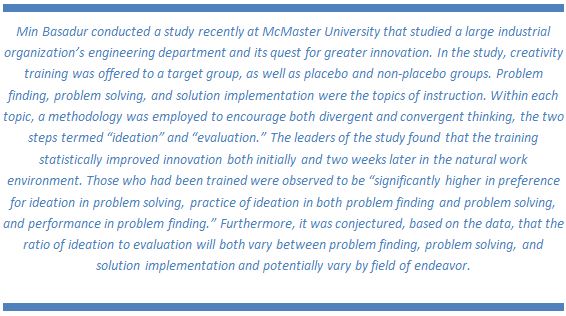
 

As you can see from the study, creativity training (when done well) can be instructive for employees who need to learn how to think and express ideas in a more positive, focused, and spontaneous way. Breakthrough results often occur when properly fueled by a rapid, flexible, and structured process at the front end of innovation.

Most R&D or innovation initiatives include no budget for training. Since creativity can aid with problem solving and problem finding, organizations need to be awakened to the potential missed from failure to pre-train.  Fraley feels  creativity and innovation training accelerates innovation in five strategic ways:

  1. Improved creative thinking leads to enhanced innovation capacity, and with action, results.
  2. Training helps instill structured creative thinking and innovation process as a cultural value and habit.
  3. Training provides innovation teams with a common language and framework to solve problems, improve communication, expedite complex problem resolution, and moving new business concepts forward.
  4. Training corrects many of the myths that surround creativity and innovation. There is a science to this that is largely ignored. For those that learn and practice the science — it’s a competitive advantage.
  5. Team efficiency improves because a lot of useless chatter, debate, and conflict are eliminated.

Creativity is intimately related to change, decision making, and problem solving — it’s not just artistic self-expression!

 

The House on the Sand Went Smash

As a youngster, I remember learning a Vacation Bible School ditty about the wise man and the foolish man. In the song, there was a great rainstorm. One builder had built his house upon a rock, and that house stood firm. The other had built his house upon sand and the house fell down (went smash!) The morale of the story is to make a sure foundation before beginning an endeavor whose outcome is important.

Most businesses know that they need to do some business or strategic or turnaround planning. Planning is vital to creating shared mission and eliciting commitment from stakeholders in the outcome(s). Most executive teams, however, underestimate the value of educating employees to prepare them to execute the plan and achieve the desired results.

We all want employees and managers who maintain a cool head and concentrated focus. What is our role, however, within executive teams, to help our people become prepared? We would assert that our role is to lead and influence through empowerment. Empowerment enhances employee engagement and reduces the likelihood that only executives will be expected to take responsibility for outcomes. 

Skilled employees are usually made, not born. Therefore, key employees deserve professional education and job training. Be constantly grooming your staff to take on more and more responsibility. Much like a second-string player on a sports team, a second generation of managers should be in waiting, ready to step in when called. This intentionality is also very useful in succession planning, because those who vacate their positions already have trained backups who would be ready to perform the role should their predecessor no longer be able or willing.

Grooming Effective Managers

Continuously analyze employees for management potential through an interactive process of interview, observation, and written response. Be on the lookout for employees in all areas who posses strong analytical and evaluation skills, combined with the emotional intelligence to handle changes effectively and appropriately. Give your people the opportunity to prove themselves worthy of consideration for grooming.

When evaluating management candidates, leaders will often try to determine, through an employee’s actions or words, the employee’s perceptions about the company’s mission. A demonstrated commitment to the mission shows promise. Using individual interviews and feedback sessions, leaders can determine whether employees understand chain of command and critical success factors for business success. Asking employees how to improve the productivity of their part of the business, their own execution, and corporate profitability can reveal (through their responses and actions) whether they understand the key levers of management.

Education and Training

Those who can consistently make recommendations for company improvement should be considered for management positions and be given an opportunity to refine their skills through education and training. The employee development need not be formal; the one-to-one mentoring of high potential employees can yield significant results. Formal workshops and continuing education offered within your industry or organizations serving people in key roles can sharpen skills, focus, and performance.

Personnel files should document employee attendance at educational programs as well as innovative solutions they have offered to real problems. These files serve as the basis for performance reviews as well as management development. Difficult work assignments containing known problems offer the high potential employees to contribute on  meaningful decisions. If unsatisfactory decisions are made in these situations, the employees can be coached and mentored through what should have been done differently and learning will occur.

Adapting to Change

Over time, employees will learn to adapt to changing events in the operating environment. The first few times a managerial candidate faces unforeseen circumstances, it may be difficult to revise the game plan to suit the conditions. With effective coaching and a sprinkling of successes, however, the new manager will learn to handle tough situations without the need to involve a higher up.

Every business has its share of unpredicatable events that can influence performance. While these events cannot be anticipated exactly, they can be expected and planned for in a hypothetical sense. As employees become more flexible in the way in which they carry out their responsibilities, they will be able to aid the business plan execution by adapting to change more quickly and accurately.


Locating the Buyer Need

Is your organization in the habit of finding unresolved problems? If not, chances are high that you are currently–or will be soon–losing market share to more nimble competitors who are “tuned in” to buyer habits and frustrations. Many industries suffer from the slow and steady move to products and services that have largely become commoditized. Once your offering is viewed as a commodity, you are no longer competing on value; the playing field is reduced to price only (or at least as a primary decision criteria.)

One of the categories that suffered this fate about 15 to 20 years ago was televisions. Appliance stores (as opposed to the modern day consumer electronics big box specialty retailer or boutique provider) were where people shopped. When looking for a TV, most consumers would walk down the aisles of sets in their beautiful shades of grey or black. Sales staff may follow or approach and offer to explain or demonstrate features of a model you may have paused near. Most buyers, however, came in to the store armed with some knowledge about prices or consumer ratings and were planning to buy a certain model…until they came across a TV with a sticker that asked the simple question, “Ever lose your remote control?”

How did Magnavox determine that the Remote Locator function (in which pressing the power button causes the lost remote to beep several times) was a missing ingredient in the TV viewing experience of many viewers? Did they simply ask, “What problems do you have with your current TV?” No; instead, they asked penetrating questions about how the TV fit into the lives of consumers. They looked at family dynamics and how TV viewing paralleled relationships with other daily activities. What they discovered was that 80 percent of Americans admitted to losing the remote control; over half of the viewers lost their remote more than five times per week. Inanimate objects like sofas, pantries, and refrigerators swallowed up the devices when the owner wasn’t watching!

The typical consumer may never have offered up that losing the remote was a problem associated with TV viewing. The TV manufacturers were not responsible for the loss of the remote (though family members and friends were certainly thought to be culprits!) Yet, when asked if the loss of remote was a problem, most readily agreed that it was.

Note that the technology used in the Locator was not novel or cutting edge. But, Magnavox had created a temporary competitive advantage among buyers of TVs for whom keeping track of the remote control was now seen as a problem that technology could solve. While some may argue that the company was fortuitous in “stumbling upon” this idea, in fact, it was very deliberately planned.

Magnavox published survey data to validate the problem. Some of the key findings included:

  • 55 percent of respondents admitted losing the remote control 5+ times/week.
  • Of those who lost the remotes, 63% said that their average search to regain the device was about 5 minutes.
  • The remote was most likely to show up in/under a piece of furniture (38 percent), in the kitchen or bathroom (20 percent), or in the refrigerator (6%)

What was the process of discovery and meeting a previously unstated need?

  1. Magnavox tuned in to a problem that TV buyers really had.
  2. They created a product experience to solve it.
  3. They shared the powerful idea with the market. (Through survey results)
  4. They communicated to the market in ways the target audience wanted to hear.

Instead of taking a traditional, worn-out R&D approach, consider changing how your company develops and commercializes product ideas. Send team members out to collect data that can drive design, packaging, messaging and other aspects of product positioning. You will be better off for the new approach!

SCARF Up Some Change

In an HBR blog post about organizational change this morning, Walter McFarland draws in the role of the brain in defining whether change efforts will meet with success. Some of the casualties of failure to adapt to changing market conditions he mentions include Sunbeam, Polaroid, and Circuit City. While each of these formerly strong companies is no longer in business, proponents of organizational change struggle to define why some are able to reinvent themselves and others are not, other than the nefarious “human element.”

Organizational change as a field of study has long maintained that change can be defined in linear, sequential terms and processes. What we are discovering, largely through examining principles of neuroscience, is that change is neither. Instead, McFarland, the board chair elect of the American Society of Training and Development (ASTD), argues that modern business dynamics would suggest that it is chaotic. It is the chaotic nature of change that creates the need for greater research. We live in a time when the need to constantly change is critical to competitiveness. Neuroscience may be a key to helping us steer organizations through adaptation more effectively.

Thompson and Luthans wrote that typical reactions to change “can be so excessive and immediate, that some researchers have suggested it may be easier to start a completely new organization than to try to change an existing one.” While industrial psychologists refer to this as “human resistance to change,” very few who study the phenomenon have identified how to lower the resistance consistently and pervasively. 

At the NeuroLeadership Summit, being held in New York this week, a panel discussion with senior executives and experts from The Conference Board, the Association of Change Management Professionals, Change Leaders, and Barnard College will explore the connection between neuroscience and organizational change, understanding how we can effectively deal with the human resistance to change. 

A new organizational change model is being proposed that takes into account how successful change functions in a modern organization, where work is conceptual, creative, and relational, and talent is portable. According to McFarland, activities that have contributed to the continuing poor performance of change initiatives include:

  • Perpetual underpreparation: change is always dreaded and a surprise to employees
  • A perceived need to “create a burning platform”: meant to motive employees via expressed or implied threat
  • Leading change from the top of the organization down: only a few individuals are actively involved in the change and either under communicate or miscommunicate with others

Top-down change (the traditional model) can trigger fear within employees because it “deprives them of key needs that help them better navigate the social world in the workplace. These needs include status, certainty, autonomy, relatedness, and fairness” — the foundation of the SCARF model

  • Status is about relative importance to others.
  • Certainty concerns being able to predict the future.
  • Autonomy provides a sense of control over events.
  • Relatedness is a sense of safety with others – of friend rather than foe.
  • Fairness is a perception of fair exchanges between people.

SCARF is a summary of important discoveries from neuroscience about the way people interact socially and is built on three central ideas:

  1. The brain treats many social threats and rewards with the same intensity as physical threats and rewards (Lieberman, & Eisenberger, 2009). 
  2. The capacity to make decisions, solve problems and collaborate with others is generally reduced by a threat response and increased under a reward response (Elliot, 2008). 
  3. The threat response is more intense and more common and often needs to be carefully minimized in social interactions (Baumeister et al, 2001).

Since organizational change is a significant social interaction in the marketplace, it is important to minimize perceived risk. Understanding how people tick, empowering them to vocalize their ideas, and creating better systems to engage them in the change process is best practice. More organizations need to get on board.


Experimental Failure Leads to Success

We’ve all heard the Thomas Edison quote that he “successfully discovered 1000 ways to not make a light bulb.” He didn’t consider the 1000 attempts as failures, but rather experiments from which he collected data that guided the innovative process. Who else lays claim to so many failures? Cisco grew to be one of the largest technology companies in the world after being rejected for funding by 76 venture capital firms. Michael Jordan, in the minds of many (including yours truly) the greatest basketball player of all time, was cut from his high school basketball team. John Grisham, award winning novelist, was rejected by a couple dozen  publishers before getting his first sizable deal. Slumdog Millionaire won 8 Academy Awards after Warner Brothers gave up on it and sold the property to Fox Searchlight. In short, each of these is a story about finding a positive way to apply lessons learned.

Why is it that workers go from being starry eyed, curious and energetic to automatons after working for a company for an extended period of time? Usually, by the time these numbed brains “check out” mentally, they have already been promoted to a managerial level. We value visionary leaders, but all disdain lethargic managers. What’s the difference between the two? The loss of intellectual creativity and desire to take risks leads to bureaucracy. The market demands innovation. Those who will lead are challenged to not become shut off to progress and new ideas.

Paul Arden wrote It’s Not How Good You Are, It’s How Good You Want To Be. The former executive creative director of Saatchi & Sattchi said, people “will say nice things rather than be too critical. Also, we tend to edit out the bad so that we hear only what we want to hear…If, instead of seeking approval, you ask, ‘What’s wrong with it? How can I make it better?’ You are more likely to get a truthful, critical answer.”

Jeremy Gutsche concurs with Arden, writing that “a culture that openly discusses imperfection is more likely to accept the failure that comes from acceptable risk.”

Michael Jordan, mentioned above as the greatest basketball player in history, said the following about taking risks, 

“I’ve missed more than 9,000 shots in my career. I’ve lost almost 300 games. 26 ti,es I’ve been trusted to take the game winning shot and missed. I’ve failed over and over and over again in my life and that is why I succeed.” 

Most companies, however, spend a lot of time in performance appraisals celebrating successful outcomes and critiquing efforts that don’t appear to meet expectations. Think for a minute, however, about how to inspire your employees to be clever and progressive. Put measures in place to help them feel protected. It must be understood that trying new things, even if failure is the outcome, is a better business decision than undertaking safe projects constantly.

It is said that Steven Ross would fire employees for not making mistakes when Warner was launching its MTV subsidiary. He and his leadership team were trying to debut new programming and needed as much innovation as possible. Similarly, Microsoft used to have the mentality that a leader was not ready for promotion if he had not had a highly publicized, big flop. Thomas Watson, Sr., founder of IBM, once received a phone call from an employee who wanted to resign after making a $10 million mistake. Watson refused to let him follow through with his intended action, telling the manager that IBM had just spent $10 million educating him.

How much money and time are you willing to spend in your organization to educate people and give them the chance to pioneer something great? Probably not enough.