How Do Successful Businesses Manage Their Operations?

After working hard on the marketing plan and the financial plan, successful executive teams develop operating plans to implement them. These are the plans that ultimately result in successfully bringing one’s idea into the marketplace–and profits into the owner’s pocket. Staffing, office administration, and work flow supervision are the primary needs. Successful businesses anticipate problems and take steps immediately to improve workflow efficiency. Supervisors and budgets are assigned to control costs. If necessary, outside fractional help is secured to make sure that appropriate resources are allocated to the best potential outcomes. In addition, the top executive may recommend steps financial and marketing teams can take to enhance overall productivity–and, by extension, profitability. For example, organizations that offer and sell the same or similar goods or services over and over usually see fewer cost overruns and therefore generate more profit per unit of sale.

Staffing a business with the correct number and types of employees makes your workplace both productive and more enjoyable. Sprinkle in some training and development and you demonstrate care and concern for your people. Create feedback loops and engagement will soar. Successful organizations increase or decrease staff levels as operating plans require. Outsourced human resources–whether through independent contractors, fractional professional staff, or subcontracting–allows your company to optimize human resources for any level of work necessary. Making preparations to finish existing projects while beginning new ones and documenting how the work will be accomplished will focus your efforts.

Administering a variety of initiatives simultaneously places certain demands on office staff as well. A successful executive team thinks through the documentation needs of the organization and assigns responsibilities to appropriate personnel. Institutional knowledge is thereby captured for the benefit of all and adjustments become easier to make. Well-organized files–physical and electronic–are another vital component to smooth business operations and can eliminate wasted time and effort, as well as reinforce best practices!

Successful supervision of field (or plant or billable or development) personnel involves more than simply the “management by walking around” approach of yore. Think about technology as a means to do more with less. Creatively brainstorm as to how to maximize the benefits of being face-to-face versus virtual–it’s a trade-off of time, money, and precious additional resources. Recruiting and hiring should reflect an effort to add to the team those who are the best cultural fit rather than simply strong technicians who may undermine the esprit de corps. Compensation and performance management systems should reinforce your value system–not stand separate from it. Think of processes like equipping, quality management, customer service, coaching, mentoring, motivating as key factors in your success. When you do, plans can be made to enable your organization’s operations to become efficient and profitable.

Solve Rather Than Analyze

Is your business underperforming? If so, chances are high that your CFO or you as owner have determined that it is necessary to “manage the business by the numbers.” Reporting systems are put in place and monitored rigorously. I know this to be the pattern because I have observed turnarounds for over 20 years. It is predictable.  For some, the focus is on sales, for others, on leads, expenses, receivables, payables, etc…

What can be lost in the “shuffle” is necessary focus on what actions are necessary to change the patterns. So much effort is dedicated to capturing information, reporting information, and communicating information that not enough is given to improving performance. Simply noting what needs to change without the corresponding strategies and tactics, as well as daily behaviors, is not enough!

When the organization takes time to problem solve, innovation can occur. Instead of doing the same thing and expecting different results (insanity), new solutions need to be developed, new processes tired, new personnel invited to help develop solutions.

Paul Williams invites change managers to ask the question “How Might We…?” How might we drive sales? How might we drive traffic? Determine at least four “how might we” answers. Then, for each of those answers ask again “How might we…” Identifying at least four responses for each.

In his blog for the Idea Sandbox, Williams recommends the tool below to guide the exploratory process:

Let’s use the “How might we drive sales?” as an example.

ROUND 1:

How might we… drive more sales?

Here are four ideas…

  1. By building more awareness.
  2. By charging more to those already coming in. (Raise Prices)
  3. By getting existing customers to visit/buy more frequently. (Increase Frequency)
  4. Get people who come in to buy more than what they normally do. (Add-on Sales)

ROUND 2:

How might we… drive more sales?

Let’s take those first four answers and ask “how might we?” about each.

1) How might we… build awareness?

  • Do advertising.
  • Do PR.
  • Do community events.
  • Word of mouth: get current customers to tell others.

2) How might we… raise prices?

  • Increase prices across the board.
  • Increase price of most popular products.
  • Add perceived higher-tier items – that command a higher price point.
  • Remove lower-priced / smaller sized options from menu.

3) How might we… increase frequency?

  • Add items for a different time of the day / daypart (e.g. add breakfast).
  • Offer special in-store events to encourage non-traditional visits (e.g. art events, live music).
  • Run frequency-building consumer promotion(s).
  • Create / suggest additional uses for your product (e.g. baking soda for cleaning, cranberry sauce – not just for Thanksgiving).

4) How might we… get add-on sales?

  • Put impulse items near the cash register.
  • Offer add-on extended warranty / product insurance.
  • Show customers products that pair with and enhance what they normally buy.
  • Offer specials encouraging families and group sales.

Williams advocates that we continue to ask the “how” question to arrive at possible solutions. By repetition, more ideas surface. Though he stopped after two rounds of brainstorming (problem solving in this case), you need not feel limited except by the creativity of your team and amount of time you are willing to commit to the process. 

Even stopping at the point above, you notice that 16 potential solutions to enhance sales were generated. While not all of them will create the desired improvement, many will and the effort is way more valuable than perseverating on the problem, as organizations and their leadership teams are wont to do.

Move to action rather than “paralysis by analysis” and you will be better off!


What Have You Overcome to Be Successful?

Entrepreneurs who don’t win business plan or pitch competitions often get down on themselves. They may wonder whether they will ever get the funding needed to turn their idea into a commercial venture. The sense of frustration when circumstances don’t appear to go the right way can lead to despondency.  Vivian Giang, writing for Business Insider in an article published earlier this week, reminds that others have overcome greater odds.

Giang shares Ryan Blair’s story of coming from a broken family, learning disorders, and gang life to become a multimillionaire serial entrepreneur. In his bookNothing to Lose, Everything to Gain,” Blair writes:

“I quickly saw how the system worked, how the street lords kept themselves in power through influence and manipulation. I observed how the older people used bribery and fear to get the younger kids to do their crimes, and I saw how the young people willingly went along with it because it seemed like the only power structure that had any kind of respect in the neighborhood.”

“Long before I became a millionaire entrepreneur, I was a kid with a criminal record, street gang experience, and a lot of emotional scarring from years of abuse from my father. My teenage years were hardly the typical starting point for a normal, productive life, let alone a successful business career. Turns out, that didn’t matter.”

Blair was arrested more than ten times. Living the street life left him facing a four year sentence and the tender age of 16. His mom began dating a businessman a couple years later who showed modeled how to make money legally. Giang observes that Blair was insightful when he decided to apply the survival skills learned on the street to make money the right way. His “street smarts,” she writes, were gained from observing the strengths of the gang system through a new lens.

“There’s a hierarchy in gangs, a hierarchy of positions and power,” he says. “A gang is an economic system, and there’s a lot of similarities between gangs and some legal companies. I know that it’s not always the most powerful organization that’s going to make it, it’s the one that’s most adaptable with the changing times, the one that understands how to manage their politics.”

At 21, Blair launched his first company (24/7 Tech) and brought his understanding of street economics, plus a determination to turn himself around, to bear on the effortToday, he’s the CEO of ViSalus and won the DSN Global Turn Around Award in 2010 when he actually turned the company around from being $6 million debt in early 2008 to sucess 16 months later.

When trying to get his first business off the ground, Blair says he was nervous about ‘taking his skeletons out of his closet,” because people were always “looking for a reason to see why they are better than you. People look at people who don’t have pedigree upbringings differently.” But “if you avoid it, or hide it, others might feel as though there’s a dishonesty there, and hiding something is a very expensive emotional thing for you.”

Blair’s belief that others, too, can overcome mistakes and troubled histories influences the way he runs his own company. He said that he’s willing to hire people with a criminal record–provided they are honest about the past in the present. It seems to be working well for him!

So, if you as an entrepreneur feel that you have long odds for success, consider what Blair and others have been through. He has faced similar challenges to your own–and additional ones that, thankfully, do not confront you. With that in mind, hopefully smaller challenges will be seen for what they are.


Do Your Cultural Diligence in M&A!

Of course the merger was a success. Neither company could have lost that much money on its own.

-Steve Case, Former Chairman of the Board
AOL/Time Warner

Competitive markets create an environment wherein companies strive for revenue growth. When organic (internal) growth is hard to come by, inorganic growth becomes a target. Inorganic is a category that includes merger and acquisition (M&A) activity as a primary strategy.

While business exigencies demonstrate the “need” for change, often the hard facts found in classic due diligence processes have far less to do with ultimate success than the cultural fit of a transaction between parties. Consequently, organizations that understand their core values are much more likely to reach the kind of growth and success that nearly all businesses seek [Gallangher 2003].

Successful M&A has been known to grow markets, build on complementary strengths, and eliminate inefficiency. But what ultimately matters in an acquisition is what happens in the hearts and minds of the people who remain with the new organization and what culture these formerly distinct entities choose to build while moving forward [Gallangher].

The Mercer Consulting Group, in studying M&A activity, finds that, among unsuccessful ones that many of the failures are caused by not conducting the same kind of “due diligence” on the culture, structure, and processes of an acquisition target as they do on the financial balance sheet [Gallangher]. 

Traditional due diligence typically analyzes the following:
– Historical performance,
– Ownership and organizational structure,
– Management team,
– Products and services, 
– Assets and liabilities,
– Information systems and technology, and
– Organizational culture [Bouchard, Pellet 2002].

J. Robert Carleton, management consultant and senior partner of the Vector Group, says, “Unfortunately, little or no time is generally spent analyzing the nature, demeanor, and beliefs of the people who will be involved in carrying out the business plan”. He believes that standard due diligence does not address some of the key questions that must be asked to accurately assess organizational readiness for a major change, such as a merger or acquisition. Even when some of the “right” questions are asked, Carleton argues, they are often limited to brief interviews with key executives, who likely have differing views from the rest of the employee group. The people in the trenches, the ones doing much of the actual work are not even involved. He  finds it interesting that “in financial and legal due diligence no such ‘act of faith’ is acceptable” in terms of the investigative procedure [Bouchard, Pellet].

“Cultural due diligence” is a phrase that more strategists are using  to assess what stumbling blocks may hinder successful integration of entities and their operations. Key factors to be considered include:

– leadership and management practices, styles, and relationships,
– governing principles,
– formal procedures,
– informal practices,
– employee satisfaction,
– customer satisfaction,
– key business drivers,
– organizational characteristics,
– perceptions and expectations, and
– how the work gets done in your organization

[Bouchard, Pellet; see also Carleton, Lineberry 2004].

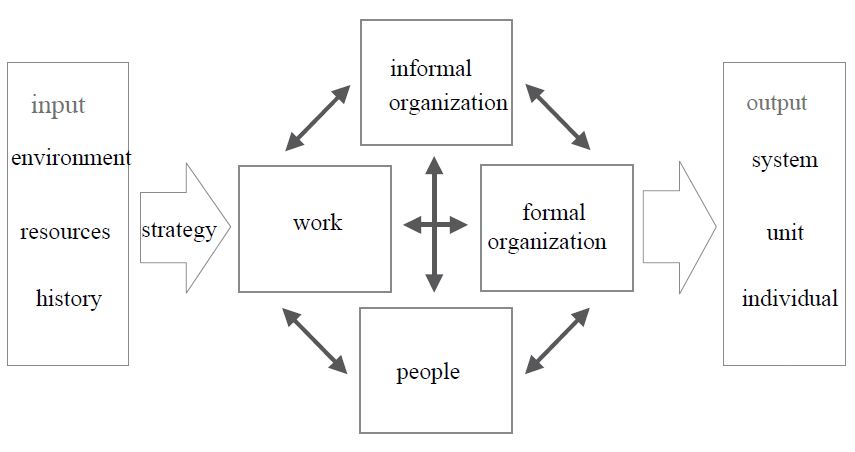
When HP and Compaq decided to combine forces, they used schematics like the one below to help them discuss the salient issues–

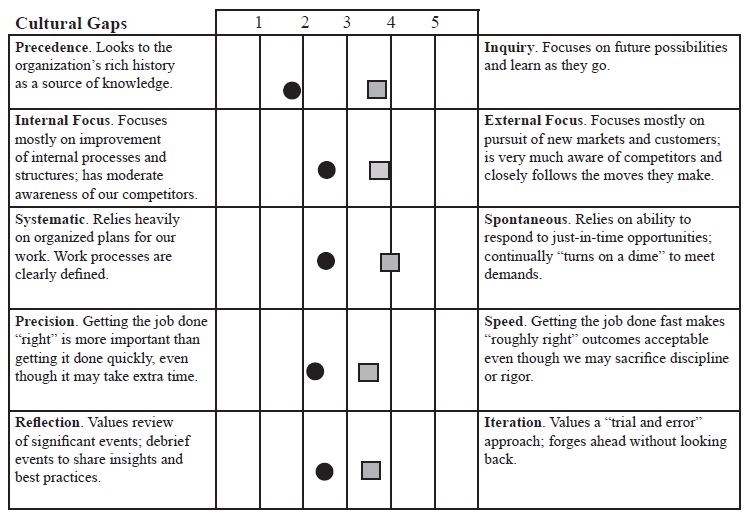
After looking through these issues and discussing each company’s culture, the merger team put together a chart like the one below to begin developing tactics to plan for a smooth post-closing integration.

As you look at this chart, think about key M&A transactions in your industry or local community. Of the ones that did not pan out as planned, do you think they would have stood a better chance had they systematically worked through these type issues during due diligence?

Cultural due diligence is vital to successful M&A processes. If earnest consideration were given to culture as it is to financial and other factors, inorganic growth and increased market share would be a realized outcome far more often!

(Thanks go out to Agata Stachowicz-Stanusch, who wrote of the value of cultural due dilgence and detailed a case study of the HP-Compaq merger in the Journal of Intercultural Management’s April, 2009 edition.)

Helping Companies Innovate On Purpose


Organizations large and small have teams that are responsible for executing business objectives. In some cases, the objective is to overcome a challenge; other times to re-engineer a process; still others are tasked with the commercialization of new ideas.  Regardless the initiative, the net result is that change will need to occur in order for a new, preferred outcome to be realized. Instead of the top executive in a group owning the need to introduce change, it is usually better to get a team involved for buy-in and swift implementation as well as diverse viewpoints.

Every team has inherent strengths, unique capabilities, passionate individuals with keen insights, and the opportunity to succeed. Invariably, however, time seems to work against innovation and helping teams find the time to do something uniquely significant can be tough work. Culture can impede team progress. It is important to provide the permission, resources, and support for teams to feel it is okay to brainstorm, invent, and implement new ideas.

Bulldog Drummond of San Diego uses a five step process to guide teams through innovation:

STEP 1:  WHAT’S THE PROBLEM? 

While it sounds obvious, framing the challenge clearly is the first step to take. Use the power of “Why?” to ensure the challenge is clearly stated and that everyone on your team understands the problem or the opportunity. Frame the challenge as a question. 

STEP 2: UNLEASH CROSS-FUNCTIONAL TEAMS

Brilliant minds inside companies are often under-utilized because there isn’t a venue to bring them together. These minds don’t get enough time with their peers and are rarely put into environments designed to produce them with enough time to attack a single issue. When solving a challenge, don’t just have marketing or product development teams attack the problem. Instead, unleash the power of cross-functional teams and, if possible, more than one. 

STEP 3: PUT THE CONSUMER (AND KEY INSIGHTS) INTO THE MIDDLE OF THE CHALLENGE

Millions of dollars are flushed down the drain because people aren’t paying attention to the data and the knowledge it contains is not organized in a manner that tells a compelling story. Bringing the consumer to life as people, not just as data, places the consumer and key scenarios into the middle of the challenge in an organized and insightful approach.

STEP 4: DESIGN AND FACILITATE AN AMAZING PROJECT EXPERIENCE

When attacking a challenge, envision the entire experience from beginning to end so that the teams can focus on solving the challenge. We begin by defining success with the project leaders and then choose an inspiring offsite venue and bring 5 to 10 cross-functional teams together. We make sure there is homework completed in advance preparing the teams for their time together, including gathered research, trends, and suggested work in the field. Next, we design the experience—from music and food, to a range of carefully facilitated exercises—and we model a passionate curiosity to solve the problem. At the end of the one or two days we always have amazing, actionable outcomes. 

STEP 5:  ACT QUICKLY ON THE OUTCOMES 

The key to success is to ensure that the ideas are not lost because they haven’t been framed correctly, or they don’t get the time and attention due to the day-to-day activities. Make sure that post the summit, the learnings and outcomes are synthesized in a compelling way, and that a project champion is chosen to lead the ideas into development.

Well-designed innovation summits are characterized by creativity, fun, and enthusiasm. Your organization can empower its teams with resources, support, and approval to dream big dreams and develop ideas that will benefit the organization. It is then incumbent upon leaders to move quickly to implement the ideas.