My China Shop Needs No Bulls

Too many corporations put “bulls” in executive roles, and surprisingly hope for good things. Hard-nosed tactics may produce some short-term gains. Under the surface, employee engagement often suffers, which can spur greater turnover and undesirable business performance. Peter Friedes, founder of the management think tank Managing People Better, offers a parable to illustrate (below):

Roger the Bull

Roger always “tells,” rarely “asks.” He knows what he wants, demands it, and pushes everyone to adapt to his schedule and expectations. He believes that every second counts and does not view relationship-building as time well spent or a necessary activity for getting great work done.

He is not empathetic or understanding. He rarely changes his mind, even with new information. He operates solely on his own agenda, showing little or no interest in his employees’ opinions. He rejects suggestions quickly, as he knows others’ ideas won’t work. He easily confronts people, often using words that are harsh, strong, or judgmental. He can be arrogant, as if to say he has all the answers. He doesn’t trust his employees to do a good job, so he hovers and corrects them.

Roger doesn’t include others before making decisions. While he thinks he coaches his employees, his “coaching” comes across as demands. No one would call him nurturing or encouraging. His language and tone exude frustration and anger. He is extremely unpleasant to work for.
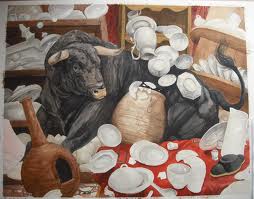
bull in china shopFriedes writes that, while Roger may have flourished as a department of one in the past, his lack of understanding of how to motivate others is a huge drawback to managerial effectiveness. What is recommended are two key skill sets:

  • Relating, which includes relationship-building activities such as asking, listening, including, coaching, and encouraging.
  • Requiring, which encompasses results-oriented activities such as setting expectations, focusing on goals, insisting on excellence, establishing appropriate controls, confronting performance issues, and asserting your views.

Read about Friedes’ experiences in trying to coach Roger-types:

Bulls are the hardest managers to coach. They typically don’t listen well. They often think they have the answers already. Over the years, I’ve tried the following messages, with limited success:

  1. “You are a results-oriented manager. But you would get far better results by asking, listening, including, coaching, and encouraging your people more often, and lowering the volume on how you demand and require of your people.”

  2. “You were an excellent, hard-working individual achiever. But now your success is measured by how well you let others achieve. This takes a different set of skills. Unless you develop these skills, you cannot be effective as a manager.”

  3. “Your goal is fine…to do a lot of excellent work and meet productivity objectives. But the manner you use to get results is damaging our business and sabotaging your career.”

  4. “Our top employees will not work for an over-Requiring, under-Relating manager very long. They will seek a more reasonable manager and leave or transfer. That will require you to start over with new people, lowering your productivity. Over time, the company will not want to give you any new people.”

  5. “You have taught your people to give you exactly what you want, but they no longer give you new ideas or suggestions for how to do things better. You have demotivated them, which is why you see them lacking.”

  6. “I know you don’t need to be liked. But you do need people to appreciate and respect being managed by you. You are not on track to get that respect.”

Since Bulls feel justified in their treatment of others, none of these statements are likely to produce changed behavior. However, being straightforward, according to Friedes, and saying “You are failing as a manager” or “You will be fired if this over-Requiring, under-Relating behavior continues.” may have the desired impact.

(Want to see how Bullish you are? Take a free assessment !)


A Matrix of Insights Into Innovation

Have you ever listened to a “friend of a friend of a friend” story and wondered why the storyteller was recounting something? Surely, you thought, there must be something substantial lost in translation–kinda like the old “telephone game” in which you are in a circle with others, share a statement with someone to your left, who does likewise around the circle only to have a totally different statement return to you. Well, I hope this blog post is nothing like that! However, I would like to share a book review by a friend of mine, Jeffrey Phillips. (Do the math–I have not read the book, do not know the author or his content except vicariously, but I do know Jeffrey and respect his commentary on a number of matters.)

Phillips is a prolific writer, speaker, and practitioner of innovation. As often happens with people who have created a following, he has been asked on numerous occasions to review books written by others having to do with his favorite professional subject–innovation. A couple weeks ago, he wrote a review of Creative Strategy, A Guide for Innovation, written by William Duggan, describing the book as follows: “a step-by-step guide to help individuals and organizations put Strategic Intuition to work for their own innovations.” It is to be noted that Duggan previously wrote Strategic Intuition. Innovation, as defined by Duggan, encompasses products, business models, entrepreneurship, and social enterprises. Phillips finds the book to be “a real conundrum, very specific in recommending (a) three step process (detailed below) and refuting or denigrating many innovation and creativity techniques, while at the same time the book can be annoyingly vague or indeterminate.” So, let me save you the experience of reading the entire book and just hone in on the three step process: rapid appraisal, the “what-works” scan and creative combinations. To quote Phillips:

Rapid appraisal is about breaking the problem into “chunks” or more discrete elements, often known as decomposition.  This simply makes a larger problem an association of smaller problems or challenges.  The What Works scan entails looking across industries, geography and time to see if anyone, anywhere has created a solution to any of the smaller “chunks”.  If so, can we adopt or modify the solution elsewhere to the problem at hand?  The third stepcreative combinations, asks us to look for creative solutions across what Duggan calls the Insight Matrix.  The Insight Matrix is a simple X-Y chart:  problem “chunks” down the vertical axis, potential solutions on the horizontal axis and interesting combinations at the intersections.

While Duggan may be the first to design his “Insight Matrix”, none of these tools will be new to innovators.  The concept of breaking challenges into smaller components (known as decomposition) is well-known to innovators and one that many innovation methodologies practice.  It is often easier to break a challenge or need into smaller components and build a solution up, rather than address the entire challenge at once.  

Creativity wordleLikewise, what Duggan calls the “what-works” scan is not new either.  There is an entire school of thought within innovation that argues that every problem has already been solved, it is simply our job to discover how and where the solution exists.  Bio-mimicry, for example, stipulates that nature has already solved many problems that we encounter, and we can learn from, adapt and adopt those solutions.  

Finally, Duggan’s creative combination approach simply suggests that we adopt the “best” solution for each chuck from the best alternative solution from the what-works scan, and create a total solution by putting these discrete solutions back together.  Again, nothing new here.  Good innovators know that most good ideas happen at the intersection of new technologies and markets. 

In the final analysis, the Insight Matrix is the best thought of the book–probably worth checking out, even if many other concepts take longer to develop and may not be innovative themselves.


Motivations From Branson’s Mom

Business leaders–whether of start-up or large businesses, should possess certain qualities in order to lead their organizations well. In the domain of emotional intelligence, these characteristics often include empathy, social skills, motivation, self awareness and self regulation. In a recent blog post on Entrepreneur.com, the following question was asked:


Q: Is self-motivation an innate quality or is it something that can be learned and improved upon?
– Chris Prior, Liverpool, England


Richard Branson, the founder of Virgin (Records, Airways, Mobile, etc) offered the following response:

If you aren’t good at motivating yourself, you probably won’t get very far in business – especially as an entrepreneur. When you’re starting up a company and for the first couple of years afterward, there are a lot of long nights and stressful days, and the workload is heavy. You have to be able to give the job everything you’ve got every day, or it will easily get the better of you.

The ability to tap into your determination and grit is not just an innate skill. You can teach yourself to get up every day and try to keep a new business going despite long odds, partly by structuring your life and job to make sure you are working toward your larger goals.Branson Virgin Brands

(My mother) feels that shyness is very selfish, as it means you are only thinking of yourself, and so she was very insistent that I look adults in the eye and shake their hands, and carry on conversations with guests at dinner and at parties — no excuses. (She) also taught me to dive into situations even if I wasn’t completely sure about my own abilities, and then solve the problems that came up as I went along. When I was almost 12, she once sent me alone on a long bike-riding expedition to another town, knowing that I would be fine, but also that I’d have to find water and ask for directions along the way.

Before I left school at 16, I was already working on launching what became one of my first businesses, Student magazine. Then when my friends and I put ourselves in a position that forced the issue, by moving into a basement in West London that served as both our office and our living quarters, we really gave our magazine everything we had.

There were times when we struggled to pool together enough money to afford a proper meal — that in itself was a great motivator to follow through on calls to potential advertisers. In the larger picture, we were willing to live with such uncertainty because we wanted to give our generation a voice on issues that we felt strongly about, such as the Vietnam War; this shared goal meant a great deal to everyone involved.

It’s important to understand what your main motivation is so that you can focus your efforts on reaching those goals. Then structure your job – perhaps by delegating some work – so that you can spend as much time as possible turning this energy to your company’s advantage.

Above all, you should work on building a business you’re proud of. This has always been a motivator for me, from my Student magazine days, through to our latest start-ups today. I have never gone into any business purely to make money. If money is your only motive, then I believe you shouldn’t launch the business at all.

Once you know what your own motivations and aspirations are, talk to your employees and colleagues about theirs, if you haven’t already. Then structure their jobs in a way that allows them to tap into this energy, too. With you and your employees approaching your work with renewed energy and commitment, you’ll find that there’s little that you can’t accomplish together.

Good advice, indeed, from one of the most successful serial entrepreneurs on the planet. Branson understands what it takes to be successful. As you evaluate your own level of motivation and how you inspire others to be self-motivated, hopefully you can take notes from him on some best practices and the proper mindset.


Innovation: Spurred By Introverts or Not?

introvert v extrovert

We are all familiar with the stereotypes surrounding introverts. Yet, Stefan Lindegaard at 15inno.com, in a blog post today, while acknowledging that he is an introvert and prefers to be alone, looks at the unique role introverts can play in innovation.  He projects that, in terms of innovation, more innovation will happen in communities either in the b2c form of crowdsourcing or in the b2b form of innovation networks, alliances and challenges. He sees the communities as not just virtual/online, but also in person. Some of Lindegaard’s observations about introversion as it relates to innovation are below (he doesn’t perceive the shift to synchronized collaboration to be one that will exclude introverts from innovation.)

Reflection is an important, but forgotten capability. It is often said that introverts get more energy through reflection and that it dwindles during interaction. Well, we need more reflection. There is too much action in this fast paced world and when it comes to ideas and innovation, the best results seem to come when you take a break and reflect on the problems you are trying to solve.

Organizational structures need to make room for introverts. With the exception of a few pockets such as R&D and accounting most functions within a company seem to be driven with an extrovert-like attitude. But not all people are social. Many are introverts and don’t necessarily want to socialize and focus on external matters. What about them?

Introverts must learn to turn on the switch. Far too many meetings either take too long or should never have taken place at all. The matters could have been dealt with in more effective ways than a meeting. Introvert or not. 

But when I need to interact with others in the physical world, I have trained myself to turn on a switch that allows me to be a good networker (ask questions, focus on the other person) and deliver good talks. I would actually argue that introverts are capable of becoming better networkers than most other people because we are more likely to define a purpose and execute on this before we interact like this.

We need to develop the softer skills. Yes, it is kind of a cliché that soft skills such as networking, communication and “people skills” are really the hard skills, but this does not change the fact that too many companies fail to educate their employees on this. More importantly; they don’t give the employees the time needed to develop these skills. Those who want to succeed in the social era need to change this.

Social media works well for introverts. You can “hide” and still have a strong voice in your community or industry. This is one reason that I spent so much time with social media. It is a great way to communicate and since there is so much input (some call this information overload), it gives you plenty of opportunities to reflect on what is happening and thus build further on your own thoughts and ideas. Social media makes it easier for introverts to become more social. It is a win for everyone.

Introverts can challenge the crowd. Since most introverts shy away from the crowd, they often see the crowd in a different perspective. We need all perspectives when we work with innovation and good innovation leader make an effort to recognize this and thus pay extra attention to listen to the more “quiet” introverts.


Lindegaard’s comments should be challenging to traditional organizational development thought. He almost goes so far as to recommend diversity strategies to balance personality types in work groups. Furthermore, he portrays as valuable the tension between thinking and communication, solitary productivity vs group performance. Think about these concepts and your own organization. Consider how you may better organize yourselves to be more innovative. 

What Raleigh Can Learn From Chengdu

Many groups of people have been trying to spur innovation in Raleigh, North Carolina. One in particular, Innovate Raleigh, has sought to unite the educational community with economic development and entrepreneurship. Conferences, forums, and meetups all have been convened to help identify what needs to be done to create an ecosystem that is comparable to other areas of extreme innovation across the United States. What about overseas? What can be learned from places like Chengdu?Innovation ball

Chengdu, with a population of 14 million, is the capital of Sichuan province. It is the city where paper money — a colossal innovation — first appeared in 1024. The printing of the Buddhist canons “Four Books” and “Five Classics” made Chengdu the early center in the art of printing.Rowan Gibson, the co-founder of Innovation Excellence, describes Chengdu’s spirit this way: “Innovative thinking is part of its history, and it is shaping its future.”

John and Doris Naisbitt, who are well known for global trends and futuristic studies, have recently written a new book, Innovation in China: The Chengdu Triangle.  They make the following observations:

Innovation in Chengdu is growing out of a strategically planned nourishing business environment and an entrepreneur-friendly administration in a stable social climate. Following the principles of a well-run company, Chengdu’s leadership combines management and business acumen with social consciousness and, to a much greater extent than we have ever seen in a Western local government, a service-oriented administration. A good example of innovative service are the quarterly meetings the  mayor holds, and in which every problem, request or complaints must be solved or dealt with within three days. The first meeting was held in March 2003 and meetings have been held without interruption since that time.

The first pillar of Chengdu’s reform is its wider focus which is not exclusive on industrial development, but on a whole range of investment attractions. 

The second pillar of Chengdu’s innovation model is to seek to enhance the allocation and efficiency of “intangible assets.” 

The third pillar of the Chengdu model is bilateral exchange.  

Chengdu is dedicated to beat its innovation drums faster, louder and more insistently on all fronts. But Chengdu is only one of China’s many ambitious and competitive cities. High Tech Parks are growing like mushrooms after a warm summer rain and lure with high wages and $150,000 moving grant for top executives. Top-talents find support in Incubation Centers. Mentors, seed capital, offices and technological equipment are part of the package. China’s “Thousand Talents Program” aims to bring back 2,000 talented Chinese paying salaries between 60,000 and 360,000 Euro. Up to the year 2020 China is dedicating 15 percent of its GDP to human resources.

As we look at ways to broaden the Raleigh economy to capitalize on the success of the Research Triangle Park, the major research institutions, and a highly educated workforce, the Chengdu model is enlightening. We have witnessed the high tech park approach as a key economic driver in our history, and are hopeful that the next evolution of RTP will benefit Raleigh as strongly as the first few decades. The emphasis on Incubation Centers is important. Raleigh needs many such centers of innovation. Thankfully, organizations like the HUB and EntreDot are addressing this need. EntreDot is, in fact, expanding beyond its Kindred Boutique for artisan entrepreneurs and opening a new innovation center in Lafayette Village tomorrow (January 17, 2013).

Innovation centers that offer programs that do not include a strong mentoring component do not prepare entrepreneurs and existing businesses to optimize their talents. Seed capital is needed, as are offices and access to the right equipment. However, the entrepreneurial education and mentoring are key. Finding a way to attract talent back to the area is another idea whose time has come. Even in biotechnology and emerging, fast-growth sectors, study after study has stated the need for more top talent to run world class organizations. Let’s apply some of the principles of Chengdu to our own market and spur even greater innovation!