The House on the Sand Went Smash

As a youngster, I remember learning a Vacation Bible School ditty about the wise man and the foolish man. In the song, there was a great rainstorm. One builder had built his house upon a rock, and that house stood firm. The other had built his house upon sand and the house fell down (went smash!) The morale of the story is to make a sure foundation before beginning an endeavor whose outcome is important.

Most businesses know that they need to do some business or strategic or turnaround planning. Planning is vital to creating shared mission and eliciting commitment from stakeholders in the outcome(s). Most executive teams, however, underestimate the value of educating employees to prepare them to execute the plan and achieve the desired results.

We all want employees and managers who maintain a cool head and concentrated focus. What is our role, however, within executive teams, to help our people become prepared? We would assert that our role is to lead and influence through empowerment. Empowerment enhances employee engagement and reduces the likelihood that only executives will be expected to take responsibility for outcomes. 

Skilled employees are usually made, not born. Therefore, key employees deserve professional education and job training. Be constantly grooming your staff to take on more and more responsibility. Much like a second-string player on a sports team, a second generation of managers should be in waiting, ready to step in when called. This intentionality is also very useful in succession planning, because those who vacate their positions already have trained backups who would be ready to perform the role should their predecessor no longer be able or willing.

Grooming Effective Managers

Continuously analyze employees for management potential through an interactive process of interview, observation, and written response. Be on the lookout for employees in all areas who posses strong analytical and evaluation skills, combined with the emotional intelligence to handle changes effectively and appropriately. Give your people the opportunity to prove themselves worthy of consideration for grooming.

When evaluating management candidates, leaders will often try to determine, through an employee’s actions or words, the employee’s perceptions about the company’s mission. A demonstrated commitment to the mission shows promise. Using individual interviews and feedback sessions, leaders can determine whether employees understand chain of command and critical success factors for business success. Asking employees how to improve the productivity of their part of the business, their own execution, and corporate profitability can reveal (through their responses and actions) whether they understand the key levers of management.

Education and Training

Those who can consistently make recommendations for company improvement should be considered for management positions and be given an opportunity to refine their skills through education and training. The employee development need not be formal; the one-to-one mentoring of high potential employees can yield significant results. Formal workshops and continuing education offered within your industry or organizations serving people in key roles can sharpen skills, focus, and performance.

Personnel files should document employee attendance at educational programs as well as innovative solutions they have offered to real problems. These files serve as the basis for performance reviews as well as management development. Difficult work assignments containing known problems offer the high potential employees to contribute on  meaningful decisions. If unsatisfactory decisions are made in these situations, the employees can be coached and mentored through what should have been done differently and learning will occur.

Adapting to Change

Over time, employees will learn to adapt to changing events in the operating environment. The first few times a managerial candidate faces unforeseen circumstances, it may be difficult to revise the game plan to suit the conditions. With effective coaching and a sprinkling of successes, however, the new manager will learn to handle tough situations without the need to involve a higher up.

Every business has its share of unpredicatable events that can influence performance. While these events cannot be anticipated exactly, they can be expected and planned for in a hypothetical sense. As employees become more flexible in the way in which they carry out their responsibilities, they will be able to aid the business plan execution by adapting to change more quickly and accurately.

 

SCARF Up Some Change

In an HBR blog post about organizational change this morning, Walter McFarland draws in the role of the brain in defining whether change efforts will meet with success. Some of the casualties of failure to adapt to changing market conditions he mentions include Sunbeam, Polaroid, and Circuit City. While each of these formerly strong companies is no longer in business, proponents of organizational change struggle to define why some are able to reinvent themselves and others are not, other than the nefarious “human element.”

Organizational change as a field of study has long maintained that change can be defined in linear, sequential terms and processes. What we are discovering, largely through examining principles of neuroscience, is that change is neither. Instead, McFarland, the board chair elect of the American Society of Training and Development (ASTD), argues that modern business dynamics would suggest that it is chaotic. It is the chaotic nature of change that creates the need for greater research. We live in a time when the need to constantly change is critical to competitiveness. Neuroscience may be a key to helping us steer organizations through adaptation more effectively.

Thompson and Luthans wrote that typical reactions to change “can be so excessive and immediate, that some researchers have suggested it may be easier to start a completely new organization than to try to change an existing one.” While industrial psychologists refer to this as “human resistance to change,” very few who study the phenomenon have identified how to lower the resistance consistently and pervasively. 

At the NeuroLeadership Summit, being held in New York this week, a panel discussion with senior executives and experts from The Conference Board, the Association of Change Management Professionals, Change Leaders, and Barnard College will explore the connection between neuroscience and organizational change, understanding how we can effectively deal with the human resistance to change. 

A new organizational change model is being proposed that takes into account how successful change functions in a modern organization, where work is conceptual, creative, and relational, and talent is portable. According to McFarland, activities that have contributed to the continuing poor performance of change initiatives include:

  • Perpetual underpreparation: change is always dreaded and a surprise to employees
  • A perceived need to “create a burning platform”: meant to motive employees via expressed or implied threat
  • Leading change from the top of the organization down: only a few individuals are actively involved in the change and either under communicate or miscommunicate with others

Top-down change (the traditional model) can trigger fear within employees because it “deprives them of key needs that help them better navigate the social world in the workplace. These needs include status, certainty, autonomy, relatedness, and fairness” — the foundation of the SCARF model

  • Status is about relative importance to others.
  • Certainty concerns being able to predict the future.
  • Autonomy provides a sense of control over events.
  • Relatedness is a sense of safety with others – of friend rather than foe.
  • Fairness is a perception of fair exchanges between people.

SCARF is a summary of important discoveries from neuroscience about the way people interact socially and is built on three central ideas:

  1. The brain treats many social threats and rewards with the same intensity as physical threats and rewards (Lieberman, & Eisenberger, 2009). 
  2. The capacity to make decisions, solve problems and collaborate with others is generally reduced by a threat response and increased under a reward response (Elliot, 2008). 
  3. The threat response is more intense and more common and often needs to be carefully minimized in social interactions (Baumeister et al, 2001).

Since organizational change is a significant social interaction in the marketplace, it is important to minimize perceived risk. Understanding how people tick, empowering them to vocalize their ideas, and creating better systems to engage them in the change process is best practice. More organizations need to get on board.


Experimental Failure Leads to Success

We’ve all heard the Thomas Edison quote that he “successfully discovered 1000 ways to not make a light bulb.” He didn’t consider the 1000 attempts as failures, but rather experiments from which he collected data that guided the innovative process. Who else lays claim to so many failures? Cisco grew to be one of the largest technology companies in the world after being rejected for funding by 76 venture capital firms. Michael Jordan, in the minds of many (including yours truly) the greatest basketball player of all time, was cut from his high school basketball team. John Grisham, award winning novelist, was rejected by a couple dozen  publishers before getting his first sizable deal. Slumdog Millionaire won 8 Academy Awards after Warner Brothers gave up on it and sold the property to Fox Searchlight. In short, each of these is a story about finding a positive way to apply lessons learned.

Why is it that workers go from being starry eyed, curious and energetic to automatons after working for a company for an extended period of time? Usually, by the time these numbed brains “check out” mentally, they have already been promoted to a managerial level. We value visionary leaders, but all disdain lethargic managers. What’s the difference between the two? The loss of intellectual creativity and desire to take risks leads to bureaucracy. The market demands innovation. Those who will lead are challenged to not become shut off to progress and new ideas.

Paul Arden wrote It’s Not How Good You Are, It’s How Good You Want To Be. The former executive creative director of Saatchi & Sattchi said, people “will say nice things rather than be too critical. Also, we tend to edit out the bad so that we hear only what we want to hear…If, instead of seeking approval, you ask, ‘What’s wrong with it? How can I make it better?’ You are more likely to get a truthful, critical answer.”

Jeremy Gutsche concurs with Arden, writing that “a culture that openly discusses imperfection is more likely to accept the failure that comes from acceptable risk.”

Michael Jordan, mentioned above as the greatest basketball player in history, said the following about taking risks, 

“I’ve missed more than 9,000 shots in my career. I’ve lost almost 300 games. 26 ti,es I’ve been trusted to take the game winning shot and missed. I’ve failed over and over and over again in my life and that is why I succeed.” 

Most companies, however, spend a lot of time in performance appraisals celebrating successful outcomes and critiquing efforts that don’t appear to meet expectations. Think for a minute, however, about how to inspire your employees to be clever and progressive. Put measures in place to help them feel protected. It must be understood that trying new things, even if failure is the outcome, is a better business decision than undertaking safe projects constantly.

It is said that Steven Ross would fire employees for not making mistakes when Warner was launching its MTV subsidiary. He and his leadership team were trying to debut new programming and needed as much innovation as possible. Similarly, Microsoft used to have the mentality that a leader was not ready for promotion if he had not had a highly publicized, big flop. Thomas Watson, Sr., founder of IBM, once received a phone call from an employee who wanted to resign after making a $10 million mistake. Watson refused to let him follow through with his intended action, telling the manager that IBM had just spent $10 million educating him.

How much money and time are you willing to spend in your organization to educate people and give them the chance to pioneer something great? Probably not enough. 

Don’t Make a Monkey Out of Innovation


The story is told of five monkeys who were a part of an experiment studying group theory. Inside the cage wherein they were placed, a ladder led to a bunch of tantalizing bananas. What the test subjects initially did not know was that a high-pressure water hose was attached to the ladder.

One eager monkey raced up the ladder, reaching for one of the tasty bananas, only to cause the entire cage to be deluged with water. Undeterred, another monkey made her own attempt to reach the top. When she ascended the ladder, all the monkeys were again treated to a downpour. The lesson began to sink in–if any one of us tries to reach for the banana bunch, we are all going to get soaked, and that is unpleasant.

As the original test group was substituted out for individual newcomers, one by one the new arrival would make an effort to scale the ladder for the tasty treat. However, the existing group, fearing the dousing, would beat the newcomer down before he could make it to the top. The cycle was repeated, with the same result, until all the original monkeys had been replaced.

When the water hose was removed, it didn’t affect the curiosity of the monkeys–they had learned to avoid the bananas.

In most organizations, there is a built-in resistance to trying new things–particularly if hard lessons had been learned that discourage innovation. It is as though the expectation of risk bringing failure or reprimand begins to thwart spontaneity and creativity, until “group think” has overtaken individual expression. As you think about your own organization, to what degree does this thought process embed itself in your company culture?

Organizations who want to improve their organizational culture need to go to work on the four dynamics above. Perspective, defined as the way we look at the future and the problems we are trying to solve, determines destiny. If it is one’s approach to always be logical, for instance, that is a matter of perspective–not necessarily a reality for all player’s in a niche market. Lou Gerstner, in speaking about his turnaround of IBM, said, “I came to see in my time at IBM that culture isn’t just one aspect of the game–it is the game.” Some of the changes he made seemed like semantics, but his commitment to them made a huge difference:

  • Shift the focus from product to customer
  • Shift from “value me” (silo) to “value us” (the whole)
  • Shift from analysis paralysis to making decisions with 80% knowledge and moving forward

Experimental failure means creating a safe environment in which ideas can be tested and allowed to fail without the idea person being labeled a failure. Instead of making minor adjustments to what exists today, we need to foster an attitude that looks for tomorrow’s breakthroughs. Often, complacency is the doom of a department, division, or business. It has been said that we grow most in the valleys. If you are a part of an organization that only wants to play “king of the hill” through entrenchment, you should look for your next opportunity today!

Disruptive innovation begins with a deep understanding of the needs of your target audience. Customer obsession is an intentional effort to connect and engage..especially on an emotional level. When the connection is made, your product or service resonates with the customer in such a way that she cannot imagine a world without your offering as a part of her life.

Breaking down worn-out structures and processes that hinder our vision of market dynamics allows us to adapt effectively. Intentional destruction challenges the assumption that a strong titular leader makes an organization high-performing. Instead, ideology becomes the unifying factor. Empowered employees can react more quickly and build greater team capabilities that those languishing under an unwieldy reporting structure.

As you look at these recommended area to improve your organizational culture (thanks, by the way, to Jeremy Gutsche, again, for articulating many of these ideas in his writings), determine one thing you can obtain buy-in to change this week and do it!


Sacrifice Opens Door to Opportunity for a Leader

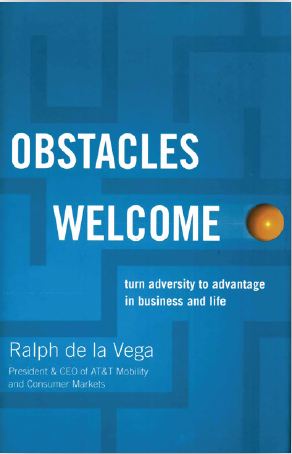
You need not to have been on this planet very long before you will encounter adversity. One popular adage states that we become stronger by going through tough times. Yet, not everyone who encounters obstacles is able to surmount them and achieve success. In Obstacles Welcome, Ralph de la Vega recounts his own “pivot points,” born of a challenging early life that shaped and molded him into a very successful businessman (currently, he serves as the President and CEO of AT&T Mobility and Consumer Markets. His positive responses to adversity formed the backbone of a successful values-based management system.

Rather than seeing separation from his parents at the age of four as a bad omen, de la Vega found a way to accentuate the positives in his life. He innately recognized that dwelling on negative thoughts and feelings was counterproductive. After that tough, early life challenge, he moved to Miami and had to overcome a language barrier in the classroom. He adapted again to his environment instead of letting it get him down in the dumps. 

Many people tack a passive approach to setbacks. They hope, wait, and some earnestly pray for a change in circumstances. The course our example provides, though, is one of planning, taking risks, and maximizing opportunities. In the book, he offers up the premise that obstacles should be embraced as a chance for personal growth. In the midst of living life, we come across those “pivot points” personally and professionally that define us–for good or bad. Getting in the right frame of mind can be achieved through his recommended 8 step process:

1. Hope is not a strategy. It is necessary to plan for success.
2. To achieve big goals and dreams, it is necessary to take calculated risks.
3. Big wins in life come from an ability to recognize opportunities. The most significant and important opportunities lie in problems that are waiting to be solved.
4. Embrace and overcome obstacles. Obstacles and adversity make stronger, wiser, and more capable leaders.
5. Be willing to unlearn old habits and relearn old lessons from life experiences.
6. Building winning teams involves effective, honest, and open communication.
7. The greatest successes always involve willingness to make sacrifices.
8. Leadership is not something inborn, but learned and practiced.

As a young executive at  Bell South Latin America, de la Vega experienced everything from military insurgency, economic meltdown, and political revolution, in addition to unstable markets, lack of uniformity in corporate leadership, and nonexistent profits. How did he respond? He took a chance and embraced the challenges as opportunities to lead an entire sector of the international communications market into profitability. What he advocates is to “become comfortable with being uncomfortable,” In order to do that, we may have to set aside what we feel we already know and become flexible in our approach to the challenges set before us.

A key habit to learn is to not allow the past to hinder the future. That is not to say, however, that our past(s) cannot be instructional. Previous experiences can help us deal with new situations only by using them to look backwards and forwards at the same time. It is important to think about how what we have done before might be useful down the road
in similar situations.  

Finally, de la Vega describes what he terms an “Extraordinary” leader, one who is able to consistently deliver excellence in all aspects of personal and corporate leadership. To achieve such status, a leader needs to do the following:

• Set the direction, create the vision.
• Establish values and lead by them.
• Select strategies and key initiatives.
• Build plans to achieve vision.
• Establish goals, priorities, and focus.
• Establish key metrics to measure progress.
• Align and inspire people.
• Empower and enable people to achieve vision.
• Create winning culture.
• Select, recruit, and develop other leaders.