How Successful Businesses Create Positive Cash Flow

Successful companies generate positive cash flow through efficient operations and effective marketing. Generating revenue is not like raising funds for a charity–people will not offer you money simply because they agree with what you do. Businesses succeed when they are able to convince buyers that their products/services are superior to and of greater value than the offerings of other providers. Controlling costs is critical; make provisions for unavoidable cost variances and eliminate waste in areas where  costs–or at least overruns–can be avoided. Planning for adequate capital structure is also essential; debt-laden companies cannot achieve the same level of success as companies with enough equity. Being able to bring in sufficient revenues and preventing large amounts from being paid out will lead to positive cash flow.

Effective companies generate positive cash flow consistently. The business is streamlined continually to  narrowly defined core acutely focused on making sales, controlling costs, and structuring capital. Creating and maintaining positive cash flows is a continual goal of any business, and an ongoing reality in profitable ones. The exercise of staying profitable and successful requires more discipline than many executive teams are willing to enforce in their operations. For example, moving inventory in a timely manner is puzzle to many businesses that make products.; however, those who develop a formula for success in this area are well on their way to positive cash flows. Controlling costs, though, is not synonymous with eliminating costs. Eliminating costs in an arbitrary fashion can kill momentum and limit financial flexibility. Capital is a useful tool if its effects are controlled, and businesses able to avoid large debt loads are more consistently profitable.

While positive cash flow may seem like a lofty ideal to some teams, the investment and financial communities consider cash flow a distinguishing barometer of business stability. Companies with favorable cash flows can secure more favorable financing terms and receive more concessions from vendors and subcontract organizations. For example, businesses with positive cash flows can negotiate higher discounts when they are able to pay invoices early. Additionally, they can prepay materials and buy in volume for even steeper discounts. An enterprise that consistently demonstrates that it can cover more than its cost of doing business (as evidenced by positive net income) will rack up profits and retained earnings year after year and attract more customers, since buyers often feel that profitable companies are more likely to survive and meet their needs for the long run. Therefore, positive cash flow should be the goal of every employee in the business. 

One of the most important things to remember when incurring financial obligations that affect your cash flow is to stay within acceptable industry ratios. Most industries have trade organizations that publish benchmarking data to help representative companies do a better job of analyzing how they compare with norms. The analysis should not become an end unto itself, however. Use the data to have productive conversations with your CPA, banker, and investors. Unless you want a very short day in the sun, avoid reliance on debt. To remain financially competitive, choose capital financing sources wisely and do not burden your operations and marketing teams with a weight too heavy to bear.


 

How Do Successful Businesses Manage Their Finances?

Once the marketing plan has been developed and the product (service) mix defined, successful executive teams develop a financial plan to determine whether their offerings are economically feasible. Such financial considerations as sources of funding, cash availability, and marketing investment need to be evaluated.

Again, no department or manager can operate in a vacuum during this planning process; it is highly likely that staff in the marketing, finance and operations areas will collaborate on the development of plans for their respective areas, as well as on all aspects of an overall business plan. When a new project, product, or service is contemplated, the finance and accounting staff, in conjunction with the business owner(s), head of marketing, and head of operations should evaluate the company’s ability to:

  • get the initiative off the ground,
  • fund it during development and launch, and
  • continue to support it through sales process and beyond.

Successful businesses are always careful to perform all necessary analysis of these three aspects of innovation. They never assume the financial capability to launch a new idea guarantees success; rather, it is understood that the ability to begin a project is of no value if momentum cannot be sustained through the point of post-sale customer service and satisfaction. The cash required to pay overhead and ongoing obligations when no revenues are coming in from the new initiative can put a company into bankruptcy if not anticipated beforehand.

Securing capital sources is another step in sound business financial planning. The timing and amounts of cash infusions are critical considerations within the overall plan. Sometimes, the lure of a large project or contract can cloud judgment. Without adequate preparation for the cash impact of “ramping up” for new scopes of work, sales volume can become a curse. In fact, some businesses become specific in their growth goals so as to not outstrip precious capital reserve allocation guidelines. (This is not to say, however, that financial instruments such as contract financing are not a way to “have one’s cake and eat it too.”)

Making sure that the business has the wherewithal to “scale” to fit customer demand is important. There will invariably be times when the requirements to pay down payables balances will be instituted by lenders or investors. Likewise, receivables balances cannot become too large too quickly without causing alarm as to the liquidity of the business to meet obligations. Creating a working capital account that is adequately funded to weather fluctuations in business volume–in either direction–is wisdom. How one goes about pre-funding it is “science!”

Businesses that plan for their monetary requirements at every stage of innovation will consistently make more money than those that “fly by the seat of their pants.”  Developing financial plans that support marketing and operational plans is essential for profit maximization. The results of this planning are recommendations to either scrap, revise, or move forward speedily with exciting projects that can lead to increased brand awareness, market share, revenues, and profitability. However, one would do well to remember that no going concern has ever gone broke because its executive team did not start a new project. 

How Do Successful Companies Market?


Businesses on the leading edge of industry trends and developments are market-driven. Thus is not to say they manage their financial and operating efforts poorly; rather, the financial and operating efforts serve as strong support bases for the marketing power from which they derive most of their profits. Possessing a thorough understanding of the various markets in which a business competes, top companies are able to identify which exact product offerings, features and characteristics are most desirable for their target customers in each market sought. Having identified these key characteristics, top performers direct aggressive marketing campaigns at the universe of prospects who meet the general description, letting them know what they plan to offer, when, how and where. Further marketing efforts are focused on developing consultative conversations to entice this target market to purchase, usually including a solid follow-up process for keeping in touch with potential buyers.

Continual market research is essential for small business success, helping the successful executive team to develop a feel for the target markets. You need to know who your ideal client will be–and create corresponding prospective buyer profiles. By studying the types of prospects who visit your website and those of your competitors, it is not hard to get a feel for who your prospects are. What other constituencies should be studied?

  • Competitors
  • Distributors or referral networks
  • Sales channels–online and other
  • Demographic groups and their buying patterns
  • Prior customers and their feedback

Knowing as much as possible about the purchaser of your offering helps successful companies design aspects of the offering that fulfill unique needs (think about how Starbucks creates an environment in which we pay three times as much for a hot beverage as the prior source). By thinking through the offering thoroughly, savvy companies gain a competitive advantage over the competition through informed development decisions. From the same marketing information gathered about prospective buyers and their habits, a business can determine pricing and sales techniques that should lead to higher revenues and profitability. This research process gives you a distinct leg up on those who do not put in adequate effort to understand customer needs.

Putting information to the best possible use is a skill that further distinguishes the successful enterprise from its competition. Selective–and effective–advertising and promotional campaigns can be carried out on even the smallest budget. Social media outsourcing companies will do a phenomenal job for you for as little as $500/month. Other forms of promotion should not be ignored, however, as many traditional approaches are still valid, perhaps none more so that one-to-one networking with the right people. Successful executive teams realize that marketing is all about building a conversation–online and in person. Good information sets the stage for the conversation, but we still must create an open two-way dialogue with people who matter. 

Successful businesses also develop marketing plans that lure prospects into asking to be contacted. For example, if your company can offer better terms than the competition, that needs to be promoted. Sales or promotions can drive short-term traffic, but are not your best long-term tactic for profitable growth. Better, think about bundling and cross selling opportunities to entice a customer to sample more of your wares. The intent is to create a symbiotic relationship wherein they see you as a trusted provider of multiple things they need and value. There are more ways to attract and optimize customer interactions, the common thread being that you need to think through how you make your offering “sticky” enough to hold someone’s attention in a day when so many other messages are competing for it. Motivate prospects to buy your offering over the competition’s!


Real Estate Agents Must Understand Content Management

Today was a good day. In addition to meeting with some smart minds about artisan entrepreneurship, I had the opportunity to plan a pitch event for would-be entrepreneurs and meet with an existing business owner who desires to invigorate his enterprise. His business is real estate–specifically residential sales. What he’s hoping to accomplish is to build a powerhouse brand that competes statistically with the leading agents in our community while targeting an under-served niche market. He asked me about my philosophy on how to accomplish his goal(s).

We began with a conversation about the role of social media in marketing services organizations. Fairly quickly, I felt the need to draw a diagram to make a key series of points. The figure below is what I drew for him–allow me to explain it to you so that you can be on the same page as we ended up:


Everyone knows that Social Media is on the rise and important to reach niche audiences in engaging conversations. What I was able to point out to this entrepreneur is that social media is a subset of Content Management Marketing. Knowing what messages you want to get across is a precursor to sharing the right information through online channels. To begin making posts, tweets, updates, etc without in-depth knowledge of target prospects and their needs is like wearing a blindfold in an archery contest.

Whether it is your strategy as an agent to build your business through referrals from prior clients, key centers of influence, or new campaigns, it is unwise to get spread too thin and not have deep relationships. Given the huge number of users on many social networks, the agent must devise a strategy that isolates niches and pursues them with targeted strategies.

The diagram shows that thought leadership is obtained by creating great content that is shared through social media. In response, the various media provide a built-in feedback loop that should drive future thought leadership strategies. For instance, some agents provide insights in multiple categories for their target audience(s). Whether it is local community, national real estate trends, the agent’s own interests, or local real estate content, the point is to demonstrate that you know what you are talking about.

Lead generation is the holy grail for many agencies that advise real estate firms. They think that, if they can generate enough new prospects for the agents to pursue. they have earned their keep. However, as the agent with whom I was meeting explained, leads that are not qualified and filtered can waste a lot of time. Smart lead generation comes from site visitor capture initiatives that are driven by a content management system that relies on social media to create online experiences for web fans.


Having worked in marketing roles for multiple services firms, I have met many peers who are entirely comfortable being creative, attending wine and cheese events, and spending the money of the business owner(s). What many of them lack are measurement systems (metrics) that validate the marketing ROI.  Furthermore, when metrics are available (web analytics come with every website), the marketers often don’t use the information to change the messaging and means of communication. Smart agents know better and use metrics to verify that what they are doing is working.

Competitive advantage is what is so hard to achieve, yet worth the pursuit. It is that unique place where the audience you target perceives that you can solve their needs “better” than any other provider. “Better” means that the home buyer/seller connects with the agent on a personal and professional basis and feels that the fee they pay to be represented is a value that exceeds what else is available to them.

What is your Content Management Strategy? Do you have one?

Do Your Cultural Diligence in M&A!

Of course the merger was a success. Neither company could have lost that much money on its own.

-Steve Case, Former Chairman of the Board
AOL/Time Warner

Competitive markets create an environment wherein companies strive for revenue growth. When organic (internal) growth is hard to come by, inorganic growth becomes a target. Inorganic is a category that includes merger and acquisition (M&A) activity as a primary strategy.

While business exigencies demonstrate the “need” for change, often the hard facts found in classic due diligence processes have far less to do with ultimate success than the cultural fit of a transaction between parties. Consequently, organizations that understand their core values are much more likely to reach the kind of growth and success that nearly all businesses seek [Gallangher 2003].

Successful M&A has been known to grow markets, build on complementary strengths, and eliminate inefficiency. But what ultimately matters in an acquisition is what happens in the hearts and minds of the people who remain with the new organization and what culture these formerly distinct entities choose to build while moving forward [Gallangher].

The Mercer Consulting Group, in studying M&A activity, finds that, among unsuccessful ones that many of the failures are caused by not conducting the same kind of “due diligence” on the culture, structure, and processes of an acquisition target as they do on the financial balance sheet [Gallangher]. 

Traditional due diligence typically analyzes the following:
– Historical performance,
– Ownership and organizational structure,
– Management team,
– Products and services, 
– Assets and liabilities,
– Information systems and technology, and
– Organizational culture [Bouchard, Pellet 2002].

J. Robert Carleton, management consultant and senior partner of the Vector Group, says, “Unfortunately, little or no time is generally spent analyzing the nature, demeanor, and beliefs of the people who will be involved in carrying out the business plan”. He believes that standard due diligence does not address some of the key questions that must be asked to accurately assess organizational readiness for a major change, such as a merger or acquisition. Even when some of the “right” questions are asked, Carleton argues, they are often limited to brief interviews with key executives, who likely have differing views from the rest of the employee group. The people in the trenches, the ones doing much of the actual work are not even involved. He  finds it interesting that “in financial and legal due diligence no such ‘act of faith’ is acceptable” in terms of the investigative procedure [Bouchard, Pellet].

“Cultural due diligence” is a phrase that more strategists are using  to assess what stumbling blocks may hinder successful integration of entities and their operations. Key factors to be considered include:

– leadership and management practices, styles, and relationships,
– governing principles,
– formal procedures,
– informal practices,
– employee satisfaction,
– customer satisfaction,
– key business drivers,
– organizational characteristics,
– perceptions and expectations, and
– how the work gets done in your organization

[Bouchard, Pellet; see also Carleton, Lineberry 2004].

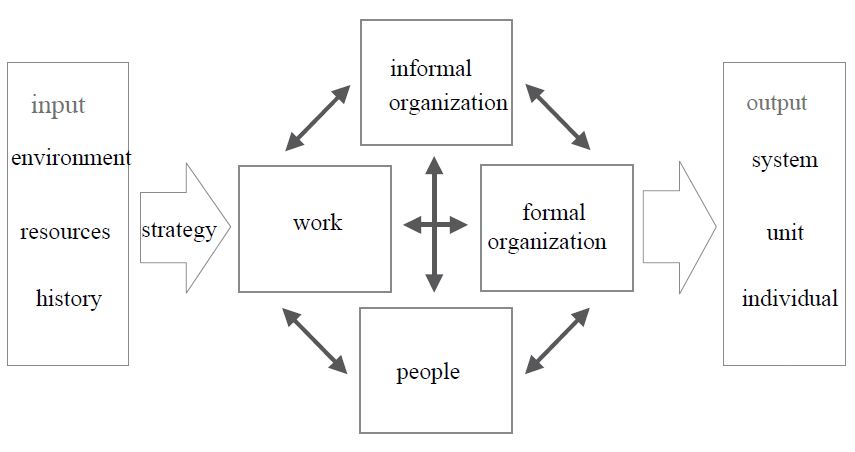
When HP and Compaq decided to combine forces, they used schematics like the one below to help them discuss the salient issues–

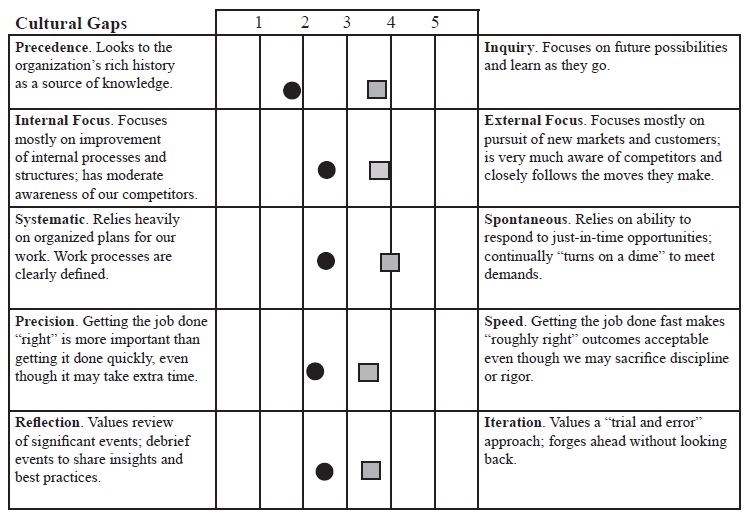
After looking through these issues and discussing each company’s culture, the merger team put together a chart like the one below to begin developing tactics to plan for a smooth post-closing integration.

As you look at this chart, think about key M&A transactions in your industry or local community. Of the ones that did not pan out as planned, do you think they would have stood a better chance had they systematically worked through these type issues during due diligence?

Cultural due diligence is vital to successful M&A processes. If earnest consideration were given to culture as it is to financial and other factors, inorganic growth and increased market share would be a realized outcome far more often!

(Thanks go out to Agata Stachowicz-Stanusch, who wrote of the value of cultural due dilgence and detailed a case study of the HP-Compaq merger in the Journal of Intercultural Management’s April, 2009 edition.)