Succeeding As the Little Fish in the Big Pond

When you set out to start a business, you can’t possible anticipate all of the challenges that will be faced. Many, many days you will find that something totally unexpected can come into your world and dominate your thoughts, perhaps even threatening your livelihood. However, most every entrepreneur knows that they start out the underdog. It is your job number one to figure out how to compete with the market leaders, outfoxing them when you can to carve out enough market share to pay your employees and pursue your dream.

First to market can be a hard advantage to overcome. Note – not impossible – just hard. 

little fish quote The Office imageWriting for Inc.com recently, Mayra Jimenez described how she and her husband found a way to compete with “the big dogs” in their industry. Her designer swimwear business, The Orchid Boutique, has grown nicely into a multimillion-dollar business. Here are some of the insights she shared earlier this week:

Separate “professional” from “robotic”

Larger companies tend to present themselves in a rather corporate manner. Their frosty approach gives you a chance to charm the market with your personalized company story. Clients want to feel they are shopping with a company that cherry-picks their products or personalizes their services in some manner. Casualness and customization are not your enemy! Take advantage of the fact that your ideas don’t have to go through a string of departments to get approved, and make it as personal as you can.

React quickly to industry trends

The most important advantage that you have over your competitor is your ability to react quickly. The bureaucracy of large teams and approval processes are tedious and time-consuming. While your senior competitor moves like an elephant, you’re a vibrant cheetah running rapidly towards your next milestone. Stay abreast of innovative strategies and implement them. This is especially important in ecommerce, as blogging, videos, and social media have changed the rules of converting browsers to customers.

Push the boundaries of your industry playbook

Let yourself think outside the box. Way outside the box. Be bold. As long as the end goal is increasing profit or branding, go for those ideas that sound crazy. Monitor the results closely, and if it’s not working, change it, cheetah.

Consider Mayra’s recommendations in your own business. How can you improve the customer experience to be more friendly, less obtrusive, an easier to navigate? When technology or another factor causes your market segment to shift, how can you respond nimbly and be on the cutting edge of innovation (though not out in front, as that often carries unnecessary risks)? All too often, established companies suffer from the “TTWWADIH” syndrome – that’s the way we’ve always done it here. Since you don’t have as much history, use it to your advantage and brainstorm new approaches that make sense for you, your team, and your target customer- without the constraints of worry about whether it will seem outlandish! 

Long ago, I heard the saying, “when small, act big; when big, act small.” The adage is just as wise today as it was when I first heard it. Think about how you can copy the things you like about your competitor but outmaneuver them in a subtle myriad of ways.


Alternative Lending Helps Small Businesses

Small businesses rely on capital to fuel business growth. Some are able to generate working capital from operations. Others, however, are forced to consider taking on debt or new stockholders because they can’t. Since most entrepreneurs would prefer to avoid giving up voting rights and/or access to profits, debt is the preferred path among those whose businesses don’t self-fund. With the recession of the past few years, however, small business lending became  much harder to secure. Ami Kassar, who founded Multifunding, published a blogpost yesterday in the New York Times, discussing the current status of small business lending in the United States.

small business lendingKassar studied numerous reports from organizations like the Small Business Administration (SBA) and the Federal Deposit Insurance Corporation (FDIC). He noted that SBA loan data, even when combined with bank lending data, fails to tell the whole story since there are so many alternative lenders who don’t aggregate and report their business activities. Kassar related his own experience as a loan broker to fill in some of the knowledge gaps resulting from the (un)reported numbers. Below are excerpts from his comments:

If you’re trying to start a business today, you can almost forget about going to a bank for financing. This situation hasn’t changed much in the past year, and we don’t see it changing any time soon — with a few exceptions. If you are opening a franchise outlet that is on the approved S.B.A. list or if you have solid personal collateral outside of your new business, you’ve got a shot.

In 2012, frustrations about the difficulties involved in financing start-ups resulted in a lot of political capital being focused on one possible solution, crowdfunding. Unfortunately, crowdfunding hasn’t taken off yet, and I don’t think it will in 2013. It will take time to iron out the kinks and figure out how to make it work — how to strike the right balance between helping companies and protecting investors.

On a happier note, things have definitely gotten better for companies that are clearly creditworthy. In 2012, if you owned an existing business and you had collateral, cash flow and good credit scores, it was a good time to borrow money at low rates. And I think that will continue for some time. Banks are now hunting eagerly for these borrowers.

The problem is that there are not nearly enough of them. And that’s why a group of alternative lenders — including factors and merchant-cash advance lenders — are lined up and ready to supply money to most of the rest of us. The challenge is that these borrowers face high rates that make it tough to grow and expand as much as they would like.

The alternative financing industry is growing rapidly and, I believe, will continue to grow in 2013. These lenders are extremely entrepreneurial and are leaving the banks behind with their speed and use of technology. Many are backed by premier investment banks and Silicon Valley venture capital powerhouses — investors who understand that entrepreneurs and small-business owners are throwing up their hands in frustration over how long it can take to get a loan from a bank, especially if the loan is backed by the S.B.A. More and more businesses are willing to pay the price of the alternative lenders just to be able to get their capital and move on.

There are some indications that the price of alternative lending may be coming down a bit as the industry gets more competitive. I expect this to continue in 2013. That said, there is still a wide discrepancy in pricing between bank loans and alternative loans.

Educate yourself on alternative lending in your area. I attend meetings of the local chapter of the Commercial Finance Association and have met some folks who are staunch supporters of small businesses through their practices rather than the mere words that we often hear from politicians or some of the large banks who really have a poor track record with small business. It very well may be that your capital needs could best be served by this emerging category of providers!


Do You Have an Innovative Strategy?


After a very long (10 days+) break from blogging, we are back on the job for the New Year today. The time away was refreshing and helped to restore focus. One of the reasons I began writing this blog last year was to develop a discipline for getting observations about small business management and strategy out of my head and into a “written” format. At some point in 2013, we will attempt to cull through last year’s blog posts, sort and organize them, and format all of the content into a cohesive story that should make a good book. It has been over 20 years since I published my last book and it will be fun to be in print again.

Back to the matters of management and strategy…I’d like to run through a few scenarios I’ve encountered with clients recently in an effort to highlight some of the ways business owners get “stuck” in their approach. One client is in the midst of a family business transition–none of which are what one would call a “piece of cake.” As with any business worth laboring over, this one has experienced enough success in its history that all parties think it has enduring value. All parties would be right–and wrong! 

Business valuations derive enhanced magnitude from observed plans for managing risk. The risk of the owner getting hit by a bus is, for instance, substantial. With no business continuity plan for such a horrible occurrence, the company that has taken years to build can be undone in a very short amount of time. Insurance is seen as a way to mitigate the impact of such an event on the financial performance of a business and its stakeholders. However, no amount of insurance can replace institutional knowledge. Most companies are operated based on lessons learned the hard way. When the person who remembers all the lessons is no longer around, others must climb the same painful learning curve and waste precious resources in the process. Taking the time to document what you have learned and how you apply that knowledge in daily management makes your company worth way more money–even if you never plan to sell it!

hourly billing agreementAnother client is a professional services firm that is struggling with the industry standard of billing fees on an hourly basis and all the timekeeping and dysfunction associated with this antiquated practice. In addition to the record keeping requirements, there are collection processes that are time consuming, result in write-downs, and become demoralizing. What we are implementing, then, is a change in the way business is done. We will begin to charge clients a retainer and a success fee. The retainer is some minor amount that basically allows this specialized practice to recoup some monies for overhead obligations while the team works on client issues. It is meant to encourage more calls from clients to discuss everyday items so that we become an extension of their management and leadership teams. The success fee is structured up front to be awarded to us for doing a better than average job. We work with clients when they are prospects to identify    how success will be measured before an engagement begins. we put the feedback responsibility in the hands of the client, and adjust our final payouts based on results.

These two examples illustrate how matters of strategy can be brought into the regular operations of any business. In every business we’ve encountered, there are things that are overlooked or left un-addressed because they are accepted rather than challenged. What are those things in your business that need to be tackled in 2013? How will you tackle them?

Crank Up Content Marketing For 2013

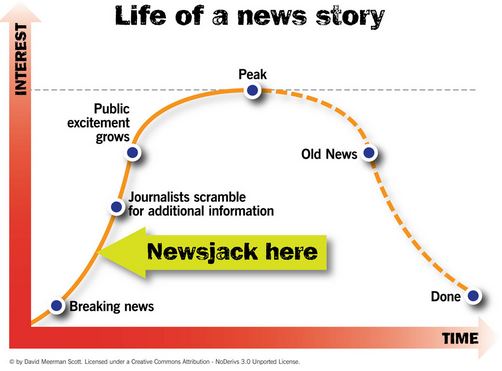
One of the leading developments in marketing has been the increased importance of content management strategies. With the proliferation of communication via the internet, companies of all sizes who are serious about engaging their target audience are looking to content as a significant tool. Clare McDermott, writing for the Content Marketing Institute today, took the opportunity to speak to to Amanda Nelson recently about how her organization creates content that is compelling, fresh, and engaging. Amanda manages content for Salesforce’s Marketing Cloud platform. Her job is to create and curate content for the Salesforce Marketing Cloud community. She manages everything from the blog and eBooks to webinars and infographics — with the help of a content team, of course.Newsjacking

Excerpts from Clare’s interview with Amanda appear below:

CMI: What issue do you think your content solves for your audience?

Amanda: Businesses want to become social, but they don’t always know where to start. What we do is create content to educate these organizations in the hope that when they are ready for social media monitoring, engagement, or publishing software, they will think of us. 

What kinds of content tactics are you using?

What we do is develop a content engine. A content engine starts with a central focus. In our case, it’s an eBook, but it could be a case study or any other piece of content that a company might have. From there, we publish the content by recycling and reusing it on multiple media:

  • We’ll read the eBook aloud and make it an audio book.
  • We’ll interview the customer for a quote in the eBook and then put that up as a video.
  • We’ll take the audio from the video and make a podcast.
  • We’ll create a presentation from the eBook with highlights.

What results have you gotten since you started using the “content engine”?

We’ve  had significant increases — about a 300 percent year-over-year increase in our eBook shares and downloads. I believe social shares of our blog posts increased by about 150 percent. What challenges have you run into?

A lot of people want to plan and curate, but at the end of the day, we need writers.. I sometimes have a need for (outside) writers..I’ll go out to the community and get guest bloggers. 

What’s your favorite tool used to communicate with the team?

We use Google Hangout because we’re actually all spread out across the country and Canada.. it is great because it’s video and it can hold up to 10 people. There are also fun things that you can do. You can do screen share or overlay funny faces. Whoever is talking is displayed predominately so it constantly changes. It’s in real-time, easy to use and free. The hangout is public so anyone else can join. People can see that you’re hanging out. It’s very social.

What are the most exciting examples of content marketing that you’ve see outside of your own business?

“News-jacking:” you see what’s going on in the media and they’re able to create content around it that becomes really shareable because it’s sitting where it’s hot. 

As you read through Amanda’s comments, take note of what she has done (with plenty of resources including a team of people) and think through how to interpret it and implement similar concepts in your business. We suggest the following:

  1. Think through your audience, where they hang out, and what your main message to each segment may be.
  2. Create a content engine that is your prescribed way of being consistent.
  3. Think about ways to use free, crowdsourced help for additional content.
  4. Investigate Google Hangout as a tool for enhanced collaboration.
  5. News-jack something interesting to supplement your original content. (Like we just did with this excerpt!)


Measure Marketing For Better Results

Marketing is the main subject of this week’s blog posts–in case you hadn’t noticed the pattern yet. One of the biggest challenges in marketing is to prove that efforts are generating results–and at a reasonable ROI to boot! We know that marketing can be used to initiate relationships–it is also about nurturing them and providing great leads to the sales side of the house. Being able to measure how much positive attention you are able to attract is key for a marketer to justify the marketing budget, and (in a recession, her role.)Mktg Dashboard

Leanne Hoagland-Smith, Chief Results Officer for Advanced Systems in Chicago, IL writes that,

With the Internet, the ability to measure your marketing efforts is far easier now than ever before. Websites can include Google Analytics or their own customized statistics dashboard. Then others sites and tools provide additional metrics to measure current marketing campaigns. Even WordPress has a plug by Yoast to measure Search Engine Optimization (SEO). This is a great tool for measuring the SEO effectiveness of your blog posts. I know because I have been using it for the last three years. 

Inbound Marketing Measurements

Each morning, the first action I take beyond deleting all the SPAM from my email accounts is to measure my inbound marketing through more than 20 metrics. Some of these measurements include:

• Unique Visitors to my website

• RSS feed from my website

• Twitter followers

• LinkedIn

• Alexa Ranking


Additionally, I also have another 10 weekly metrics plus another 15 monthly metrics.

I am currently expanding into delivering some webinars and Eventbrite provides additional statistics as does Citrix Go to Webinar. All of this data is crucial if I wish to use my limited resources of time, energy, money and emotions to increase sales.

..These numbers allow ..me.. to see trends, what is working ..and what is not working. The time investment averages around 10 minutes each day with another 10 minutes for the weekly data capture. At the end of the month, this adds another 20-30 minutes for updating and analysis.

Outbound Marketing Measurements

During the course of the last 10 years, I have identified some key benchmarks for the more traditional marketing efforts. For example, when I speak, I usually receive a client from that presentation within six months. Lately, that statistic has changed with two to four months being the average. What has also changed due to the economy is the average sales value of that client has dropped.

Another marketing effort was something I gleaned from Robert Middleton specific to sending pertinent articles to potential customers. When I employ this marketing campaign, my first time appointment rate is around 50 percent compared to the usual cold calling rate of 25 percent. As I am selective when I do engage in cold calling, my success rate is probably higher than most…

One simple action is to always ask how a potential customer discovered you. Sometimes these prospects will tell you without asking. Just this past month, I earned my first client from a YouTube video. Efficient and effective marketing is hard work. To not measure the efforts of all those actions is not probably the smartest course of action.

The role for small business owners have expanded to include measuring marketing efforts. Without knowing the results from all marketing efforts both inbound and outbound, the small business owners to even crazy busy sales professionals are missing significant opportunities to maximize their profits, reduce costs and increase sales.

As you look at what LeAnne does in her business, what ideas come to mind? Check out the tools she recommends. Determine your own marketing dashboard. Think through how to collect data, analyze it, and make adjustments. As you begin to apply some science to the art of marketing, you can calculate the metrics of success that drive revenues and profitability. Isn’t that why we all started businesses?