A Very Nichey Girl

It’s an old adage, but a true one, that “you can’t be all things to all people” without losing a strong connection to someone specific. In the world of marketing professional services, those who choose not to build an intentional, focused relationship with clients in a niche market segment do so to their own detriment.

Responding to a Jolt

Sally was employed by an AmLaw Top 100 firm about 10-15 years ago when the large firms were targeting vertical markets.  Her firm had targeted the CPA industry and Sally, with prior stints inside CPA firms, was eager to help develop the market.  When her firm shifted priorities from the niche, she had a decision to make.

Instead of trying to take firm clients with her, Sally  opened her own firm, to focus on regional accounting firms in the area where she had attended law school.  This strategic choice was effective for two reasons:

  1. It avoided even the appearance of trying to compete with her former firm, and
  2. It gave her an entree’ to a target group of profitable prospects not being pursued by others

Learning Competitive Advantage

For several years she continued to develop and deliver specialized services offerings tailored to CPA firms, such as partner compensation consulting, strategic planning, partner retreats, organizational restructuring and profit enhancement.  By the 5 year anniversary of being in business for herself, Sally had identified the need to build a team around her with scalable infrastructure that would allow her to focus on client service rather than firm management. She joined a regional law firm with about $7 million in gross revenue and six partners that had begin to see the revenue and profit benefits of pursuing highly specialized niche practices.

For the past decade, Sally has led the firm’s niche practice for CPAs and seen the firm grow to over twice the size it was when she joined.  By getting to know finance executives, CPAs, firms and the industry, she has been able to create a value-added service that goes well beyond compliance into unique complementary offerings.  By choosing to specialize and establish herself as a subject matter expert, she has enjoyed great success.

Not content to only be a service provider, Sally has taken on the coveted roles of a.) trusted advisor and b.) referral source.  Some say she “knows every CPA in town.” Her strong relationships have been maximized to win considerable business for her firm.  While others attend chamber and other networking meetings, she introduces CPAs she knows to firm partners according to their industries and areas of specialty.  Her efforts have developed into a solid channel of business development and referrals for her partners and clients.

Value Proposition

The highly specific niche has permitted the firm to win against many of the area’s most respected law firms that offer the usual corporate business and estate services.  Certainly, the firm can–and does–provide these at the highest level.  But Sally and her colleagues have positioned themselves beautifully – a focused, reputable law firm that can provide the usual suite of legal services and, significantly, knows the industry and its unique challenges and nuances, offering the experience and expertise to help the client become more successful.

Ultimately, specialization is offering a value proposition rather than a reduced-price commodity.  Under Sally’s leadership, her firm has added a tremendous value to traditional legal services by customizing their offerings to keenly understood market segments.

 

5 Ways ‘treps Maximize Mentor Feedback


Asking a mentor for feedback is a critical step in turning an idea into a successful business. Noted members of the Young Entrepreneur Council share how they feel ‘treps should make the best use of mentors below–

Draft a Summary

Entrepreneurs’ ideas are often most easily “felt” through passion and an intuitive belief that great potential awaits. When expressed verbally, however, the vision can be easily misunderstood. Avoid this by taking some time to write a concise, one-page Executive Summary that you can share with mentors you respect. This will ensure they understand your idea and offer relevant and quality feedback.

Kent HealyThe Uncommon Life

Time Is Valuable

If you’re in a mentoring relationship with someone who is also an entrepreneur, there is one thing that you both know is ridiculously valuable: time. Regardless of whether your next business venture is the greatest or worst idea you’ve ever had, keep the call focused to keep mentors in your life. Have an agenda and stick to it. You can make small talk later. Time is money; spend it wisely.

Sydney Owen3Ring Media

No Hesitation

While preparation is important in pitching a business idea to anyone, the best tip for asking a mentor for feedback is not to hesitate about it. Your mentors are there for you to bounce ideas off. Most mentors are thrilled when you come to them with questions or feedback solicitations, so don’t pause in engaging them in your project. They — and you — will be glad if you don’t wait.

Doreen BlochPoshly Inc.

One Small Step

They’re busy and smart, so treat them as such. Don’t ask for a long term commitment up front and don’t waste their time. Start with a short email with options you’ve thought of to a problem you are facing. Ask them to simply reply with which option they think is the best. Implement, thank them, and show them how their advice got you results.

Josh ShippJSP, Inc.

Ask For Specific Feedback

If you’ve chosen the right mentor, they have a wide body of expertise and experiences to draw on. Too many entrepreneurs present a lot of information to mentors and then ask something akin to, “What do you think about all this?” That gets nowhere. Better to have structured information and ask for specific feedback: “Is this key assumption realistic?” or “Is this an appropriate place to start?”

Charlie GilkeyProductive Flourishing


Start-Up Savvy: Taught & Caught

Image

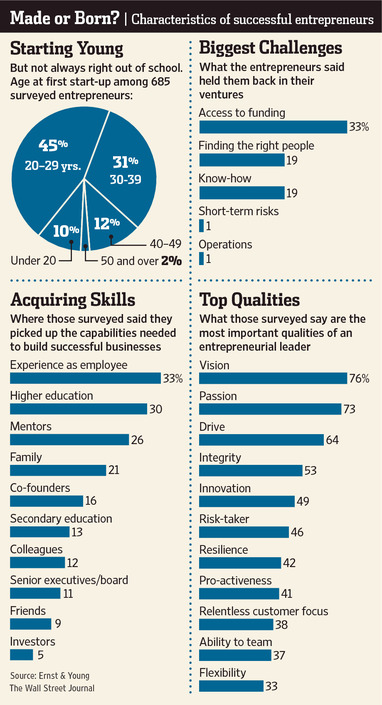
In an article last month entitled, “Can Entrepreneurship Be Taught?,” two sides of the argument were presented that, while equally valid, were at odds with one another. Noam Wasserman, Harvard Business School professor of Entrepreneurship and author of “The Founder’s Dilemmas: Anticipating and Avoiding the Pitfalls That Can Sink a Startup,” takes the position that too many founders have to climb the same steep learning curve as others before them, bereft of insights that could help great ideas become great businesses. Victor Hwang, co-author of “The Rainforest: The Secret to Building the Next Silicon Valley” and managing director of T2 Venture Capital in Silicon Valley, posits that only experience can teach an entrepreneur how to successfully launch a business.

Within the Wasserman camp are educators who believe that documented best practices and potential problem areas can be shared with the entrepreneurs. For instance, the idea that the founder must do the three following things has been challenged with research data to instruct otherwise:

  1. Following one’s gut
  2. Having a “glass half full” view about resources and time
  3. Stay in the top executive role as the company matures

Augmenting the classroom instruction with deliberate opportunities to “try out” a principle in a role play seem to yield good results. Additionally, self assessments are helpful in increasing one’s self awareness and ability to lead others. Notably mentoring is recognized as one of the best ways an entrepreneur can learn how to do the right thing in a myriad of scenarios.

What is also being learned is the need to not just offer principles of management (regardless the field of management–finance, operations, marketing, etc), but to also focus on the soft skills requisite to be an effective leader. Whether the entrepreneur is embracing better social skills, motivational techniques for self and others, or other facets of emotional intelligence, there are competencies to be gained that are simply not intuitive for most.

Hwang and the experiential learning community holds steadfastly to the conviction that entrepreneurship is taught rather than caught and is more of  an impartation than an education. Rather than the typical domain of business schools–resource allocation and risk management, it is argued that the necessary skills fall more into the following categories:

  • Comfort with a high degree of uncertainty
  • Willingness to become a generalist rather than a specialist
  • Abilities in inspiring others through storytelling and personal charisma

Since some programs are heading in the direction of trying to advise start-ups on what actions to avoid, Hwang is concerned that the willingness to try something unconventional may become minimalized. He and others believe that such a mindset is critical to entrepreneurial success. The main thesis behind Hwang’s proposed approach is that entrepreneurs would have the greatest chance of success if communities with resources, counsel and mentoring were available for their growth and development.

The common theme, then, is that mentoring and nurture is the best medicine for someone who “suffers” from entrepreneurial dreams. We wholeheartedly concur with this bottom line approach and advocate innovation centers (incubators with assigned mentors, education, and planned activities to build a sense of community) as a best practice!

Better Than Dilution & Debt

One of the most interesting websites we’ve discovered recently about entrepreneurs is called Under30CEO. Today the site featured an interview with Trevor Mauch, founder of AutomizeIt and Mach One Media, serial entrepreneur and founder of a few multimillion dollar businesses. Excerpted from the interview is the quoted section below:

One of the things I see a lot of people I’m coming across, they’re making the funding part (of entrepreneurship) out to be a huge deal [when it’s not.] As a great example…this guy was selling his linen [or garment] business services for hotels or whatnot. He bought his equipment for 500 bucks. And this guy bought this equipment, and then he went to the biggest account in town, which is our local hospital and said “what do I have to do to have your business?” (After he heard the answer,) ..he said “okay, I can’t do all of this capacity right now but if you fund $25,000 to get into a facility and to buy our equipment that can service ..what you need, then will accept this bid.”  …The hospital..it’s like (a) $15,000 – $20,000 dollar a month account! ..The hospital ended up going with this guy and funded the whole growth of his business!

..With two of my different businesses, …we saw what people wanted, and we went out there and pre-sold one of our training programs before it was ever created! We made sure that people wanted it, made sure it’s really quality, and we pre-sold to our customers, and our customers funded that startup.  And same thing with our software company.  We funded that company with our revenues from the publishing company, and same thing we went out there before we were finished. We pre-sold memberships in it and that help us get some cash to start that goal. So yeah definitely don’t look at funding as an obstacle because there’s a lot of different ways to get funding, especially from your customers, and sites like Kickstarter.

(At Kickstarter) anybody can go there and post their project, their business or products whatever their looking at launching. And they raise funds for their business by getting people to “pre-buy” whatever it is. So, I was last week and uhmm there’s this one [business], that was some kind an iPod speaker and so they had a prototype…they sold a prototype and said “that’s what you’re gonna get,” and they had a goal they wanted to raise, I think that one is about $50,000 bucks. And they raised their $50 grand in about 14 days after they started, just from people seeing this idea and jumping pre-buying one of the things from it!! And that’s just a killer model.

So, the moral of the story is…become creative in your approach to funding your business! It’s not necessary to run up exorbitant credit card debt, nor follow the angel-VC-dilution pattern. Mauch started his first business with $600 cash. Stretch your mind–think hard about how you can accomplish your objectives without copying someone else’s success path. You will be so happy you did when it’s your turn to be interviewed.

Bureaucracy: The Entrepreneur’s Kryptonite

As Dan Sullivan says in The Strategic Coach® Program, “The human brain cannot do extraordinary things, only normal things.” “So the trick,” he says, “is to make the extraordinary normal.”

Corporate employees operate based on policy: that’s what keeps them from having to think. Entrepreneurs depend thrive on having the freedom to constantly grow and change, to make new connections, and to ask questions that shake everything up. To an entrepreneur, groupthink (i.e. bureaucracy) is like Kryptonite.

Just because we don’t like being bogged down by over reliance on structure doesn’t mean that we are always creative. Following established patterns and trying to approach every issue with the same solution is a bad habit even for an entrepreneur. Rather than seeing opportunity, we can become fixated on solving a problem.

When Jim Collins wrote about Big Hairy Audacious Goals (“BHAGs”), he was challenging small thinking. Simply considering an aggressive goal causes the mind to see the environment differently. Unable to stop thinking about the “What ifs,” we are empowered to consider new concepts,  linkage and alternative ways of viewing the same issue. Divergent thinking is modeled by the likes of Richard Branson, who tweeted, “My interest in life comes from setting myself huge, apparently unachievable challenges, and trying to rise above them.”

Your definition of “normal” daily experience becomes unique when you think in terms of BHAGs.  Dream for a moment about what life could look like in 5-7 years. Can you imagine performing at 10x today’s level? Earning 10X what you do today?

Bureaucracies are based on keeping everything the same so they can preserve their status. Policy and rules “protect” the structure from the effects of individuals, whose participation is measured in hours on the clock, not in results. In an entrepreneurial organization, by contrast, change is life, because “holding your ground” means stagnating and falling behind. Individuals are sought out and rewarded for their ability to think, create, and make a unique contribution.

Make a habit of  what Sullivan terms the “10x Mindset,” and innovation, risk-taking, and teamwork will all come together for you in a completely new way. Bureaucratic thinking and structures simply won’t survive in your environment because you and the people around you will be entirely focused on building, adapting, and expanding a path toward your “bigger future” vision.

Cultivate a creative mindset that makes growth and progress “normal.”