Rainmakers Outperformed By Personal Marketing Plans

Fundamentally, successful business development occurs when a professional has superior understanding of what a target client needs. To arrive at such enlightenment, the service provider has honed time-tested skills. The most successful ones have been very deliberate and intentional about the emphasis placed on the soft skills that wonderfully complement the technical acumen. In times past, such requisite skills for success were imparted through mentoring. However, the pressure to generate greater billings and profits today distracts mentors from their charge.

                Why not outsource a mentor like other business functions have been outsourced? In fact, why not become very specific and outsource a business development mentoring service that teaches your staff how to become inspirational? If succession planning is about identifying capable replacements, preparing them to assume a more executive role and helping them earn the following of others, then organizations should pay more earnest heed to it! Within the preparation of staff for leadership, it would be argued that business development is not learned through osmosis (years on the job). The skillset that makes one inspirational/capable of developing business is definable.

Inspirational employees are respected, admired, and well-known. Let’s say that respect means that one is competent, as evidenced by subject matter knowledge, a displayed ability to lead others and self-controlled. Admiration may then be construed as being expressed towards those who are consistent, fair and care about the well-being of others. One cannot be inspirational if no one knows in what context, how often, in what ways and to what constituency the inspiration is directed.

Do your employees have a plan to become respected, admired, and well-known? To refute the counterargument that some do not aspire to become well-known, I simply posit that unknown service providers do not enjoy the opportunity to serve significant clients. As for the aforementioned plan, we have heard of personal development plans (PDP). If the PDP is meant to address one’s emotional intelligence, then what plans are in place to help staff:

  • Become a subject matter expert?
  • Learn how to discern client needs?
  • Become referable?
  • Network more effectively?
  • Promote their personal specialty?

Savvy service firms empower their key staff to become inspirational leaders by helping them to produce a Personal Marketing Plan (PMP) that includes the PDP and the items listed in the bullets above. The PMP becomes the backbone of a succession plan, onto which other ligaments, tendons, and muscles familiar to HR executives can be attached. It is probably best developed by an outside third party who has no emotional ties to anyone internal to the organization and can objectively help staff develop and implement the Plan.

Organizations that are serious about the PMP have multiple Rainmakers and a system to produce more. Performance objectives and compensation systems can then be tied into succession management as all share the responsibility to grow personally and corporately.

Let’s become inspirational!!!

Personal Marketing Plans Outperform Rainmakers

Organizations that depend on their staff to only fulfill orders are short-sighted. Whether those orders are for products or services is not the issue; how they are sold is what is critical. Let’s assume for the moment that products are sold through a variety of sales channels and that services are primarily sold face-to-face. It is not uncommon for the services organization to have an aversion to using the term “sales” because it seems transactional. So, in an all-out effort to avoid being “salesy,” cloaked in a mantra that one’s organization is only concerned with great customer service, services firms create a culture that is averse to engaging new prospects.

There are, however, exceptions to most every business “rule” or stereotype. Enter The Rainmaker. The Rainmaker is both the organization’s greatest asset and liability. Employees understand that the creation of need for their intellectual contributions is usually a feat reserved for The Rainmaker. With considerable aplomb, this individual networks with ease, establishes strong referral networks, is well-known and is most appreciated by those who have a fear of ever being asked to copy what she does.

                When organizations rely on The Rainmaker—be that one or multiple—to generate enough work for everyone else to be paid competitive wages regardless of whether they ever successfully bring in a new account, they create a long-term liability. Like the temptation to live large off credit cards today in one’s personal life or to distribute earnings and share profits but not reinvest into a business, this practice of overreliance on The Rainmaker is precarious. Reckoning Day will arrive and most organizations realize that they have created a monstrous succession problem. Some are successful in delaying the inevitable by hiring a business development professional (read: salesman in any other context) who augments current revenue growth, but is not a viable replacement of the DNA of The Rainmaker, who is usually a 40 plus year old equity owner of the company.

Why is it that an executive who has strong technical skills is perceived as even more valuable when possessing business development skills? Is it because the firm administrator has calculated the number of employees that The Rainmaker can keep employed? While revenue generation and the ability to cover overhead expenses are important to success in business, this is not what sets The Rainmaker apart. Rainmakers are special because they inspire! The inspiration comes from fulfilled promises, a sense of hope and optimism and the ability to understand client needs.

Annihilated by Apathy

The story is told of military training (whether true, or no, is immaterial–the principles are sound) wherein the new soldiers are placed in a simulation. Within the war game being played, they are told  that three snipers are crawling towards them through tall grass. The snipers are live soldiers who have been trained for their role in the exercise; the “bullets” to be fired are blanks. As the defenders wait for the attack, a  figure pops up across the field suddenly and is fired upon with full force. Closer to the defenders, another attacker pops up and the newbies direct their attention to the target. Immediately thereafter, the entire platoon is taken out by hand grenades thrown by the third attacker, who had been sneaking towards them and was able to obtain a close position undetected.

Because the platoon failed to recognize the immediate threat closest to them they lost an insignificant, yet instructive battle. Similarly, as business owners and managers, we have as our most important target the existing customer base. If these folks go somewhere else, collectively they can “upset the apple cart” of business success.

Since most businesses don’t have an offering that is clearly superior to the competition, they must focus on how they provide goods or services as a differentiator. If your organization has a great quality control system to make sure jobs are done to standard and timely, but the customer is not aware of your system, you are missing a great opportunity to connect with what’s truly important. Or, maybe your efforts to simplify the ordering process have not seen the return you hoped because the customer doesn’t yet know. Educating customers about what they are receiving for the money is good business!

Ike Behar is in the men’s clothing business. While this line of work, like many, faces pressures from abroad and tries to avoid commoditization, the way the company differentiates itself is far from apathetic. Taken from some of its promotional materials about men’s dress shirts, the statements below will show you: a.) how Behar stakes a claim for competitive advantage and b.) the type things you need to be able to say about your business that will matter to a prospect.

  • There are 52 steps involved in making one of our shirts. Each shirt sports an authentic split yoke, removable collar stays, and button sleeve pocket.
  • Handkerchief-rolled seams. This tailoring technique prevents puckering and produces and elegantly finished shirt, with added durability.
  • Buttons. We carefully match our buttons–ranging from mother-of-pearl to unbreakable plastic–to complement the fabric and style of each shirt. A spare button is sown into the tail of every shirt.
Behar lists many more, but these should give you an idea of what is helpful to get your point across. (With thanks to Jaynie Smith, who literally wrote the book on Creating Competitive Advantage.)
You can see the threat in the grass, but what are you going to do?


Consultative Solutions Beat Hard Closes

In times past, “good” salespeople  had a method to close out a meeting with a prospect that was successful in getting them to “sign on the dotted line.” In some industries, the sales function is described as business development because of stereotypes of sleazy salespeople who use high pressure techniques to cajole an uncertain buyer into a (sometimes regrettable) decision. This is especially true in business services firms, where there is a stigma in many cases about seeking out new business at all.

The biggest development of the past few decades has been the consultative selling approach. Yet, even this shift is not satisfactory for people who just do not like the word “sales.” When I have been working alongside attorneys and CPAs, for instance, the terms “client development” or “business development” are much preferred. In general, these practitioners provide offerings that have long sales cycles or are perceived as commodities. So…to unlock the motivation of my clients to do the development that is needful for practice growth, I usually have a series of conversations and trainings around the concept that client service requires a similar approach. Few argue that client service is needful.

Rich Grehalva writes and speaks about the array of sales/business development models:

CLOSING SALES MODEL
The 1950’s introduced this model, which concentrated on the product being heavily emphasized.
Key Elements:
✗ Presentation Skills
✗ Trial Closing
✗ Overcoming Objections
✗ Final Close
This model is still in use today, usually in high-pressure sales.

PRODUCT/SERVICE PUSHING THROUGH
PERSONALITY, PERSISTENCE AND PRICE
➲ The salesperson is tenacious, persistent and usually has a low-cost item and works on a numbers game.
➲ The natural born salesperson enjoys interfacing with people and usually has an engaging personality.

RELATIONSHIP SALES MODEL
➲ The salesperson builds a relationship, over time, with repeated visits.
➲ The buyer and seller get to know each other on a personal and professional level.

PROBLEM-SOLVING SALES MODEL (1960’s)
Focusing on:
➲ Open-ended questions – Role-playing is used with students to get them to understand how to get clients or prospects to talk about the things that are important to them.
➲ Closed-ended questions – Closed-ended questions require a yes or no response.
➲ Listening skills is a key component.
➲ The salesperson takes the information and then presents solutions.

VALUE ADD SALES MODEL (appeared in late 1960’s).
Price objections raised by the “Problem-Solving Sales Model” can be countered by adding additional services. In this way, adding these services to the base product/service gives a perception of the value received versus the price.

CONSULTATIVE SALES MODEL (surfaced in early 1970’s)
➲ Determines how to lower the clients costs and/or
➲ Determines how to increase the client’s revenues The company requires a depth of understanding of their clients’ business, as well as a solid track record in delivering proven results. Start-ups find it difficult to compete in this
type of sales model.

PARTNERING
This model became the buzzword used by salespeople–not in creating a legal entity, but in building a joint plan for
creating an opportunity. The sale is conducted at the highest level of the company and an output is a business plan
targeted at a niche within the clients’ market. The term partnering became highly overused and misused. Clients and
prospects soon tired of hearing the word.

TEAM SELLING MODEL
Though not new, the Team Selling Model became increasingly more integrated into the sales model. The salesperson
in this model must coordinate all of the activities within the organization and external to the organization, in order to
win the business.

COMPLEX SALES MODEL
✗ Large ticket sales
✗ Multiple decision makers
✗ Extensive coordination, both internal and external
✗ Long lead times
The role of the salesperson involves taking on a strategic role in developing win themes, internal politics, competitor
analysis, and legislation, as examples.

It is important to think about your client base, your reputation and brand, your team–whether they are salesmen or technical people who happen to need to bring in business, and what your goal is. (Hint: a sale that is undone a year later when the client is not retained is not an accomplishment.) In general, it is best to educate and involve the prospect, help them feel good about choosing your company, and guide them through letting the current provider go. When we consistently approach prospects with consultative solutions rather than hard closes, then we are developing business rather than selling.

Resist the Urge to Resist Change!

Innovation is a word that is bantered about unwittingly by many. From its Latin root, it generally means to renew or change. Yet, many reduce innovation to invention—as in product-specific concepts come to fruition and production. If we faithfully apply the definition, innovation may be seen to pertain to any ideas to effect positive change that go from origination to transformation to implementation to systemization within an organization.

To make the mental transition from viewing innovation as invention to what it really is, one must see innovation as culturally transformative. What was can no longer be what is, and certainly not what shall be. Change is hard for many people. Making a commitment to continuous change can be downright overwhelming. Yet, choosing to take action when others are stagnant can create tremendous strategic advantage. Look at Steve Jobs and Apple after the dotcom bust of the new millennium.  As others shrank from R&D, fearful that the technology boom was forever dead, his group increased investment in innovation and they have prospered for it. Think Apple and technology are an isolated company/industry? Explain away the following mix of companies founded during poor economies: Disney, CNN, Hyatt, Burger King, FedEx, Gillette, AT&T, Merck, Coors, IHOP, Fortune, GE, and the Jim Henson Company.

During the agricultural age, the asset everyone wanted was land and the critical success factor was yield. Agriculture gave way to industry with manufacturing and processing facilities and their efficiency defining success. As information became a greater commodity than industry, computers and their speed became the yardsticks. Today, in the creative age, innovation is the key asset and, as a means of differentiation, determines ultimate success.

If your organization is to remain/become competitive in the current world economy and proliferation of information sharing, it is unlikely to do so without making a commitment to continuous improvement. Again, so as to not confuse this phrase with the Deming’s work in documenting kaizen approaches to manufacturing in Japan, let’s define what is meant. We are speaking here of a core value within an organization to not accept the status quo—to not become complacent.

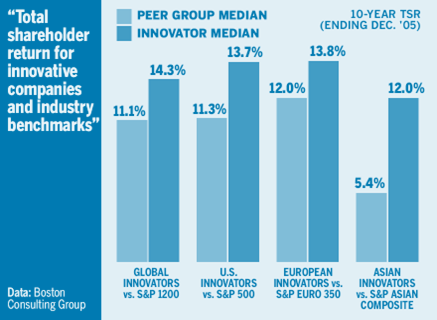
In a Business Week survey conducted in conjunction with the Boston Consulting Group in 2008, it was noted that total shareholder return (TSR) was greater over a three, five, and ten year period among business model innovators versus their industry peers.  Notice that it was those who innovated their business model rather than those who tried to hold onto their old one who prospered! TSR was greater among global innovators than the S&P 1200, greater among U.S. innovators than the S&P 500, greater among European innovators than the S&P Euro 350, and greater among Asian innovators than the S&P Asian composite.

“Wealth flows from innovation not from optimization.  Wealth is not created from perfecting the known, but imperfectly seizing the unknown.”

-Kevin Kelly, founding editor of Wired


In 1989, Smith Corona had annual sales of $500 million, producing typewriters. Word processing and computerization overtook their market position and they could not innovate fast enough to ride the wave. Jeremy Gutsche of trendhunter.com says, “Be wary of your strengths; success leads to complacency.” He maintains that, over time, most people stop trying. Need convincing?

  1. “We own that market.”
  2. “He’s been a client forever.”
  3. “She’s already my girlfriend.”

Gutsche cites each of these statements as examples of a pervasive attitude of entrenchment. Since most people are risk averse, we have learned to polish the “spin” on our actions and speak glibly of “tweaking” and “optimizing.” Instead, successful people and organizations must learn to pursue that which is splendid, unique, and paradigm-changing.

The secret, though, is to not just produce an innovative product or service; to not just culturally innovate, but to commit to innovation and change continuously. Daunting? You bet it is! How can you lead yourself and others to protect the value that innovation has created? How can change be “maintained?” This is a rhetorical question—it can’t! Change cannot be maintained—it must itself be changed to remain responsive, relevant & vibrant!!!