Lead Me – Don’t Manage Me!


“People don’t want to be managed. They want to be led. Whoever heard of a world manager? World leader, yes. Educational leader. Political leader. Religious leader. Community leader. Labor leader. Business leader. They lead. They don’t manage. The carrot always wins over the stick. Ask your horse. You can lead your horse to water but you can’t manage him to drink. If you want to manage somebody, manage yourself. Do that well and you’ll be read to stop managing. And start leading.”

-Printed by United Technologies Corporation in the Wall Street Journal

One of the most heated conversations we had in the MBA program at Elon (ranked #1 part-time program in the USA) was over the value of management versus leadership. One of our courses was in organizational leadership and many of the younger students did not enjoy the finesse and nuances of the subject matter. They wanted to stay in the realm of concrete, numbers driven topics wherein there is a clear cut “right” answer. Leadership, for people who have not held positions with substantial responsibility, is challenging to describe, pursue, evaluate, and articulate. Management, on the other hand, was easier for the cohort to articulate in terms of metrics and definitions that met with consensus.

Whether in class or on the job, very few people want to be managed per se, they would prefer to be led. Managing is a process better applied to resources rather than individual people. Even in our home lives, when we are trying to get our children to do the right thing, it is incumbent upon us as parents to inspire them to make good choices. Inspiration is one of the key results of leadership.

Cynthia Stewart, writing for the Lead Change Group’s website last week, made some keen observations about the dichotomy between management and leadership:

“One specific example of what I am talking about comes to mind that illustrates this perfectly.  In fact, I was speaking with a President of a company today and she mentioned the same example.  Most of us have been part of a United Way campaign.  In the early days, these campaigns were delegated to management to run.  Typically management would take the tact of talking to their employees about the importance of being a good citizen and helping to fund helping agencies so their patrons could have a hand up (effectively trying not to appear to strong arm you into giving so that the company goals could be met.)

Then, one year things changed.  The leaders asked for employee volunteers to lead the campaigns. Everyone couldn’t wait to show up to the next new event, and attendance and giving doubled and tripled.  You saw people showing their true talents, coming alive, doing things you had no idea they could do.  The fun quotient spiked, the giving exceeded goals, employee morale improved, and the new office stories were accompanied with more laughter.   Hmmm – no management in the picture.”

Stewart’s commentary reveals a gap in thought leadership. Many Millenials are misunderstood because Boomers think that they are too revolutionary and almost insubordinate. That’s because many in management are not leading them; they are trying to only tell them what to do. My experience with the younger generation is that they are in search of authentic leadership.

How can we individually and collectively make a commitment to leadership?



Entrepreneurs Have Not Because They Ask Not

The world of entrepreneurship is becoming more divided almost daily between the “haves” and the “have nots.” In this context, we would be referring to technology. Whether a start-up is seen as a technology company or not is determining not only valuations, but access to resources. One of the more common resources available to tech companies that “have” what others presume it takes to cash out somewhere in their trajectory for a very favorable multiple is an incubator, increasingly referred to synonymously as an accelerator.

Until very recently, these accelerators extract an equity position in the start-up company’s cap table in order to justify the risk of helping them for very little compensation up front. Most tech entrepreneurs learn to play the game this way and progress through the angel–Series A–Series B–etc process if they hit their milestones. But…the “have nots” bristle at the model and try to create worthwhile businesses without giving up equity. Unfortunately, they also try to go without mentoring and systematic instruction–to their detriment.

There is an emerging trend toward fee-based offerings that is on the horizon. Organizations like EntreDot, with a fashion innovation center and an industry agnostic innovation center in downtown Cary, NC, prefer the fee-based “pay to play” model. The premise is that a Main Street entrepreneur (otherwise known as “have not”) needs access to resources just like a tech start-up. In order for the innovation centers to provide services like instruction, mentoring, and space, they charge the entrepreneur on a “pay-as-you-go” basis. While this may be an affront to the typical “have” start-up mentality, it meets with less resistance among “have nots.”

Leaders of accelerators around the country who are trying to convert to more of the fee-based services model point to the fact that competition is stiffer than ever to get into the top  accelerators and too many entrepreneurs are being left by the wayside, just as the “have nots” have been for a longer period of time. What the newly disenfranchised and ignored sectors of entrepreneurship have in common is that they are trying to figure out how to commercialize an idea.  They each need help to do so!

Alexander Taub, the director of business development at the Des Moines, Iowa-based mobile-payment network Dwolla, spoke recently with Lauren Cannon for an article on the topic for Young Entrepreneur. Really young companies that aren’t necessarily ready for the big time may not benefit from accelerators, he says. Still, Taub does use General Assembly’s offices, which serve as Dwolla’s NYC home base. The value from using the co-working space stems from connecting with other companies that are also being incubated there, he says. “That’s definitely worth it… We’re part of the community.”

Plus, the experience might be worth paying a little extra for. At the Cary Innovation Center, less than six months of involvement has lead to strong growth for its initial two residents, Shelten Media and the CaryCitizen. Shelten saw an increase in billings of over 60% in her first 60 days and is now looking for larger space at the Center. CaryCitizen has seen their staff grow from two to five people as advertising revenues have increased. Both companies appreciate the value of the mentoring, but are committed to the program due to the cross pollination occurring among the residents. While it is definitely a significant and personal choice to decide to become a part of an accelerator (or innovation center as EntreDot calls theirs), the proof is in the results. As long as those serving the participants help them achieve desirable results, they will enjoy helping both the “have nots” and some who would otherwise be in the “have” category.


It’s the Emotions, Stupid!


Have you ever seen a scenario like the following play out? Someone new joins the company. After the newness wears off, the new hire finds someone with whom he can identify and begins “sharing” concerns about the workplace. The things he brings up, purportedly, are meant to help. After a while, the observations being offered shift from seemingly inane to almost accusatory about other members of the team. Eventually, the newbie may feel emboldened to make suggestions about hiring, firing, and everything in between as though having the authority and credibility to make such changes.

Over time, the positive culture in your department or broader category begins to turn negative at times. Other staff members come to you as a manager and let you know that they, too, have been approached by the newbie with complaints.  At this point, it is not uncommon for us to feel embarrassed, frustrated, or angry about what’s happening. We can become justifiably fearful that one person is poisoning many others. Like a contagious disease, negativity can soon permeate an organization if unchecked.

Even when organizational performance is sky high, a pervasive negative attitude can sap your group of the energy needed to sustain success. Emotions are an important part of the workplace–on both good and bad ways. Many of us have been victims of horrid customer service from employees of organizations who clearly do not enjoy what they do for a living. Contrastingly, we all hopefully have had the experience of a “Ritz Carlton” type experience where the employee loves serving customers.

Tony Schwartz, writing for the Harvard Business Review Blog Network, decided to let go of (just such a) negative executive, “both because he’d lost the trust of our team, and because I didn’t believe he was capable of changing. The day I made the move, it was as if a cloud had lifted and the sun came back out.”

Lessons Schwartz took away from this experience:

  • The emotions people bring to work are as important as their cognitive skills, and especially so for leaders.
  • Because it’s not possible to check our emotions at the door when we get to work — even when that’s expected — it pays to be aware of what we’re feeling in any given moment. You can’t change what you don’t notice.
  • Negative emotions spread fast and they’re highly toxic. The problem with the executive we let go was not that he was critical, but rather that he was so singularly focused on what was wrong that he lost sight of the bigger picture, including his own negative impact on others.
  • Authenticity matters because you can’t fake positivity for long. It is possible to put on a “game face” — to say you’re feeling one way when you’re actually feeling another — but the truth will ultimately reveal itself in your facial, vocal, and postural cues. We must learn to monitor and manage our moods.
  • The key to balancing realism and optimism is to embrace the paradox of realistic optimism. Practically, that means having the faith to tell the most hopeful and empowering story possible in any given situation, but also the willingness to confront difficult facts as they arise and deal with them directly.

In working with organizations on development issues and advising them on strategy, I have found that emotions are often the elephant in the room, undiscussed but omnipresent. For this reason, I often lead workshops on the topic of emotional intelligence (EQ).  When it comes to high potential leaders, EQ mentoring can help change behaviors and create a more healthy environment in which better decisions are likely to be made. 

Due Diligence Must Include Culture

60% of mergers, acquisitions, and joint ventures fail to perform up to expectations in their first year, often because of cultural incompatibilities between the two prospective partners. The losses in shareholder value are in the hundreds of millions of dollars in many of these star-crossed liaisons. Cultural Due Diligence is a technique for keeping both eyes wide open when approaching an attractive prospect, whether for a merger, joint venture, or offshore vendor.

-Wayne State University, Institute for Information Technology and Culture

When two companies agree to join forces in some type of agreement, cultural fit is usually the last factor considered-if at all! Instead, many numbers are crunched, recrunched, and analyzed ad nauseum. Market impact, anticipated back office savings, etc receive the lion’s share of the secondary consideration after financial statement items. “Culture” is perceived as too soft an issue to justify the time and attention of high-powered executives. Big mistake!

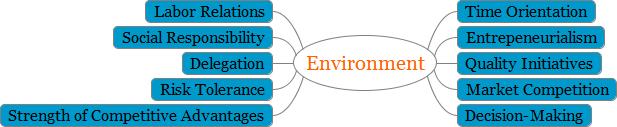
At the very minimum, the operating environment and organizational structure of each entity needs to be explored. When we are working with a client, we use the following two charts to help us ask solid questions about these two components of culture. From the answers received, we make value judgments and recommendations as to the degree of “fit” between organizations and what to do about it.

In considering the operating environment, we look at whether the company has a long-range or short-term approach to management. We ask questions to determine whether the organization is more entrepreneurial or bureaucratic. Quality initiatives are a good indicator of what aspects of performance are most important to management. The degree an strength of market competition for each party is important. How decisions are made is another leading indicator of what it may be like to work alongside the other team.

How management handles relationships with employees, (unions), and contractors is important to search out. Is giving back to the community and having respect for the environment a value of the other organization? Do meaningful tasks get delegated effectively, or are there barriers to professional development , shared responsibility, and growth through the contributions of many? Discovering how the other party perceives risk and builds strategy accordingly is a key conversation. When one’s competitive advantages are articulated, it is vital to verify how strong they are in the eyes of the buyers.

In addition to the operating environment, it is critical to understand the organizational structures that represent the philosophy of your intended. Do employees have direct access to top executives, or must they work through a layered management team? Understand whether the employees feel that they are protected to the point of not being allowed to make any mistakes. Examine whether generalist skills are valued versus everyone having a narrow scope. Look at the board of directors to see whether it is comprised of objective, strong leaders. Pay attention to the diversity of the employees and management team.

If the other company has a multi-office system, is it managed out of corporate, or are those in the field given autonomy? Notice whether task or relationships seem to carry more weight. Analyze the turnover rate among management and key positions. Is the human resources department deep enough to undertake complex issues like training and development, talent management, succession planning, coaching and the like, or compliance focused? Ask for examples of how technology is used to solve problems and enhance work flow.

The careful review of these “soft” factors can save you some headaches and hardships–do it! (We would love to help.)


Prepare Yourself to Become an Entrepreneur

There are two divergent schools of thought about whether entrepreneurs should get big company experience before starting a new business.  Some feel that learning how to run a department or project is a good training ground for managing a company. The argument is that entrepreneurial lessons are costly and it is better to learn “on someone else’s dime.”

Dave Lavinsky (the founder of Growthink), in an Inc magazine article, did start out with a corporate career, but feels it’s a bad idea:

Sure, you can learn some things from big companies–mainly how to run a big company. You’ll learn the type of corporate structures that are needed and the key departments, etc. But most of that doesn’t help you when you first start a company. For that, you need to think very differently. You need to think and act like an entrepreneur, which is the art and science of accomplishing more with less (less money, less human resources, less time, etc.)

Big companies are not great at accomplishing more with less, nor are they great innovators. So it’s very easy to pick up bad habits that actually make it harder to start your own business.

While the highly creative type can come up with an idea, it is often said that strong technical capabilities don’t necessarily translate to management and leadership abilities, let alone other significant soft skills requisite for successful start-ups.  General management/ jack-of-all-trade knowledge usually only comes through experience.  This factor prompts delving into how an entrepreneur can find the necessary experience to be successful. Lavinsky says, 

One option is to find a slightly older co-founder who has more managerial experience. Another option is to form a Board of Advisors consisting of several experienced entrepreneurs who lend guidance and advise. Another option is to raise funding and use it to hire several seasoned managers to help guide you.

If these options–either separately or pursued in concert with one another–seem daunting in terms of how someone with no prior business experience could feel qualified to identify and select such input, then there are other ways to gain experience besides working for a big company. One is to work for a VC-backed start-up. Another is to work as an independent sales contractor. Regardless of the type company that you may ultimately start, learning how to overcome rejection and meet quotas is going to be very important.

In summary, most successful entrepreneurs feel as though big company experience is incongruent with the skill development necessary to become a good entrepreneur. Yet, either by association with others possessing experience who join your start-up, or by acquiring skills before start-up, every entrepreneur can prepare.