Start-Up Savvy: Taught & Caught

Image

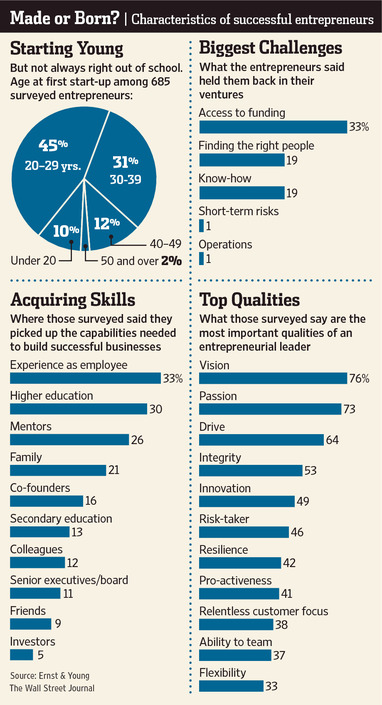
In an article last month entitled, “Can Entrepreneurship Be Taught?,” two sides of the argument were presented that, while equally valid, were at odds with one another. Noam Wasserman, Harvard Business School professor of Entrepreneurship and author of “The Founder’s Dilemmas: Anticipating and Avoiding the Pitfalls That Can Sink a Startup,” takes the position that too many founders have to climb the same steep learning curve as others before them, bereft of insights that could help great ideas become great businesses. Victor Hwang, co-author of “The Rainforest: The Secret to Building the Next Silicon Valley” and managing director of T2 Venture Capital in Silicon Valley, posits that only experience can teach an entrepreneur how to successfully launch a business.

Within the Wasserman camp are educators who believe that documented best practices and potential problem areas can be shared with the entrepreneurs. For instance, the idea that the founder must do the three following things has been challenged with research data to instruct otherwise:

  1. Following one’s gut
  2. Having a “glass half full” view about resources and time
  3. Stay in the top executive role as the company matures

Augmenting the classroom instruction with deliberate opportunities to “try out” a principle in a role play seem to yield good results. Additionally, self assessments are helpful in increasing one’s self awareness and ability to lead others. Notably mentoring is recognized as one of the best ways an entrepreneur can learn how to do the right thing in a myriad of scenarios.

What is also being learned is the need to not just offer principles of management (regardless the field of management–finance, operations, marketing, etc), but to also focus on the soft skills requisite to be an effective leader. Whether the entrepreneur is embracing better social skills, motivational techniques for self and others, or other facets of emotional intelligence, there are competencies to be gained that are simply not intuitive for most.

Hwang and the experiential learning community holds steadfastly to the conviction that entrepreneurship is taught rather than caught and is more of  an impartation than an education. Rather than the typical domain of business schools–resource allocation and risk management, it is argued that the necessary skills fall more into the following categories:

  • Comfort with a high degree of uncertainty
  • Willingness to become a generalist rather than a specialist
  • Abilities in inspiring others through storytelling and personal charisma

Since some programs are heading in the direction of trying to advise start-ups on what actions to avoid, Hwang is concerned that the willingness to try something unconventional may become minimalized. He and others believe that such a mindset is critical to entrepreneurial success. The main thesis behind Hwang’s proposed approach is that entrepreneurs would have the greatest chance of success if communities with resources, counsel and mentoring were available for their growth and development.

The common theme, then, is that mentoring and nurture is the best medicine for someone who “suffers” from entrepreneurial dreams. We wholeheartedly concur with this bottom line approach and advocate innovation centers (incubators with assigned mentors, education, and planned activities to build a sense of community) as a best practice!

Better Feedback Models

Traditionally feedback has been seen as occurring externally between a customer and a provider and internally as flowing from a manager to a direct report. Many changes in the work environment, including self-directed project teams, matrix management, flat organizational structures, and doing more with less resources, lead employees to work more closely with one another and become less dependent on management to provide them with feedback.

The Feedback Cycle graphic below illustrates that, these days, we must recognize that feedback – from project team members, peers, and direct reports – is the primary way to give and provide information and suggestions to each other to improve work output and performance. We must also be certain to listen for emotions and feelings as part of the feedback process. Whether your role is within a multinational corporation or a small start-up, the need to look around you 360 degrees and see yourself and your work product as others see it is critical to charting your own and team success.

Within the field of emotional intelligence, there’s a best practice of trying to see matters from another’s perspective. It is in this ability to “be on the outside looking in,” observing our decisions as a series of choices based on information we have processed, that we gain insight, perspective, and mutually desirable outcomes. Intentionally studying how our actions will affect others, asking for their input, and incorporating a “win-win” scenario into our decisions makes for better management of self, projects, and others.

In the start-up world, the Feedback Model can be used to test and validate “fit” with co-founders, employees, strategic vendors, investors, professional services providers, and so on. If the other party is not incorporating your input into their communication, planning, and execution, they are not a good fit. Likewise, if we are not able to receive feedback from others, we will not be successful in executing our business/departmental/project strategy.

Successful Business Plans: 5 More Keys


EntreDot Executive Director Bill Warner wrote a blog post this week for the Raleigh Emerging Designers Innovation Incubator website about business plans. In it, he shares keys to success.  Yesterday’s post here dealt with 5 keys; 5 more are offered below:

“Have a compelling value proposition.”

  • Solve a truly important problem with an attractive return on investment.
  • Make sure it fits into your buyer’s priorities.

The Challenge: You must fit within your buyer’s priority list for planned purchases. The benefit of your product has to be at the forefront of your customer’s needs. The best way to express the value of your product or service is to present a return on investment (ROI) analysis. You should be providing either higher revenue or lower cost/expense, and it should take less than a year to pay the investment back. Anything else is probably a “nice to have,” and is unlikely to win in a market where buyers are only purchasing “must have” solutions.

“Have a targeted marketing plan.”

  • Know how to reach your buyer to gain awareness
  • Establish a cost effective lead generation plan

The Challenge: Select the right way to deliver your message to your potential buyer: advertising, trade articles, mail or email campaigns, telemarketing, distributors, value added remarkets, dealers or direct sales force. Many companies are over-reliant on franchises as offering a silver bullet strategy for support and getting started. They don’t sufficiently analyze what the franchiser brings to the table that you can’t do for yourself. Franchisees sometimes over-estimate the value of the support from the franchiser; in that, is it worth the franchising fee and the royalty payment? Can those costs be made up by efficiencies offered by the franchiser? Can those costs be passed on to your customer? If not, the franchisee is at a competitive disadvantage. Those with a “brand” that can bring customers in the door on “day one” and provide active business operation assistance, rather than arms length promises, are particularly worth looking into. Once you have generated qualified leads, manage them through the entire sales process.

“Create the most efficient sales channel and excellent customer support.”

  • Ensure the sales approach is affordable
  • Build satisfied customers

The Challenge: Establish a sales forecast. Hoping for sales is not planning. Sales forecasts are based on understanding the buyer in your selected market segment and on the experience of others in it. Many new companies underestimate the time it takes to build a business to the point where it is profitable. As a result, many new businesses are under-financed and have insufficient working capital to sustain themselves in the initial growth period or during seasonal downturns. Being new and small is no excuse for cutting corners in dealing with customers. Would you go into a shop in the mall with cheap looking furnishings and lighting? Don’t try to save money there. Your sales and support efforts should be guided to create a satisfied customer who is willing to be a reference to other potential customers and give you repeat business as well.

“Understand your entire financial model.”

  • Establish realistic sales, cost, capital and expense plans
  • Understand cash flow and profit dynamics

The Challenge: Establish a solid financial plan. Many new companies are unplanned or under-planned. Planning cannot deal with all the surprises in the real world, but why be surprised by things you can anticipate and deal with beforehand? Planning requires a highly detailed and kinetic vision of the future of the business that reduces that vision to the language of business, dollars and cents. A financial plan is required to raise money from banks and investors in addition to helping you set financial objectives. Many new companies try to save money by avoiding the costs of lawyers, accountants and insurance agents. One mistake can cost you many times the small cost of relying on experts. Operationally, the most important financial dynamic to understand is cash flow. Know how money comes into and goes out of your company and when the transactions occur. The penalty for not managing your financials well is running out of money and probably losing your business.

“Ensure you have a winning team.”

  • They should have the passion for success
  • Attract the best experience and know-how

The Challenge: Pick the best people for your company. Many new businesses reach too far in a single step; for example, starting a trucking business without any prior experience. Take it “step-by-step”. Often the first step is to get a job in a business similar to the one you want to start. Learn the business from the inside out. Then start your own business.  With the right experience under your belt, build your team with people that fill out the strengths that you need to run your business. Pick only the best people that can get the job done. Avoid hiring friends and family.

5 Keys to a Successful Business Plan

Bill Warner, in a blog post on the Raleigh Emerging Designers innovation incubator website this week, shares the following about successful business plans:

If you were to ask twenty experienced business people what it takes to have a successful business plan, chances are you will get many of these answers and more. Here is my view of what a successful business plan is made of.

“Most importantly, have the passion for your business.”

  • Confirm that your entire heart and soul is behind the business.
  • Insure you have family and friends supporting you.

The Challenge: Having the passion for your business means it is something you may want to do for the rest of your life. It is not a sideline until the job market improves. It is not something you can manage part-time while you are looking for a “real” job. You may not be passionate about the idea initially, but if you don’t become passionate as you do your research, beware. Sometimes, your passion will be the only thing that will keep you going.

“Define your market.”

  • Focus on large and growing opportunities.
  • Intimately understand your buyer’s wants and needs.

The Challenge: A market is a group of buyers that have common buying wants and needs. Business owners need to understand if the market is big enough to go after and whether or not it is reachable. Many small businesses fail to define their market, lack emphasis on customers and groups of customers (market segments), and how to reach buyers in those market segments. Your market definition should include market size, growth rate, market trends, market influencers, number of buyers, buyer wants and needs, competitive analysis and regulatory influences. Test your definition by meeting with other companies in your market segment and with potential buyers.

“Ensure you have a winning business model.”

  • Understand everything that affects your market segment.
  • Determine if your business will produce results.

The Challenge: A business consists of a market and a product or service; not just an operation or a product. You must define both. Export-import is not a business; rather, “importing decorative candles for sale by mail-order to wealthy collectors of oriental art” defines a business. You need to understand how your business will coexist in your selected market segment. How will your business operate within an environment of suppliers, manufacturers, distribution channels, competitors and buyers? Put the whole picture together so you know how your company fits in.

“Know how to beat your competitor(s).”

  • Understand their strengths.
  • Exploit their weaknesses.

The Challenge: New businesses need a creative concept. Sometimes they just follow the pack; thus have no competitive advantage. New businesses cannot ignore the competition. You must look for underserved niches in the marketplace. The creative concept does not have to define a totally new class of business, but rather a “twist” on an existing business may be adequate.  Know all about your competitors and clearly understand how you will beat them. With a product that is uniquely differentiated and satisfies the buyers need, you will win more than you lose.

“Create a winning product or service.”

  • Provide what the buyer wants and in the way they want it.
  • Have a plan to expand to new opportunities.

The Challenge: There are three strategies for success in dealing in a competitive environment: lowest cost (not lowest price), best product and market focus. The first two are difficult or impossible to achieve for most small businesses. The third, focus, requires management discipline and overcoming the urge to do too many other things. If you really understand your buyer and know what it takes to win against competition, your product or service will be easy to sell. Anything less will lead to failure.

Reverse the Mentoring Stereotype

In its most common context, mentoring is understood as someone with experience (and a few grey hairs!) showing someone younger how to perform key job functions. Yet, one of the hottest trends in human resources is termed “reverse mentoring.” Whether due to job loss and the need for new training, or “Second Act” entrepreneurship, or simply the precipitous amount of change being introduced in organizations trying to compete globally, there has arisen a need for this practice where younger workers are now showing the older ones “the ropes.”

While the concept is that exposure to those outside the corporate suite may be good for staying in touch with the values held by newer workers, there are several other benefits. Higher employee retention rates among younger workers are cited as an unexpected, but welcome outcome. Exposure to management issues and how decisions are made are additional upsides.

When Jack Welch was the CEO of General Electric, he  was mentored on how to use the internet by a young employee in her 20s. He saw such promise from the process that he mandated that 500 of his top executives reach out to younger employees to do likewise. These days, mentees are learning how to use social media effectively from their younger mentors. Even at top ad agencies like Ogilvy & Mather, a worldwide managing director admitted that his more youthful mentors had shown him how to enhance his Twitter posts to be less boring. His eyes have been opened to new possibilities and he now plans to utilize Skype and videoconferencing to facilitate distance mentoring across the firm’s 450 offices. HP & Cisco also have reverse mentoring programs in place.

Michelle Rafter, in a blog post entitled “8 Ways to Make a Reverse Mentorship Work For You,” suggests the following guidelines:

1. Find a compatible partner –someone with skills in areas you’re lacking

2. Set expectations- create ground rules for what you want out of a partnership, such as how often you’ll meet and what both parties will get out of it

3. Get your boss’s OK- A lot of reciprocal mentoring can happen on an informal basis. But if you want or need to set up a formal program, you’ll need your manager’s or company’s approval.

4. Be open to suggestions and criticism- learn in days from someone else what one could take decades otherwise by having a thick skin

5. Make it more than just about tech- maybe a younger person could help you learn about sushi, Chinese, popular music, or even how to lead the next generation more effectively

6. Give as much as you get-the relationship should be mutually beneficial

7. Experiment with approaches– a single department, a program that crosses departments, and a multitude of variations

8. Don’t stereotype- not every 45-year-old has the same knowledge or expertise, so don’t assume every Gen Y worker does, either.