Discovering Financial Keys to Higher Profits

Keeping a finger on the pulse of the company is essential; financial reports and management information provide vital signs of business performance. The accuracy and timeliness of financial and management information is, therefore, critical for maximizing profits. 

Systems Management

The person managing your company’s management information systems is a key ally for the business owner. With responsibilities encompassing data collection, entry and analysis, this employee must have a solid grounding in accounting and information technology. In addition, the manager must be able to implement solutions to problems discovered during review and analysis of the information generated. 

Reporting Systems

Three areas affect the way reports can be used to enhance company profitability:

  1. how information is entered and maintained
  2. how results are read, and
  3. how the reports are used to influence business decisions.

The daily tasks of information entry and data maintenance are the building blocks of any management information system. Since it does not accurately reflect the true operating and financial conditions of the business, incorrectly entered or antiquated information can lead a company to ruin if used to make important decisions. The systems manager should employ systems, then, that are relatively easy to use and allow for daily but controlled data entry; menu-driven systems are easiest to use. The system should be selected based on designed checks and balances of the data to prevent reliance on incorrect information. Review of information to catch any errors or omissions and make corrections is a best practice.

Be sure that management team members all know how to use the system. If only the systems manager can use the system, it is useless because one person begins to wield too much  influence and indirect control over the company’s direction. Take care not to fall into a trap of the system driving the company rather than the other way around. 

Reading reports requires more than a casual glance; a thorough study of a report’s essential indicators gives the owner and other key executives in-depth knowledge of operating performance. The figure below is an example of such a report:
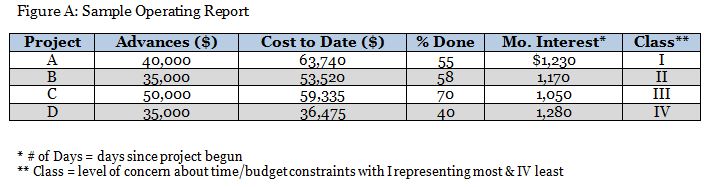
 

An effective system must be able to generate this kind of information. For example, reading Figure A prepares an executive to question issues of timeliness in production scheduling, loan advances, and interest rates.


Figure B is a job costing report. The way in which the report is read and interpreted will affect every decision made–or not made–with regard to the job listed. Comparing this report with a similar report for a project either in progress or completed, the relationship between the materials and labor for specific designs can be determined. The goal of the report is to establish standards for purposes of comparison; current projects are compared to the standards to analyze their performance.

Figure C shows a sample income statement for a growing small business ($3-5 million in sales). The income statement reports prior activity and should therefore be used to modify future business operations to maximize profits.  The statement needs to be even more detailed than the sample below to help determine how the profits or losses are being generated. One can be profitable and still not have cash. Cash flow projections, incorporating actual expenses, show the sources and uses of cash and are a good complement to the income statement and balance sheet.


The ability to read and understand reports and statements prepares the executive team member to use the information to influence business decisions. After reviewing Figure B, you should be equipped to establish workable production schedules. Subsequent production meetings should highlight areas to reduce costs and improve production deadlines.

Figure B should be discussed with all managers, who in turn implement  the schedules and budgets with subs and vendors. The resulting scheduling and budgeting systems ensure timely, cost-efficient job completion. Managers also need to assist in keeping the information current.

In Figure C, data is presented comparing the current year to the prior year in order to analyze trends and ratios. Tracking composite numbers such as gross profit takes on meaning when it serves as a basis for comparison, rather than being viewed in isolation. Deviations from the norm should be discussed in management meetings. So, if sales and profits are lagging,  the group should investigate any underlying causes and develop alternative production and sales methods–and implement them immediately.


Keeping Costs Under Control

If expenses are simply allowed to fluctuate, with no way of monitoring where they will be, optimal profitability will be hard to come by. Cut out as much fat as possible and keep the company lean. Clearly, certain expenditures are necessary and unavoidable. There are ways, however, to limit their influence on company profitability. For example, taking advantage  of any offered cost savings an creating efficient procedures to save time and project financing overruns will cut costs significantly. A purchasing requirements program is a start for reducing many hard costs. Most soft costs, however, can be decreased through effective scheduling.

An effective requirements program includes the following steps:

  • using purchase orders 
  • inspecting all deliveries
  • taking advantage of discount incentives
  • implementing invoice verification procedures
  • scheduling efficiently

Using Purchase Orders

Purchase orders are seen as a relic of old business practices by some. Others view them as an indispensable management tool. Somewhere in between the extremes there is a fit for every organization. Their usefulness is in getting reliable quotes upon which invoices can be checked later.

Inspecting all Deliveries

Inspecting all deliveries is essential to make sure orders are shipped according to the quantities and quality specifications provided on the purchase orders. Many managers complain that they do not have the time to physically inspect every item delivered to a work place. Inasmuch as doing so would require a huge time commitment, they are right.  However, for containing cost overruns, these same managers could not be more wrong in their assumptions.  Inspecting samples  from every delivery when delivered and figuring quantities by up close, visual inspection are necessary steps to ensure that suppliers are responding to the company’s needs.

Taking Advantage of Discounted Materials Prices

When suppliers make discounts available on purchases, your team should try to make the most of them. In addition, verify all invoices against delivery inspection reports, checking  the invoiced amount against the total amount delivered, and unit prices against the purchase order. This procedure will help ensure that a supplier’s negligence is not costing the company money.

Scheduling Efficiently

Time constraints are of utmost importance in eliminating inventory carrying costs–whether your business produces goods or services. If a product line or project is slow to be completed, many extra costs begin to accumulate. Alternative uses of profit margins are foregone. Had your team been able to finish sooner and collect within a finance cycle closer to the one in which work began, there would have been profit margin to discuss how to allocate. With margins, choices exist that don’t otherwise–suppliers can be kept happy and bankers and investors can too! If yours is a business that uses work in process assets, insuring those assets is an ongoing cost for the company. Theft and obsolescence of design and features due to carrying raw inputs too long further eat away at margins. The cost to repair items damaged over time also rings up expenses. All of these combine to make inventory (due to delayed delivery) costly.

Proper scheduling is not limited to getting one work team to immediately follow another onto the job. By ordering raw inputs in bulk through purchase orders, trips to supply houses are reduced, resulting in cost savings through lower fuel costs and less time away from actual work. As these employees spend more time on the job and less time running around town picking up materials, their projects are completed faster. Getting teams to succeed one another promptly with slight overlaps can also tighten production schedules and help reduce costs.

By tying your project financing to interest rates in a market where rates are rising, you and your team can make the most of prompt completion of projects. If you operate efficiently, you can move before rates rise consistently. Finally, scheduling vacations with as little overlap as possible will help with your production efficiency, and thereby improve margins.


Fail to Research; Fail to Secure Market Share

As companies seek to gain a competitive market position and execute on their business objectives, various problems can crop up. In the last post, we examined a case study on inventory control as one issue that needs addressing. In this installment, we will look at a case study involving loss of market share:

A company in the Northeast had always been able to sell enough product to secure a 15-20 percent local market share within the primary price range and portfolio of designs. As other competitors began to outsell this company in the local market, the owner commissioned some research to determine what percentage of the market share had been lost. Upon discovering that their share had dropped to 9-11 percent, the executive team became worried.

Why would this company’s–or any company’s–market share deteriorate to this point? Experience shows that one common reason for the decreased market share might be increased competition. As other competitors, whether established or new businesses, begin to offer viable or even more attractive alternatives, your business may begin to lose a percentage of share  in the local market. Another possible reason for declining market share could be perceived poorer quality in the products offered. Rumors of a company’s demise can fuel such a perception and scare buyers away, allowing other businesses to take advantage of this image problem.

The solution to declining market share varies according to the source of the problem. If bad image and rumors appear to be hurting the business, the owner must move quickly to dispel any rumors and improve company image through a bold and highly visible public relations campaign. For example, companies can generate goodwill by meeting with influential members of the local community to let them know that any perceived problems are being taken care of and that the company plans to be making products in the community for some time to come. This exposure can often be gained through attendance at chamber of commerce and other local business group meetings.

To overcome competitive advances, the executive team must aggressively outmarket and outproduce competitors in each niche market. By beating them in head-to-head competition, the problem is solved while the company’s reputation for high quality products is enhanced. In terms of quality initiatives, management should devise ways of improving quality in all projects, passing the word along to all employees, suppliers, and subcontractors that quality is becoming an issue and that only those who can produce quality work will remain a part of the team.

Stabilizing and regaining market share demands that the team know the local market inside and out. While calculated risks are allowed if the executive team feels confident that they can get product manufactured and sold quickly, the potential success of any such project must be measurable in terms of researched demand for the product line the company plans to produce. Clearly, companies must target opportunities that allow them to make their best products at competitive prices. By keeping abreast of new developments and new competitors attempting to make an entry into a particular market, the team can revise plans–and keep buyers from running to the competition.


Too Many Houses Are Us

Most businesses face unforeseen circumstances while in pursuit of their sales and other goals. The way these situations are handled will quite often determine the degree to which the company’s efforts are successful. A useful method to see what others have tried and what principles we can learn from their experience is the case study. When your business produces products, it creates inventory. When the inventory is too large for the demand, it becomes a problem. Let’s take a look:

A speculative home builder on the West Coast discovered to his chagrin that the market in his local area was inundated with homes very similar in style and price to those he was building in large numbers. There was both a general glut, and a specific one related to this company. As his lender began to point out, an inventory level that has escalated out of control presents severe cash flow problems among a variety of other concerns. The lender was also quick to point out that the builder was in jeopardy of defaulting on construction loan interest payments a couple of months down the road if he did not begin selling some of his inventory–and soon.

How could this builder (and others in a similar situation) end this problem of increasing inventory? First, the problem can normally be attributed to one or more of the following factors:

  • an overbuilt market in the builder’s product offering
  • incorrect, incomplete, or absent market research
  • an inability to revise product in terms of plans, elevations, and prices to meet buyer demands.

Once a builder has determined the existence of increasing inventory levels–and their cause–it is time to stabilize the situation. Selling off an old unit for every new unit constructed is a bare minimum requirement. It is not wise to continue building simply to try to fund aging inventory interest payments out of new construction loan draws. As older homes are sold, new construction can be considered. Due consideration includes understanding the problems that led to former inventory level increases well enough to avoid the same errors in the future.

In addition, an inventory reduction plan should be initiated immediately, making sure to target the oldest inventory with the worst gross margins first in any type of incentive offer. The use of incentives can be gradually lessened as the builder moves through the oldest inventory into newer inventory with better margins. Sales staff can be of great help in determining what may help to move homes. If qualified buyers are hard to come by, it may be advantageous to work with local mortgage lenders and offer a program for qualifying buyers at lower monthly payment levels in the early years of a home purchase. Also, it is always helpful to walk all inventory and make lists of all items that need to be repaired, replaced, or cleaned up.

Finally, a builder can prevent uncontrolled increases in inventory levels by performing more careful, thoughtful research, making revisions to product as soon as buyer tastes are known to have changed, and offering ongoing, automatic incentives for aging inventory to be sold. It is often helpful to “re-research” current projects to make sure that the original research findings remain valid and informative. Periodic product updates and revisions are necessary even in a stable, conservative market. Buyers are always looking for small things that make one home purchase better than another. By catering to buyers’ particular tastes and requests, a builder can offer a better home and still make money.

Even if you are not in the homebuilding business, but in some other business that has inventory, these principles are important to observe. Think through ways to reduce inventories–better yet how to prevent them from ever becoming a problem!

Urgency in Turnarounds

When a team has tried everything in their power to solve a dilemma and is unsuccessful, the turnaround manager must step in. The buck stops with him; if a third party cannot reach resolution with company staff, someone with more clout must reestablish credibility. Use of a consistent complain resolution process can prove quite effective. It frees the team up to not have to stress relationships with those with whom they have either had long term relationships or with whom they must transact business once the turnaround is complete. Even managers should appeal to the business owner or turnaround executive if a third party will not accept their efforts to resolve issues.

Doing the Job Effectively

Encouraging employees to perform their jobs thoroughly, to the point they exceed performance standards, is most easily done by providing responsibility and reward. Treat employees as peers, recognizing that they too have responsibilities and commitments. Offering them the opportunity to wield more authority is rarely rejected. Promote a diligent working atmosphere wherein employees want to go the extra mile.

Ask all employees to document any problems with suppliers, customers, or service providers. Often, taking it a step further and documenting issues with sales teams, distributors and governmental agencies (where appropriate) can provide a paper trail to  help the executive team and turnaround artist in their work to remove roadblocks. When relevant facts are understood, appropriate actions can be taken.

Dealing With a Lack of Resources

When a company is in the middle of a turnaround, certain items that would make work easier are not going to be available due to a lack of funds. Using skills and abilities creatively to overcome this lack of resources or other unpredicted occurrence as an example for employees to follow. In tough situations, executives should look for a way to overcome the situation rather than dwelling on the inconvenience caused.

Successful turnarounds are a tribute to employees who strive to overcome limitations and exceed performance standards rather than merely meet them. To bring work projects in early and under budget, everyone must strive to do much better than is required, constantly searching out ways to improve efficiency. No time can be wasted–every minute and every dollar that exceeds schedule or budget extends the distance between a struggling company and its ultimate goal of renewed profitability.

Following the Turnaround Plan

All employees need to be reminded that a plan has been developed to promote optimal recovery and that all actions taken are done so in accordance with the dictates of the plan. United by common objectives, the work force can and will help to implement the turnaround plan. Three essential principles apply:

  • Some short-term gains will be sacrificed for ling-term profitability.
  • Some long-term successes will have to be postponed for short-term cash flow.
  • The means of implementation is always open to suggestion and never open to argument.

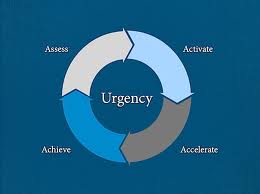
Creating a Sense of Urgency

Certain goals, particularly dates and milestones, need to be met without fail. To accomplish these goals, a sense of urgency must prevail. Departures from the schedule can cause the company to lose out on windows of opportunity. The interest carrying cost of financing operations longer than anticipated is an example; if work projects are completed on time, lines of credit can be paid down sooner. Even one foot-dragging employee can impede the progress of the group, and the resulting missed deadlines can mean substantial financial losses.

Meet With Employees

Sit down with your staff and clearly and frankly describe the situation. Inform them that the company is experiencing some short-term problems in meeting its objectives and that actions are being undertaken to minimize long-term  impact. Explain and reiterate throughout the turnaround that company health can be restored through combined best efforts. Explain the turnaround plan, with an emphasis on the valuable role of each and every employee in reaching plan goals.

Meet With Management

Regular meetings with managers will be needed to discuss progress in detail. Begin with twice weekly meetings and progress to biweekly as the situation improves. Update reports should be given on activities since the prior meeting, with input required from managers from each department. Discuss problems and develop plans to resolve them within the meeting. Take advantage of a quorum of opinions to move the company forward in rapid-fire fashion.