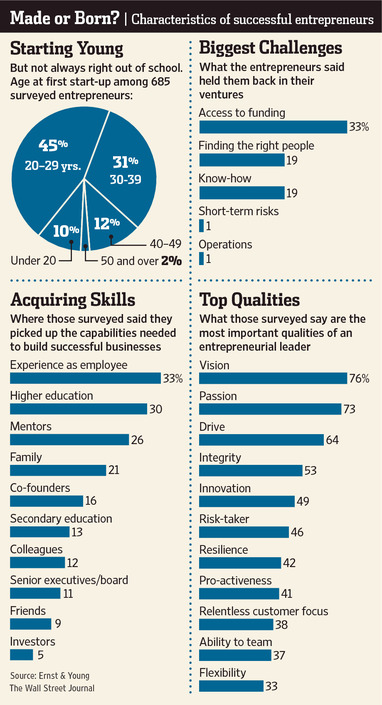
Start-Up Savvy: Taught & Caught

Image

In an article last month entitled, “Can Entrepreneurship Be Taught?,” two sides of the argument were presented that, while equally valid, were at odds with one another. Noam Wasserman, Harvard Business School professor of Entrepreneurship and author of “The Founder’s Dilemmas: Anticipating and Avoiding the Pitfalls That Can Sink a Startup,” takes the position that too many founders have to climb the same steep learning curve as others before them, bereft of insights that could help great ideas become great businesses. Victor Hwang, co-author of “The Rainforest: The Secret to Building the Next Silicon Valley” and managing director of T2 Venture Capital in Silicon Valley, posits that only experience can teach an entrepreneur how to successfully launch a business.

Within the Wasserman camp are educators who believe that documented best practices and potential problem areas can be shared with the entrepreneurs. For instance, the idea that the founder must do the three following things has been challenged with research data to instruct otherwise:

  1. Following one’s gut
  2. Having a “glass half full” view about resources and time
  3. Stay in the top executive role as the company matures

Augmenting the classroom instruction with deliberate opportunities to “try out” a principle in a role play seem to yield good results. Additionally, self assessments are helpful in increasing one’s self awareness and ability to lead others. Notably mentoring is recognized as one of the best ways an entrepreneur can learn how to do the right thing in a myriad of scenarios.

What is also being learned is the need to not just offer principles of management (regardless the field of management–finance, operations, marketing, etc), but to also focus on the soft skills requisite to be an effective leader. Whether the entrepreneur is embracing better social skills, motivational techniques for self and others, or other facets of emotional intelligence, there are competencies to be gained that are simply not intuitive for most.

Hwang and the experiential learning community holds steadfastly to the conviction that entrepreneurship is taught rather than caught and is more of  an impartation than an education. Rather than the typical domain of business schools–resource allocation and risk management, it is argued that the necessary skills fall more into the following categories:

  • Comfort with a high degree of uncertainty
  • Willingness to become a generalist rather than a specialist
  • Abilities in inspiring others through storytelling and personal charisma

Since some programs are heading in the direction of trying to advise start-ups on what actions to avoid, Hwang is concerned that the willingness to try something unconventional may become minimalized. He and others believe that such a mindset is critical to entrepreneurial success. The main thesis behind Hwang’s proposed approach is that entrepreneurs would have the greatest chance of success if communities with resources, counsel and mentoring were available for their growth and development.

The common theme, then, is that mentoring and nurture is the best medicine for someone who “suffers” from entrepreneurial dreams. We wholeheartedly concur with this bottom line approach and advocate innovation centers (incubators with assigned mentors, education, and planned activities to build a sense of community) as a best practice!


No Freakin’, Entrepreneur

In a recent blog post Dharmesh Shah cites 8 examples of  things entrepreneurs freak out about. Do any of them sound familiar?

1. Your lead investor in a funding round backs out in the final stages. (By the way, when this happens, you’re almost never going to hear what the real reason is).

2. You get a certified letter in the mail from some big law firm you’ve never heard of (nobody’s heard of law firms, until they they do). The envelope the letter came in is the nice, creamy, heavy-stock kind. It’s more expensive-looking than the one you used for your wedding invitations. The letter uses a lot of words to basically say “you’re being sued”.

3. Your lead developer leaves. This is about half way into a project to rewrite your product in Scala, which he convinced you to do.

4. A very big customer deal you were just about to close falls through. Normally, this wouldn’t be a big deal, except that you spent a bunch of time and money trying to get this deal done. Time and money you couldn’t really afford to waste.

5. You were about to be acquired, and now the acquirer has “gone dark”. Despite your best intentions, the team and you have been making decisions based on the impending acquisition. “It would be silly to do X, Y and Z when we’re going to be acquired next month…”

6. The production system that hosts all your customers came crashing down. And that live backup system you thought you had isn’t all that live.

7. One of your competitors just went and raised a ton of money. They’re blanketing the industry with PR, marketing, fancy new booths at tradeshows, local events involving a winnebago and taking out ads, seemingly all over the Internet. Potential customers, investors, friends and even your mom ask you about this big, bad competitor. You get tired of saying: “But their product sucks!”

8. Co-founder takes a job somewhere. Feels really badly about it. Promises to help out nights and weekends. You don’t have the heart to say: “Yeah, but it’s the emotional support I’m going to miss the most…”

Any one of these events can cause an entrepreneur to overreact. Rash decisions are often made to the detriment of the business and its team. Instead of knee-jerk reactions, try to remain calm and seek the counsel of your mentor(s). For perspective, consider that many others before you have encountered and survived similar challenges.

Bureaucracy: The Entrepreneur’s Kryptonite

As Dan Sullivan says in The Strategic Coach® Program, “The human brain cannot do extraordinary things, only normal things.” “So the trick,” he says, “is to make the extraordinary normal.”

Corporate employees operate based on policy: that’s what keeps them from having to think. Entrepreneurs depend thrive on having the freedom to constantly grow and change, to make new connections, and to ask questions that shake everything up. To an entrepreneur, groupthink (i.e. bureaucracy) is like Kryptonite.

Just because we don’t like being bogged down by over reliance on structure doesn’t mean that we are always creative. Following established patterns and trying to approach every issue with the same solution is a bad habit even for an entrepreneur. Rather than seeing opportunity, we can become fixated on solving a problem.

When Jim Collins wrote about Big Hairy Audacious Goals (“BHAGs”), he was challenging small thinking. Simply considering an aggressive goal causes the mind to see the environment differently. Unable to stop thinking about the “What ifs,” we are empowered to consider new concepts,  linkage and alternative ways of viewing the same issue. Divergent thinking is modeled by the likes of Richard Branson, who tweeted, “My interest in life comes from setting myself huge, apparently unachievable challenges, and trying to rise above them.”

Your definition of “normal” daily experience becomes unique when you think in terms of BHAGs.  Dream for a moment about what life could look like in 5-7 years. Can you imagine performing at 10x today’s level? Earning 10X what you do today?

Bureaucracies are based on keeping everything the same so they can preserve their status. Policy and rules “protect” the structure from the effects of individuals, whose participation is measured in hours on the clock, not in results. In an entrepreneurial organization, by contrast, change is life, because “holding your ground” means stagnating and falling behind. Individuals are sought out and rewarded for their ability to think, create, and make a unique contribution.

Make a habit of  what Sullivan terms the “10x Mindset,” and innovation, risk-taking, and teamwork will all come together for you in a completely new way. Bureaucratic thinking and structures simply won’t survive in your environment because you and the people around you will be entirely focused on building, adapting, and expanding a path toward your “bigger future” vision.

Cultivate a creative mindset that makes growth and progress “normal.”

Better Feedback Models

Traditionally feedback has been seen as occurring externally between a customer and a provider and internally as flowing from a manager to a direct report. Many changes in the work environment, including self-directed project teams, matrix management, flat organizational structures, and doing more with less resources, lead employees to work more closely with one another and become less dependent on management to provide them with feedback.

The Feedback Cycle graphic below illustrates that, these days, we must recognize that feedback – from project team members, peers, and direct reports – is the primary way to give and provide information and suggestions to each other to improve work output and performance. We must also be certain to listen for emotions and feelings as part of the feedback process. Whether your role is within a multinational corporation or a small start-up, the need to look around you 360 degrees and see yourself and your work product as others see it is critical to charting your own and team success.

Within the field of emotional intelligence, there’s a best practice of trying to see matters from another’s perspective. It is in this ability to “be on the outside looking in,” observing our decisions as a series of choices based on information we have processed, that we gain insight, perspective, and mutually desirable outcomes. Intentionally studying how our actions will affect others, asking for their input, and incorporating a “win-win” scenario into our decisions makes for better management of self, projects, and others.

In the start-up world, the Feedback Model can be used to test and validate “fit” with co-founders, employees, strategic vendors, investors, professional services providers, and so on. If the other party is not incorporating your input into their communication, planning, and execution, they are not a good fit. Likewise, if we are not able to receive feedback from others, we will not be successful in executing our business/departmental/project strategy.

Non Profit Your Way to Helping Others

One of the interesting things we are discovering at EntreDot is the power of a non-profit to garner collaboration. EntreDot™ is a newly formed business mentoring organization that is committed to ensuring entrepreneurial success. Our objective is to increase the chances of entrepreneurial success by creating high impact companies that are run by entrepreneurs with sustainable business management and leadership capabilities. By providing needed business assistance, we will help entrepreneurs increase revenue and job growth for their companies and communities.

Were we simply a management consulting firm, we would be perceived as being in competition with other consultants, certified public accountants, attorneys, angel funds, investment bankers, and so on… in which case, we would be left to ourselves to try and help one entrepreneur at a time. We knew that we wanted the cooperation of people from all of the categories above, plus many more, so it was a strategic business model decision to become a 501 (c) (3).

What we did not count on, however, is the strong community support. Whether it is the local government (Thank you Mayor McFarlane, Council members Bonner Gaylord and Mary Ann Baldwin for your support evident last night at the Innovate Raleigh event at REDii!), paragovernment organizations like the Cary Chamber and the Downtown Raleigh Alliance, educational groups like the NCSU School of Textiles and School of Design plus Wake Technical Community College, volunteers who serve tirelessly, or great sponsors, we have been overwhelmed at the synergy created by bringing people together who all want to see more entrepreneurs be successful.

The benefits to the entrepreneurs and to their communities are:

  • Avoiding critical errors that lead to business failure
  • Improving the business skills of local entrepreneurs
  • Having a second set of eyes on key business issues like financing, cash flow management, marketing programs, sales traction, and many more
  • Validating entrepreneurs’ their ideas and decisions
  • Helping entrepreneurs build the right management team to run their companies
  • Assisting entrepreneurs in building relationships with all their stakeholders, and potentially steering them to new customers, suppliers and financing sources
  • Retaining local entrepreneurs who will stay in their communities to create new businesses; reducing the “brain drain”
  • Increasing the number of good jobs within the rapidly growing new companies throughout NC, including in its most distressed counties
  • Increasing revenue to local communities via the expansion of local economies

Recently, I had the distinct pleasure of hearing Nobel prize winner Muhammad Yunus espouse the virtues of social business as a means to solve community issues. This is an idea whose time has come! We are excited to be helping entrepreneurs create better local economies, with the myriad of spillover effects.

What non-profit can you help create that will solve community needs through strong collaboration?