Leaders Instill Vision and Creativity


“Vision is the best manifestation of creative imagination and the primary motivation of human action. It’s the ability to see beyond our present reality, to create, to invent what does not yet exist, to become what we not yet are. It gives us capacity to live out of our imagination instead of our memory.” 

– Stephen Covey

Vision cogAs a management consultant of 25 years, I have had the opportunity to interact with a variety of companies, their leadership teams, and employees. What Covey describes above is the missing ingredient in many businesses and the critical success factor in others. Jeff Orr, who coaches executives and their organizations, has this to say about Covey’s quote:

Vision. A key component of leadership. The ability to see what doesn’t exist…yet. And then to communicate that vision, so compellingly, that anyone who hears it can’t help but jump on board. This is the stuff of great leadership.

I have found that one of the most challenging aspects of vision casting is not the actual speaking of the vision, but what the person receiving the message actually sees in their mind regarding that vision. I have discovered that I can verbally paint a vision for a group of people and, depending on their experience, upbringing, etc., each person can have a slightly different picture in their mind of what the vision looks like. They also have a particular view of how they play a part in that vision – which may or may not be what I had intended. This has led to miscommunication and missed expectations. So how do we as leaders cast a compelling vision that is caught by our audience as we intend it to be caught?

Know your audience-their background, personalities, language and culture; (then) you can (better) craft your message to connect with them. If your audience is diverse, you may need to use multiple word pictures to say the same thing to different people. This takes a bit more time, but can be an eye-opener for you. Learning how to convey your vision in multiple “languages” will make you a better communicator.

Once you feel enough of your audience has “gotten it,” you still need to continually cast that vision. As one great leader has said, “Vision leaks.” Imagine a bucket with small holes in the bottom. As you fill that bucket with water, some of it leaks out the bottom. If you don’t continually fill the bucket, all of the water will eventually empty out. People are no different. The concerns of their department, projects, and life in general, all compete for their attention, crowding out the vision. It’s up to you as their leader to keep “filling their bucket” with the vision so it stays top of mind. As you utilize various methods of delivering the same message, you will see your team gain energy, synergy, and momentum.

What applies to leadership applies to intrapreneurship especially well. Organizations that lack visionary leadership often stagnate in their business performance. As the followers sense that the leaders care about creative capacity and are doing something about it, they become very motivated to produce.

When the workers are unable to see beyond their current reality (and not encouraged to do so), they can become disheartened. Being able to envision a better day with more positive outcomes fuels the fires. Given the opportunity to be creative, to look for what lies beyond the obvious, most will work harder with less need for exterior reward because they are motivated by what they can contribute. Seek to be an organization that values vision!
 

Overcoming Business Failures With Mentoring


According to Bill Warner, co-founder of EntreDot, approximately 26,000 new companies are formed each year in North Carolina and, in that same year, over 23,000 companies fail due to poor management and operational mistakes. Warner further states that, “The statistics are worse in rural and minority populations. This means that good ideas go to waste along with the grant and investor funds that helped get these companies started. As a result, the potential growth of revenue and new jobs is lost also.” These comments are very similar sentiments to what Dun and Bradstreet found in some surveys conducted during the period of 2007 – 2010. D&B found that the rate of business failure went up by an average of 40% during the recession years.

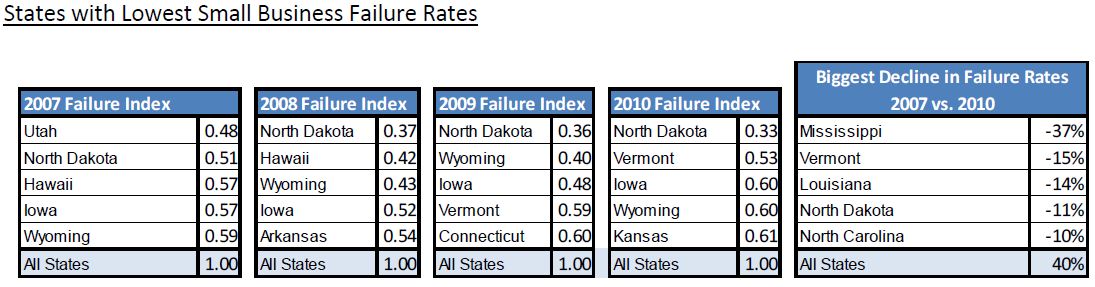
D&B SMB Lowest Failure Rate by State 2010


Many of the states with lower failure rate increases are less heavily populated states. In fact, of all the states that have seen a decline in the rate of small to medium sized business failure, only North Carolina makes the list of 10 most populous states in the country. Of states (below) with large increases in failure rates, only California is heavily populated.  

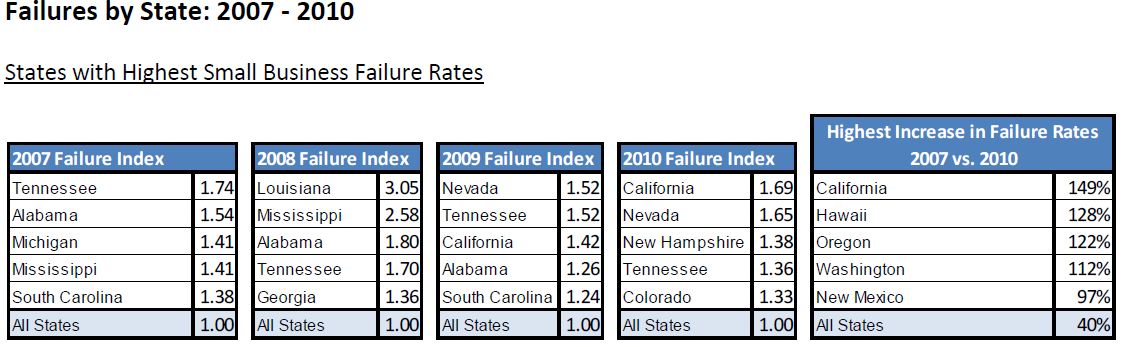
D&B SMB Failure Rate by State 2010


From 2007 through 2010, Western states in the West had the highest increase in failure rates. Reasons D&B provided for the uptick in failures include continued instability in the residential housing market and drop-off in the tourism, travel and hospitality sectors. Interestingly, Tennessee has been home to the highest small business failure rates for four years in a row.  

D&B Largest SMB Industries 2010


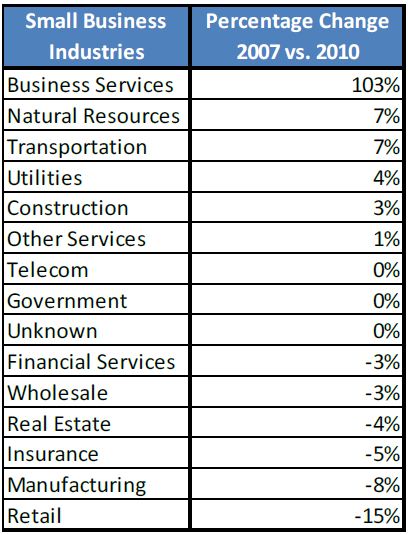
These trends have been occurring at a time when the number of retail establishments and corresponding retail employment have both dropped by 15-20%. On the other hand, the number of SMBs in the Business Services category more than doubled and these businesses experienced a 30% increase in the number of people they employ. The fastest growing industries for SMBs are summarized below:

D&B Fastest Growing Industries 2010


As you can plainly see, nothing else comes close to the growth of  the Business Services category. Bear in mind that many software as a service companies are part of this category and have been launched in only recent years. The macrotrends that become evident are that retail is on the wane, highly populated states are more stable in terms of business failure statistics, and the business services category’s growth will be a key cog in the engine of our economy.

Warner points to the following issues of significance to these small businesses:

  • Business strategy and planning to make sure their business is focused on a viable market with a winning product and/or service that has a competitive edge
  • Forecasting and financing ensuring that sales forecasts are realistic and that revenue, cost, expense and cash are well managed
  • Operational discipline and judgment to increase the chances of success by making fewer mistakes
  • Industry connections that can help accelerate the business and its operations
  • Start-up company experience that can instill the wisdom of what it takes to really start and manage an emerging business


He feels that these companies need the dual combination of basic business know-how and mentoring. The situation in North Carolina, where Warner and I live, is that our state has a comprehensive array of entrepreneurship education programs throughout the community college and university systems including various other private and public organizations. The problem is that we have little help for entrepreneurs once they have completed these programs and actually try to start a business. We recommend assistance for entrepreneurs who are struggling to create successful businesses, the failures should decline considerably. Entrepreneurs should be seeking out business mentors that can help them through the early years of their business.


Climbing Your Management Everest

Stretching oneself to the maximum can reveal what we are made of. Whether the subject matter is a test of mental strength or physical, it is exhilarating to overcome a daunting obstacle. Sir Edmund Hillary is celebrated for his perseverance in conquering Mount Everest. One of my LinkedIn contacts and an internationally known innovation resource is Gijs van Wulfen. Van Wulfen states that, in the 1950s, the route to Everest was closed by Chinese-controlled Tibet. Nepal allowed one expedition per year.

Sir Edmund Hillary had been part of a British reconnaissance expedition to the mountain  in 1951. The 1953 Everest expedition for which he is now famous consisted of a huge team of over 400 people. Expedition leader Hunt named two assault teams. Hillary and Norgay were the second assault team. The first team only reached the South Col, about 100 meters below the summit. Then Hillary and Norgay got their chance. They reached the 8,848-meter high summit, the highest point on Earth, at 11:30 a.m. on May 29, 1953.Mt Everest

Gijs says the following 10 management lessons came to mind as he read the Hillary accounts:

1. Passion. As a youngster, Hillary was a great dreamer, read many adventure books and walked many miles with his head in the clouds. He was unaware his passion for adventure would make him, together with Tenzing Norgay, the first man to set foot on the highest point on Earth.

2. Urgency. In 1952 the British heard that in 1954 the French had been given permission to attempt Everest. The British wanted more than anything to be first. The expedition just had to succeed.

3. Teamwork. Getting to the summit of Everest is all about teamwork. As Hillary wrote: “John Hunt and D Namgyal’s lift to the depot on the South-East Ridge; George Low, Alf Gregory and Ang Nyima with their superb support at Camp IX; and the pioneer effort by Charles Evans and Tom Bourdillon to the South Summit. Their contribution had enabled us to make such good progress.”

4. Courage. The higher you get on Everest the more courage you need. At 7,800 meters Hillary wrote in his diary: “Even wearing all my down clothing I found the icy breath from outside penetrating through my bones. A terrible sense of fear and loneliness dominated my thoughts. What is the sense of this all? I asked myself.”

5. Test. On the 1951 reconnaissance expedition, team members tested oxygen equipment and did research on high-altitude physiology. The results of both studies were important in determining the right approach for Everest in 1953.

6. Initiative. While in India, Hillary read in a newspaper that the British were taking an expedition to the south side of Mount Everest in 1951. He contacted expedition leader Eric Shipton and suggested that a couple of New Zealanders could make a substantial contribution to the team. And they were invited!

7. Choices. The British Himalayan Committee replaced the 1951 expedition leader Eric Shipton with Colonel John Hunt, a climber. After eight failed attempts on Everest they needed someone to the top first, before the French would have their chance.

8. Overcome setbacks. Along the way there are always major setbacks. After finding a new route up Everest during the reconnaissance expedition of 1951, the British heard that the Swiss had obtained permission for two attempts on Everest the following year. The only thing the British could do was wait and see if the Swiss would succeed.

9. Competition. Hunt proposed that Evans and Bourdillon should use the closed-circuit oxygen equipment to reach the South Summit and Norgay and Hillary would push to the top with the open-circuit oxygen. The competition fueled the eventual success of Hillary’s team.

10. Luck. Hillary, a New Zealander, was lucky to qualify as a British subject and be invited to join the British team. Secondly, in 1952 the Swiss failed to climb Everest on their two attempts. 

How do you view these management lessons in light of your own organization’s efforts to be innovative and competitive?


My China Shop Needs No Bulls

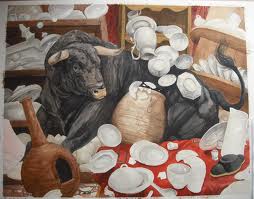
Too many corporations put “bulls” in executive roles, and surprisingly hope for good things. Hard-nosed tactics may produce some short-term gains. Under the surface, employee engagement often suffers, which can spur greater turnover and undesirable business performance. Peter Friedes, founder of the management think tank Managing People Better, offers a parable to illustrate (below):

Roger the Bull

Roger always “tells,” rarely “asks.” He knows what he wants, demands it, and pushes everyone to adapt to his schedule and expectations. He believes that every second counts and does not view relationship-building as time well spent or a necessary activity for getting great work done.

He is not empathetic or understanding. He rarely changes his mind, even with new information. He operates solely on his own agenda, showing little or no interest in his employees’ opinions. He rejects suggestions quickly, as he knows others’ ideas won’t work. He easily confronts people, often using words that are harsh, strong, or judgmental. He can be arrogant, as if to say he has all the answers. He doesn’t trust his employees to do a good job, so he hovers and corrects them.

Roger doesn’t include others before making decisions. While he thinks he coaches his employees, his “coaching” comes across as demands. No one would call him nurturing or encouraging. His language and tone exude frustration and anger. He is extremely unpleasant to work for.

bull in china shopFriedes writes that, while Roger may have flourished as a department of one in the past, his lack of understanding of how to motivate others is a huge drawback to managerial effectiveness. What is recommended are two key skill sets:

  • Relating, which includes relationship-building activities such as asking, listening, including, coaching, and encouraging.
  • Requiring, which encompasses results-oriented activities such as setting expectations, focusing on goals, insisting on excellence, establishing appropriate controls, confronting performance issues, and asserting your views.

Read about Friedes’ experiences in trying to coach Roger-types:

Bulls are the hardest managers to coach. They typically don’t listen well. They often think they have the answers already. Over the years, I’ve tried the following messages, with limited success:

  1. “You are a results-oriented manager. But you would get far better results by asking, listening, including, coaching, and encouraging your people more often, and lowering the volume on how you demand and require of your people.”

  2. “You were an excellent, hard-working individual achiever. But now your success is measured by how well you let others achieve. This takes a different set of skills. Unless you develop these skills, you cannot be effective as a manager.”

  3. “Your goal is fine…to do a lot of excellent work and meet productivity objectives. But the manner you use to get results is damaging our business and sabotaging your career.”

  4. “Our top employees will not work for an over-Requiring, under-Relating manager very long. They will seek a more reasonable manager and leave or transfer. That will require you to start over with new people, lowering your productivity. Over time, the company will not want to give you any new people.”

  5. “You have taught your people to give you exactly what you want, but they no longer give you new ideas or suggestions for how to do things better. You have demotivated them, which is why you see them lacking.”

  6. “I know you don’t need to be liked. But you do need people to appreciate and respect being managed by you. You are not on track to get that respect.”

Since Bulls feel justified in their treatment of others, none of these statements are likely to produce changed behavior. However, being straightforward, according to Friedes, and saying “You are failing as a manager” or “You will be fired if this over-Requiring, under-Relating behavior continues.” may have the desired impact.

(Want to see how Bullish you are? Take a free assessment !)


A Matrix of Insights Into Innovation

Have you ever listened to a “friend of a friend of a friend” story and wondered why the storyteller was recounting something? Surely, you thought, there must be something substantial lost in translation–kinda like the old “telephone game” in which you are in a circle with others, share a statement with someone to your left, who does likewise around the circle only to have a totally different statement return to you. Well, I hope this blog post is nothing like that! However, I would like to share a book review by a friend of mine, Jeffrey Phillips. (Do the math–I have not read the book, do not know the author or his content except vicariously, but I do know Jeffrey and respect his commentary on a number of matters.)

Phillips is a prolific writer, speaker, and practitioner of innovation. As often happens with people who have created a following, he has been asked on numerous occasions to review books written by others having to do with his favorite professional subject–innovation. A couple weeks ago, he wrote a review of Creative Strategy, A Guide for Innovation, written by William Duggan, describing the book as follows: “a step-by-step guide to help individuals and organizations put Strategic Intuition to work for their own innovations.” It is to be noted that Duggan previously wrote Strategic Intuition. Innovation, as defined by Duggan, encompasses products, business models, entrepreneurship, and social enterprises. Phillips finds the book to be “a real conundrum, very specific in recommending (a) three step process (detailed below) and refuting or denigrating many innovation and creativity techniques, while at the same time the book can be annoyingly vague or indeterminate.” So, let me save you the experience of reading the entire book and just hone in on the three step process: rapid appraisal, the “what-works” scan and creative combinations. To quote Phillips:

Rapid appraisal is about breaking the problem into “chunks” or more discrete elements, often known as decomposition.  This simply makes a larger problem an association of smaller problems or challenges.  The What Works scan entails looking across industries, geography and time to see if anyone, anywhere has created a solution to any of the smaller “chunks”.  If so, can we adopt or modify the solution elsewhere to the problem at hand?  The third stepcreative combinations, asks us to look for creative solutions across what Duggan calls the Insight Matrix.  The Insight Matrix is a simple X-Y chart:  problem “chunks” down the vertical axis, potential solutions on the horizontal axis and interesting combinations at the intersections.

While Duggan may be the first to design his “Insight Matrix”, none of these tools will be new to innovators.  The concept of breaking challenges into smaller components (known as decomposition) is well-known to innovators and one that many innovation methodologies practice.  It is often easier to break a challenge or need into smaller components and build a solution up, rather than address the entire challenge at once.  

Creativity wordleLikewise, what Duggan calls the “what-works” scan is not new either.  There is an entire school of thought within innovation that argues that every problem has already been solved, it is simply our job to discover how and where the solution exists.  Bio-mimicry, for example, stipulates that nature has already solved many problems that we encounter, and we can learn from, adapt and adopt those solutions.  

Finally, Duggan’s creative combination approach simply suggests that we adopt the “best” solution for each chuck from the best alternative solution from the what-works scan, and create a total solution by putting these discrete solutions back together.  Again, nothing new here.  Good innovators know that most good ideas happen at the intersection of new technologies and markets. 

In the final analysis, the Insight Matrix is the best thought of the book–probably worth checking out, even if many other concepts take longer to develop and may not be innovative themselves.