Traffic Schmaffic – Get Conversions

In the course of advising startups (and some existing clients) on how to gain traction with their business proposition, I ultimately have a conversation about target buyers. Notice the word “buyer” –it is a different word altogether than “shopper” and “viewer.” When we obsess on trying to get web traffic, foot traffic, and the like–but not on conversion–we have lost sight of what is ultimately most important.

If given the choice between 100 website visitors of whom 20 become buyers or 1000 of whom only 15 become buyers, most would actually choose the 1000. Their reasoning would likely be that 1000 impressions is better than 100 and that they hope that the other 985 could be targeted for future conversion or word of mouth marketing. Yet, your business would have 5 fewer sales and a significantly lower conversion rate (1.5% vs 20%). Better, we would argue, to have a high conversion rate, more revenues, enhanced cash flow, and the opportunity to build relationships with five more people.

So much effort is wasted among entrepreneurs to get traffic–and not just in an online sense–that very little is left to think through conversions. Conversions are a better predictor of long term success than impressions. Get this thought into your psyche. It can make the absolute difference between success an failure.
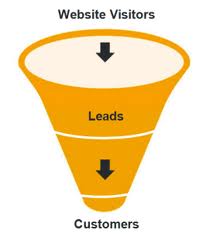
Matthew Toren, founder of Young Entrepreneur, offers the following 5 tips for lead nurturing:

1. Be a problem solver. You have to admit that at least part of business success has to do with the timeliness of your products or services. You must answer people’s needs. The key is settling into a business that has problems you really love to solve, with customers whose pressing needs you are very good at addressing. When you’re able to identify your niche, you don’t only go out there to earn, you have a unique passion and an offering that suits the needs of those people.

2. Get into your customers’ psyche. People buy not only because they need things, they often buy to satisfy something deeper in them. It’s often the feeling they associate with a product that they finally make the decision to buy. Everybody needs a pair of shoes, but not just any shoes can satisfy that need. This is when branding, reputation and customer service come into play. In fact, this is why there is marketing in the first place. Get into what excites and interests your target market. This is the only way you can tailor-fit your campaign to the people who would not think twice of paying for what you have to offer.

3. Where are your customers? In online marketing, determining how your market interacts with the Internet is very important. It gives you leads to “where” they are online. Online behavior can point you to what sites they frequent, the social-media networks they prefer, the news they’re more likely to read and so on. If you know where they are, you can be sure to focus on places you need to have a commanding presence. This assures you of a steady stream of traffic of ready-to-pay customers, and it prevents you from effectively barking up the wrong tree. We all know how costly and time consuming that can be.

4. Do you really know them? To really pinpoint who your target customer is, you’ll want to dig in deep… find out how they tick, if you will. The key is to learn about them, even change with them over time. So basically, this means you can’t just buy one customer list and operate off that in perpetuity. You’ll need to continuously find out about your target audience. Are they reading things you should be reading? Do they shop at stores you’ve never heard of? All of these puzzle pieces could fit together and help you identify the bigger customer picture, if you’re willing to spend time accumulating them.

5. Close in on the deal. Once you know your customers and understanding where they are and how they think, you can specifically design an online marketing campaign that appeals to those people who would love to pay for your products or services. By being a problem solver, you’re forced to know yourself and understand your brand’s strengths and weaknesses. But understanding who you want to engage with online really seals the success of your business.

Why Ignore the Obvious?

Margaret Heffernan wrote a book last year entitled Why We Ignore the Obvious at Our Peril, a look at how leaders have intentional blind spots. She queries why many people prefer ignorance over being well informed. In examining the Catholic Church, political despots, unethical corporate leaders, financial mismanagement, and the foibles of top military brass, Heffernan makes the tie between a leader’s choices and the impact on the organizations served. using psychology, researched accounts, and some intuition, she has been compared to Malcolm Gladwell and Nicholas Taleb and has received kudos from Dan Pink.

In an article published in Inc, she analyzes the General Petraeus fiasco and makes comparisons between others she covered for her book and the characters in the saga splashed across many websites, newspapers, and journals presently. Heffernan tries to get inside his head as to what he may be thinking about his new dilemma: soon to be unemployed and suddenly having destroyed a very accomplished career that others coveted until the story broke. 

Yet, was it so sudden? Hasn’t this revelation been building since the point of the first indiscretion? Digging more deeply, what was the thought process that led up to the first bad decision? Heffernan says she heard a CNN interview in which a Petraeus friend said that the general “sees this as a failure, and this is a man who has never failed at anything.” She asks the counterintuitive question–did he go wrong by never going wrong? An excerpt from her article:

If you have never failed at anything, then you haven’t been trying hard enough, aren’t very imaginative, or have had such extraordinarily good luck that you have come to believe you are invincible. And that, of course, is the problem.

“Success confers its own blindness,” Emily Brown told me. She’s a marriage counselor who has worked extensively with couples who have had the experience of infidelity.

“Successful people believe they can get away with it,” she says. “I talked once to a group of men who’d all become millionaires before the age of 40, and they’d had affairs. They don’t even see the danger! It isn’t a love of risk. They think: The wives will never know, so where’s the harm? Everything else in their lives has worked out, so they think they have some kind of magic, that their success has meant that they can have everything they want and they’re invulnerable. And they were completely blind to the harm they had done.”

Most of us make mistakes, and we should take some comfort in the fact that these usually remind us that we are fallible. If we are very lucky, we make mistakes from which we can learn and recover. Most of us have the oddly good luck not to imagine that we are infallible.

I’m a big believer in mistakes. Not just because I make lots of them–like everyone, I try very hard not to–but because every mistake contains learning. The best mistakes are the ones from which you learn the most and that you never forget. I would bet Petraeus thought that never failing was a sign of his genius. The truth is probably that he made mistakes, but he didn’t take time to learn from them. Or, hauntingly, he got away with mistakes by benefiting from everyone else’s care and attention, like a man who drinks too much but drives home safely.

No one is infallible. And those who think they are are probably going to be the most disappointed.

As you read about the former general’s mistakes, hopefully you can look at your own and have some perspective. Have you grown from them? Do others cover over your missteps — or do you have a circle close to you who will level with you at the expense of saying something that you may not want to hear in the short run?


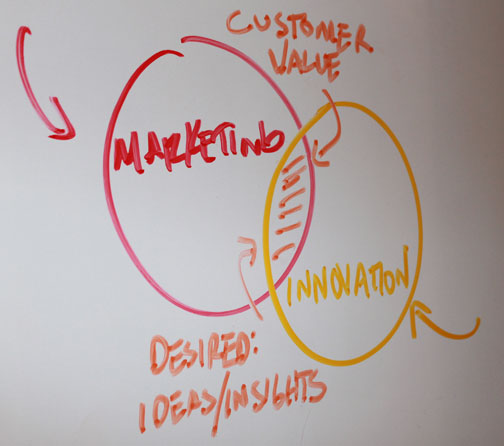
No Buyer Insight Equals No Innovation

Yesterday, the blog post was on the value of social media inputs in marketing strategy and planning. The core thought was engaging your target market. Once you figure out why consumers like your brand, you can focus on how to give them what they want faster and easier.

Jeff Hoffman, who was on the founding team of both Priceline and Ubid, tells the story of a road trip with the pop wonder band ‘N Sync: (He was in a huge Times Square music store and had the following observation.)

As the CEO of a start-up entertainment company, I was trying to remake the movie Grease with ‘N Sync in the starring role.  And while my friendship with the band didn’t make me one ounce cooler, it did give me a unique view into the inner workings of the music industry. Because of the immense popularity of the band at that time, the owners of the major music store chain were with us in the room.  Watching people come in and out of the giant store to buy music, I asked those owners why they thought people bought music from them.

“To buy CDs,” they told me.  I replied: “I don’t think so.”  

They looked at me like I was nuts.  “Nobody anywhere wants to buy a CD,” I offered.

They responded indignantly. “Do you have any idea how many millions of CDs we sell a year?”

I pushed further, adding, “Nobody in the world wakes up in the morning thinking to themselves, ‘Wow, I wish I was holding a round piece of plastic with a hole in it right now.’  They wake up in the morning thinking, ‘I want to hear that new song in my ear! Right now!’  They have to buy a CD, but what they want is to put a song in their ear.  Right now!” 

Walking away in disgust at my apparent stupidity, the CEO said to me: “What’s the difference?”

Clearly, the CEO did not understand how to give customers what they wanted faster and easier. Napster was the first to try and harness the power of the customer preference, but they ran into legal snags. Apple, through the iTunes brand and a legal approach, came up with  a service, then tied it to a proprietary device and made money on both. In the meantime, record companies and music stores have seen declining margins and top line revenues lost.

Pandora took the iTunes model and provided music on demand. More recently, Spotify began offering streaming music from playlists that consumers could create. Hoffman says that the music chain of stores he was visiting with ‘N Sync in New York City eventually filed for bankruptcy.  Why? Their executive team did not understand why customers came in to buy records.

Take a look at your own situation. Have you clearly identified your business objective and target market?  What motivates your customers?  Hoffman shares that, in the early days of Priceline, when a group of the founding executives and he discussed the fact that they were not selling airline tickets for a living.  Instead, the team saw their “product” as  helping someone get you to a sister’s wedding, at an affordable price.  The difference in perception resulted in an improvement in service.

You too can improve your service by paying better attention to what motivates and engages your target audience. Think through how you can connect with them. How can you make it as easy as possible for them to do business with you instead of the other company? What can you do to help them get what they want faster, at a competitive price?


Get More Sales on Purpose

To support your team and finance operations, an executive team must be able to generate large volumes of revenue throughout the year. This revenue generation takes place through a combination of marketing, sales, and service. The customer has to

  • know that a product is available (marketing)
  • be convinced to buy that product (sales), and
  • be pleased with the purchase (service).

We have been discussing how research leads to better product positioning, and that is certainly an important part of marketing. We will zero in on the other components of revenue generation in this edition.

Many companies assume that all they have to do is make a product or offer a service and everything else will fall into place. Nothing could be farther from the truth! If no one knows who your company is, what the offering is, and how/why to buy it, you will either have inventory (goods) or idle workers (services). Similarly, if buyers know your business has something to offer but have no reason to purchase your offering over another’s, you will not make sales critical to business survival and growth. Providing a quality product in a timely manner an correcting defects quickly translates into repeat sales in any industry. 

Sales

Sales depend on three critical elements:

  1. the quality of leads
  2. the quality of the sales team
  3. buyer perceptions

The three need to converge into transactions built on relationships. Buyers are like pupils in an educational system–the sales team and the marketing team are the teachers. The marketing team must supply enough information so that the target buying market can learn about your offering. What is supplied to the sales team is information to reinforce the message: these products or services meet a distinct need in the mind of the buyer. As feedback is collected from target buyers, those conversations become a means to qualify leads that are much easier to convert.

Marketing

Inform the general buying public both directly (in face to face situations) and indirectly (in various forms of media, including social). Failure to reach either audience results in insufficient leads for the sales team–both in quality and in quantity. If your marketing team is not accountable for lead generation, it should be. Those who do not perform the lead generation function well should be replaced with others who are tuned into what makes your business continue to exist: revenues. The marketers can improve effectiveness by paying attention to statistics–whether it is website inquiries, newsletter subscribers, store visitors, or something comparable. There has to be several metrics in your setting that you can identify that make the conversations very professional an on point all the time.

Selling

Think through things like your incentive programs for your sales team, but don’t neglect to think through how to equip the individuals for success with well produced collateral, clear messaging and selling tactics, and sufficient training to overcome potential objectives smoothly and respectfully. Appreciation notes to customers are an art that has lost ground, but that demonstrate a personal touch that often leads to new customers. In your training sessions, emphasize product or service features, how and why they are important, how you have positioned your offering versus the competition, what your perceived competitive advantage is, what common objectives are, and how you want prospects to be treated when in a consultative sales conversation.

Buyers

Buyers also need to be instructed about what they encounter. Make an effort through both marketing and selling activities to run through the competitive advantage positioning messages that you have developed. Be consistent. Be passionate. Be sensitive. Emphasizing your research findings as to what potential buyers want and how you have tailored your offering will go a long ways to build identification with your company and its product or service. Think about where the buyers hang out and “meet” them with a compelling invitation.

Service will be tackled in the next post!

Discovering Financial Keys to Higher Profits

Keeping a finger on the pulse of the company is essential; financial reports and management information provide vital signs of business performance. The accuracy and timeliness of financial and management information is, therefore, critical for maximizing profits. 

Systems Management

The person managing your company’s management information systems is a key ally for the business owner. With responsibilities encompassing data collection, entry and analysis, this employee must have a solid grounding in accounting and information technology. In addition, the manager must be able to implement solutions to problems discovered during review and analysis of the information generated. 

Reporting Systems

Three areas affect the way reports can be used to enhance company profitability:

  1. how information is entered and maintained
  2. how results are read, and
  3. how the reports are used to influence business decisions.

The daily tasks of information entry and data maintenance are the building blocks of any management information system. Since it does not accurately reflect the true operating and financial conditions of the business, incorrectly entered or antiquated information can lead a company to ruin if used to make important decisions. The systems manager should employ systems, then, that are relatively easy to use and allow for daily but controlled data entry; menu-driven systems are easiest to use. The system should be selected based on designed checks and balances of the data to prevent reliance on incorrect information. Review of information to catch any errors or omissions and make corrections is a best practice.

Be sure that management team members all know how to use the system. If only the systems manager can use the system, it is useless because one person begins to wield too much  influence and indirect control over the company’s direction. Take care not to fall into a trap of the system driving the company rather than the other way around. 

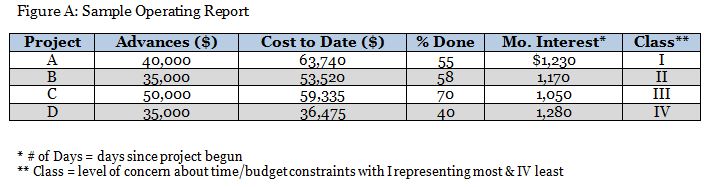
Reading reports requires more than a casual glance; a thorough study of a report’s essential indicators gives the owner and other key executives in-depth knowledge of operating performance. The figure below is an example of such a report:


An effective system must be able to generate this kind of information. For example, reading Figure A prepares an executive to question issues of timeliness in production scheduling, loan advances, and interest rates.


Figure B is a job costing report. The way in which the report is read and interpreted will affect every decision made–or not made–with regard to the job listed. Comparing this report with a similar report for a project either in progress or completed, the relationship between the materials and labor for specific designs can be determined. The goal of the report is to establish standards for purposes of comparison; current projects are compared to the standards to analyze their performance.

Figure C shows a sample income statement for a growing small business ($3-5 million in sales). The income statement reports prior activity and should therefore be used to modify future business operations to maximize profits.  The statement needs to be even more detailed than the sample below to help determine how the profits or losses are being generated. One can be profitable and still not have cash. Cash flow projections, incorporating actual expenses, show the sources and uses of cash and are a good complement to the income statement and balance sheet.


The ability to read and understand reports and statements prepares the executive team member to use the information to influence business decisions. After reviewing Figure B, you should be equipped to establish workable production schedules. Subsequent production meetings should highlight areas to reduce costs and improve production deadlines.

Figure B should be discussed with all managers, who in turn implement  the schedules and budgets with subs and vendors. The resulting scheduling and budgeting systems ensure timely, cost-efficient job completion. Managers also need to assist in keeping the information current.

In Figure C, data is presented comparing the current year to the prior year in order to analyze trends and ratios. Tracking composite numbers such as gross profit takes on meaning when it serves as a basis for comparison, rather than being viewed in isolation. Deviations from the norm should be discussed in management meetings. So, if sales and profits are lagging,  the group should investigate any underlying causes and develop alternative production and sales methods–and implement them immediately.